
Sugar in a mask. How one spray gave wheat what GMO could not
A sugar that cannot cross the wall
In Hertfordshire, half an hour north of London, stands the world's oldest agricultural research station. Rothamsted. Wheat has been bred here since 1843 — and for decades researchers have tried to force it to produce more grain.
Around 2015–2016, the team of Matthew Paul and Cara Griffiths found the answer. And it was bad news.
The key to yield does not lie in genes. It lies in a molecule that cannot be used.
That molecule is trehalose-6-phosphate, T6P for short. The plant's internal signal. It works like the accelerator pedal of a growth engine: when T6P appears in a cell, the plant gets an order — bind carbon dioxide, build starch, grow. When T6P disappears, metabolism hits the brakes. That brake is a protein called SnRK1 — the master regulator of metabolism, present in every organism from yeast to humans.
The problem is that the accelerator pedal is locked behind a wall. T6P carries a negatively charged phosphate group, and the cell membrane does not let charged molecules through. You cannot spray it onto a leaf. You cannot inject it. The molecule that controls yield is literally unreachable from the outside.
So how do you deliver a signal that cannot cross the wall?
Twenty years of faith in genes
For two decades the answer seemed obvious: since you cannot deliver T6P, you must force the plant to make more of it itself. That meant genetics.
And for a moment it looked like victory. Genetically modifying the T6P pathway raised maize yields. It raised rice yields. In individual varieties, under field conditions, with concrete numbers on the charts. Molecular biologists were convinced it was only a matter of time before the same method worked in wheat — the world's most important cereal. Because wheat is no small thing: it supplies about 20 percent of the calories and protein in the human diet, 770 million tonnes a year.
Money followed that faith. Biotech companies invested in transgenic cereals. Breeding programmes scanned the genome for a yield gene. At food-security conferences the word 'gene' appeared in every other sentence. Everything pointed to one answer: rebuild the plant from within.
They were wrong.
Somewhere on the margins of that race, in 2016, the same Rothamsted team published in Nature a paper about something that looked like a chemical curiosity: a T6P 'precursor' that could be sprayed onto a leaf. Under controlled conditions, the spring wheat variety Cadenza produced 18 percent more grain. But that was a greenhouse, not a field. The breeding world shrugged and went back to genes.
Why genes failed in wheat
Wheat refused to cooperate. For three reasons at once.
First — yield is a polygenic trait. There is no single 'yield gene' you can swap in. It is controlled by dozens, perhaps hundreds of genes scattered across the genome, and each one's effect is small and weather-dependent. Gene editing, which can precisely change a few elements, proved too weak for such a dispersed target. It succeeded where it could: disease resistance, quality traits. Not yield.
Second — acceptance. GM wheat is a political and social minefield in Europe. Even if the genetics worked, regulation and consumer resistance could stall it for years.
Third — and this hurt the most — the promise of the laboratory did not translate to the field. Many methods that produced spectacular gains under controlled conditions did nothing in a real field. The Rothamsted authors put it bluntly: this is the main obstacle that keeps successive genetic technologies out of agriculture.
The false lead turned out to be a dead end. Not because the genetics was bad. Because it aimed at the wrong thing. The goal was delivering a signal — not rewriting the genome.
The mask the sun removes
Then a chemist entered the game. Benjamin Davis of the University of Oxford and the Rosalind Franklin Institute came up with an idea that sidestepped the entire genetics problem in one move.
Since T6P cannot cross the membrane because it carries a charge, you have to hide that charge. Davis designed a molecule called DMNB-T6P: T6P dressed in a chemical 'mask' that neutralises the charge. Masked, the molecule is neutral, so it slips freely through the leaf membrane. And it is inactive — like a key wrapped in foil.
And then the sun comes in.
Sunlight tears the mask off. Inside the leaf, exactly where needed, active T6P is released. The plant receives the 'grow' signal at a precisely chosen moment — ten days after flowering, as the grain shifts from grain-set to starch-filling.
Instead of rebuilding the plant, they dressed up the molecule.
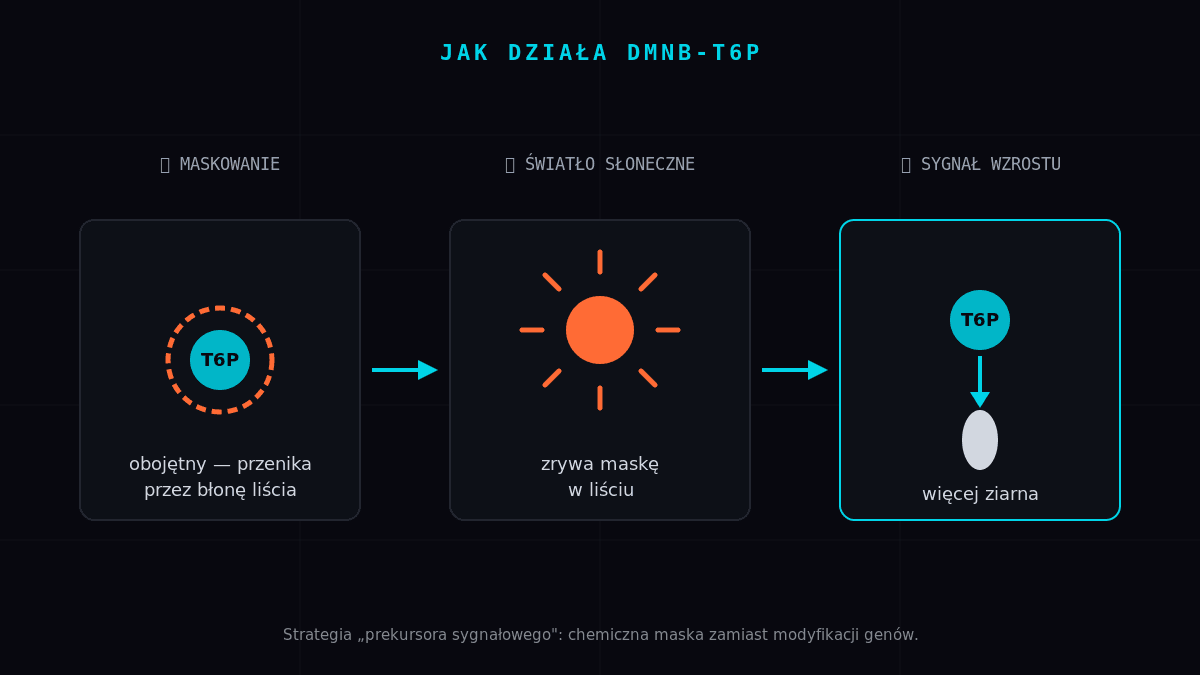
Rys. 1. Strategia „prekursora sygnałowego”: zamaskowana cząsteczka DMNB-T6P przenika przez błonę liścia, a światło słoneczne uwalnia w środku aktywny T6P — sygnał wzrostu zwiększający liczbę i masę ziaren. Opracowanie własne na podstawie: Griffiths i in., Nature Biotechnology (2025), DOI: 10.1038/s41587-025-02611-1.
Ten percent without a gram of fertiliser
The field results surprised even the authors.
First came a trial at the Mexican CIMMYT station in Obregón — the very one that for decades selected high-yielding wheat for the Global South. A micro-dose of 0.5 millimolar, a single spray. Yield rose by 9 to 22 percent, on average 15.3.
Then four years of field trials in Argentina, on three elite bread-wheat varieties, in wet years and dry years. Average yield gain: 10.4 percent. In the best year — the wet 2018 — the variety Saeta produced 17 percent more grain, an extra 0.88 tonnes per hectare. In the dry 2020, when rainfall fell 70 percent below normal, yield still rose by an average 9.3 percent.
Those are numbers that beat everything breeding knows. Annual genetic progress in wheat is about 0.6 percent. A single DMNB-T6P spray delivers a gain an order of magnitude larger.
No extra water. No extra fertiliser.
And here is the most counterintuitive part: the protein content of the grain did not fall. With a higher yield the opposite usually happens — the plant dilutes protein, because nitrogen only stretches across so many grains. Here it stayed level, and in some varieties it even rose. The plant made more out of the same nitrogen.
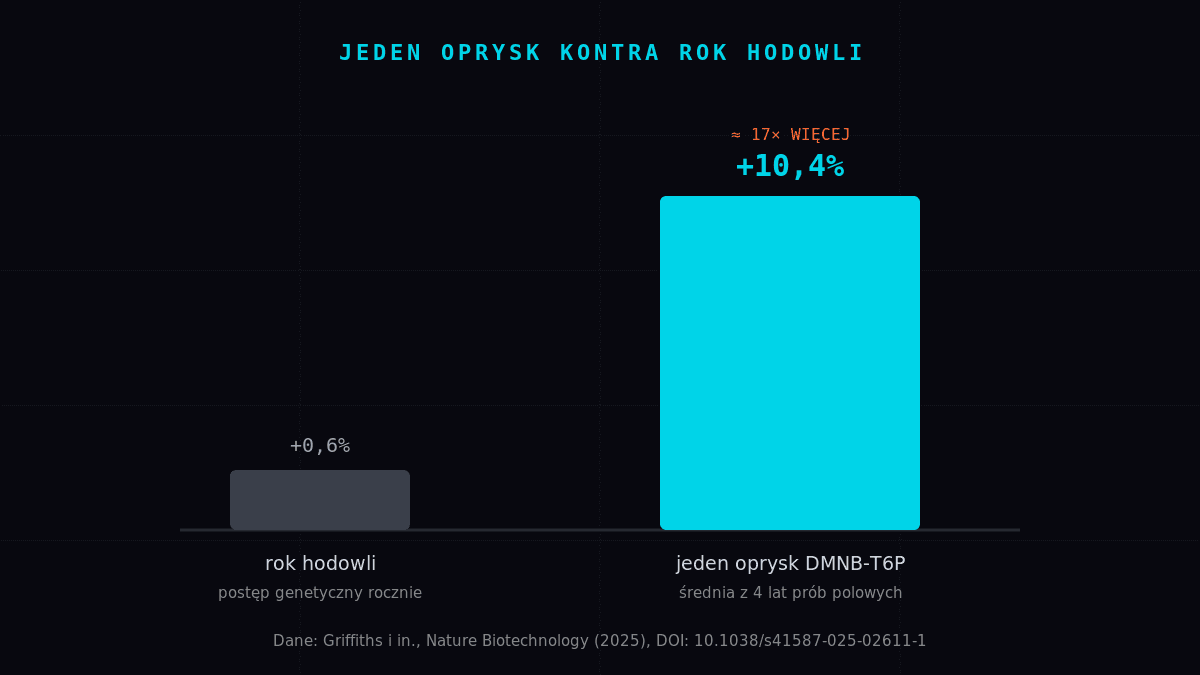
Rys. 2. Jeden oprysk DMNB-T6P daje średnio +10,4% plonu pszenicy wobec +0,6% rocznego postępu hodowlanego. Dane: Griffiths i in., Nature Biotechnology (2025), DOI: 10.1038/s41587-025-02611-1.
25 billion dollars and a biostimulant
The economics of this technology is as remarkable as the biology.
Synthesising DMNB-T6P costs about 300 dollars per tonne. At current doses that is a few cents per hectare. An average yield gain of 0.37 tonnes per hectare means 116 dollars of profit per hectare — at the February 2023 wheat price. If the technology worked on all 221 million hectares of wheat worldwide, it would add 25.6 billion dollars of value a year.
And that is just wheat. Under controlled conditions DMNB-T6P raised sorghum and barley yields by 10.8 to 24.3 percent. The T6P pathway is shared by all cereals.
Then there is the logistics. The substance mixes in the tank with other products, keeps well in storage and needs no specialist equipment. This is not a laboratory — it is the sprayer a farmer already owns. The application window is wide: six days, from day 10 to day 16 after flowering.
There is one more effect the authors highlight. The Green Revolution of the 1960s bought yield gains with nitrogen fertiliser — and fertiliser production generates carbon dioxide and nitrous oxide. DMNB-T6P breaks that link: yield rises per unit of fertiliser, not because of a bigger dose. Grams of signal instead of kilograms of nitrogen.
A race nobody sees
The market at stake is growing faster than wheat itself. The global biostimulant market — products that do not feed the plant but strengthen its own mechanisms — is valued at several billion dollars and grows at a double-digit annual rate. It is still a fraction of the fertiliser market, but it grows exactly where fertiliser becomes a problem: costly, emissive, constrained by regulation.
DMNB-T6P lands at exactly that moment. It is not another seaweed extract or humic preparation with a vague mechanism of action. It is a molecule with a known, precisely described signalling pathway — something regulators and farmers increasingly demand from biostimulants.
But the road from publication in Nature Biotechnology to a sprayer in the field is long. It takes registration, toxicology studies, production scale. The agrochemical giants — Syngenta, BASF, Bayer, Corteva — have both the money and the distribution networks. They, not the laboratory in Hertfordshire, will decide how fast this technology reaches the farmer.
That is why every season counts. The publication gives the Rothamsted team priority — but priority in science is not the same as priority in the market.
Poland has wheat. And a yield gap
Poland is among the top five wheat producers in the European Union — we harvest about 10 to 13 million tonnes a year from over two million hectares. But the average yield, around 4.5 to 5 tonnes per hectare, lags Western Europe, where 7–8 tonnes are harvested. This is not a lack of land. It is a technological gap that can be closed.
And here Poland has the base to do it. The Institute of Soil Science and Plant Cultivation in Puławy (IUNG-PIB) and the Plant Breeding and Acclimatization Institute in Radzików have studied cereal yield and stress for decades. Polish breeding companies — DANKO Hodowla Roślin, Hodowla Roślin Strzelce, Poznańska Hodowla Roślin — register their own wheat varieties, competing with the Western giants.
A technology like DMNB-T6P fits this ecosystem like a key in a lock. It is a biostimulant — a category growing at double digits in Europe, and only now taking off in Poland. It requires no genetic modification, so it sidesteps the entire GM regulatory barrier. It works with existing varieties, not with a single transgenic line.
One link is missing: a Polish team that would test this signalling pathway on our varieties and in our climate. Rothamsted and Oxford showed it works in Argentina and Mexico. No one has yet shown how DMNB-T6P behaves in a field near Puławy, in a colder spring and with a later harvest.
This is an open window. The technology is described, published, quantified. Whoever in Poland first combines signalling chemistry with domestic breeding can offer farmers a yield gain without a gram of extra fertiliser. And in a country that must feed itself and still export, that is a stake larger than a single season.
Sources
- Griffiths C.A., Xue X., Miret J.A., Salvagiotti F., Acevedo-Siaca L.G., Gimeno J., Reynolds M.P., Hassall K.L., Halsey K., Puranik S., Oszvald M., Kurup S., Davis B.G., Paul M.J., Membrane-permeable trehalose 6-phosphate precursor spray increases wheat yields in field trials, Nature Biotechnology (2025). DOI: 10.1038/s41587-025-02611-1
- Griffiths C.A., Sagar R., Geng Y., Primavesi L.F., Patel M.K., Passarelli M.K., Gilmore I.S., Steven R.T., Bunch J., Paul M.J., Davis B.G., Chemical intervention in plant sugar signalling increases yield and resilience, Nature 540, 574–578 (2016). DOI: 10.1038/nature20591
- Bentley A.R. et al., Near- to long-term measures to stabilize global wheat supplies and food security, Nature Food 3, 483–486 (2022). DOI: 10.1038/s43016-022-00559-y
Comments· 0
No comments yet. Be the first.