
An AI-designed synthetic RNA courier. A shape nature never found
The scale of an RNA courier
A single RNA molecule does not heal. It heals only when it reaches the inside of the right cell — intact, in the right place, without surplus cargo. Over billions of years evolution pushed viruses toward similar “boxes”: large, multimeric capsids with icosahedral or helical symmetry. In 2026 a Helmholtz Munich and TUM team showed in Nature that artificial intelligence can design a courier nature never assembled — and that this courier carries RNA several orders of magnitude more efficiently than widely used clinical lipid nanoparticles (DOI: 10.1038/s41586-026-10952-3).
Scale is the spine here, not decoration. More than a hundred variants. One winner. From cell culture to mouse and pig. From reporter RNA to a gene editor. From a Munich lab to a planned spin-off. Poland already knows RNA as a product (vaccines, clinical trials, contract manufacturing), but still rarely asks who will own the next “box” that gets RNA into the cell at all.
A hundred designs, one shape outside nature
Researchers at the Institute of Stem Cell Research and the Institute of Developmental Genetics (Helmholtz Munich / TUM) did not want to “improve a virus.” They wanted to build a transport vehicle from the ground up: assign concrete jobs to natural protein domains (membrane binding, RNA packaging, budding) and assemble the scaffold from a generative-AI-designed protein — in a geometry evolution never chose.
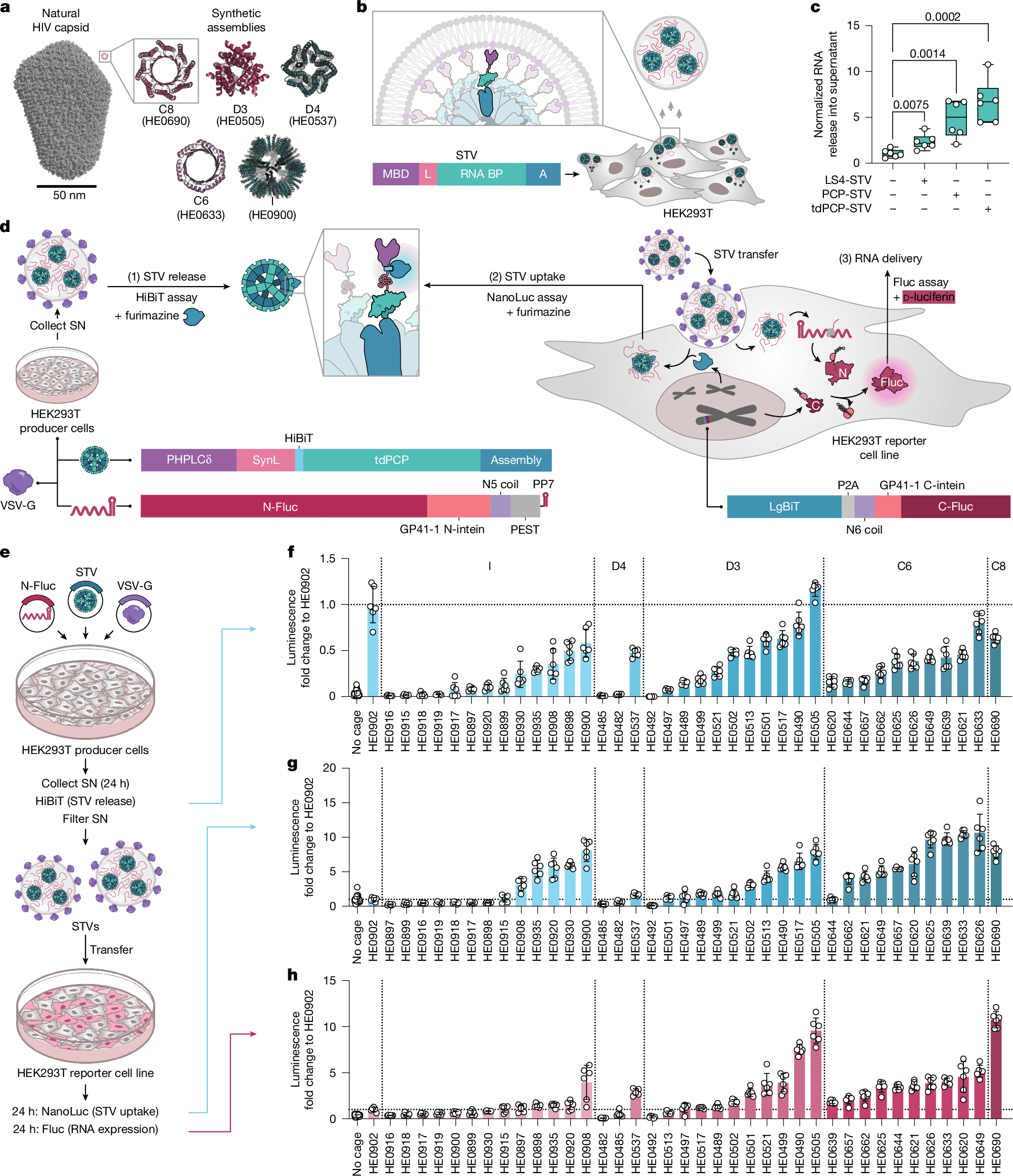
Rys. 1. Projekt i przesiew syntetycznych kurierów RNA (STV): porównanie kształtów wirusowych i AI oraz schemat architektury. Źródło: Schuhmacher et al., Nature 2026, CC BY 4.0.
They screened more than a hundred constructs. Unusual shapes relative to classic capsids performed best. The winner was STV-C8 (synthetic transfer vehicle C8): a synthetic RNA carrier with flat, atypical symmetry. In cell culture it delivered cargo clearly more efficiently than the virus-like particles and lipid nanoparticles tested; to reach comparable protein production it needed substantially less RNA. Tropism could be programmed — by attaching computationally designed peptide binders — and cargo swapped: reporters, gene editors, programmable antivirals, transcription factors, across cellular models from several species.
Here is the first scale jump: not “a slightly better vector,” but a platform that leaves the evolutionary corridor of viral shapes. The second jump: the same architecture should work like a set of blocks — different cargo, different target cell — instead of a separate research programme for every disease.
From a single cell to the whole body
In mice after intravenous dosing, STV-C8-driven expression of delivered RNA concentrated mainly in the lungs; the team found no evidence of immunological or toxic effects in the animal models studied. Biodistribution was mapped at near-single-cell resolution. Another scale change: from a Petri dish to a whole-body map.
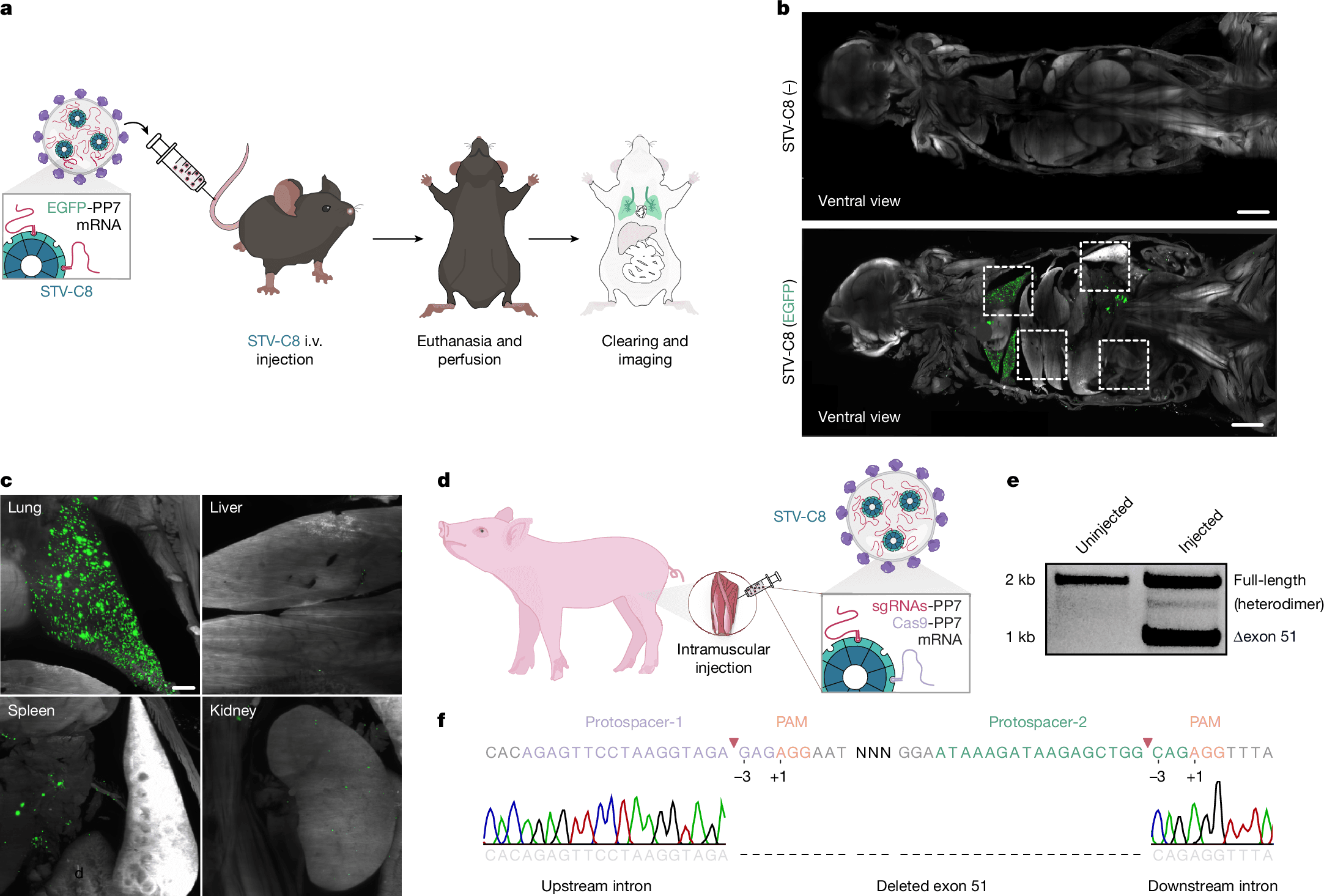
Rys. 2. Rozkład STV-C8 w organizmie myszy oraz dostarczanie ładunków do edycji genów w modelach myszy i świni. Źródło: Schuhmacher et al., Nature 2026, CC BY 4.0.
In pig muscle the same class of courier, loaded with CRISPR–Cas9 components, removed a dystrophin gene fragment (exon 51) — a strategy considered for Duchenne muscular dystrophy. Helmholtz Munich also highlights an earlier path: the 2025 m4 Award for project SYNTRA, which develops AI-aided delivery of RNA medicines. The Nature paper of 2 September 2026 closes the stage “does this work in a living organism at all.” It opens the stage “who turns the platform into a product.”
The TRL of this story sits around 4 today: evidence in animal models and patient-derived cells is solid; steering to arbitrary cell types, human pharmacokinetics and industrial manufacture are not. The authors say plainly that before STV-C8 enters medicine, targeting to specific cells and body distribution must be studied. At the same time they plan to move the technology into a spin-off.
Who earns on the box, not only on the strand
The RNA therapy and gene-editing market already knows that delivery is often the bottleneck, not the sequence itself. Lipid nanoparticles entered the clinic with mRNA vaccines, but they carry cargo costs, tropism limits and a safety profile that must be renegotiated for every new drug. Viral vectors bring their own immunogenicity history and capacity limits. A protein courier designed outside evolution — if it keeps orders-of-magnitude advantage at scale — becomes a candidate platform layer: licences, delivery-service contracts, packages for specific indications.
The intellectual margin does not sit only in the dystrophin gene. It sits in the library of shapes, the screen of hundreds of variants, tropism-binding peptides, purification know-how and patents on STV architecture. Munich and Helmholtz are harvesting that knowledge capital now — before someone in Warsaw, Kraków or Gdańsk asks only: “which mRNA should we buy from the catalogue?”
Poland: we make strands, we buy boxes?
Poland has a growing presence in RNA biotechnology, clinical research and contract manufacturing. It also has patients with rare diseases, including muscle disorders, and clinical genetics centres that understand exon editing. What is often missing is not an idea for a sequence, but ownership of the delivery layer: who licences the vector, who holds platform rights, who sets the price of RNA’s “entry” into the cell.
If the answer on the courier is “from Bavaria, under licence,” the scale of the Nature discovery becomes a scale of dependence. Poland need not build an STV factory tomorrow. It does need to know the game is about Pathfinder and technology-transfer partnerships, its own protein-design and non-viral vector groups, and early patents — before “a courier outside evolution” is only a pretty Munich figure, and a Polish patient receives therapy from someone else’s component catalogue.
Closing
Viruses had billions of years to converge on similar capsids. Generative AI assembled more than a hundred vehicles in geometries nature never chose — and one of them, STV-C8, carries RNA orders of magnitude more efficiently than clinical lipid nanoparticles, works in mouse and pig, and aims at a Duchenne strategy. The scientific scale is on the table. The business scale is just opening: spin-off, patents, licences, clinic.
The question for Poland is not “does RNA work.” It is: who here will earn on the box before Munich does.
Sources
- Schuhmacher, M. K. et al. Creating bottom-up RNA transfer vehicles from synthetic protein assemblies. Nature (2026). DOI: 10.1038/s41586-026-10952-3. Open Access, CC BY 4.0.
- Helmholtz Munich. AI-Designed Proteins Enable a New Generation of RNA Transporters (2 Sep 2026). helmholtz-munich.de.
- Helmholtz Munich. m4 Award 2025 Goes to Helmholtz Munich for RNA Therapy Innovation (project SYNTRA, 3 Jul 2025). helmholtz-munich.de.
Figures: Figure 1 and Figure 2 correspond to Fig. 1 and Fig. 4 in source (1), used unchanged under CC BY 4.0; credit: Schuhmacher et al., Nature 2026.
Comments· 0
No comments yet. Be the first.