
Perovskite will not wait for Poland
Akt 1
Olga Malinkiewicz did not plan to become an entrepreneur. In 2013, she was a PhD student at the University of Valencia, where she discovered - by accident, like most breakthrough discoveries - that perovskite could be deposited on a substrate using a solution technique, without a vacuum and without high temperatures. The silicon solar cell requires an oven heated to 1,400°C, a vacuum chamber the size of a shipping container, and an ISO Class 5 cleanroom. Her method required an inkjet printer.
Ten years later, he stands on a production floor in Wrocław and watches as the same technology - refined, scaled, patented - applies a layer of perovskite to a flexible foil with micrometer precision. Her company, Saule Technologies, is the first in the world to do this commercially. Not in Silicon Valley. Not in Shenzhen. In Wrocław, at Długa Street.
Perovskite is not a new material. The German mineralogist Gustav Rose discovered it in 1839 in the Urals and named it after the Russian aristocrat Lev Perovsky. For the next 170 years, no one thought of making a solar cell out of it. In 2009, Japanese scientists tried it - the cell had an efficiency of 3.8% and fell apart after a few minutes. The world shrugged.
And then something unprecedented in the history of photovoltaics happened.
Over fifteen years, the efficiency of perovskite cells has increased from 3.8% to a certified 27% for single cells and 34% in tandem with silicon. It took silicon half a century to achieve this. Its theoretical limit is 29%.
Shen, Lin, Su, Zhang and Wu - a team from Chinese institutes in Fujian, Shanghai, Wuhan and Xinjiang - published a review in January 2026 in Nano-Micro Letters that summarizes this progress in impressive numbers. 23 citations in a few months. 160 references. A text that should wake up anyone who thinks that photovoltaics is a solved problem.
But not only fitness counts. For years, perovskites' Achilles heel was stability - cells degraded within hours when exposed to moisture and oxygen. “It doesn't work outside the lab,” said the skeptics. And they were right. Until 2017. Then Grancini's team showed at Nature Communications a cell that survived a year without degradation. Today—nine years later—researchers have stopped testing perovskites exclusively in laboratory chambers. They expose them to external conditions. Rain, wind, thermal cycles. And they work.
At the same time - and this is the second breakthrough that may mean more than efficiency records - production no longer requires toxic solvents and an inert gas atmosphere. Green solvents. Ambient fabrication - fabrication in plain air. This moves the technology from the "works in the lab" phase to the "it can be manufactured" phase. From the "scientific curiosity" phase to the "silicon competitor" phase.
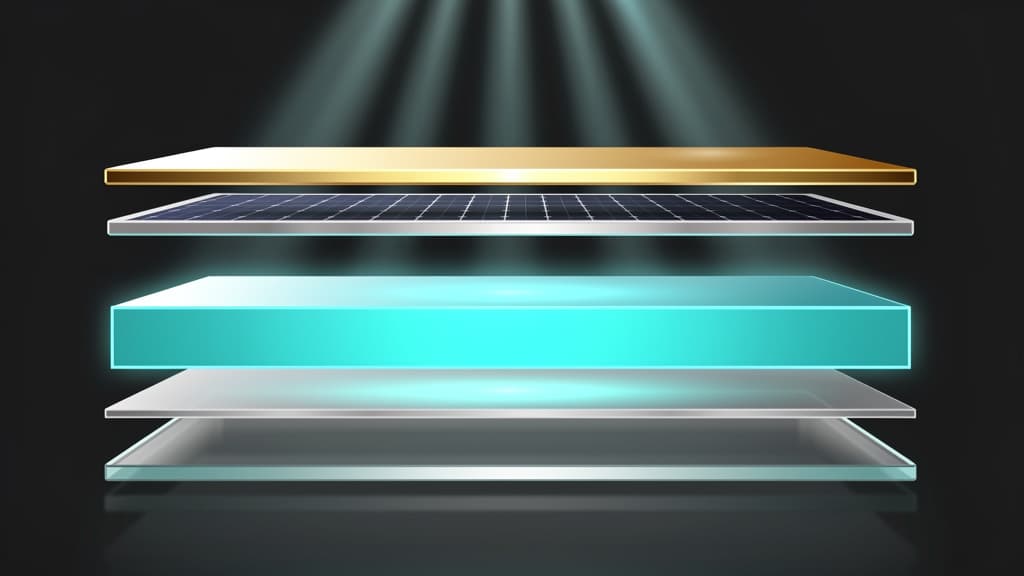
Rys. 1. Struktura warstwowa ogniwa perowskitowego — od podłoża szklanego po elektrodę górną
Akt 2
The perovskite patent landscape is dense and dominated by Chinese institutions. Over the past two years, the number of patent applications in this field has increased by more than 40% year-on-year. Chinese Academy of Sciences. Tsinghua University. Fujian Institute of Research on the Structure of Matter - the same one where the authors of Shen's review come from. This is no coincidence: China today controls 80% of global silicon cell production and has no intention of relinquishing its advantage in the next generation. Their strategy is clear: patent everything they can before the West realizes the race is on.
On the western side, the field is more scattered, but not empty. Oxford PV - a spin-out of the University of Oxford - has closed a funding round exceeding $1 billion. It is building a pilot line in Brandenburg, an hour from Berlin. Swift Solar in the US, founded by MIT and Stanford graduates, focuses on perovskite-silicon tandems - cells that layer perovskite on silicon, squeezing extra percentage points of efficiency out of it. CubicPV tries to combine both technologies in one production process. Microquanta in China announced a 1.2 m² perovskite module - a size that is becoming commercially important because it allows for installation in standard systems.
At the same time, learning does not slow down. In 2025:
- Sciencepublished a paper on the integration of a wafer-scale MoS₂ monolayer with perovskite cells - 188 citations in a few months. Keyword:wafer-scale. Not "in a laboratory on a square centimeter". On a waffle scale.
- Natureshowed the Nd@C₈₂-polymer interface increasing stability and efficiency at the same time - 132 citations. Fullerenes as a protective layer. An idea that was heresy ten years ago.
- Nature Communicationspublished a universal passivator for single- and tandem cells - 72 citations. One molecule that works in both architectures.
- Same thingNano-Micro Letterspublished an analysis of the economic profitability of perovskites against silicon - 53 citations. The question is no longer "if", but "when".
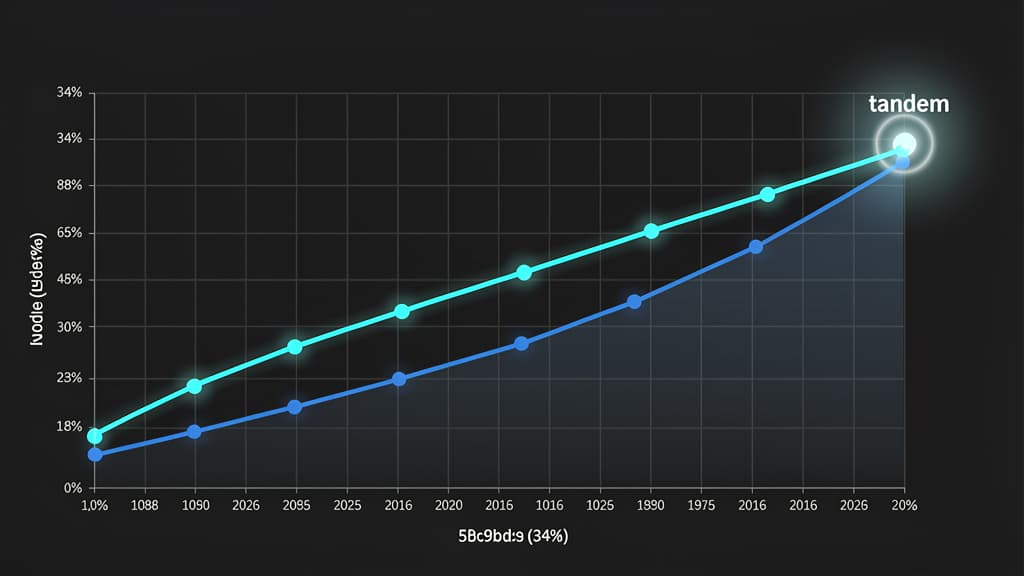
Rys. 2. Wzrost sprawności ogniw perowskitowych 2009–2026 na tle krzemu krystalicznego
Regulatorily, the European Union is doing what it always does: creating frameworks. The Net-Zero Industry Act lists photovoltaics as a strategic technology. REPowerEU sets a target of 600 GW of installed PV capacity by 2030. The European Hydrogen Bank finances hydrogen projects, some of which - such as Bieńkowski's work from the University of Warsaw on the photoelectrochemical decomposition of water - are directly related to perovskites.
But neither of them says "perovskite" directly. The framework is general and the technology window is specific. Whoever certifies a perovskite module first according to the IEC 61215 standard will set an entry barrier for others. The IEC 61215 standard is not paperwork - it is a set of tests that a cell must pass in order for a developer to insure it and a bank to finance its installation. Without a certificate there is no market. Without a market, there is no scale. Without scale, there is no price competitiveness.
Akt 3
Poland has something no other country in continental Europe has: a working perovskite cell production line.
Saule Technologies - founded by Olga Malinkiewicz, who returned to Poland after completing her PhD in Valencia instead of accepting the offer from Oxford - went from laboratory to factory within a decade. In 2025, the company launched a line capable of producing modules with a total capacity of megawatts per year. For comparison: the global PV market is hundreds of gigawatts. But Saule isn't aiming for rooftops - he's aiming for places where silicon can't go. Building facades. Windows. Personal electronics. IoT. Where lightness, flexibility and aesthetics mean more than every percentage point of efficiency. Where silicon panels simply do not fit.
This is the Polish niche in the perovskite race. Not competing with Chinese giants on mass. Not racing against Oxford PV for fitness. Just mastering the segments that silicon can't physically handle - and building an unassailable position on them.
The research base exists and is surprisingly complementary:
- Anna Gągorfrom the Institute of Low Temperature and Structural Research of the Polish Academy of Sciences in Wrocław, studies phase transitions in halide perovskites. This is a fundamental understanding of why a material degrades – and how to prevent it at the level of its crystal structure. 119 citations in 2024.
- Krzysztof Bieńkowskifrom the University of Warsaw uses perovskites for photoelectrochemical decomposition of water. Green hydrogen production powered by sunlight - without the intermediate electrolyzer step. 74 citations.
- Łukasiewicz – PORTin Wrocław develops perovskite scintillators for medical imaging. A market worth billions dominated by inorganic crystals. Perovskite could be cheaper, faster to produce and more sensitive.
- Silesian University of Technologyinvestigates dual perovskites for hydrogen storage. Two uses for one material: energy generation and energy storage.
Total: five institutions, five complementary approaches, zero redundancy. Wrocław is the informal capital of Polish perovskites - Saule, PAN, PORT - three entities within a radius of ten kilometers. Warsaw and Gliwice provide the missing links.
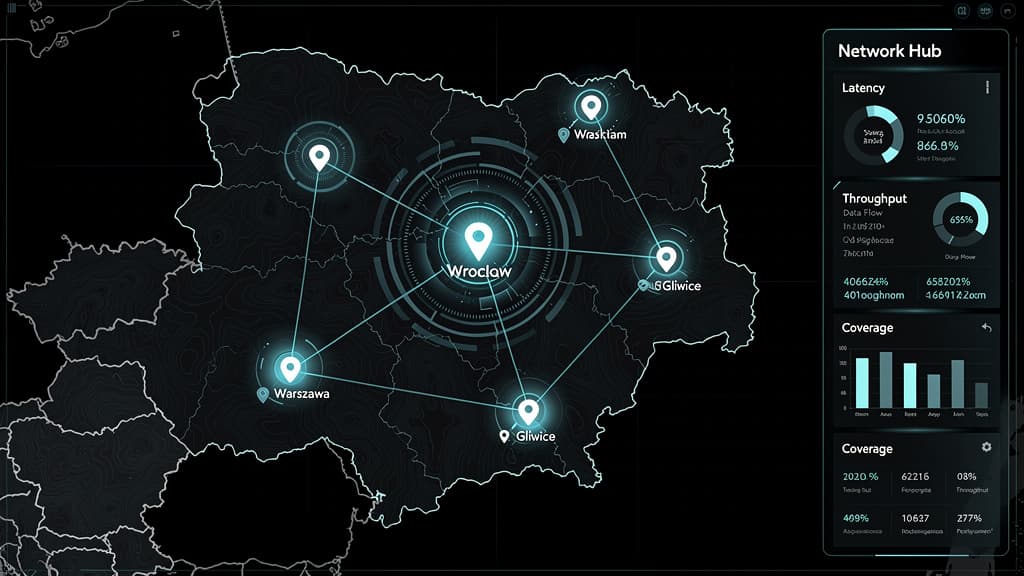
Rys. 3. Polski ekosystem perowskitowy — 5 ośrodków od Wrocławia po Gliwice
Funding paths are viable but need to be accelerated. FENG - European Funds for a Modern Economy - has the priority "Innovation and competitiveness". NCBR runs a Fast Track for SMEs, which theoretically should consider applications within 60 days. EIC Accelerator - the European Commission's flagship program for deep tech - offers up to EUR 2.5 million for a single project, and in the blended finance path an additional EUR 15 million in equity capital.
The problem is not lack of money. The problem is that the average time from application to first tranche in national programs is eighteen months. At this rate, we're not losing with better technology - we're losing with someone else's faster calendar. Oxford PV closes the round in four months. Chinese institutes are launching six pilot lines.
There is also a factor that cannot be overestimated: the Polish prosumer photovoltaics market. 1.4 million prosumers - the largest number in the European Union, more than in Germany with a population twice as small. This is not the audience for perovskites - not today. But this is an army of people who understand solar technology, follow it, make purchasing decisions based on data, not habit, and - most importantly - are accustomed to the fact that Polish photovoltaics is at the forefront. A Polish prosumer who is installing a silicon panel on the roof today will tomorrow ask about a perovskite roller blind in a window, a perovskite facade on the wall, a perovskite charger in a backpack.
The internal market provides scale that neither Oxford PV nor Swift Solar has. They have to export from day one. Poland can first saturate its own market, improve the product for the demanding, conscious consumer, and then - with references, certificates and a learning curve behind it - enter foreign markets.
The rate is specific and has a date. By 2028, the perovskite cell standard will be defined - not by a standards committee, but by the first player to deliver a product that meets the IEC 61215 standard and win a contract with the first large developer. This player will set the specifications that the others will have to follow. It will set market expectations regarding price, durability and warranty. It will establish, in short, the rules of the game.
Poland is in a unique position today: it has a factory that is already producing. It has staff who understand technology from the fundamental and application side. It has an internal market that gives you the first income and the first reference. What there is not is time. The decision to dramatically increase the scale of production, certification and enter the development market must be made within 12-18 months. Then others will do the same. And then being first will no longer be an advantage - it will be a memory.
Sources
Main examination:Shen X., Lin X., Su H., Zhang Z., Wu T. (2026).Key Advancements and Emerging Trends of Perovskite Solar Cells in 2024–2025. Nano-Micro Letters. DOI:10.1007/s40820-025-02022-6
Key Works Cited:
- Min H et al. (2021).Perovskite solar cells with atomically coherent interlayers on SnO₂ electrodes. Nature. 3,149 citations.
- Grancini G. et al. (2017).One-Year stable perovskite solar cells by 2D/3D interface engineering. Nature Communications. 2,038 citations.
- Lin Q. et al. (2014).Electro-optics of perovskite solar cells. Nature Photonics. 1,730 citations.
- Li Z et al. (2018).Large tunable photoeffect on ion conduction in halide perovskites. Nature Materials. 583 citations.
Competitive works 2025 (outside the bibliography):
- Hou Y. et al. (2025).Wafer-scale monolayer MoS₂ film integration for stable, efficient perovskite solar cells. Science. 188 citations.
- Li M et al. (2025).A Nd@C₈₂–polymer interface for efficient and stable perovskite solar cells. Nature. 132 citations.
- Chen H et al. (2025).Homogeneous 2D/3D heterostructured tin halide perovskite photovoltaics. Nature Nanotechnology. 120 citations.
- Kumar R. et al. (2025).Cost Effectiveness Analysis of Perovskite Solar Cells. Nano-Micro Letters. 53 citations.
- Ding B. et al. (2024).Dopant-additive synergism enhances perovskite solar modules. 282 citations.
Polish ecosystem:
- Gągor A. et al. (2024).Phase Transitions and Dynamics in Mixed Lead Halide Perovskites. YOU. 119 citations.
- Bieńkowski K. et al. (2024).Halide Perovskites for Photoelectrochemical Water Splitting and CO₂ Reduction. University of Warsaw 74 citations.
- Saule Technologies -saulesolar.com
TRL09 — from scientific research to Polish companies.
Comments· 0
No comments yet. Be the first.