Horses versus computers. A duel over snake antivenom
Venom with three fingers
A cobra doesn't kill with force. It kills with a molecule.
Its venom contains a group of toxins shaped like three outstretched fingers. Scientists call them exactly that: three-finger toxins. They bind to nicotinic receptors — the same ones through which the brain tells muscles to work — and block them. The victim doesn't die from the wound. They die because they stop breathing.
This isn't an exotic rarity. Two million bites a year. A hundred thousand deaths. Three hundred thousand people left permanently disabled — by necrosis, amputation, blindness. In 2017, the World Health Organization placed snakebite on its list of neglected tropical diseases of the highest priority.
And here is where it stops making sense. For 130 years, snake antivenom has been made the exact same way. With horses.
The horse as a factory. Since 1894
In 1894, the French bacteriologist Albert Calmette discovered that injecting a horse with a small dose of venom made the animal produce antibodies. All that remained was to draw blood, purify the plasma — and there was the serum. The same principle holds today.
The method is simple, but it has four flaws that together form a wall.
First — cost. A single vial of serum can run from $100 to over $500, and a bite victim often needs several. For a farmer in sub-Saharan Africa, where bites are most common, that's an unattainable price.
Second — the cold chain. Serum is a blood product; it has to be kept refrigerated. Yet bites happen exactly where there are no refrigerators: in the field, in the village, hundreds of kilometres from a hospital.
Third — the blood itself. Even correctly administered serum can trigger anaphylactic shock or a pyrogenic reaction. A patient's body sometimes rejects the drug before it can take effect.
Fourth — and this is the crux — serum works poorly against three-finger toxins. They're small and poorly recognised by the horse's immune system, so the animal's body simply doesn't produce enough antibodies against them. The result: the patient receives a dose of drug, and the neurotoxin still blocks their breathing.
Four flaws, one conclusion: the horse is a factory with its limits.
The computer that reads proteins
In Seattle there's a laboratory that has been playing a different game for years. David Baker of the University of Washington won the 2024 Nobel Prize in Chemistry — for not reading proteins, but designing them.
Baker's method is the mirror image of the horse's. Instead of immunising an animal and waiting for nature to produce antibodies, his team has a computer design a protein from scratch. The RFdiffusion algorithm sketches the skeleton of a protein meant to stick to a specific target. A second algorithm, ProteinMPNN, selects an amino-acid sequence for that skeleton. A third, AlphaFold2, checks whether the design actually folds as planned.
In January 2025, this team — together with Andreas Laustsen of Denmark and Nicholas Casewell of Liverpool, both venom specialists — took aim at three-finger toxins. The question they posed was brutal: could a protein that exists only inside a computer neutralise the real venom of a real cobra?
Three fingers. Three designs. Three numbers.
They designed three proteins. SHRT — against the short-chain neurotoxin. LNG — against the long-chain one, the cobra's. CYTX — against the cytotoxin that dissolves tissue.
And then came the numbers that set up the whole duel.
Binding strength is measured in nanomoles per litre — the smaller the number, the tighter the grip. SHRT holds the toxin with a force of 0.9. What does that mean in practice? It's like dropping a single drop of ink into an Olympic swimming pool — and being certain that this one drop will still find and seize its partner. The protein holds its target tighter than the best known nanobodies, the miniature antibodies an entire industry is working on. LNG reached 1.9. For comparison: the first design they started from bound at a mere 842. They improved it nearly a thousandfold, sifting through 78 variants.
Heat resistance. SHRT withstands 78 degrees Celsius. LNG — more than 95. That means one thing: this antivenom needs no refrigerator. It can sit in a backpack in the heat.
Size. Each of these proteins has roughly 100 amino acids. An antibody has thousands. Small size means the designed molecule reaches deep tissue faster — where the neurotoxin has already done damage.
But the most important number came in the mouse tests. The animals were given three times the lethal dose of cobra venom. Then — the designed protein.
And here is a note on the method that says more than all the numbers combined. Traditional drug discovery takes years: immunising animals, building vast molecular libraries, rounds of selection and optimisation. Baker and his team got these results after screening just a few dozen designs — because the computer aimed from the start at what was meant to work. CYTX, the third design, bound the cytotoxin with a strength of 271 and withstood 61 degrees, though the authors admit it is still far from fully neutralising cytotoxins. But the direction is clear: instead of shooting in the dark, you design with precision.
They all survived.
One hundred percent. And when the protein was administered 15 minutes after the toxin — after the fact, with the venom already circulating in the blood — survival was still 100 percent for SHRT and 80 percent for LNG. This isn't prophylaxis. It's rescue after the bite.
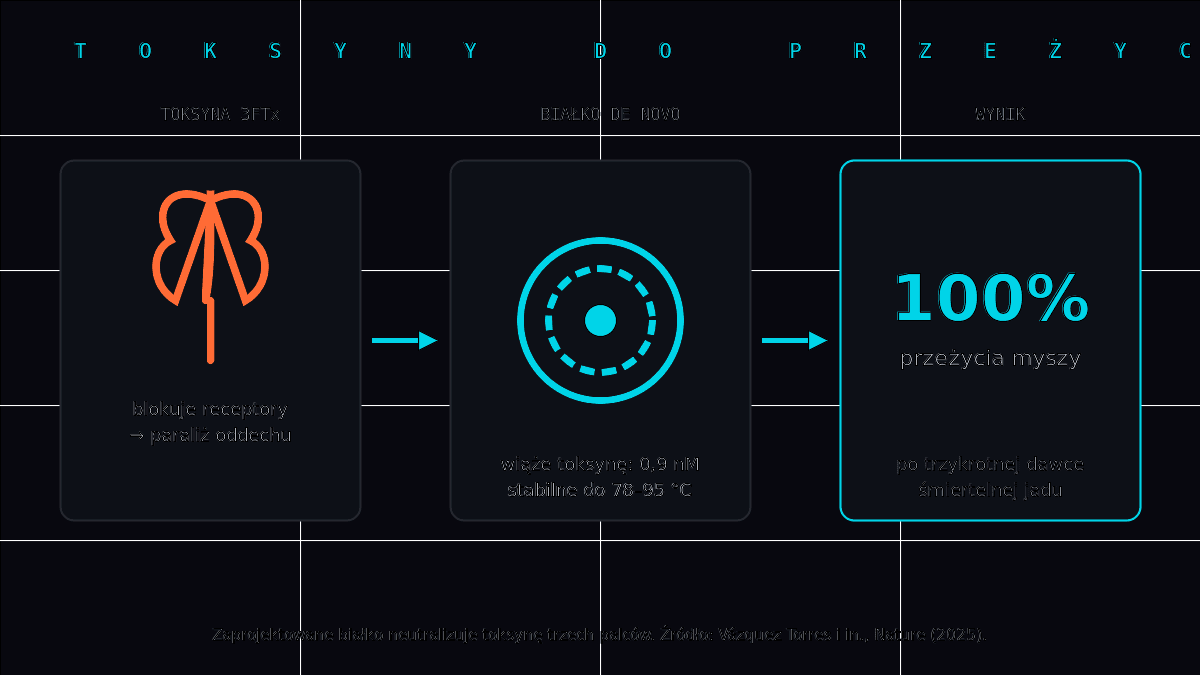
Rys. 2. Od toksyny do przeżycia: białko de novo wiąże toksynę trzech palców z siłą 0,9 nM i daje 100% przeżywalności myszy po trzykrotnej dawce śmiertelnej jadu. Opracowanie własne na podstawie: Vázquez Torres i in., Nature (2025), DOI: 10.1038/s41586-024-08393-x.
The result. And what it means
On the scoreboard, this duel looks like this.
The horse: 130 years of experience, regulatory approval, ready logistics. But cost, refrigeration, the risk of shock, and a hole in its defence precisely where the snake is most dangerous.
The computer: zero years on the market, no approval. But production in yeast or bacteria, stability in the heat, binding precision, and full protection of mice against a lethal dose.
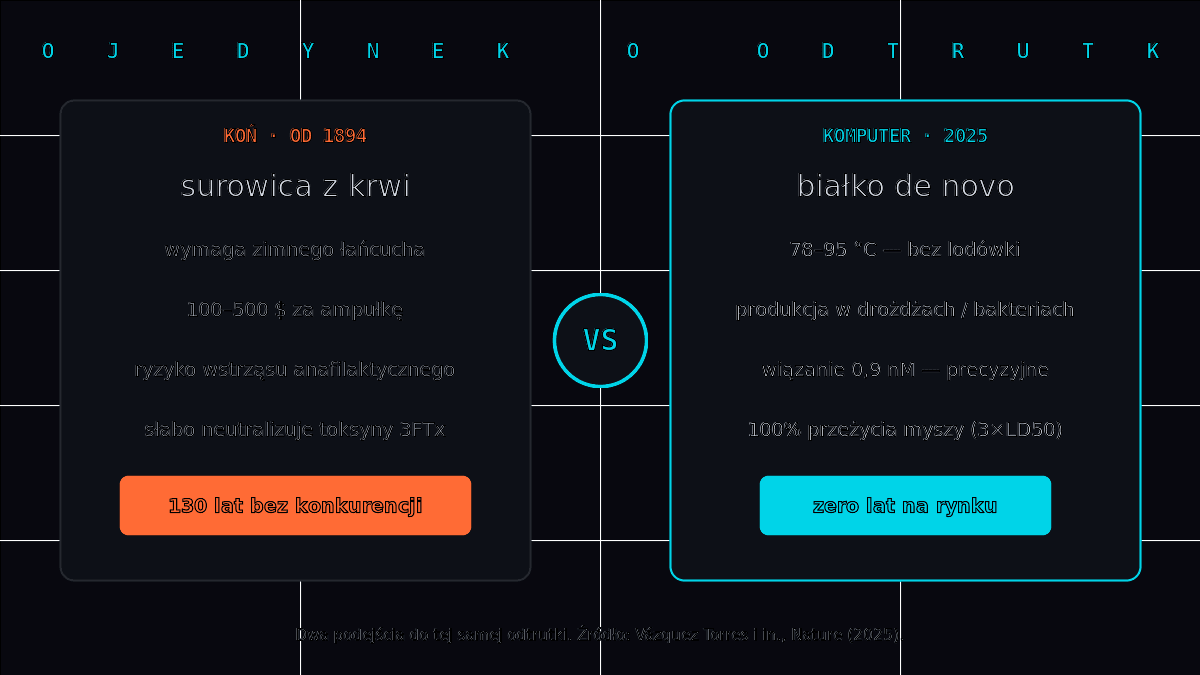
Rys. 1. Pojedynek o odtrutkę: surowica z krwi koni (od 1894 roku) kontra białka projektowane komputerowo (2025). Komputer wygrywa w koszcie produkcji, stabilności termicznej i precyzji wiązania; koń — w zatwierdzeniu regulacyjnym i logistyce. Opracowanie własne na podstawie: Vázquez Torres i in., Nature (2025), DOI: 10.1038/s41586-024-08393-x.
The duel isn't settled — but its character has changed. Yesterday the question was whether horse blood could be replaced at all. Today it's: how quickly.
There is one more dimension, beyond snakes. Baker's method doesn't work only on venom. Any protein that causes disease — and that's most of them — can be tracked down and neutralised by a designed molecule. This is a machine for making antivenoms, not a single antivenom. The authors say it outright: computational design could democratise drug discovery, especially where no one can afford research today.
The market no one is looking at
The paradox of snakebite is this: it kills a hundred thousand people a year, and yet there is no market for it.
The victims are the poorest. Farmers in sub-Saharan Africa, South Asia, Papua New Guinea, Latin America. People who can't afford a $500 drug. As a result, serum production is shrinking rather than growing. When the Sanofi group withdrew its Fav-Afrique serum in 2014 — the last effective one against African venoms — the continent was left practically without a drug within a few years. Because producing for the poorest doesn't pay.
In 2019, the WHO adopted a strategy: by 2030, halve the number of deaths and disabilities from snakebite. That is a hard deadline. And it is exactly here that a technology enters which needs no horses, no refrigerators, and no high-margin market.
A designed protein is produced in yeast or bacteria. It's the same infrastructure used to make insulin. The cost falls from dollars to cents. And the protein withstands 78 degrees, so it can reach the village in an ordinary bag, not a cold chain.
The authors, by the way, don't propose that the computer immediately replace horses. They suggest something smarter: designed proteins could work as 'fortifiers' — an additive that strengthens existing sera where they fail today, namely against neurotoxins. Horse and computer could work in tandem for a while.
Poland. Where our seat is
Poland doesn't have a snakebite problem. Its only venomous snake — the common European adder — is rarely encountered, and its venom rarely kills. But the technology behind this discovery is universal, and here Poland has something to say.
Selvita — a Kraków company employing close to a thousand people — has been doing drug research for global groups for years. Molecure and Ryvu Therapeutics, both listed on the stock exchange, design their own molecules. Adamed and Polpharma have production capacity. This is a chain that can carry a molecule from the computer to the vial.
In science, too, we don't start from zero. A team from the University of Gdańsk recently published work on the computational design of an inhibitor of the LIGHT protein — exactly the same method Baker used against venom: structure modelling, sequence design, verification. The Institute of Biochemistry and Biophysics of the Polish Academy of Sciences and the Centre of New Technologies at the University of Warsaw have teams that read and model proteins every day.
What's missing is one thing: a team that would connect these skills to a concrete clinical target — and to money. The Foundation for Polish Science and the NCBR fund biotechnology, but protein design is still sometimes treated as an academic curiosity rather than a path to a drug.
And the stakes are bigger than snake venom. Whoever is first in Poland to build a team that designs therapeutic proteins at industrial scale isn't just entering the global race for next-generation drugs. They're building a competence that corporations pay billions for — and one that can stay in the country.
The duel between the horse and the computer has just begun. By 2030, when the WHO deadline passes, we will know who won it. Poland can field its own contender. Or watch others do it.
Sources
- Vázquez Torres S., Bénard-Valle M., Mackessy S.P., Menzies S.K., Casewell N.R., Ahmadi S., Burlet N.J., Muratspahić E., Sappington I., Overath M.D., Rivera-de-Torre E., Ledergerber J., Laustsen A.H., Boddum K., Bera A.K., Kang A., Brackenbrough E., Cardoso I.A., Crittenden E.P., Edge R.J., Decarreau J., Ragotte R.J., Pillai A.S., Abedi M., Han H.L., Gerben S.R., Murray A., Skotheim R., Stuart L., Stewart L., Fryer T.J.A., Jenkins T.P., Baker D., De novo designed proteins neutralize lethal snake venom toxins, Nature 639, 225 (2025). DOI: 10.1038/s41586-024-08393-x
- Gutiérrez J.M., Calvete J.J., Habib A.G., Harrison R.A., Williams D.J., Warrell D.A., Snakebite envenoming, Nature Reviews Disease Primers 3, 17063 (2017). DOI: 10.1038/nrdp.2017.63
- Watson J.L., Juergens D., Bennett N.R., Trippe B.L., Yim J., Eisenach H.E., Ahern W., Borst A.J., Ragotte R.J., Milles L.F., Wicky B.I.M., Hanikel N., Pellock S.J., Courbet A., Sheffler W., Wang J., Venkatesh P., Sappington I., Torres S.V., Lauko A., De Bortoli V., Mathieu E., Ovchinnikov S., Barzilay R., Jaakkola T.S., DiMaio F., Baek M., Baker D., De novo design of protein structure and function with RFdiffusion, Nature 620, 1089–1100 (2023). DOI: 10.1038/s41586-023-06415-8
- Dauparas J., Anishchenko I., Bennett N., Bai H., Ragotte R.J., Milles L.F., Wicky B.I.M., Courbet A., de Haas R.J., Bethel N., Leung P.J.Y., Huddy T.F., Pellock S., Tischer D., Chan F., Koepnick B., Nguyen H., Kang A., Sankaran B., Bera A.K., King N.P., Baker D., Robust deep learning–based protein sequence design using ProteinMPNN, Science 378, 49–56 (2022). DOI: 10.1126/science.add2187
Comments· 0
No comments yet. Be the first.