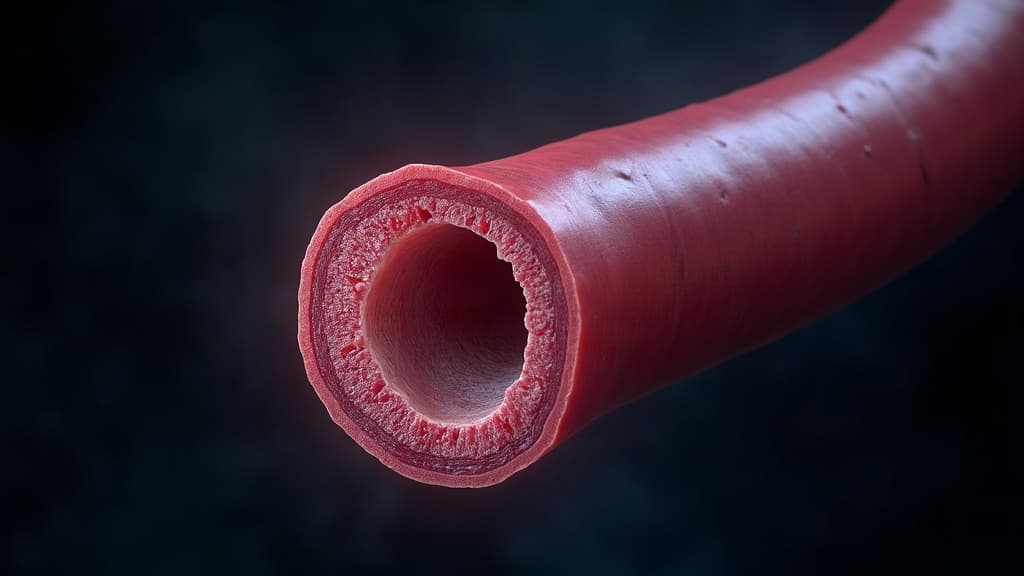
Every other seemingly healthy adult already shows arterial plaque
A detective looks for plaque, not only a SCORE2 number
On paper the patient looks fine. Blood pressure is acceptable, cholesterol “good enough,” no smoking. The risk score says: relax. Into that gap steps a plain question from the REACT study: what if plaque already sits in the arteries, and it simply does not hurt yet?
Teams led by Henning Bundgaard at Rigshospitalet in Copenhagen and Borja Ibáñez at CNIC in Madrid tested that on a large sample. In the New England Journal of Medicine they report how often silent atherosclerosis appears in adults with no known atherosclerotic cardiovascular disease. The paper ran with an ESC Congress 2026 Hot Line session (DOI: 10.1056/NEJMoa2609059).
What they did
REACT-DETECT enrolled 16,808 people aged 18–70 in Denmark and Spain. Mean age: 45. Women were 51.4 percent. Nobody had previously known atherosclerotic heart or vessel disease. The investigators wanted silent disease — present on imaging, still without heart attack, stroke, or sudden death in the history.
Every participant received imaging in three territories. Three-dimensional vascular ultrasound looked for plaque in the carotid and femoral arteries. Coronary CT angiography (CCTA) examined the coronary arteries. Classic risk factors, blood markers, multi-omics samples, and retinal images were added. The result is one of the broadest databases yet assembled on early atherosclerosis.
This was not a trial of a new drug. It was a detective inventory: where the disease already sits before the clinic labels an “event.”
What the numbers show
Silent atherosclerosis was found in 57.1 percent of participants (95% CI 56.3–58.0). That is more than half of people who looked symptom-free at entry.
In the youngest stratum — ages 18–29 — plaque was present in 8.7 percent of men and 6.7 percent of women. In popular shorthand: about one in thirteen people before thirty. Prevalence then rises with age. In the 60–70 group, imaging finds disease in about nine of ten people.
In younger adults plaque more often sits peripherally and in a single territory. With age, plaque volume rises sharply and multi-territory disease becomes typical. A key screening detail: isolated coronary atherosclerosis is uncommon — at most 9.3 percent of men and 5.0 percent of women in any age stratum. Whoever has plaque in the heart usually also has it in the neck or the leg.
Sex differences are concrete too. In men, prevalence rises earlier — the pattern runs about five to ten years “ahead” of women. In women the steepest jump falls between ages 40 and 60, near the menopausal window.
Bundgaard states REACT’s aim plainly: shift primary prevention toward precision medicine based on early detection of atherosclerosis, not only on probability estimated from risk factors. Ibáñez adds the study’s idea: instead of stopping at blood pressure, cholesterol, and smoking, check whether plaque is already there.
The paradox of a “healthy” score
Classic scores — in Europe often SCORE2 and relatives — answer: what is the chance of an event? REACT answers a different question: is disease already standing in the vessel wall?
Those are not the same. Plaque does not automatically mean a heart attack. The authors do not claim that. But silent atherosclerosis links to later events independent of traditional risk factors — which is why its age- and sex-specific map matters clinically.
For a non-cardiologist reader the stake is simple. You can hold a “good” paper result and still carry material in the arteries that a risk score does not see. The detective with ultrasound and CT shows that gap without moralizing about lifestyle.
Product takeaway: ultrasound before only a chart
Territory overlap supports a practical thesis. If isolated coronary disease is rare, scanning the carotid and femoral arteries with ultrasound — faster, no radiation, easier in daily practice than CCTA — can become the first sieve. Ibáñez speaks of portable ultrasound devices that a wide range of clinicians could use from early adulthood.
Hold the fact line. The NEJM paper describes detection and a prevalence map, not proof that such screening cuts heart attacks. Phase two, REACT-PROTECT, is planned roughly for 2027–2032. Only then will the team test whether finding plaque early and intervening changes outcomes. The registry ID is NCT06692127; DETECT is backed by the Novo Nordisk Foundation (up to about EUR 23 million).
In the market, waves of portable ultrasound with AI measurement hints are already visible. REACT does not test a brand. It does supply clinical reason for why that hardware should sit in a clinic, not only on a ward. The clearer the map of “who already has plaque,” the easier it is to lay a path: ultrasound first, then a decision, optionally coronary CT, treatment of risk factors or referral. Without the map, only a SCORE chart remains.
So the TRL of this story is not “a new drug in the pharmacy.” Vascular ultrasound and CCTA are mature clinical tools. What is new is the scale of the map (over 16,000 asymptomatic adults), a clear case for imaging screening, and a product path around portable US as a first-contact standard. That is care-pathway prototype and population validation — on the TRL09 scale about 4–5, with the outcome trial still ahead.
What this means for Europe and Poland
Denmark and Spain built a shared cohort. CNIC and Rigshospitalet push a European prevention narrative: less guessing from risk factors, more direct evidence of disease. In Poland, debate over SCORE2, age cut-offs, and access to preventive cardiology returns every budget season. REACT does not clear specialist queues. It does give a hard argument that “young and symptom-free” does not mean “no plaque,” and that cheaper peripheral US may show who deserves deeper CT.
For medtech firms the stake is not another SCORE algorithm but hardware and workflow: portable ultrasound, a 3D protocol, staff training, EHR integration. For payers — when imaging screening stops being a congress curiosity and becomes a basket item. REACT-PROTECT will answer that, not the 57 percent figure alone.
How silent disease looks on imaging
Atherosclerosis builds for years in the artery wall. Plaque may grow outward or into the lumen without chest pain or breathlessness. The patient trains, works, sleeps without an alarm. Only rupture, thrombosis, or critical narrowing turns silence into an event.
So the investigators did not wait for symptoms. They hunted material in three places at once. Neck and leg are ultrasound-accessible. The heart needs CCTA — costlier, with contrast and a radiation dose. Once coronary disease almost always came packaged with peripheral disease, screening logic flipped: cheap US window first, selective deepening later.
That matters for care-pathway TRL. You need not wait for a new blood marker to state a product thesis. You need a standardized 3D protocol, read quality, and a threshold for onward referral. REACT-DETECT delivers a prevalence map; it does not yet deliver a ready reimbursement algorithm.
What remains on the SCORE2 side
Risk scores will not leave the clinic after one NEJM paper. They still organize talk about blood pressure, lipids, diabetes, and smoking. REACT does not call those factors useless. It shows their blind spot: disease already in the wall before the score labels the patient “high risk.”
For a family doctor the tension is daily. Limited minutes, limited cardiology access, a patient who wants either zero or an alarm. Imaging moves the talk from an abstract percent to a concrete: plaque is visible here. It also opens overdiagnosis risk — treating people who would have lived quietly with a mild lesion. That is why PROTECT is necessary. Without it the detective has a strong file, but the health system has not yet ruled on net benefit.
Sex, age, one detective — three rhythms
REACT does not give one curve for everyone. Men accumulate plaque earlier. Women catch up in midlife as the hormonal backdrop changes. This is not an estrogen essay; it is an empirical pattern from balanced age strata. Screening that starts too late in men or ignores the jump in women after forty will repeat the mistakes of scores built mainly on later events.
For device and pathway designers the brief is simple: the protocol must work for a young adult with a low SCORE and for someone near menopause with “medium” paper risk. Portable ultrasound without training and clear referral thresholds only multiplies chaos.
Limits this article does not cross
We do not transplant Denmark–Spain percentages onto a Polish county clinic as a ready indicator. We do not call portable US an “EU-approved standard” on the strength of this paper. We do not promise fewer deaths. We do not scrap CT — CCTA stays in the algorithm as the coronary layer, only less often as the first sieve.
We leave the fact: in a large, carefully stratified cohort without known ASCVD, more than half already had plaque on imaging, disease began early, and it rarely sat only in the heart. The rest is a research and product track, not an ad.
The detective closes the file — for now
REACT-DETECT shows that silent atherosclerosis starts early, grows differently with age in women and men, rarely stays only in the heart, and can be seen before the patient earns a “heart disease” label. That is strong material for changing the language of prevention: from risk estimation alone to evidence that plaque is present.
What the paper does not do: promise that clinic ultrasound will save a specific life; erase the sense of treating blood pressure and lipids; map Denmark–Spain one-to-one onto Poland without local data. It does leave a clear track for the next phase and for hardware that looks for disease where the risk score stays silent.
Sources: Bundgaard H. et al., N. Engl. J. Med. 2026, DOI 10.1056/NEJMoa2609059; ClinicalTrials.gov NCT06692127; ScienceDaily / ESC 2026 materials (Bundgaard, Ibáñez quotes).
Comments· 0
No comments yet. Be the first.