Base editing was winning the race. Then it met a gene it can't fix
Two editors, one gene
In one corner of the ring stands an editor that can swap a single letter of DNA. In the other, a “search-and-replace” machine that rewrites an entire stretch of a gene from scratch. Both tools came out of the same laboratory. For years, the first one led.
Until it met a gene it couldn't fix.
The gene is called ATP1A3. It encodes the sodium-potassium pump — the molecular machinery that keeps neurons alive. Imagine a bilge pump on a ship that throws water overboard. This one does the same with ions: it pumps sodium out of the cell, pulls potassium in, millions of times a second. Without it, the neuron cannot breathe.
A mistake in a single letter of this gene causes alternating hemiplegia of childhood (AHC): a disease that appears in the first eighteen months of life and has no treatment. Parents usually learn about it when their months-old child has its first attack and half of its body suddenly refuses to obey. Then come painful muscle spasms and epileptic seizures. Frequency: one case in a million. Three mutations (D801N, E815K, and G947R) account for over 65 percent of cases.
The pump is damaged insidiously. The mutation does not switch the gene off. It makes the faulty protein actively sabotage the healthy one. This is a dominant-negative effect. And it decided the outcome of the race.
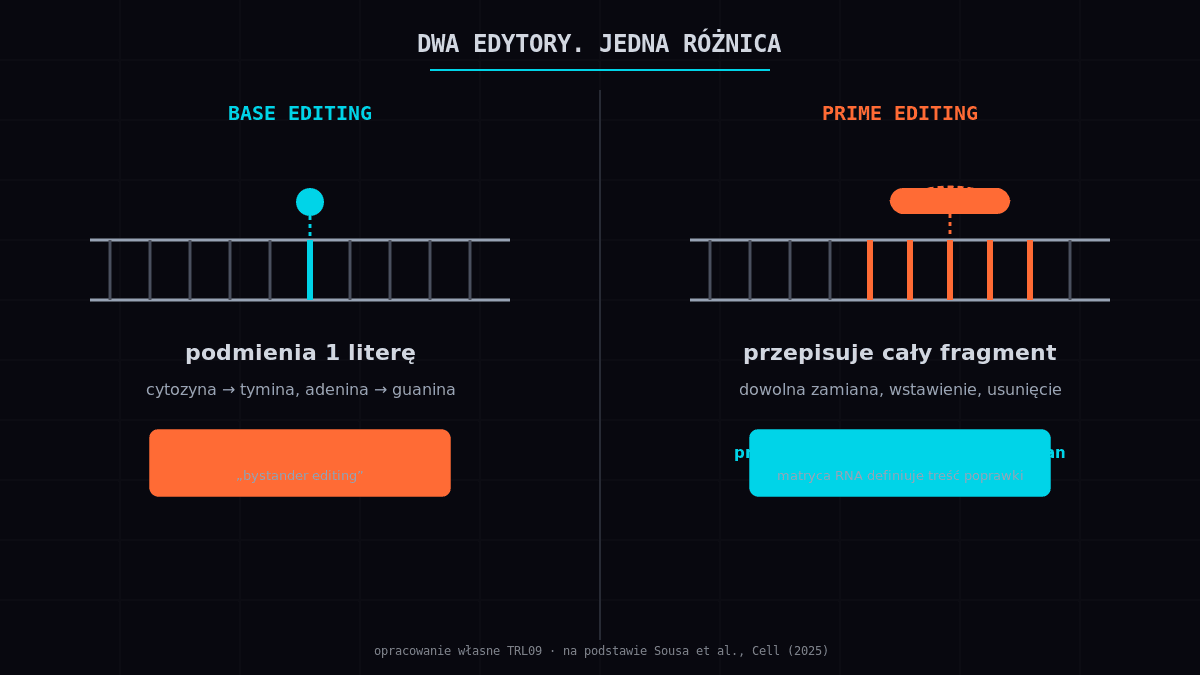
Rys. 1. Dwa edytory, jedna różnica. Base editing (po lewej) podmienia pojedynczą literę DNA, ryzykując przypadkowe zmiany sąsiednich liter. Prime editing (po prawej) przepisuje cały fragment według matrycy RNA. Schemat własny na podstawie: Sousa A. A. et al., Cell (2025), DOI: 10.1016/j.cell.2025.06.038.
Round one: base editing leads
Base editing was born in 2016 in David Liu's laboratory at the Broad Institute in Cambridge. Instead of cutting both strands of DNA, as classic CRISPR does, it uses an enzyme that simply swaps one nitrogenous base: cytosine to thymine, adenine to guanine. No breaks, no accidental rejoinings.
It is a proofreader that fixes a typo. It doesn't cut the page or paste in a new one. It swaps one letter for another.
January 2025 looked like a knockout. Two teams published results in Nature Medicine that looked like a preview of a cure.
In Basel, the team of Botond Roska and Bence György fixed, in the eyes of monkeys, the most common mutation causing Stargardt disease, an inherited blindness. An adenine editor packaged into two viral vectors corrected the gene in 75 percent of cones and 87 percent of retinal pigment epithelium cells. With no detectable off-target edits.
In the same week, a second team — Sonia Vallabh, Eric Minikel, and David Liu himself — showed that a base editor extends the lives of mice with a human form of prion disease. One intravenous injection: 37 percent of cells corrected, toxic protein levels cut in half, lifespan extended by 52 percent.
Base editing was simpler, smaller, faster. It already had patients in clinical trials. The race looked settled.
Round two: prime editing responds
There was just one catch. Base editing can make only four of the twelve possible DNA letter swaps. AHC theoretically didn't have to worry about that. Its three most common mutations happen to be swaps that an adenine editor can fix.
Theoretically.
When Liu's team tried, it hit a wall biologists call “bystander editing.” The editor swapped not only the diseased letter but also neighboring, healthy ones. Like a surgeon who, while stitching one wound, accidentally severs the vessel next to it. Of the five AHC mutations, only one could be fixed cleanly. Four ended in new mutations that hadn't existed before.
Prime editing, three years younger (from 2019), doesn't have this problem. Instead of a deaminase it uses a reverse transcriptase: an enzyme that reads a template and transcribes exactly what was programmed. Any swap, insertion, deletion. “Search and replace” at genome scale.
The mechanism is clever. The editor receives a short RNA instruction containing two elements: an address in the genome and the content of the correction. The protein reaches the address, nicks one strand of DNA, and then rewrites it letter by letter according to the attached template.
The team programmed prime editors for all five AHC mutations. In stem cells taken from sick children, it corrected 43 to 90 percent of faulty alleles. For comparison: base editing solved one mutation out of five.
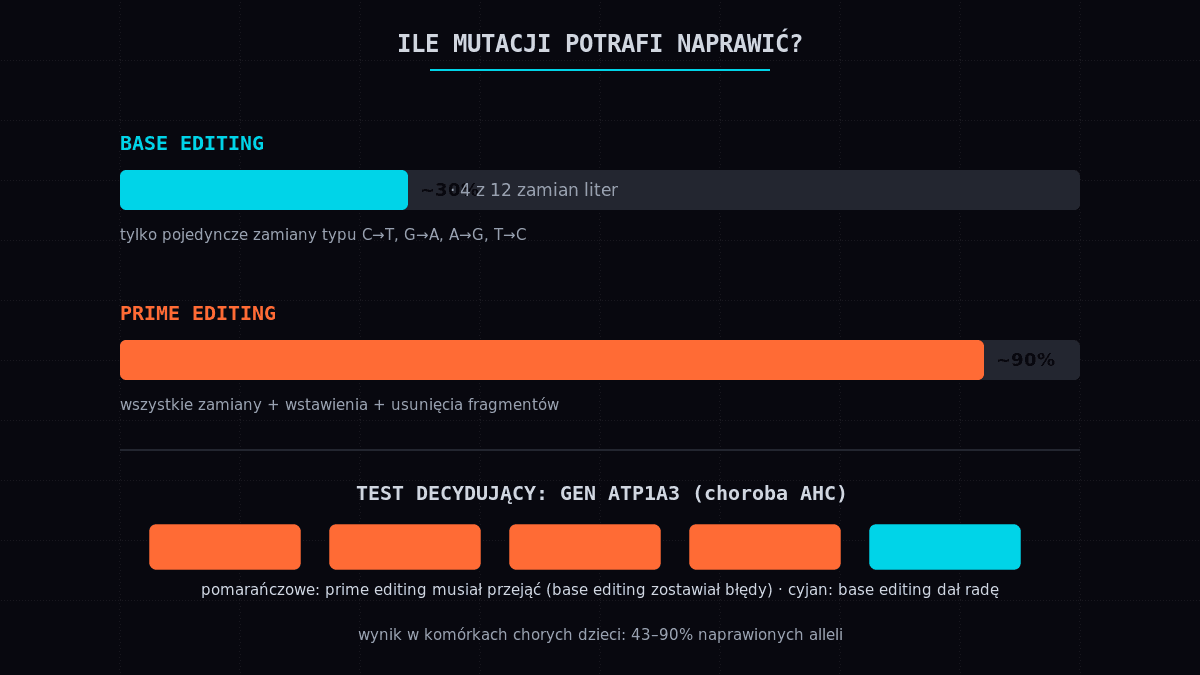
Rys. 2. Zasięg obu narzędzi. Base editing naprawia około 30% mutacji (4 z 12 zamian liter); prime editing niemal 90% (wszystkie zamiany plus wstawienia i usunięcia). W genie ATP1A3 prime editing musiał przejąć 4 z 5 mutacji. Schemat własny na podstawie: Sousa A. A. et al., Cell (2025), DOI: 10.1016/j.cell.2025.06.038.
Round three: brain, mouse, and fourfold longer life
One question remained, and it weighed the most. Could it be done in a living brain?
The prime editor is too big to fit in a single viral vector. The team split it into two halves and packaged it into two AAV9 viruses. An injection into the cerebrospinal fluid of newborn mice. A dose lower than in the approved drug Zolgensma.
The result, published in Cell in July 2025: up to 48 percent of DNA corrected in the cerebral cortex, 73 percent of mRNA corrected. Sodium-potassium pump activity restored. Seizures subsided, motor skills and cognitive function improved.
And the most important number concerns life itself. Males with the D801N mutation lived a median of 13 weeks. After editing, 56 percent survived to 52 weeks — the study's endpoint. Females: from 25 weeks to over 52. A fourfold extension of life.
This is the first time prime editing has rescued a neurological disease in a living animal.
The team also checked whether the editor left traces off-target. It scanned hundreds of potential sites in the genome and found no clinically significant edits. To boost efficiency, it added one more trick: it temporarily disabled the DNA mismatch-repair machinery that normally rejects the corrections introduced by the editor. Thanks to that, the edit held more firmly.
There is one more detail in this story that explains why the simple solution never worked. Someone earlier tried to cure AHC the old-fashioned way: by delivering an extra, healthy copy of the ATP1A3 gene to the brain. Classic gene therapy. It didn't work.
Precisely because the disease is dominant-negative: the faulty protein kept sabotaging the healthy one. You can't add a good copy. You have to fix the bad one.
A race that isn't over yet
Who's leading? It depends on which finish line you're asking about.
Base editing is closer to the clinic. Beam Therapeutics, founded by Liu, is testing a base editor in sickle-cell anemia. Verve Therapeutics is giving it to patients with familial hypercholesterolemia; that was the first base edit ever made inside a human body. The first approved gene-editing drug is already on the shelf too: Casgevy, based on the older CRISPR that cuts DNA. Proof that genome editing as a therapy works at all.
Prime editing wins where base editing doesn't even start: in scope. It can fix almost any of the more than 75,000 known disease-causing mutations, not just single swaps. Its first clinical trial, in children with chronic granulomatous disease, is already underway. It's an ex vivo edit: cells are taken out of the body, corrected in a test tube, and given back.
The real arena is delivery. Both editors barely fit into viral vectors, and prime editing, being larger, suffers more. The alternative is lipid nanoparticles — the same ones that carry mRNA vaccines. And that's where a quiet, second round of the race is being fought.
So: base editing leads in the hospital, prime editing leads in the textbook. The only certain outcome of the duel is this: the patient doesn't have to choose. They need a tool that fixes their specific mutation. Sometimes that means swapping one letter. Sometimes rewriting a whole stretch.
The second battle: how to deliver the editor
Editor biology is only half the race. The other half is delivering them to the right cells. And there an equally fierce rivalry is playing out.
There are two strategies. The first: ex vivo. Stem cells are taken out of the patient's body, corrected in a test tube, and given back. That's how Beam's sickle-cell trial works and the first prime-editing attempt in children with granulomatous disease. Advantage: full control, easy to check what was edited. Disadvantage: cost. Cell therapy today runs to millions of dollars per patient, plus preparatory chemotherapy.
The second: in vivo. One injection, and the editor goes straight to the organ, as in Verve's cholesterol trials or the AHC mouse-brain experiment. It's the only route for diseases of the brain and heart, where cells can't be taken out. But the risk rises: an editor given once stays forever.
And then the choice of vehicle. The AAV virus, the same one that carries Zolgensma, enters cells effectively, but after a single dose the body builds immunity against it. The dose cannot be repeated. Lipid nanoparticles, known from mRNA vaccines, can be injected repeatedly, but they degrade faster and home in on specific tissues less well.
Every team is betting on a different horse. And it's this race, more than the biology of the editors themselves, that will decide how many of these therapies reach patients and how many stay in the lab.
Poland: an engine in RNA, not in editing
Poland's footprint in this story is indirect. And that is the point.
Prime editing stands or falls on delivery: how to get the editor into a specific tissue without harming the rest of the body. That's a problem of lipid nanoparticles and mRNA chemistry, not of editing itself. And here Poland's competencies are real: centers working on RNA and LNPs in Warsaw, Poznań, and Gdańsk have spent recent years building expertise through vaccines and RNA therapies. Add to that PolTREG from Gdańsk, a stock-market-listed company developing cell therapy with regulatory T cells, proving that advanced clinical research in advanced therapies is possible in Poland.
What Poland doesn't have isn't worth pretending: there is no Polish company that edits genes. There is scientific infrastructure (IIMCB in Warsaw, IBB PAN), but no path from editor to patient.
This is not a verdict. It's a gap visible to the naked eye. Editor delivery is exactly the layer where Poland has an edge and the rest of the world is only just building it. The Medical Research Agency funds non-commercial clinical trials. The NCN gives grants for basic research. FENG (EU funds) for technology transfer.
Whoever first combines Polish RNA chemistry with a gene editor will play in the next round of this race. And that round is starting now. In five years, gene editing will be the standard of care for monogenic diseases, just as targeted therapies are in oncology today. Poland can become the supplier of the layer that decides it: delivery. Or a passive importer of ready-made therapies at millions of dollars per patient. The choice is being made now.
Sources
- Sousa A. A., Terrey M., Liu D. R. et al., In vivo prime editing rescues alternating hemiplegia of childhood in mice, Cell (2025). DOI: 10.1016/j.cell.2025.06.038
- Muller A., Roska B., György B. et al., High-efficiency base editing in the retina in primates and human tissues, Nature Medicine (2025). DOI: 10.1038/s41591-024-03422-8
- An M., Vallabh S. M., Minikel E. V., Liu D. R. et al., In vivo base editing extends lifespan of a humanized mouse model of prion disease, Nature Medicine (2025). DOI: 10.1038/s41591-024-03466-w
Comments· 0
No comments yet. Be the first.