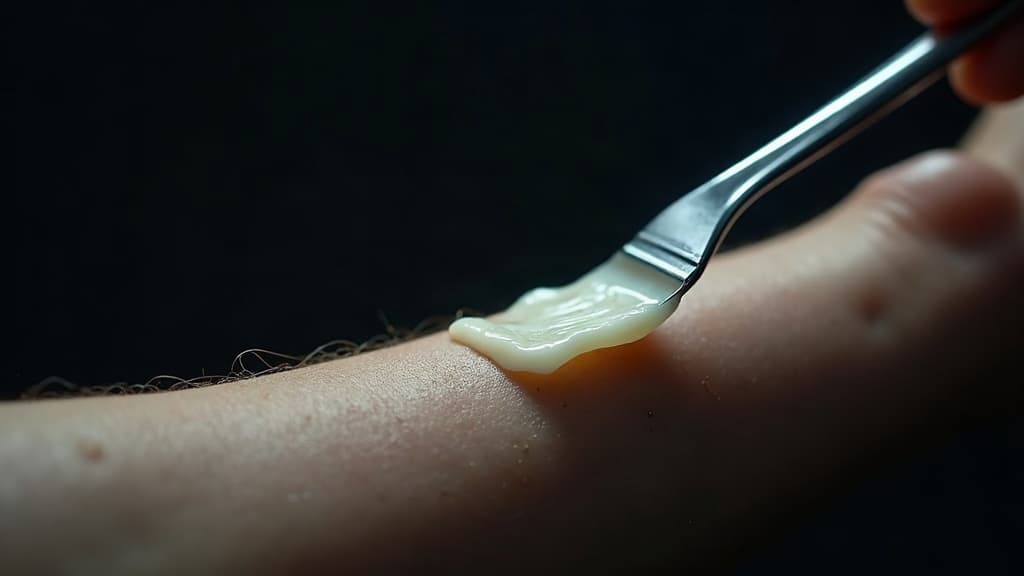
An ointment clears aged-skin cells that slow healing
Five days of ointment on the skin
In Daniel S. Roh’s lab at Boston University, the skin of old mice gets a simple protocol. For five days someone paints it with ABT-263 — a molecule previously known mostly from pills and infusions. Then the researchers make small wounds and count which ones close by day 24.
The result is concrete. Among mice after topical ABT-263, about 80 percent reach full wound closure. Among aged controls without the drug — about 56 percent. This is not a “face-rejuvenating cream.” It is a test of whether clearing old, damaged cells before a wound appears prepares tissue to repair.
The paper appeared in Aging (DOI: 10.18632/aging.206165). Authors including Maria Shvedova, Rex Jeya Rajkumar Samdavid Thanapaul, and Daniel S. Roh write explicitly about a preoperative strategy: clean the skin of “sleeping but toxic” cells, and only then cut.
What sits in the skin and will not leave
With age, senescent cells accumulate in tissues. They no longer divide, but they also do not die. They stay in the skin and release signals that sustain inflammation and spoil repair. This is not one “bad cell.” It is the background on which a wound in an older person heals more slowly than in a young one.
Clinicians know the picture from the wards. A pressure sore, a post-amputation wound, an incision after joint replacement — in an 80-year-old it closes differently than in a 40-year-old. Part of the difference is circulation, nutrition, diabetes, medicines. Part is the local biology of skin that, over years, loses the flexibility of its repair program.
ABT-263 belongs to senolytics. It selectively kills cells that have entered senescence and largely leaves healthier cells alone — at least in principle. The drug was studied mainly as systemic therapy. Here Roh’s team changes the route: ointment instead of a pill.
The experiment used 24-month-old mice — old on the rodent scale. After five days of topical ABT-263, skin shows lower expression of senescence markers p16 and p21. There are also fewer SA-β-gal–positive and p21-positive cells versus DMSO controls. The effect mainly concerns aged skin. In young animals the same protocol does not produce comparable clearance — because there is less to clear at that scale.
Laboratory: ointment first, then the scalpel
The protocol sounds like a pre-op instruction, except the protagonist is a mouse. Five days of application. Then marker readout. Then a wound. Then a healing curve.
That order matters. In many wound studies a drug is tested after injury: a dressing, a gel, an injection into the wound edge. Roh flips the clock. First the tissue is prepared, then the injury is made. The hypothesis: skin without excess senescent cells starts repair from a better position.
RNA-seq of skin after ABT-263 shows a prompt rise in genes tied to repair pathways: hemostasis, inflammation, proliferation, angiogenesis, collagen synthesis, extracellular-matrix organization. That matters, because a drop in p16/p21 alone could be empty molecular cosmetics. Here the tissue switches into a “prepare to build” program.
Collagen gives skin strength. New vessels bring oxygen and nutrients to the place that must close. When those programs turn on earlier, the healing curve has something to accelerate with.
There is also an effect that sounds like a warning. ABT-263 temporarily increases inflammatory activity and macrophage infiltration. Chronic inflammation harms healing. A short, controlled inflammatory pulse is nonetheless a normal early stage of wound repair. The authors suggest that this burst helps “wake” regenerative machinery before a cut appears.
In the ScienceDaily account the team stresses the preoperative angle: a topical senolytic as skin prep for a planned injury. That is a different story from “we will fix the wound you already have.” First cleaning, then injury, then faster closure.
Why ointment, not a pill
Systemic navitoclax (ABT-263) has known toxicity, including thrombocytopenia risk. Local delivery is therefore not only a lab convenience. It is an attempt to limit whole-body exposure.
For the market that matters. In longevity talk, senolytics often look like daily pills. Dermatosurgery and perioperative care need tools with a short window: a few days before a planned cut, then stop. If the path works in people, the buyer will not be a “longevity customer at the pharmacy,” but a hospital, a chronic-wound clinic, or a pre-op protocol.
Competition is already in the field: growth-factor dressings, negative-pressure therapy, antisepsis, skin grafts, other senolytics and senomorphics. ABT-263’s edge in this paper is not a magic scar cream. It is a sequence hypothesis: clear senescence before a wound, not only after it.
Commercially it looks like a procedural product, not lifestyle. A procedure has a date, a dose, and a checklist. That is easier to write into reimbursement and a ward protocol than an “anti-aging cream” everyone hears differently.
What ABT-263 does inside the cell
ABT-263 inhibits BCL-2–family proteins that help cells avoid apoptosis. Senescent cells often survive thanks to such “death brakes.” When the brake releases, some of them enter programmed death. Hence senolytic: it does not repair the cell; it removes it.
In skin after topical dosing, senescence markers fall and — as the authors show — remodeling genes activate in parallel. That joins two layers of the story. Layer one: cleanup. Layer two: a build signal. Without the second layer the paper would only be about the count of SA-β-gal blue spots. With it, it becomes about tissue readiness for a wound.
Macrophages that arrive after treatment are not only “inflammation to strike out.” In healing they help clear debris and coordinate later repair phases. The clinical question is how long that influx should last and when it becomes harmful. In mice Roh’s team sees a transient, beneficial effect on the closure curve. In humans that must be measured separately.
Planned wound versus a wound that already exists
The paper’s strongest angle is the planned wound: surgery, biopsy, elective procedure. Then you can paint the skin for several days before the scalpel. Harder is a wound that already exists — a pressure sore, an ulcer, a diabetic foot. There is no luxury of “clean first, then make the wound.” There a drug would have to act on tissue around active damage, in a different microenvironment, often with infection and ischemia.
So an honest product narrative splits indications. Indication A: prep before a planned cut in older people. Indication B: treatment of chronic wounds — a separate, harder path this paper does not close. Confusing A with B is a classic overclaim shortcut.
Fact boundary: a mouse is not a patient
The study is murine. There is no proof that the same ointment will speed healing in a 70-year-old after joint replacement or in someone with a diabetic foot. The vehicle, dose, and safe window for human skin are unknown. It is also unknown whether a short inflammatory burst in people will stay “useful,” or tip into infection or scarring risk.
Senescent cells also have physiological roles. Total elimination is not a goal in itself. The paper shows marker reduction and better wound closure in old mice, not a revolution in geriatrics.
TRL for this story is roughly 2–3: a live animal model, a clear protocol, no human clinical trial. For an investor that is a direction signal, not a shelf product. For a clinician — an interesting mechanism that needs translation.
Two marketing layers must also be separated. First: “we reverse skin aging.” Second: “we prepare aged skin for a planned injury.” Roh’s paper defends the second. The first would abuse the data.
What this means for medtech
If topical senolytics enter practice, they will change the checklist before a cut. Today skin is washed, shaved, sometimes covered with antibiotic. Tomorrow — hypothetically — a short “clearance” of cells that spoil the start of repair may be added.
That also raises a marker question. Whom to qualify? Is calendar age enough, or do we need a biological age readout of skin, a biopsy, or a noninvasive p16/p21 trace? Roh’s paper does not solve clinical logistics. It shows that local pharmacology alone can switch aged skin into a readiness mode.
For Poland and Europe the topic fits aging societies and rising chronic-wound costs. No Polish hero is required in the abstract to see the stake: longer hospital stays, pressure sores, post-amputation wounds, slower healing after orthopedics. Every day of faster closure has a price in bed-days and complications.
Around senolytics a market of promises has already grown. Some firms pitch systemic longevity. The Boston paper is more modest and therefore more interesting for medtech: a narrow indication, a local route, a measurable endpoint (wound-closure curve), and a clear species limit.
The laboratory closes the protocol
Roh’s team does not promise a miracle. It shows a sequence: five days of topical ABT-263 → fewer senescence markers → an inflammatory pulse and repair genes → faster wound closure in old mice. About 80 percent full healing by day 24 versus about 56 percent without the drug is a difference you can tell without marketing shout.
The next step is not literary. A human-skin formulation, local safety, pharmacokinetics, and only then trials in patients before planned procedures. Until that exists, ABT-263 on skin remains a laboratory tool — with a clear, practical dream: prepare aged skin for a wound before the scalpel appears at all.
Sources: Shvedova et al., Aging, DOI 10.18632/aging.206165; EuropePMC abstract; ScienceDaily 2026-09-22.
Comments· 0
No comments yet. Be the first.