AI versus superbugs. 40 peptides, 25 hits
In 1928, Alexander Fleming returned from vacation and found bacteria-killing mold in a forgotten Petri dish. For the next 40 years, humanity searched the soil, oceans and jungles for the next natural antibiotics. The last new class, lipopeptides, was discovered in 1987. Since then: drought.
Meanwhile, antibiotic resistance (AMR) has become one of the ten greatest threats to public health according to WHO. 1.27 million deaths per year directly from drug-resistant infections. By 2050, this number could rise to 10 million, surpassing cancer deaths. The problem is not that we are not looking. The problem is that we have been searching the same way for a hundred years: extracting compounds from nature and testing them one by one.
Yeji Wang's team from Shandong University has just shown that there is no need to search. Just generate. Their pipeline combines a diffusion model (the same architecture behind the image generators) with molecular dynamics simulations. The model does not search databases of existing peptides. Does not modify known sequences. It designs from scratch, amino acid by amino acid, guided only by physicochemical constraints: charge, hydrophobicity, amphipathic moment.
This is a fundamental difference in philosophy. Previous approaches to antimicrobial peptide (AMP) discovery have involved screening libraries (natural or synthetic) and testing them one by one. Wang's model generates candidates that do not exist in nature and are unlike anything that has ever evolved. There is no coincidence here. No luck. There is a calculation.
The pipeline works in two stages. First, a diffusion model trained on known AMP sequences generates hundreds of candidates by gradually denoising random vectors in the latent space toward sequences with the desired properties (the reverse process of diffusion, hence the name). Molecular dynamics simulations then filter the generated peptides for stability in the lipid membrane, discarding those that do not form a stable ion channel (the mechanism of action of most AMPs). This second sieve is crucial: many peptides look good on paper, but curl up into inactive balls when they come into contact with the membrane. MD eliminates these cases before the wet synthesis step, saving weeks of laboratory work.
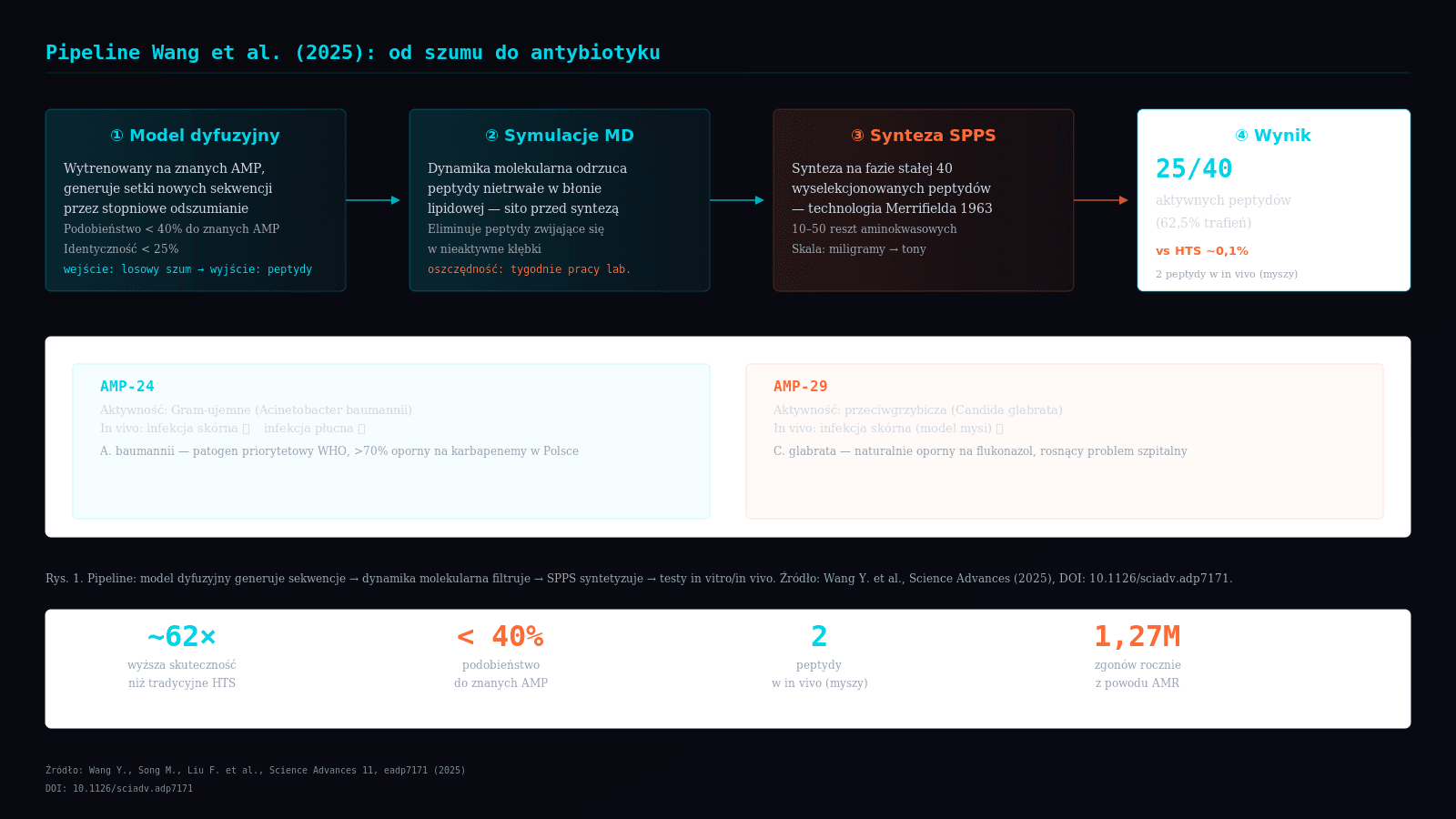
Fig. 1. Wang et al. (2025) pipeline: diffusion model → MD simulations → SPPS synthesis → results. 25 out of 40 peptides active. AMP-24 effective against A. baumannii, AMP-29 against C. glabrata. Source: Wang Y. et al., Science Advances 11, eadp7171 (2025).
Of the 40 peptides synthesized for experimental validation, 25 showed antibacterial or antifungal activity. Efficiency: 62.5%. For comparison, traditional high-throughput search (HTS) yields hits of 0.1-1%. The difference is not quantitative. She is categorical.
Two peptides have entered in vivo testing in mouse models. AMP-24 eliminates Acinetobacter baumannii, a Gram-negative bacillus that has been at the top of the WHO list of priority pathogens. It works in both cutaneous and pulmonary infection models. The latter is much more difficult: the lungs constitute a pharmacokinetic barrier that most AMPs do not overcome due to the mucus trap and proteolytic enzymes.
AMP-29 has selective antifungal activity against Candida glabrata. This yeast is naturally resistant to fluconazole, which is a growing problem in hospital infections in immunocompromised patients. Wang's model is one of the first to successfully generate antifungal peptides. Most previous AI systems focused solely on bacteria.
Importantly: the peptides designed by the model have low sequence similarity to known AMPs (similarity below 40%, identity below 25%). These are not variations on a theme. These are new structures that nature could evolve in a few million years - if it had that much time.
Why the economics of antibiotics are more difficult than biology
The antibiotic market is economically broken. The cost of bringing a new antibiotic to market is estimated at $1–1.5 billion. Revenues from its sales: 50-100 million per year. Any new antibiotic is, by definition, a drug of last resort. It is used sparingly so as not to develop resistance. The more effective the drug, the less often it is used. The less frequently it is used, the less it earns. An equation that cannot be completed in any spreadsheet.
That's why big pharma has left the sector. Novartis closed its antibiotics division in 2018. Sanofi in 2019. AstraZeneca sold its antibiotics portfolio to Pfizer. Small biotechnology companies remain. Achaogen: FDA approval for plazomicin in 2018, bankruptcy in 2019. Melinta: bankruptcy in 2019. Tetraphase: sold for a fraction of value. They all had working products. None had a working business model.
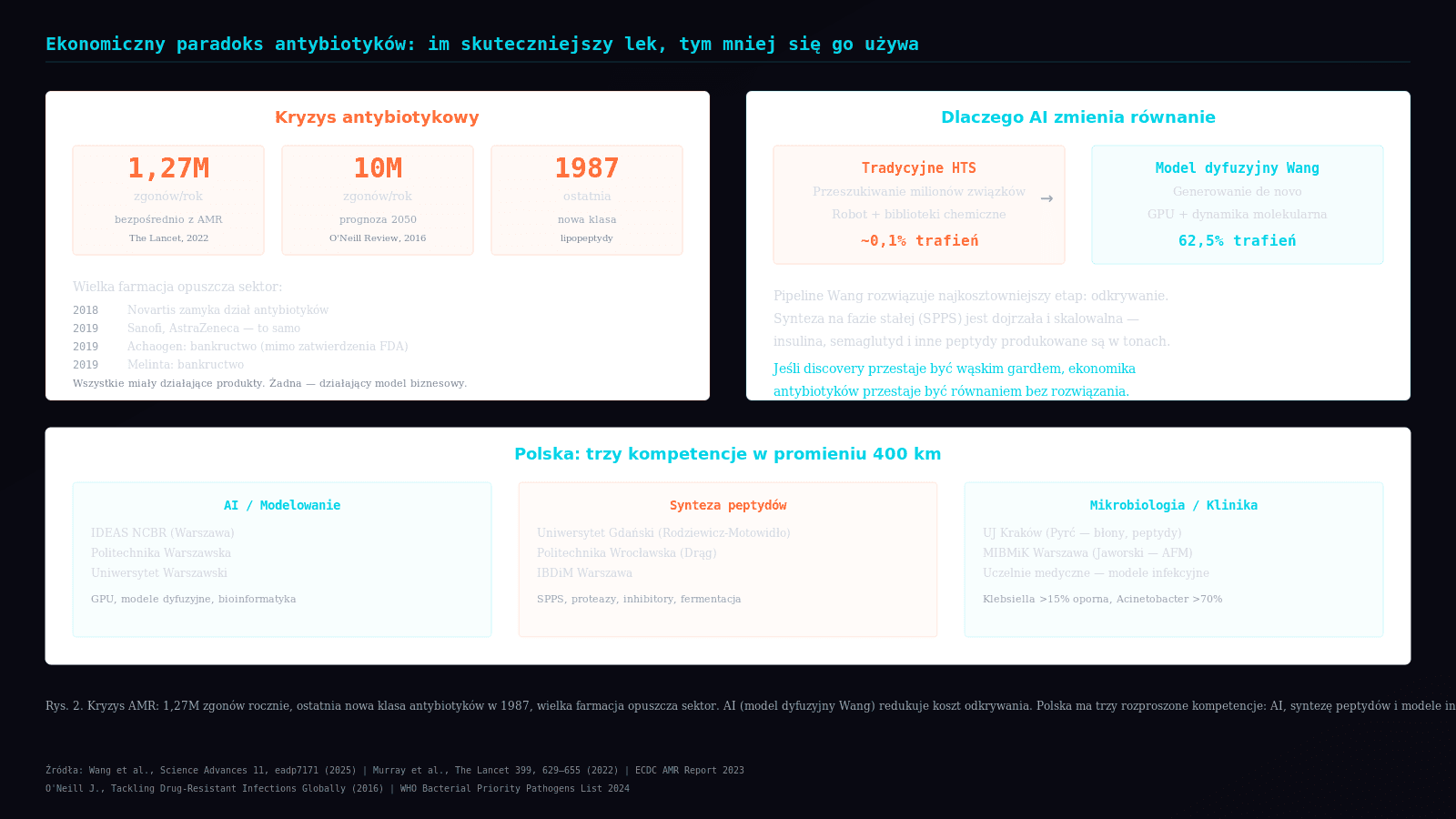
Fig. 2. The AMR crisis: 1.27M deaths/year, last new antibiotic class in 1987, big pharma exiting. Wang's diffusion model: 62.5% hit rate vs HTS 0.1%. Poland: three competencies within 400 km. Sources: Wang et al. (2025), The Lancet (2022), ECDC (2024), O'Neill Review (2016).
In this context, Wang's model does not address the economics of antibiotics as a category. However, it solves its most expensive stage: discovery. The cost of synthesizing and testing 40 peptides in an academic laboratory is several tens of thousands of dollars. In the pharmaceutical industry, the same experiment (with infrastructure, robotics, and compound libraries) costs hundreds of thousands. The diffusion model shifts the focus from the "find the needle in the haystack" logic to the "generate the needle you want" logic.
If the discovery stage ceases to be a bottleneck, the development stage remains. And the development of peptides is cheaper than the development of small molecules. Solid phase synthesis (SPPS) is a mature technology, mastered in the 1960s by Merrifield (Nobel 1984). Insulin, semaglutide (Ozempic), liraglutide: all produced on a tonne-per-year scale using SPPS or related methods. Antimicrobial peptides are not chemically different from these drugs. They are short chains of amino acids (10–50 residues), but optimized for disrupting bacterial membranes instead of regulating glucose levels. There is also the challenge of toxicity: AMPs must kill bacteria, not human cells (an optimization problem, not a fundamental one).
Poland: between generics and peptides
Poland is one of the largest producers of antibiotics in Central and Eastern Europe - but only generic ones. Polpharma in Starogard Gdański, Adamed in Pabianice, Polfa Tarchomin: all produce amoxicillin, ciprofloxacin and clarithromycin. None of them conducts their own research on new classes of antibiotics.
At the same time, Poland has a growing problem with resistance. According to ECDC data for 2023, the percentage of Klebsiella pneumoniae strains resistant to carbapenems in Poland exceeds 15% (above the EU average). Acinetobacter baumannii (the same pathogen against which AMP-24 acts) is resistant to carbapenems in over 70% of isolates from Polish hospitals. Intensive care units in Poland more often than in Germany or the Netherlands encounter a situation in which there is nothing left to treat.
There is competence in laboratories. Sylwia Rodziewicz-Motowidło's team at the University of Gdańsk studies peptides that penetrate cell membranes and their use as drug carriers. Her group has published over a dozen papers over the last three years on designing peptides from non-coded amino acids that are more resistant to proteolysis than natural AMPs. Marcin Drąg at the Wrocław University of Science and Technology is one of the most frequently cited experts on proteases and inhibitor design (over 10,000 citations). His lab is developing hybrid substrate technologies that enable rapid profiling of protease specificity—the same methodology can be applied to study which bacterial proteases degrade a given AMP and how to modify the sequence to prevent it from doing so.
The Institute of Biotechnology and Antibiotics in Warsaw (the only research unit in Poland dedicated exclusively to antibiotics) has been working on optimizing fermentation and synthesis of bioactive compounds for years. At the Jagiellonian University, Krzysztof Pyrć's team studies interactions between peptides and lipid membrane rafts in the context of viral infections - knowledge directly translatable to the mechanism of action of AMPs. At the International Institute of Molecular and Cell Biology in Warsaw, Jacek Jaworski's laboratory specializes in imaging peptide-membrane interactions using plasmon resonance and atomic force microscopy.
There is a missing bridge between these islands and the global race for new AMPs. Model Wang has released the source code. Pipeline (diffusion plus molecular dynamics) can be reproduced on a GPU cluster for several dozen thousand zlotys. You don't need a BSL-3 lab, libraries of millions of compounds, or an army of medicinal chemists. Three competencies are needed: AI (IDEAS NCBR, Warsaw University of Technology, University of Warsaw), peptide synthesis (Gdańsk, Wrocław, IBDiM) and access to infection models (medical universities). All three exist within a radius of 400 kilometers.
NCBR may finance the consortium's project under the Fast Track (up to PLN 50 million). The European Funds for a Modern Economy (FENG) offer even larger budgets for projects combining AI with biotechnology. Horizon Europe regularly announces competitions for new approaches to AMR in the IHI (Innovative Health Initiative) program, with budgets of EUR 5–10 million per consortium. Poland does not have to reinvent the wheel. The diffusion model already exists, the code is open, the pipeline is described in Science Advances. It needs to be fed with Polish data and Polish clinical priorities - for example, Klebsiella pneumoniae strains from Polish hospitals, which have a different resistance profile than Chinese or American isolates. The window won't stay open forever: laboratories in China, the US and the UK are already training the next generations of these models. In two years, AMP-24 will have successors. The question is whether any of them will have a Polish name.
Sources
- Wang Y., Song M., Liu F. et al.,Artificial intelligence using a latent diffusion model enables the generation of diverse and potent antimicrobial peptides, Science Advances11, eadp7171 (2025).DOI: 10.1126/sciadv.adp7171
- Murray C.J.L. et al.,Global burden of bacterial antimicrobial resistance in 2019: a systematic analysis, The Lancet399, 629–655 (2022).DOI: 10.1016/S0140-6736(21)02724-002724-0)
- O'Neill J.,Tackling Drug-Resistant Infections Globally: Final Report and Recommendations, The Review on Antimicrobial Resistance (2016).Link
- WHO,WHO bacterial priority pathogens list, 2024, World Health Organization (2024).Link
- Chen S., Lin T., Basu R. et al.,Design of target specific peptide inhibitors using generative deep learning and molecular dynamics simulations, Nature Communications15, 2345 (2024).DOI: 10.1038/s41467-024-45766-2
- ECDC,Antimicrobial resistance in the EU/EEA — 2023 summary, European Center for Disease Prevention and Control (2024).Link
- Drąg M., Salvesen G.S.,Emerging principles in protease-based drug discovery, Nature Reviews Drug Discovery9, 690–701 (2010).DOI: 10.1038/nrd3053
Comments· 0
No comments yet. Be the first.