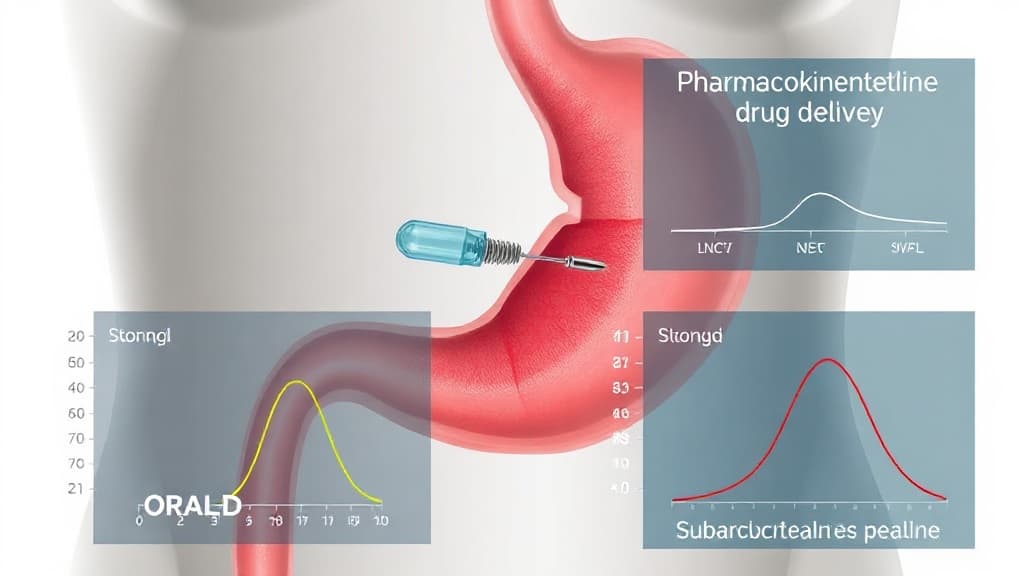
A spike instead of a syringe - BIONDD® capsule delivers biologics with 116% bioavailability
A spike instead of a syringe - BIONDD® capsule delivers biologics with 116% bioavailability
Introduction - problem by example
Imagine: in the morning, before breakfast, 280 million people around the world reach for a syringe. One of several injections a day, every day, for life. This is the reality for many diabetics who require insulin - not because medicine doesn't know what to do with it, but because the stomach is the enemy of the drug.
Insulin is a protein. All it takes is a few dozen seconds in the stomach acid and digestive enzymes for nothing to remain - or fragments that are useless to the body. The same applies to most modern biological drugs: monoclonal antibodies, GLP-1 receptor agonists (used to treat diabetes and obesity), therapeutic enzymes. The oral form of these molecules is a dream that laboratories have been trying to achieve for decades.
Chemical technology has already made some progress: Rybelsus® Novo Nordisk is the first approved oral form of a GLP-1 agonist (semaglutide). However, its bioavailability is less than one percent - such a low level of absorption that the therapeutic dose of the drug is several dozen times higher than with an injection. What would happen if, instead of helping the drug pass through the intestinal wall, we simply put it directly behind the intestinal wall?
Solution from a scientific article
This is exactly what the BIONDD® capsule does, described in a study published on May 28, 2026 inDrug Delivery and Translational Research (DOI: 10.1007/s13346-026-02157-y). The authors from Biograil ApS (Roskilde, Denmark) tested the device in dogs using liraglutide, a GLP-1 agonist drug used clinically to treat diabetes and obesity.
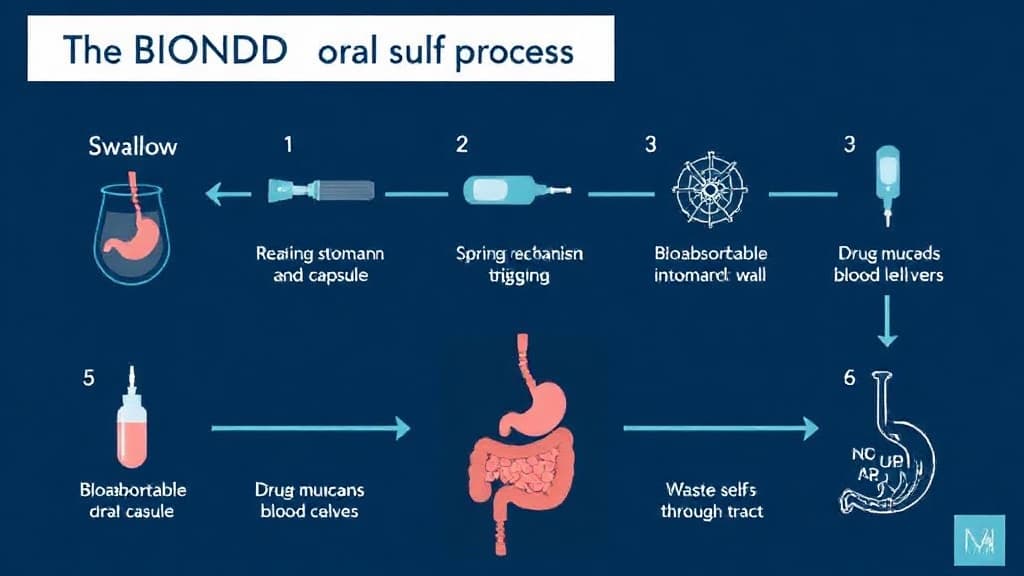
Mechanizm działania kapsułki BIONDD® (Biograil ApS) — diagram poglądowy
The mechanism is strikingly simple in description, yet advanced in engineering. The capsule is swallowed like a regular tablet. When it reaches the stomach and dissolves there, a spring mechanism is activated - it pushes the thin, biodegradable element (spike) straight into the stomach wall. The spike contains a solid drug formulation—in this study, 40% liraglutide by weight and 60% polyethylene glycol (PEG 6000). The drug is released directly into the mucosal tissue, from where it penetrates into the blood vessels of the stomach. The spike itself degrades spontaneously, the remains of the capsule pass safely through the digestive tract.
Fact: The study compared four routes of administration of liraglutide in dogs: subcutaneous injection (n=6 dogs), direct injection into the stomach wall (n=3), mechanical insertion with solid formulation (n=3), and the actual BIONDD® capsule (n=9). The relative bioavailability of the BIONDD® capsule was 116% compared to subcutaneous injection - and the pharmacokinetic parameters (time to maximum blood concentration and this maximum concentration) were in the same range as with the injection.
To give this number a scale: if we imagine that a subcutaneous injection delivers 1,000 units of the active substance to the bloodstream, Rybelsus delivers 8 - and the BIONDD® capsule provides 1,160.
Honestly about the limitations: this is still a preclinical study on animals. Dogs are not people - the anatomy and physiology of the stomach differ, and the most important question for regulators will be the repeatability of dosing after repeated use. Human trials (Phase 1) are planned; Biograil has completed pre-clinical development and has raised funding to launch, but no date has been publicly announced. The authors do not evaluate the long-term safety of daily use of the mechanism in the gastric wall. We rate TRL as:5–6: effective proof of concept in a large animal model, ready for human trials, but the road to the clinic is still ahead of the company.
Commercialization proposals
1. Oral insulin and GLP-1 agonists - a market of 280 million patients
The first and most obvious path is to replace injections in patients requiring biologics. The oral insulin market itself has been described by analysts for years as a multi-billion dollar opportunity - assuming effective delivery technology. Fact: Biograil announced cooperation with Eli Lilly & Company, one of the two largest producers of insulin and GLP-1 agonists in the world.
Speculation, warranted: if Phase 1 in humans confirms a similar pharmacokinetic profile, BIONDD® capsule becomes a serious competitor not only to injections, but also to Rybelsus - at a biologically correct dose and without the need for absorption aids. Horizon: 5–8 years until potential registration for the first indication. Main barrier: mechanical repeatability in daily use and regulatory pathway for the device+drug combination requiring double assessment (FDA/EMA).
2. License platform - conversion of injectable drugs to oral form
Biograil does not have to develop each medicine itself. The licensing model - i.e. providing technology to companies with a portfolio of expensive injection preparations - is a ready-made business scheme. Analogy: just as SNAC became an ingredient in Novo Nordisk medicines, BIONDD® could become an embedded device in partner products.
Fact: Biograil has entered into talks with CSL Behring, a manufacturer of drugs from blood plasma (immunoglobulins, coagulation factors). Justified speculation: in the case of immunoglobulins previously administered intravenously or subcutaneously, switching to an oral form with comparable bioavailability would have a direct impact on the quality of life of patients and the rate of treatment compliance. Horizon: 4–7 years until the first partner products. Barrier: Each molecule requires separate pharmacological and regulatory validation.
3. Pharmacokinetic validation service by CROs
The third path, with the lowest financial entry threshold, is contract clinical research organizations (CRO). They could offer pharmaceutical companies a standardized service: examining the absorption profile of a specific molecule administered with a BIONDD® capsule - as a basis for a licensing decision or in a registration application.
Horizon: 2-4 years, after Biograil enters Phase 1. Barrier: Total dependence on the success of human trials.
Polish angle:lack of identified Polish involvement - requires further investigation. Potential entry points: Polish CROs with experience in gastroenterology research as candidates for the role of validation partner; in the area of platform licenses - biotechnology companies such as Selvita or Ryvu Therapeutics as market observers.
Sources
- Oral capsule administration of biomacromolecules that achieves bioavailability and pharmacokinetics comparable to subcutaneous injection in dogs – the BIONDD® technology — Drug Delivery and Translational Research, 2026
- BIONDD® Technology - Biograil— description of the mechanism and device
- Biograil raises EUR 8.5 million for clinical testing— press release, July 2025
- Expanding Biologics Delivery Options Via Oral Devices - Drug Delivery Leader— interview with the CEO of Biograil
Comments· 0
No comments yet. Be the first.