A fish built from salt and gelatin. The fillet that never swam
Salt that builds a fish
In winter we scatter salt on the pavement so the ice melts. In a lab in Qingdao, salt does exactly the opposite: it makes ice crystals grow — and in a carefully planned way. Xuan Zhou, a doctoral student at the Ocean University of China, watches a porous bead the size of a grain of flour under the microscope. Inside it are hundreds of microscopic caves. They will decide whether lab-grown meat ever reaches the plates of billions of people.
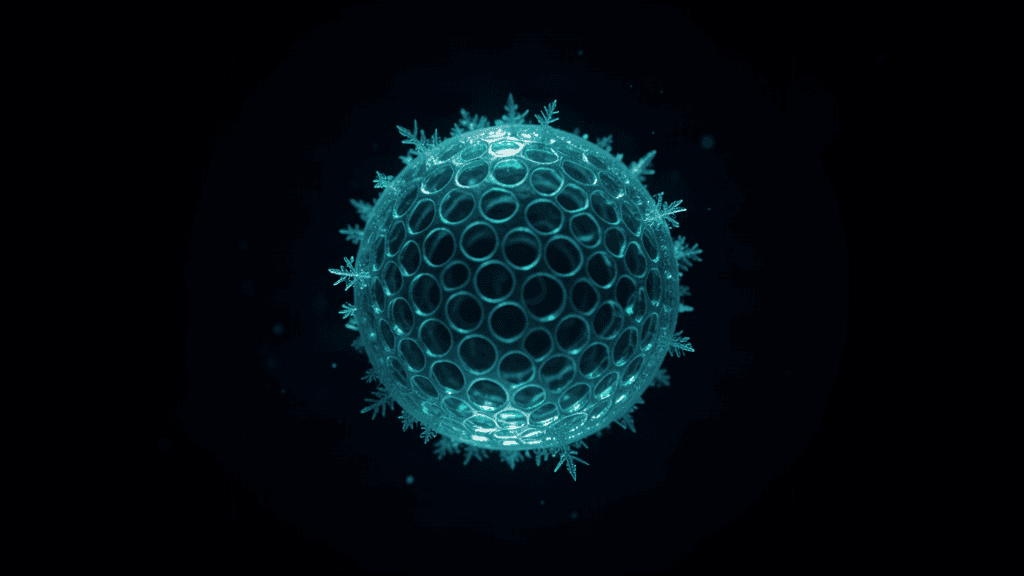
The bead is an EPM — an edible, porous microcarrier. It is made not from plastic or synthetic medical materials, but from fish gelatin: the skin, scales and bones that normally end up in the trash. In its pores grow the muscle and fat cells of the large yellow croaker — a fish that costs a fortune in China and is fished to the edge of depletion. After sixteen days, a single flask of cells becomes two and a half billion. From them, a fillet is printed.
This is not another “test-tube meat” experiment. It is an answer to the question that has blocked the entire industry for a decade.
Billions of cells with nowhere to grow
The world eats hundreds of millions of tonnes of meat and fish every year. Animal protein makes up more than 18 percent of global protein intake, and demand is growing faster than farming can keep up. Aquaculture, which was supposed to relieve the oceans, is itself a source of pollution, emissions and welfare problems. Hence the idea of cultured meat: growing muscle and fat cells in a bioreactor, without killing animals.
The first cultured-meat burger was made in 2013 in Maastricht. It cost more than a quarter of a million euros. Since then the price has dropped by two orders of magnitude; Singapore approved cultured chicken for sale in 2020, the US followed in 2023, and Israel approved cultured beef in early 2024. But one thing has not changed.
The race for a bioreactor fillet runs from Singapore to Silicon Valley. BlueNalu grows cells of the bluefin tuna — a fish whose kilogram costs thousands of dollars. Wildtype is going after salmon, Germany's Bluu Seafood after marine fish, and Singapore's Shiok Meats after shrimp. They have all hit the same wall: cells need somewhere to attach, cheaply and without poison. Whoever breaks through first wins a market analysts value at tens of billions of dollars within a decade.
Muscle cells do not grow in suspension. They are “glued” to a surface — without something to grip, they die. To grow a kilogram of meat you need billions of cells, and each one needs a place to sit. The industrial microcarriers used to culture cells in medicine contain toxic substances and are not edible. They then have to be separated from the cells — costly, and with losses.
That is the wall. It is exactly what Zhou and her team ran into.
Their first idea seemed obvious. When cells outgrow one batch of microcarriers, you simply transfer them to fresh ones — the “bead-to-bead” method, borrowed from vaccine production. It did not work. Cells died off, viability dropped, and under the microscope dead spots multiplied. They had to go back.
The rescue came in the form of an enzyme — collagenase, which gently detaches cells from gelatin. After digestion, more than 80 percent of the cells survive and can be evenly transferred to a larger vessel. That was the breakthrough moment, but only half the solution. Because one problem remained: how to give the microcarrier enough surface area for the cells to really take off.
That is where salt comes in.
A pinch of salt that sculpts a sponge
Gelatin plus the crosslinking enzyme mTG — that is the recipe for a bead. But an ordinary bead has pores in the fractions of a micrometre. A cell cannot squeeze in. Zhou discovered that simply adding table salt to the solution before freezing changes the pore architecture.
The mechanism is subtle and physical. Salt weakens the gelatin network — the Hofmeister effect, known to chemists since the nineteenth century. A weakened network releases more free water, and free water crystallizes into larger ice crystals. When the ice later melts, larger caves remain behind. Salt does not create pores directly. Salt steers the ice, and the ice sculpts the sponge.
Changing the salt concentration from zero to five percent is enough to make the pore diameter jump from 4.34 to 27.64 micrometres — a more than sixfold increase. Porosity stays above 80 percent. After soaking, the bead swells eighteenfold, and the pores stretch to as much as 70 micrometres. This microscopic sponge holds up to 128 muscle cells or 118 fat cells per particle.
And it scales. In a single production cycle, 600 grams of fish gelatin yields close to half a kilogram of microcarrier powder — in a hundred-litre reactor, not a lab dish, but an installation that can be replicated.
The numbers are brutal. From five million muscle cells — the contents of one standard flask — sixteen days later you get 2.5 billion living cells. That is a 499-fold expansion for muscle and 461-fold for fat. The harvested material yields 31 grams of microtissue, each gram containing more than 80 million cells. What is more, cells divide faster in the bioreactor than in a classic flat culture.
A fillet that never swam
The muscle and fat microtissues go into a bioink — a mixture with a touch of pea protein for viscosity and the same mTG enzyme for cohesion. A 3D printer shapes them into a fillet ten centimetres long. Steamed, it looks like fish: it browns in the Maillard reaction, binds water like real meat, and its firmness matches fillets of croaker.
The differences are where nobody expected them. The cultured fillet has 69 percent less fat and 88 percent less cholesterol than fish, along with 8.5 grams more protein per 100 grams. It retains omega-3 — including DHA at 5.99 grams per 100 grams of oil — and its essential amino acid content is 51 percent higher than the original. The fillet also has significantly less DNA, which matters for safety.
Not everything is perfect. The fillet is yellower than the natural one — the fault of the pea protein — and has more sodium, by almost 193 milligrams per 100 grams. Chewiness after cooking is slightly lower. These are problems solved by tweaking the recipe, not fundamental barriers.
The point lies elsewhere. This experiment shows it is possible to go the whole way — from fish waste through an edible scaffold to a printed fillet — without a single toxic ingredient and without any step that requires separating cells from something. The microcarrier is not a temporary scaffold to be thrown away. It is an ingredient in the final dish.
This changes the economics of the whole technology. In classic cell culture on medical scaffolds, the step of separating cells from their carrier alone can swallow a large share of the cost — and kill off some of the living cells in the process. Here that step simply disappears. The edible sponge in which the cells grew stays in the fillet and becomes part of its texture. Fewer steps, fewer losses, less money.
And the scale in question is tangible. One flask of cells, five million. Sixteen days. Two and a half billion. That is not a percentage increase — it is four and a half orders of magnitude, repeated across three independent cycles. If every industrial stage could scale like this one, cultured meat would stop being a curiosity.
Poland is fishing somewhere else
Poland is the largest poultry producer in the European Union — more than 20 percent of EU production. It also has one of the EU's largest fish-processing bases — smoked salmon, herring, sprat. Companies like Morpol (today part of Mowi) built empires on this, and Graal and King Oscar are known in every Polish port. If cultured meat ever reached Central Europe, the processing and cold-chain infrastructure is already here.
What is missing is the science to feed it. Culturing animal cells for food is a niche in Poland. The expertise is scattered: food biotechnology at SGGW in Warsaw, fisheries and aquaculture at the University of Warmia and Mazury in Olsztyn, food technology at the West Pomeranian University of Technology in Szczecin. There are people, there are laboratories, but no programme linking them into a single chain: from cell to fillet. And the raw material is at hand — Polish aquaculture produces tens of thousands of tonnes of trout and carp a year, and the fish waste from which Zhou makes microcarriers piles up in every processing plant.
The plant-based alternatives market already shows that Poles are looking for options — companies like Bezmięsny Mięsny or Dobrowolski have built recognizable brands on it. But between a pea burger and a fillet made of cells there is a technological chasm that cannot be crossed without money. NCBR and PARP fund individual projects, usually in biomedicine, not cellular agriculture. Yet this is exactly where Poland could enter the game before others do: with a ready raw-material base, infrastructure and science that lack only one thing — a shared direction.
Meanwhile the stakes are rising. The large yellow croaker — the hero of this experiment — is a symbol of the problem: a fish so valuable it is caught faster than it can replenish. If such a fish's cells could be multiplied in a reactor, the price would stop depending on how many fish are left in the sea.
That still needs two things this paper does not have: serum-free culture media, and bioreactors holding thousands of litres instead of four. Those are the next walls. But Zhou has shown that the first — the scaffold — can be broken with table salt and a little gelatin from waste.
And time is running out. The large yellow croaker, where it all began, does not have as much time as unhurried research requires. Fish are vanishing from the seas faster than science can propose an alternative. Whoever first brings the price down to the level of fish at the market will not only profit — they will relieve the oceans before it is too late.
In winter, salt melts ice on pavements. In Qingdao, salt makes ice grow, so that one day a fillet will not have to come from a fish. Let us hope we do not have to wait another thirteen years.
Sources
- Zhou X., Zheng H., Wu Y., Yin H., Mao X., Li N., Guo H., Chang Y., Jiang X., Ai Q., Xue C. — “Scalable production of muscle and adipose cell-laden microtissues using edible macroporous microcarriers for 3D printing of cultured fish fillets”, Nature Communications 16:1740 (2025).DOI: 10.1038/s41467-025-57015-1
- Ben-Arye T. et al. — “Textured soy protein scaffolds enable the generation of three-dimensional bovine skeletal muscle tissue for cell-based meat”, Nature Food 1, 210–220 (2020).DOI: 10.1038/s43016-020-0046-6
Comments· 0
No comments yet. Be the first.