
A few atoms decide whether a drug reaches the lungs or the liver. The linker paradox in nanomedicine
The same capsule, the same address
Two shipments. They look identical, go to the same sorting facility, and carry the same delivery address. One reaches the lungs. The other gets stuck in the liver.
This is not a logistics flaw. It is the result of an experiment that Dan Peer and his team at the Center for Nanoscience and Nanomedicine at Tel Aviv University described in 2025 in the journal ACS Nano. They built eleven variants of the same lipid nanoparticle, a tiny capsule that carries mRNA through the blood. The variants differed by just a few atoms hidden in the linker between the "head" and the "tails" of the lipid.
And here the contradiction appears. All eleven nanoparticles landed in the same organs. On imaging they looked almost like clones. Yet one delivered mRNA to the lungs while the rest sank into the liver.
The same distribution. A completely different effect.
Both things should not be true at once. And yet they are. That is precisely what makes this paper one of the more interesting in nanomedicine in recent months.
Millions of dollars drowned in the liver
To understand the stakes, you need to know how every mRNA-based drug works, from COVID-19 vaccines to cancer therapies. mRNA is an instruction that a cell reads and uses to produce a protein. The problem is that a naked mRNA molecule breaks down in the blood within minutes. So it is wrapped in a lipid capsule, an LNP nanoparticle, that protects the cargo and carries it into the cell.
For a decade, though, these capsules have had one predictable flaw. After intravenous injection, the vast majority end up in the liver. The liver filters the blood and traps foreign particles like a sieve, and LNPs, which carry a fatty "address" in their structure, fit that sieve perfectly.
For vaccines this is no problem. The liver is an excellent protein factory. But for therapies meant to target the lungs, kidneys, heart, or tumors, it is a fundamental problem. The entire promise of mRNA medicine comes down to one question: how do you get the capsule to where it is needed, and not to where it is easiest?
The market is already waiting. mRNA therapies beyond vaccines, from cystic fibrosis to cancer immunotherapy, are valued in the tens of billions of dollars. And whoever first solves the problem of steering a drug to a specific organ wins the whole race.
The most boring atom in the molecule
For years, scientists did one of two things with the lipid. They changed the "head," the part that binds electrically to the mRNA and determines the escape from the vesicle inside the cell. Or they changed the "tails," the long carbon chains that determine the shape and stability of the capsule.
The linker, that short fragment joining the head to the tails, they left alone. "Largely overlooked," the authors write bluntly.
Peer's team decided to see what happens when the linker itself becomes the main character. They synthesized eleven lipids with different linkers: ester, carbonate, amide, urea, and their "reverse" variants. The same backbone, the same head, the same tails. A different set of atoms in the middle.
The difference in electric charge was measurable but small. Most of the new lipids had a pKa between 5.9 and 6.5, the standard value. Two urea variants and the "reverse amide" jumped higher: 7.2 and 7.6.
And then something happened that nobody expected.
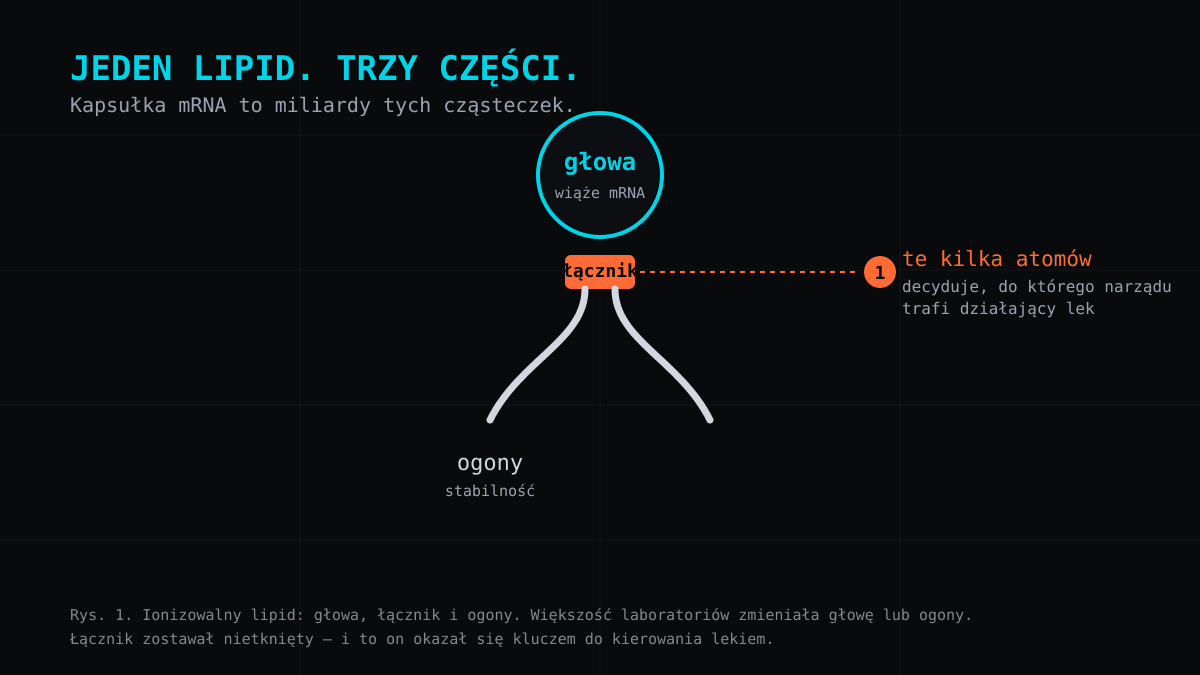
Rys. 1. Ionizowalny lipid składa się z trzech części: głowy, łącznika i ogonów. Większość laboratoriów zmieniała głowę lub ogony; łącznik zostawał nietknięty. Źródło: opracowanie własne na podstawie Naidu G.S. et al., ACS Nano (2025), DOI: 10.1021/acsnano.4c18636.
The paradox that breaks the logic
All eleven capsules were injected into mice and the usual thing was done: they checked where the particles accumulate. The result was boring. The distribution across organs was nearly identical for all variants. Liver, spleen, lungs. All eleven looked the same.
If the study had ended there, the paper would have gone in the bin. Because if the particles land in the same places, the effect should be the same.
It wasn't.
When they measured in which organs the mRNA actually produces protein, glowing and countable, the picture flipped upside down. Lipids with the urea linker and the "reverse amide" glowed in the lungs. The rest, in the liver. The correlation between pKa and lung expression was 0.84 at a significance of p=0.0006. That is not chance. That is a signal.
Here is the paradox in full glory: the same destinations, a completely different result. How is that possible?
The answer lies in the difference between where a particle lands and what it does once it gets inside. "Landing" is biodistribution, measured for decades because it is easy to see. But whether the mRNA works at all is decided one step later, inside the cell.
The cell swallows the capsule and seals it in a vesicle, an endosome, a small bag of acid. If the mRNA does not escape from there, it gets digested. And here the linker returns. Through its pKa value, it decides whether the lipid charges up electrically at the right moment and bursts the vesicle open from the inside. The linker does not change the address. It changes the key to the door.
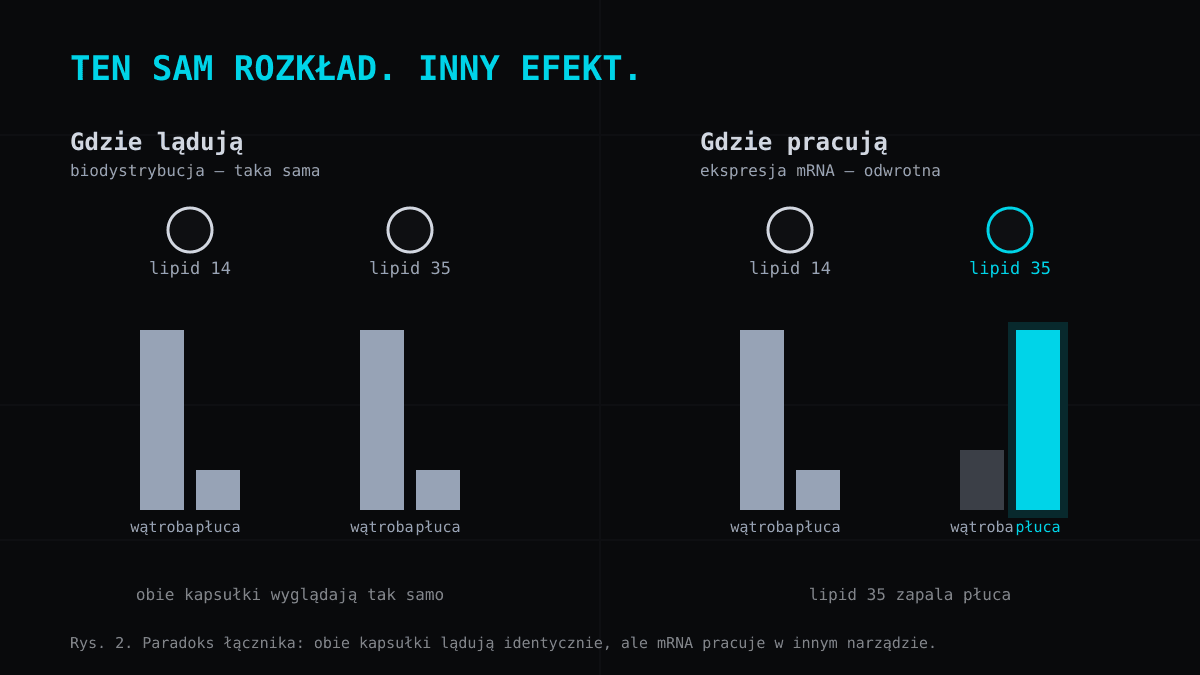
Rys. 2. Paradoks łącznika: obie kapsułki lądują w tych samych narządach, ale mRNA pracuje w innym miejscu. Lipid 35 zapala płuca. Źródło: opracowanie własne na podstawie Naidu G.S. et al., ACS Nano (2025), DOI: 10.1021/acsnano.4c18636.
Forty-two percent more time
To prove this is not a laboratory curiosity, Peer's team reached for the hardest test: lung cancer metastases. Mice received intravenous melanoma cells that form tumors in the lungs. Then they were injected with mRNA encoding a toxin, domain III of exotoxin A from the bacterium Pseudomonas aeruginosa. The toxin is meant to kill cancer cells, but only where the mRNA is correctly read.
The dose was microscopic: 0.09 milligrams of mRNA per kilogram of body weight, given three times, on the first, fifth, and ninth day after implanting the tumor cells. And the cargo loaded into the capsules at over 95 percent, in a nearly perfectly uniform population in which all particles had practically the same size.
The result depended solely on the linker. Capsules with the standard lipid SM-102, the same one the Moderna platform is built on, gave a median survival of 24 days. Capsules with the urea linker: 34 days.
Forty-two percent more time.
The number of metastases fell from 21 to 12. Lung mass, an indicator of how much tumor had grown in them, returned almost to normal. And more importantly: liver enzymes in mice treated with the new lipid returned to baseline within 72 hours. The old formula kept them elevated longer.
For certainty, they also compared a control group whose capsules carried plain luciferase, a glowing protein, instead of the toxin. Those mice had 42 metastases, nearly as many as untreated ones. So it was the toxin killing the tumors, not the injection itself.
The drug did not just work better. It did less harm where it should not.
The competition does it differently. And at higher cost
The Tel Aviv team is not the first to try steering LNPs beyond the liver. At the front of the pack for years has been the SORT concept, selective organ targeting, developed in Daniel Siegwart's lab at UT Southwestern and described in Nature Nanotechnology in 2020. The idea: add a fifth, charged lipid that "reprograms" the capsule's address.
Another approach is active targeting, gluing antibodies or peptides to the capsule's surface that recognize a specific organ. It works in principle, but it raises cost, complicates manufacturing, and can provoke an immune response.
Peer's approach is different in one disarming detail. It adds no new component. It changes no surface chemistry. It shifts just a few atoms in the linker that was already there. The lung-targeting effect is achieved practically for free, through what everyone had previously ignored.
And because amide and urea linkers are also more chemically stable, the whole formulation better withstands storage and production scale-up. That is a detail that weighs more in industry than many a chart in a publication.
The race where single atoms count
To understand the stakes, go back five years. At the end of 2020, two vaccines, Moderna's and Pfizer and BioNTech's, proved to the world that lipid capsules carrying mRNA work. Within two years, billions of doses were injected. A technology that a decade earlier was a laboratory curiosity became the foundation of an industry worth hundreds of billions of dollars.
But almost all of these therapies share one common denominator. They aim at what LNPs do naturally. The liver. Intramuscular vaccines work locally, in the muscle. And systemic therapies, from gene editing by Intellia to the base editing developed by Beam Therapeutics, go to the liver because that is where the capsules go on their own.
That is not chance. That is a compromise. The whole nascent field of mRNA and CRISPR medicine stands today before the same wall: we can deliver a drug to the liver, but we cannot lead it back out.
That is why Peer's paper weighs more than its modest size suggests. It shows that steering a drug to an organ does not require new components or complicated surface chemistry. It is enough to rethink what is already in the particle, and to understand that a drug's fate is decided not where the capsule lands, but where its cargo escapes the vesicle.
That is knowledge that can be transferred to any existing platform. You do not need to build a new factory. You just need to look at a few atoms differently.
Poland has the workshop. It lacks the patent
Where is Poland in this race? It does not yet have its own ionizable lipid, the key patent that decides whose capsules reach patients. But it has everything around it.
Jagiellonian University has worked for years on chitosan nanoparticles for drug delivery. Gdańsk University of Technology develops nanomedicine, while Silesian University of Technology and the University of Silesia study nanotoxicity. The Medical Universities of Lublin, Łódź, and Toruń have a base in drug bioavailability.
On the industry side stand companies that already know how to make molecules at production scale. Molecure and Ryvu Therapeutics design small molecules against cancer. Celon Pharma develops biologics. And Polpharma Biologics and Mabion run production lines on which LNP and mRNA manufacturing could theoretically stand.
So the missing link is not the factory or the people. It is intellectual property. And the insight Peer's paper brings is exactly what lowers the barrier to entry: it turns out that steering a drug to an organ can be achieved not through complicated surface chemistry, but through a thoughtful choice of a few atoms in the middle of the particle.
That is knowledge a Polish team could pick up and develop today, before the market closes the window. The window will not stay open long. Americans, Britons, and Koreans are already building their own LNP platforms. In a few years the ionizable-lipid market will be divided. And a patent on the linker that steers a drug to the lungs will cost more than an entire research program does today.
Sources
- Naidu G.S., Rampado R., Sharma P., Ezra A., Kundoor G.R., Breier D., Peer D., Ionizable Lipids with Optimized Linkers Enable Lung-Specific, Lipid Nanoparticle-Mediated mRNA Delivery for Treatment of Metastatic Lung Tumors, ACS Nano (2025). DOI: 10.1021/acsnano.4c18636
- Cheng Q., Wei T., Farbiak L., Johnson L.T., Dilliard S.A., Siegwart D.J., Selective organ targeting (SORT) nanoparticles for tissue-specific mRNA delivery and CRISPR–Cas gene editing, Nature Nanotechnology (2020). DOI: 10.1038/s41565-020-0669-6
- Dilliard S.A., Cheng Q., Siegwart D.J., On the mechanism of tissue-specific mRNA delivery by selective organ targeting nanoparticles, PNAS (2021). DOI: 10.1073/pnas.2109256118
Comments· 0
No comments yet. Be the first.