A cable that grows. Why the future of neuroimplants is not made of metal
Philadelphia, Friday afternoon
Flavia Vitale stares at the confocal microscope screen. On a slide - rat neurons wrapped in a thin layer of the conductive PEDOT polymer. The cells didn't just survive. They release neurites. They connect with each other. They create a network. And current flows through this network.
This shouldn't work. Neurons are delicate - they respond to any change in temperature, pH, and surface tension. Wrapping them in synthetic polymer should kill them within hours. Meanwhile, on the glass, Vitale sees the opposite: the polymer creates a bridge between two worlds.
Vitale, a bioengineer and assistant professor in the Department of Neurology at the University of Pennsylvania, has been working for a decade on a question that sets her apart from most neuroengineers: not how to miniaturize an electrode, but how to make the brain stop rejecting it.
The problem that plagues Vitale and her team at the Center for Neurotrauma in Philadelphia is called foreign-body response — the body's reaction to a foreign body. Any implant placed in the brain, no matter how small and precise, triggers an immune cascade. Microglia and astrocytes - the brain's defense cells - surround the electrode in glial scar within weeks. After a few months, the signal weakens so much that the implant is no longer useful. 30 years of neurotechnology development. Hundreds of millions of dollars from DARPA and NIH. And the problem has remained the same since the first brain-computer interface was implanted in humans in 1998.
"For decades we have tried to fight biology," writes Vitale. "Maybe we should invite her to cooperate instead."
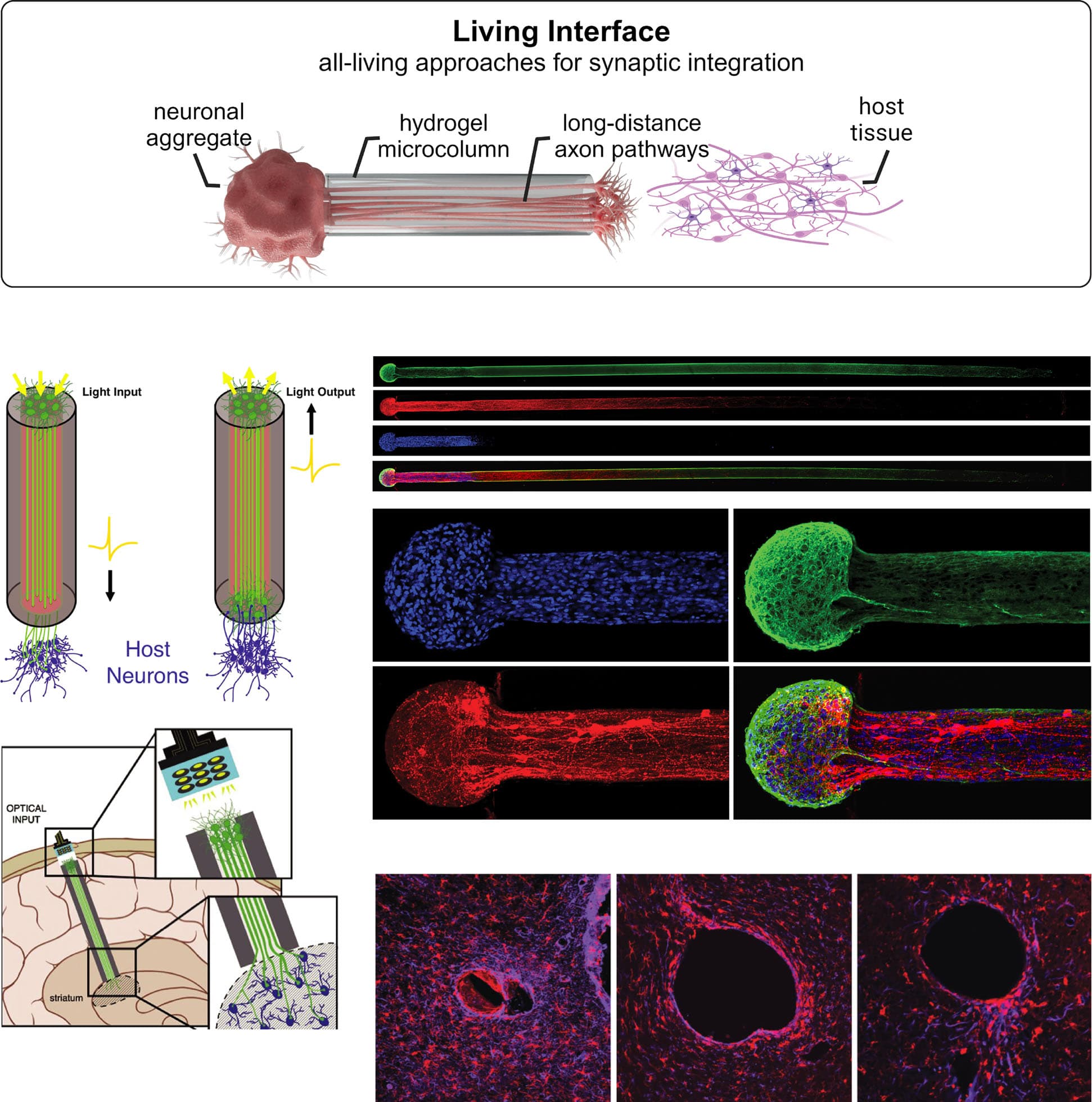
Rys. 1. Przegląd strategii bioinspirowanych interfejsów neuronowych — od materiałów biomimetycznych przez bioaktywne powłoki po układy biohybrydowe i żywe elektrody. Źródło: Boufidis D. et al., Bio-inspired electronics: Soft, biohybrid, and "living" neural interfaces, Nature Communications (2025), DOI: 10.1038/s41467-025-57016-0.
Four generations of one problem
In a review published in February 2025 in Nature Communications — 121 citations in 5 months — Vitale and four colleagues map four strategies that form the evolutionary ladder of bioinspired electronics. Each subsequent level departs more radically from the traditional implant concept.
Biomimetics: make it soft. The first generation mimics the mechanical properties of tissue. Instead of stiff silicon blades - flexible polymers (PDMS, Parylene-C, SU-8), hydrogels capable of absorbing 90% of water, meshes less than 1 micrometer thick. Two groundbreaking examples: e-dura — a PDMS and platinum implant that mimics the elasticity of the spinal dura — restored the ability to walk in spinal cord-injured rats while delivering serotonergic drug through a built-in microfluidic channel. NeuroGrid — an array of 4-micrometer electrodes with PEDOT:PSS — recorded action potentials of single neurons from the surface of the rat cerebral cortex for 10 days, without penetrating the tissue.
But Vitale knows that softness is not enough. Glial scar formation is slower, but it is forming. A biochemical signal is needed, not just a mechanical one.
Bioactivity: Paint it with protein. Second strategy: cover the electrode with molecules that the brain recognizes as "self." Extracellular matrix proteins - collagen, laminin, fibronectin, hyaluronic acid. Antibodies that bind specific types of neurons. In the experiment that Vitale cites in his review, silicon electrodes coated with L1 — a nerve cell adhesion protein — recorded signals from the visual cortex of mice for a full 16 weeks. The signal amplitude was higher, the signal-to-noise ratio was better, and the density of neurons around the electrode was higher than with bare implants.
Biohybrid: add living cells. Third rung: Instead of imitating biology, physically place it on the electrode. Neurons, astrocytes or progenitor cells are grown on the implant surface in a protective fibrin or alginate hydrogel. Once implanted, these cells secrete neuroprotective factors, reduce inflammation and create a biological buffer. In a groundbreaking 2024 study, biohybrid implants with human skeletal myocytes formed functional neuromuscular junctions in vivo - the electrical signal from the electrode was biologically amplified by living tissue. Crucially, the signal improved week by week. This is the opposite of every existing clinical implant.
Living electronics: goodbye, metal. The fourth strategy, which Vitale describes as the most transformative, no longer involves any synthetic electronic components. The signal doesn't travel through copper or polymer - it travels through axons, natural biological cables that are a single micrometer in diameter. Synapses replace solder joints.
Kacy Cullen, a neurosurgeon and co-author of the review with Vitale, is behind this concept. His lab created μTENNs — micro-Tissue Engineered Neural Networks: hydrogel columns 1 to 5 centimeters long, filled with neuronal aggregates. Axons growing from them create "living electrodes" capable of synaptic integration with the host tissue. In a model of Parkinson's disease, μTENNs with dopaminergic neurons implanted in the rat striatum restored the lost nigrostriatal connection — releasing dopamine on demand, with an anatomical precision unattainable by deep brain stimulation.
12.8 billion and three speeds
The global neurotechnology market was worth $12.8 billion in 2024. It is growing at a rate of 14.2% per year - by 2030 it will exceed 28 billion. But this growth is hitting a glass ceiling.
Biomimetics is closest to the clinic. Stentrode from Synchron (an implant placed inside a blood vessel, without opening the skull) has already been tested on 6 patients with ALS and is in the pivotal trial phase. Neuralink threads, implanted by the R1 robot with a precision of 5 micrometers, record the activity of 1,024 channels from the motor cortex. Precision Neuroscience tests ultra-thin micro-ECoG meshes on 4,096 channels. All three startups have collectively raised over $800 million in funding. They all belong to the first generation. None of them solve the FBR problem - they just postpone it.
Biohybrid and living electronics are a decade behind them. Research on small animals - sheep, pigs - is just beginning. Cullen estimates that the first clinical trial of μTENNs in Parkinson's disease is at least 8-10 years away. The main challenges are not conceptual - they are engineering and regulatory. How to ensure that implanted neurons do not migrate? How do I ensure they don't create aberrant connections? How to turn them off if necessary - a genetic "kill-switch"? Each of these questions is a separate research program worth tens of millions of dollars.
Meanwhile, biomimetic devices are already gaining FDA breakthrough device designation. Vitale sees this tension: the market is gravitating towards what works today, while the real breakthrough - an interface that the brain accepts as its own tissue - still requires a decade of fundamental work.
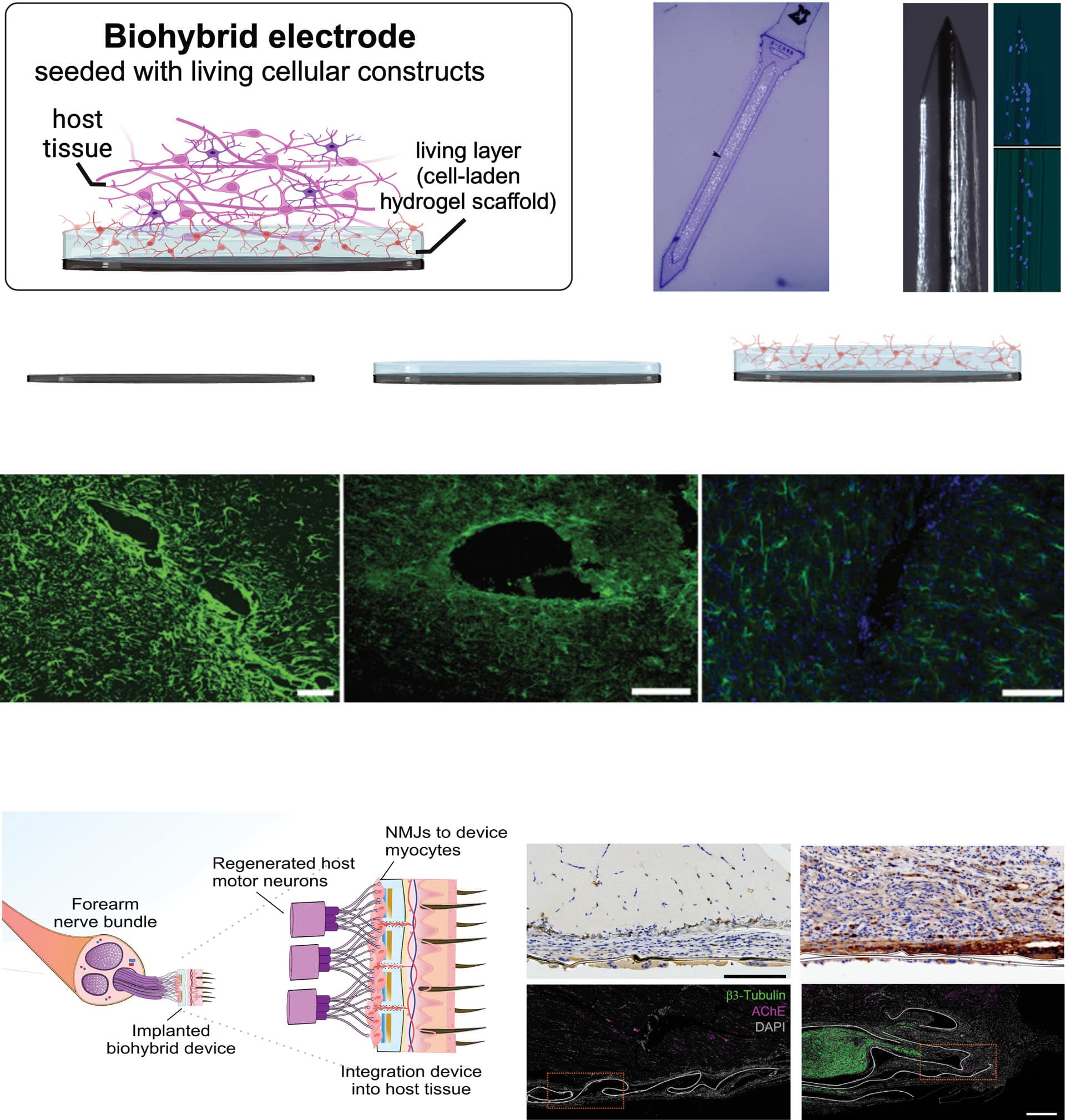
Rys. 2. Hierarchia strategii bioinspirowanych — od biomimetycznych materiałów po biohybrydowe interfejsy łączące żywe komórki z elektroniką. Źródło: Boufidis D. et al., Bio-inspired electronics: Soft, biohybrid, and "living" neural interfaces, Nature Communications (2025), DOI: 10.1038/s41467-025-57016-0.
Poland: there is nanotechnology, but there is no bridge
In the global neurotechnology race, Poland has its advantages - and its gap.
Filippo Pierini from the Institute of Fundamental Technological Research of the Polish Academy of Sciences publishes a review of interfaces between nanomaterials and the brain in ACS Nano (2025). His team studies conductive nanofibers, magnetic nanoparticles for non-invasive neuromodulation, and polymer scaffolds for axon regeneration. This is world-class science - cited, peer-reviewed, published alongside groups from MIT and ETH Zurich.
At AGH University of Science and Technology in Kraków, Krzysztof Formela's team from the Gdańsk University of Technology is developing conductive hydrogels for bioelectronic applications - work published in the Journal of Materials Chemistry A in 2026. At the University of Warsaw, Monika Wojciechowska studies endolysins - enzymes that can be used as biological switches in biohybrid interfaces. These are the building blocks.
Problem: There is no one between the brick and the building. No Polish startup is working on a biohybrid neural interface. No hospital is conducting preclinical studies using μTENNs. The National Center for Research and Development is offering up to PLN 15 million in the TEAM-NET FENG program for neurotechnology consortiums - but the money mainly goes to academics publishing subsequent works on "material characterization in vitro". There is simply no bridge between the laboratory and the Class III medical prototype.
Vitale works in an ecosystem where the University of Pennsylvania shares a campus with Children's Hospital of Philadelphia and a hundred startups. Pierini works at the Polish Academy of Sciences institute 20 minutes away from Warsaw's clinical hospitals - but these two realities do not meet. It's not a matter of talent or ideas. It's a matter of the missing link: a clinical engineer who can translate the characteristics of the nanofiber into an ISO 13485-compliant implantation protocol.
Vitale has this luxury that Polish scientists do not have. He works a 15-minute walk from a university hospital that could start a clinical trial tomorrow. Her lab is adjacent to that of Cullen, himself a neurosurgeon—each μTENN idea is immediately tested for surgical feasibility. This is not a coincidence. It's an ecosystem built over 30 years - from DARPA's first BrainGate grant in 2002, through the creation of the Center for Neuroengineering and Therapeutics in 2018, to today's 121 citations in Nature Communications.
Poland has individual building blocks of this ecosystem: Pierini, Formela, Wojciechowska. He has money - up to PLN 15 million in TEAM-NET FENG. It has clinical infrastructure - hospitals implanting DBS in Warsaw, Kraków and Poznań. There is no single person or team who will take responsibility for building the first Polish prototype of a biohybrid neural interface. Without this bridge, in 5 years Polish Parkinson's patients will still be implanted with conventional DBS produced in Minneapolis, while in Philadelphia the first patient will receive a living electrode.
Sources
- Boufidis D, Garg R, Angelopoulos E, Cullen DK, Vitale F. Bio-inspired electronics: Soft, biohybrid, and "living" neural interfaces. Nature Communications (2025), 16:1861. DOI:
- Ahmed AAA, Alegret N, Almeida B, Pierini F, et al. Interfacing with the Brain: How Nanotechnology Can Contribute. ACS Nano (2025). DOI:
- Rocha RG, Siqueira GP, Formela K, et al. From conductive filament design to 3D-printed devices: a critical review. Journal of Materials Chemistry A (2026). DOI:
- Adewole DO, Cullen DK, et al. Development of optically controlled "living electrodes" with long-projecting axon tracts for synaptic brain-machine interfaces. Science Advances (2024). DOI:
- Struzyna LA, Cullen DK, et al. Tissue-engineered nigrostriatal pathway for treatment of Parkinson's disease. Advanced Healthcare Materials (2024). DOI:
- Serruya MD, Cullen DK, et al. Living electrodes for linking brain and machines. Advanced Functional Materials (2024). DOI:
- Global Neurotechnology Market Size & Share Report 2024-2030. Grand View Research. $12.8B in 2024, CAGR 14.2%.
Comments· 0
No comments yet. Be the first.