27.2 percent. How China solved the problem blocking silicon's successor
Chlorine that no one has seen
Zhuang Xiong is looking at a thin film to replace silicon. It is one thousandth of a millimeter thick - thinner than a human hair. Under the microscope, it looks perfectly uniform.
But it's not.
Perovskite - a material that has gone from 3.8% to over 27% efficiency in converting light into electricity in fifteen years - harbors a flaw invisible to the naked eye. Chlorine is not distributed evenly in its structure. There is more of it near the surface, less deep inside. And it is this invisible inequality, rather than anything else, that has kept silicon's successor off the roof for years.
Let's stick to the numbers. Silicon - the same element from which we make processors - today achieves around 27% efficiency in the best laboratories. After seventy years of refinement. Perovskite reached 27.2%. After fifteen.
And yet there's no perovskite slab hanging over your head.
Why is the most efficient candidate for silicon's successor also the worst? Because what gives him an advantage in the laboratory is also his Achilles heel. Perovskite disintegrates under the influence of moisture, oxygen and - irony of ironies - the light itself, which it is supposed to convert into electricity.
Two camps, one layer
The race to commercialize perovskite has split into two camps. It's a fight where both sides are right - at least for now.
Camp one: Europe.Oxford PV, a spin-off of the University of Oxford, has compromised. Instead of replacing silicon, he stacked perovskiteonsilicon. The top layer captures the blue part of the spectrum, the bottom - the red part. It's like two filters placed back to back, each focused on a different color of the rainbow, instead of one that tries to block all the light at once. In 2024, the company showed a module with an efficiency of 28.6% and launched the world's first line of perovskite-silicon tandems in Brandenburg an der Havel.
Camp two: China.The team of Jingbi You from the Institute of Semiconductors of the Chinese Academy of Sciences in Beijing and Yaowen Li from Soochow University focused on pure perovskite. No silicon, no compromise. It's a riskier game: A single layer has a theoretical ceiling of about 33% — the Shockley-Queisser limit — higher than silicon will ever reach. But no one knew if it could be reached before the material disintegrated.
Two strategies. Two continents. One goal: a roof that generates electricity cheaper.
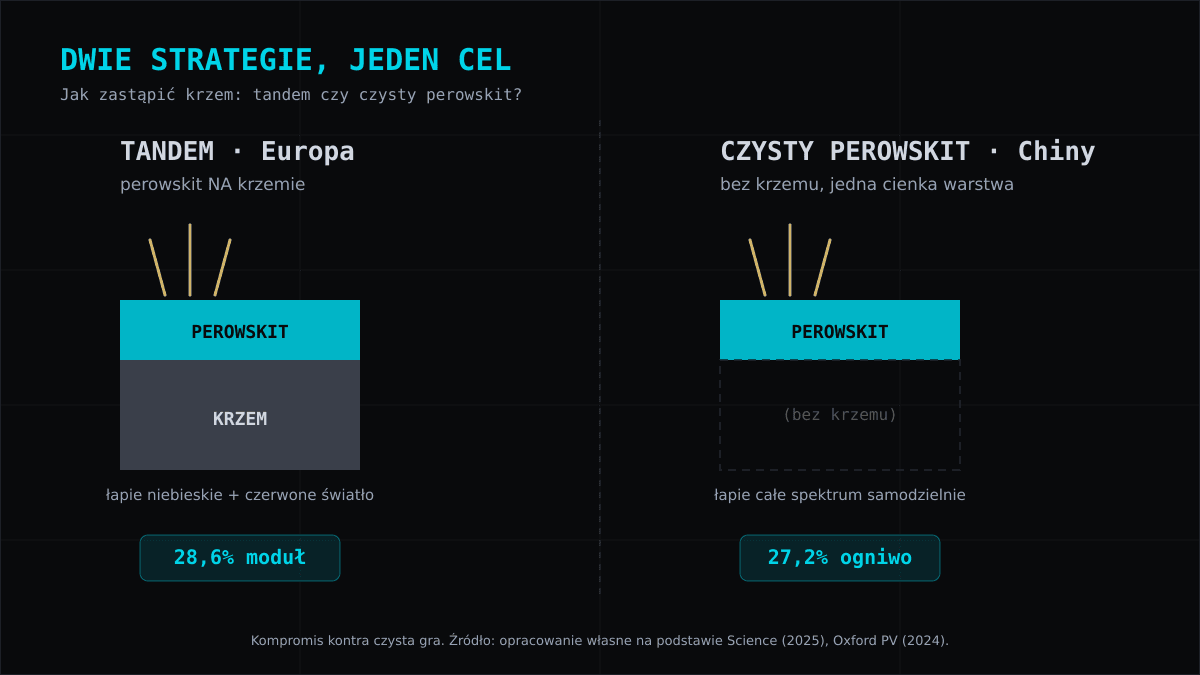
Rys. 1. TEST polski
Fig. 1. Two silicon replacement strategies: perovskite-silicon tandem (Europe) versus pure perovskite (China). Source: own study based on Xiong et al., Science (2025) and Oxford PV (2024).
Round one: silicon doesn't give up
To understand what's at stake, you have to know that silicon has won once before - and won by a landslide. About 80% of the world's solar panels are made in China. LONGi, the largest manufacturer, holds the record for a single silicon cell at around 27%.
And that's almost the ceiling. Silicon has a physical limit: it can only convert a narrow band of the entire spectrum of sunlight into electricity. The rest is lost as heat. The theoretical maximum of a single silicon cell is about 29%, and practice has been close to 27% for years. In other words, the silicon is reaching the wall. To go further, you either have to arrange the layers in tandem or change the material.
Perovskite enters the ring from an underdog position. Discovered as a photovoltaic material in 2009 by Japanese chemist Tsutomu Miyasaka — with a modest efficiency of 3.8% — it was a laboratory curiosity for a decade. Nice result, no practice.
And then something happened that no one predicted. The perovskite efficiency curve began to climb at a rate unseen by any other photovoltaic technology. Silicon climbed a percentage point per decade. Perovskite - by a few per year.
Round two: Europe goes for tandem
The European plan was elegant. Don't fight silicon - climb it. The perovskite-silicon tandem uses existing silicon factories: you add one thin layer, and the panel gains a few percentage points. Less revolution, faster profit.
Oxford PV looked like the leader. Module 28.6%, factory in Brandenburg, talks with American giants. However, the strategy had one hidden flaw: you still need silicon. And silicon - and its entire production chain - rests in the hands of those with whom Europe is trying to compete.
Meanwhile, in Beijing, You and Li's team took a different path. Pure perovskite, silicon free. And there lurked the problem that started this story.
Chlorine.
Round three: turning point
In the most promising perovskite - formamidine-lead-iodine, or FAPbI₃ - scientists add methylammonium chloride to make the layer crystallize better. But this additive leaves behind an uneven distribution of chlorine. There is more of it near the surface, less deep inside. And each such place of imbalance is a defect - a trap in which the electron is lost instead of flowing to the electrode. The efficiency decreases and the layer ages faster.
The Beijing team's solution turned out to be surprisingly simple. They added alkali metal oxalates. During heating, oxalate decomposes, releasing metal cations that selectively bind chloride ions and even out their distribution throughout the film thickness.
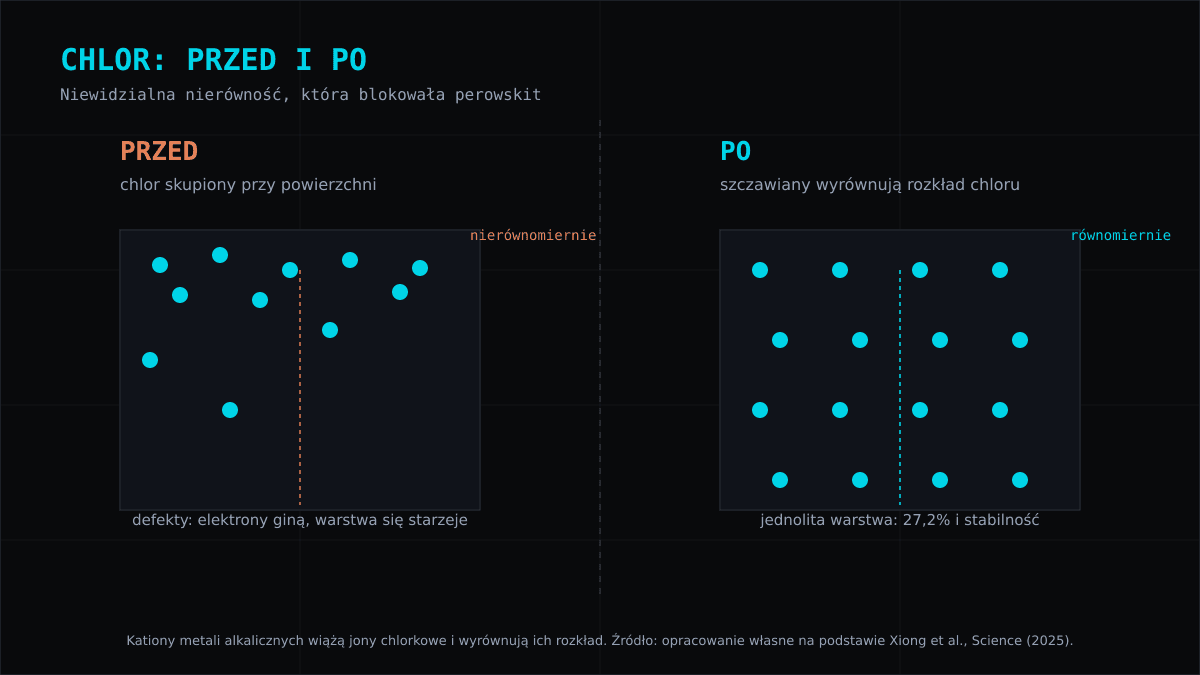
Fig. 2. Chlorine distribution in the perovskite film before and after adding alkali-metal oxalates — homogenizing chlorine removes defects and boosts stability. Source: own work based on Xiong et al., Science (2025), DOI: 10.1126/science.adw8780.
Imagine salt spilled on the counter. Instead of sweeping it sideways, you add a substance that makes the salt spread evenly over the entire surface. Something like this - only on the scale of atoms.
Fig. 2. Chlorine distribution in the perovskite layer before and after adding alkali metal oxalates - chlorine equalization removes defects and increases stability. Source: own study based on Xiong et al., Science (2025), DOI: 10.1126/science.adw8780.
Result? 27.2% certified efficiency - measured in an independent laboratory, not in the maker's showcase. But the second number is more important, the one everyone has been waiting for. After 1,529 hours of continuous operation in full sunlight, the cell retained 86.3% of its initial efficiency. And in the accelerated aging test at 85 degrees Celsius - 82.8% after a thousand hours.Honestly: 1,529 hours is not twenty-five years. That's two months of constant sunshine. But for material that recently died after a few days, this is an abyss. Because the degradation of perovskite has so far been so fast that no one has even had time to measure it properly. Now we can start talking about years.This is a turning point. For the first time, pure perovskite simultaneously demonstrated the efficiency of silicon
and
stability that gives hope for a roof. Two problems that seemed irreconcilable for fifteen years were solved by one carefully selected salt.
Who's driving?
The duel now has a new state. Let's count the points.
China leads the laboratory: 27.2% pure perovskite, plus records for LONGi tandems at 34.6%. And they have the production machinery - 80% of the world's panels, and companies like GCL and Renshine are rolling out perovskite lines on the gigawatt scale. Europe leads in tandem commercialization: Oxford PV is the first to sell perovskite in a real product. But this advantage is fragile - hard-financed, dependent on a silicon supply chain that belongs to a competitor.
The irony of the race is that both strategies can win at the same time. The tandem will hit the roofs of houses, where every percentage counts. Pure perovskite - into flexible films, facades and devices that silicon will never cover because it is stiff and heavy.
But if the stability of pure perovskite is confirmed on an industrial scale, the advantage of tandem will begin to disappear. Why add silicon if a thin layer alone is enough?
They're already doing it. Just not in Europe.
While Europe debates, China builds.UtmoLight, a Wuxi company, has launched a gigawatt perovskite production line. GCL Technology - the silicon giant - is switching some power to perovskite. Renshine Solar announces further lines. In total, Chinese companies have announced perovskite plans for several gigawatts in the coming years. For comparison: the entire Polish photovoltaics system has just over 20 gigawatts of installed capacity, built over a decade.The United States is taking a different path. First Solar, the only major U.S. panel manufacturer, is betting on cadmium telluride, a thin-film technology, but not perovskite. Perovskite startups like Caelux instead sell glass with a layer of perovskite that can be applied to an existing silicon panel and increase its efficiency by several points. This is the third way: do not replace, do not arrange - only
glue
Oxford PV remains the only player to sell the perovskite-silicon tandem in a viable product. But the scale of its line in Brandenburg is a fraction of what the Chinese announce. The race is no longer a laboratory race. It's starting to become a factory race.
Wrocław had perovskite before it was fashionable
In this race, Poland held a card that it did not play until the end.
Saule Technologies from Wrocław - founded by physicist Olga Malinkiewicz, who co-created the low-temperature perovskite printing method at EPFL in Lausanne in 2013 - produced flexible, inkjet-printed cells. The company was several years ahead of the world. At a time when the rest of the industry was just learning to pronounce the word "perovskite," Saule had a prototype, a factory, and awards.
But the perovskite race is won by scale, not by idea. Saule did not make the leap from prototype to mass production and underwent restructuring. Her story is a warning: Poland can invent the technology of the future, but is still unable to fully finance it.
This does not mean that there is nothing to save. Wrocław University of Science and Technology, the Institute of Physics of the Polish Academy of Sciences and AGH have competences in perovskite materials and printing. Saule managed to show that it can do it: Skanska tested its cells on its façade, and Japanese investor Hideo Sawada entered the company, seeing it as a bridge to the Asian market.
There is room for specialized players in the global perovskite chain: inks, protective layers, printing machines, stability testing methods. This is not a game for the biggest factory. It's a game for the best component - and components can be made from Wrocław. The question is whether there will be financing for this - from the NCBR, in PARP programs, from an investor who will understand that perovskite is not a research project, but an industry in its infancy. Poland already invented this technology earlier than the rest of the world. He may not get a second chance.
Rate
Perovskite is not just another curiosity from the laboratory. This is the answer to the question whether photovoltaics will become really cheap and ubiquitous - not only on roofs, but also on facades, in foils that can be rolled up and taken away. The China-Europe race will be decided not this year, but in the next few years.
- And silicon, the undisputed king of the last seventy years, has just heard that it has a successor. A successor that is thinner, cheaper and - from November 2025 - finally stable.SourcesXiong Z., Zhang Q., Cai K. et al.,Homogenized chlorine distribution for >27% power conversion efficiency in perovskite solar cells
- , Science 390, 638–642 (2025).DOI: 10.1126/science.adw8780Liu Z., Lin R., Wei M. et al.,All-perovskite tandem solar cells achieving >29% efficiency with improved (100) orientation in wide-bandgap perovskites
Comments· 0
No comments yet. Be the first.