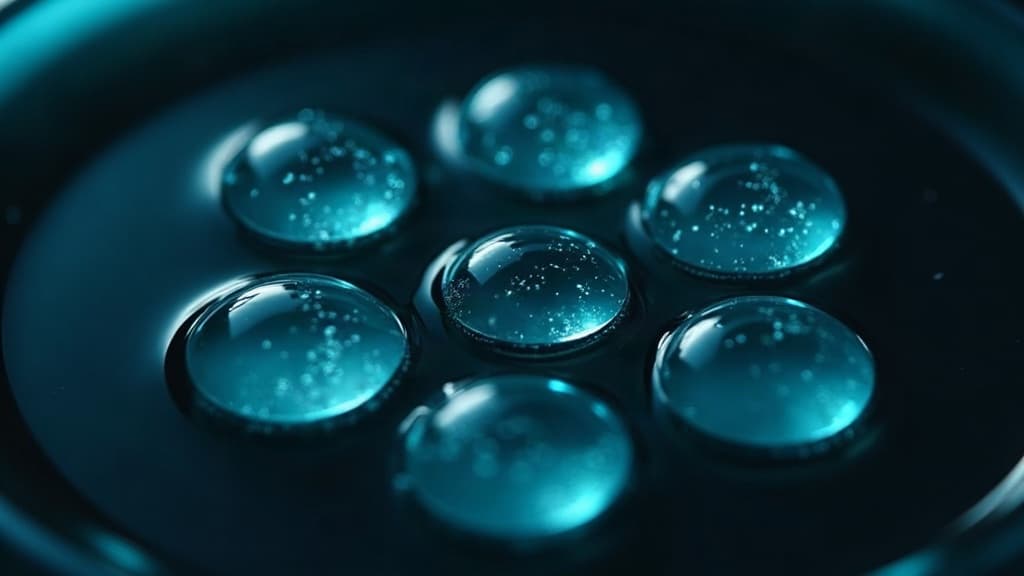
Water droplets in oil compute with ions and remember what just happened
In electronics, neighbouring components are not supposed to "hear" each other. Crosstalk between tracks is a defect engineers have fought for decades. A team at Penn State did the opposite. It built a network of water droplets in which every droplet feels its neighbour, and that mutual eavesdropping turned out to be the source of computing power. The authors call such a network a neuromorphic tissue. The current inside it is carried by ions, not electrons.
The paper "Neuromorphic tissues: Soft biomolecular networks for brain-inspired temporal computing" appeared on 24 July 2026 in Science Advances (vol. 12, eaed0971). Its authors are Nicholas X. Armendarez and Ahmed S. Mohamed, who contributed equally, together with Md Sakib Hasan of the University of Mississippi and Joseph S. Najem of Penn State. Najem and Hasan are the corresponding authors. The result drew wider attention on 13 October, when the university issued a press release.
A computer made of droplets, oil and fat
The recipe sounds like it comes from a kitchen. A drop of salty water containing a lipid, the fatty molecule that cell membranes are made of, is placed in oil. The lipids arrange themselves on the droplet surface into a thin layer. When two such droplets touch, their layers join into a double membrane. The result is a very simplified copy of a cell wall. Researchers call it a DIB, short for droplet interface bilayer.
The membrane on its own conducts poorly. It behaves like a capacitor, storing charge on both sides. But the droplets contain one more ingredient: alamethicin, a short peptide produced by fungi. As long as the voltage across the membrane stays low, the peptide just sits on its surface. Once the voltage crosses a threshold, the molecules push into the membrane and form pores. Ions start to flow and the membrane suddenly conducts. After a moment the pores close and the membrane returns to its starting state.
Electronics has a name for this behaviour. A component whose resistance depends on what just happened to it is a memristor. Najem's group showed back in 2018 in ACS Nano that alamethicin-doped membranes act as such soft memristors. Their memory is short and fades over time. This is where the paradox begins: a fading memory, which an ordinary memory chip would treat as a flaw, is exactly what is needed here.
Why forgetting helps computation
This style of computing is called reservoir computing. The idea is simple. You take a physical system with rich, nonlinear dynamics and feed it a signal that changes over time. The system responds with a complex pattern of states. That pattern keeps traces of earlier inputs, but old traces slowly fade. At the end, a simple trained readout layer combines the measured states into an answer. Nobody trains the reservoir itself.
Such a reservoir can be optical, magnetic or electronic. Memristors are attractive because they are small and use little energy. The authors point out a weakness of most earlier attempts, though. Memristors were placed side by side, and each responded to the signal independently. A parallel array like that has a short, flat memory. The mathematics is unforgiving: a single element of this kind is a first-order system. Complex, chaotic behaviour cannot be squeezed out of it, even if thousands are placed next to each other.
The brain works differently. Neurons are densely connected and constantly pass signals to one another. In the droplet network this coupling appears by itself. Each droplet shares membranes with its neighbours, so current injected into one charges the membranes around it. When the voltage on one of them crosses the threshold, pores open and charge moves on. For a moment the membrane becomes a conducting link that the authors compare to a synapse. The signal circulates, overlaps and returns without any external feedback circuit.
"With silicon, circuitry is needed to build a computer," Najem says in the university's release. "With our approach, the circuitry is the material itself." The membranes store charge, and the ion channels regulate the flow between droplets.
What was built in the lab
It is fair to separate the work into two parts. The first is the experiment. The team 3D-printed a mould, cast from it a silicone tray with a row of small wells, and brought a thin silver wire coated with silver chloride into each well from below. The tray was filled with oil, and droplets of about 500 nanolitres were moved into the wells. Seven droplets formed a chain. The alamethicin concentration in it followed a 1, 2 and 3 micromolar pattern.
The first droplet received a current from 0 to 170 nanoamperes, delivered in 3-millisecond pulses. The last droplet was grounded, and the voltage was read from the six others. The key change from older work is precisely this: the network takes in current and gives out voltage. Previously the group applied a voltage and measured the current of each element separately. In a connected network currents share pathways, so that no longer works. As a bonus, the voltage rises gently, which lowers the risk of breaking the membrane. Such breakdown usually threatens at around 200–300 millivolts.
From the measurements the team built a physical model of the network and compared it with the experiment over 100 signal changes. The agreement was good, especially at higher voltages. The average normalised mean squared error between model and measurement was about 0.41. For a single membrane the same measure was 1.15, because alamethicin pores open and close at random. In the chain this noise was markedly weaker. The authors think the coupling between droplets averages out random events.
The researchers also checked that they were not just watching an ordinary capacitor charge. In a simulation of a chain of plain membranes without the peptide, the voltage merely rose slowly and noisily. The alamethicin network kept up with fast signal changes. The pulses lasted 1 to 10 milliseconds, and pores in the membranes form and vanish at a similar pace.
What was computed in simulation
The second part of the work is computation on the validated model. This is where the numbers that made the headlines come from, so it is worth remembering that they refer to virtual networks larger than the one on the bench.
The first test is called NARMA. It is a standard task in which a system has to predict the next step of a sequence that depends on many previous values. In the NARMA-10 version it has to remember ten steps back and process them nonlinearly. For parallel memristors this is usually too much. The best simulated network had 50 droplets in a chain. Each pulse was split into three shorter segments, giving 150 states to read out. The test error (NRMSE) was 0.327. A parallel reservoir of independent membranes reached 0.627. That is roughly half the error, which is where the release's "nearly 50%" comes from. In the easier NARMA-2 version the gap was huge: 0.0124 versus 0.458.
The second test was harder. The Lorenz system is a classic model of chaos with three variables that influence one another. A tiny change in starting conditions quickly produces a completely different trajectory. Three currents, one per variable, ranging from −50 to +50 nanoamperes, were fed into a simulated honeycomb network of 43 droplets. The network had to predict the next step. The test errors were 0.071, 0.183 and 0.174 for the three variables. The reconstructed trajectory kept the characteristic "butterfly wings" shape. The parallel reservoir failed already on the training data, with errors of 0.6 to 0.8, and its predictions quickly drifted apart.
A bigger network gave a better result. With 13 droplets the errors for the two harder variables were 0.244 and 0.222; with 43 droplets they fell to 0.183 and 0.174. Even the smallest connected networks did reasonably well, though. The authors' conclusion is clear: coupling, not the number of elements alone, decides the outcome.
The third observation concerns diversity. Networks of droplets with mixed peptide concentrations did better than uniform ones. A random mix of concentrations worked as well as an ordered pattern. Different droplets respond slightly differently, so their responses repeat less and carry more information.
Who needs a wet computer
Najem does not claim that droplets will replace processors in laptops. His argument concerns the place where electronics meets biology. The body sends signals with ions in fluids and across cell membranes. An implant or a sensor in the body has to convert those signals into electrons moving through metal. Every such conversion, he says, can delay and distort the signal, and it also costs energy. A system that computes with ions in water from the start could do part of that work on the spot.
The team names three directions: sensors that adapt on their own, soft robotics, and computing at the interface with living tissue. Najem speaks of a goal of "commercially scalable" ionic computing and of jelly-like chips that might one day support electronics in the body. These are statements from the release, not results of the paper.
The business layer is thin for now, but it exists. On 7 July 2026 Penn State filed a US provisional patent application for the apparatus and method for building such networks. The four authors are listed as inventors. The paper mentions no spin-off or industrial partner. The research was funded by the Army Research Office and the US National Science Foundation. The code and data are in the open Zenodo repository, so other groups can check the simulations.
The droplet network belongs to a broader trend. Physical reservoirs are built from lasers, nanowires and nanoparticle networks. The advantage of droplets is not speed. The network assembles itself, is easy to rebuild, and every droplet can be given a different composition. The material is also a natural fit for biological environments.
What this work does not promise
First, the lab worked with a chain of seven droplets. The networks of 43 and 50 nodes that solve the NARMA and Lorenz tasks exist only in simulation so far. The model agrees with measurement, but only for a small chain and one type of lipid.
Second, the droplets do not work alone. An external source supplies the current, a multichannel converter collects the voltage, and an ordinary computer runs the readout layer. The authors themselves write that small, low-power drivers and readout built into the material are needed to depend less on rigid electronics.
Third, there is no measurement of the whole system's energy use. The claim of a "far lower energy cost" refers to the operating principle, not to a number in a table.
Fourth, lipid membranes are fragile. They break at too high a voltage, and alamethicin pores open at random. The paper shows that this noise weakens in a network, but says nothing about how long such tissue survives in operation.
Maturity: TRL 2
On the technology readiness scale this is TRL 2. The operating principle is formulated and described mathematically. A small prototype confirmed the model, and simulations showed what larger networks could achieve. Missing are a physical network of several dozen droplets, an energy measurement, long-term stability and any work beyond the lab bench. The authors see the next steps in 3D printing of droplets, new lipids and other peptides, and learning that happens during operation.
The most interesting lesson runs against an engineer's intuition. Silicon teaches us to isolate components from each other. The droplet tissue shows that sometimes it pays to let them talk.
Bibliography
- Armendarez N. X., Mohamed A. S., Hasan M. S., Najem J. S. Neuromorphic tissues: Soft biomolecular networks for brain-inspired temporal computing. Science Advances 12, eaed0971 (2026). DOI: 10.1126/sciadv.aed0971
- Armendarez N., Mohamed A., Hasan M. S., Najem J. Neuromorphic tissues code repository. Zenodo (2025). DOI: 10.5281/zenodo.17296788
- Najem J. S., Taylor G. J., Weiss R. J., Hasan M. S., Rose G., Schuman C. D. et al. Memristive ion channel-doped biomembranes as synaptic mimics. ACS Nano 12, 4702–4711 (2018). DOI: 10.1021/acsnano.8b01282
- Armendarez N. X., Mohamed A. S., Dhungel A., Hossain M. R., Hasan M. S., Najem J. S. Brain-inspired reservoir computing using memristors with tunable dynamics and short-term plasticity. ACS Applied Materials & Interfaces 16, 6176–6188 (2024). DOI: 10.1021/acsami.3c16003
- Du C., Cai F., Zidan M. A., Ma W., Lee S. H., Lu W. D. Reservoir computing using dynamic memristors for temporal information processing. Nature Communications 8, 2204 (2017). DOI: 10.1038/s41467-017-02337-y
- Appeltant L., Soriano M. C., Van der Sande G., Danckaert J., Massar S., Dambre J. et al. Information processing using a single dynamical node as complex system. Nature Communications 2, 468 (2011). DOI: 10.1038/ncomms1476
- Tkacik T. Tiny droplets form soft networks for brain-inspired computing. Penn State / TechXplore, 13 October 2026. techxplore.com
Comments· 0
No comments yet. Be the first.