Twice as strong, twice as plastic. A paradox that refutes a hundred years of metallurgy
This metal is at the same time twice as strong and twice as malleable as its predecessor. He shouldn't be like this.
Dislocations (linear defects in the crystal lattice of a metal) have been a textbook strengthening mechanism for a hundred years. You hit a sheet of metal with a hammer, the dislocations increase and the metal hardens. But there's a catch. There cannot be too many of these defects, because then the material loses its plasticity: it cracks instead of deforming. This is an iron rule of metallurgy. Every materials engineer knows it by heart. Dislocations provide strength at the expense of ductility.
The problem is that Bojing Guo's team from Northwestern Polytechnical University in Xi'an has just proven that this rule does not always work.
When defects stop being defects
Guo's team worked with the Ni35Co35Cr25Ti3Al2 alloy: a material from a family of so-called medium entropy alloys (MEA). It is the younger cousin of the famous high entropy alloys (HEA), which have been electrifying materials engineering for a decade with the promise of unique combinations of strength and ductility. Guo's alloy was produced using the Laser Powder Bed Fusion method: 3D printing from metal powder, where a laser melts layer by layer.
What they saw under the electron microscope was unlike anything seen in textbooks.
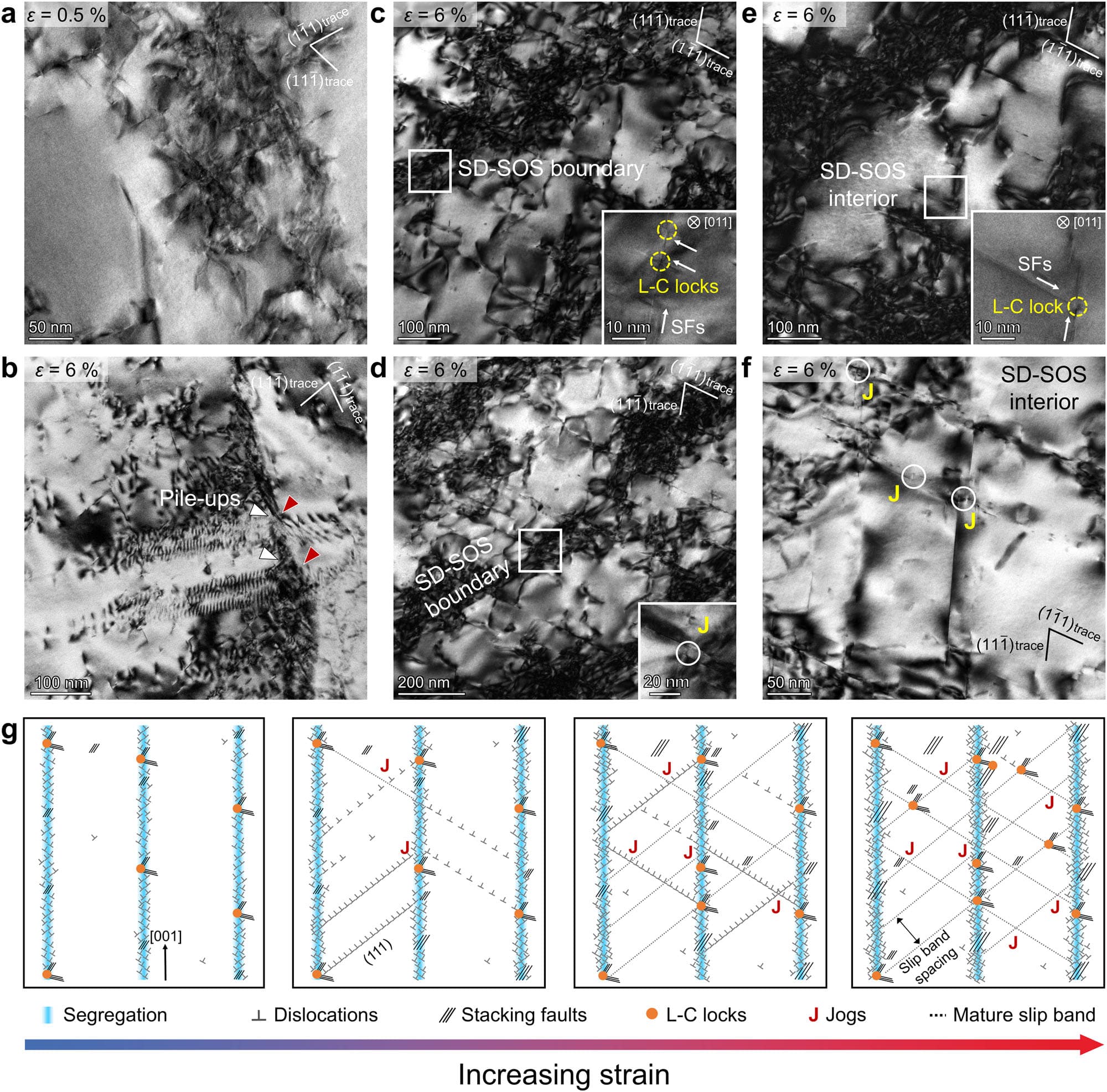
In normal metal, after plastic processing, dislocations are arranged in structures called LEDS (Low-Energy Dislocation Structures): something like chaotic tangled balls of thread. In Guo's foot, something completely different was created: SD-SOS, or Segregation-Dislocation Self-Organized Structures. Self-organizing dislocation-segregation structures.
Let's imagine it this way: instead of a tangled ball of thread, we have carefully arranged partitions. Ti and Al atoms (the same ones added to the alloy to strengthen them) migrate to the dislocations and create a segregation "coat" around them. This coat stabilizes the dislocation, does not allow it to move freely, but also... does not allow it to get "stuck" for good.
This is not a passive obstacle. It is an active structural element.
Strength and plasticity: both at once
Now the most important numbers.
Alloy after conventional casting: yield strength 338 MPa, elongation at break approximately 16 percent. Decent, nothing extraordinary.
The same alloy after 3D printing with SD-SOS: yield strength 655 MPa: almost twice as high. And an elongation to break of about 35 percent: more than twice as much.
To be clear: in the normal world, doubling the strength means reducing the ductility by half or more. Here both values went up at the same time.
What is happening at the microstructure level? Well, SD-SOS works twice. First: it emits new dislocations, acting as a Frank-Read source. Second: it captures sliding dislocations and transforms them into permanent Lomer-Cottrell locks. The effect: the more you deform the material, the denser and more even the network of slip bands becomes.
The distance between the slip bands drops from 327 nanometers in the as-cast alloy to just 67 nanometers in the printed alloy after 24 percent deformation. The denser it is, the more evenly the stress is distributed. No local accumulations, no microcracks.
Rys. 1. Krzywe naprężenie-odkształcenie dla stopu Ni35Co35Cr25Ti3Al2. Stop po druku 3D (as-built, kolor niebieski) osiąga prawie dwukrotnie wyższą granicę plastyczności i ponad dwukrotnie większe wydłużenie niż stop po klasycznym odlaniu (as-cast, kolor czerwony). Źródło: Guo B. et al., Segregation-dislocation self-organized structures ductilize a work-hardened medium entropy alloy, Nature Communications (2025), DOI: 10.1038/s41467-025-56710-3.
A look at the sample fracture under a scanning electron microscope says the same: the diameter of the dimples in the printed alloy is 0.37 micrometers: much smaller than in the classical counterpart. Smaller dimples mean a more even distribution of plastic strain. The metal does not break in one weak point: the entire volume works.
Why it works: A lesson from the Chinese laser
The key is cooling speed. Physically brutal, incomparable to anything in classical metallurgy.
In LPBF printing, a laser melts a microscopic layer of powder within microseconds. The molten pool (several dozen micrometers in size) solidifies at a speed of 10⁶–10⁷ kelvins per second. This is a million times faster than in classic casting. For comparison: if you dropped a red-hot nail into a bucket of liquid nitrogen, it would cool a hundred times slower.
At such an extreme rate, the atoms do not have time to diffuse freely. They become "frozen" in non-equilibrium positions: exactly where the coagulation front found them. Ti and Al, which under normal conditions would form separate intermetallic precipitates, become trapped directly at the dislocation lines. This physical confinement creates a chemical gradient: a "mantle" of atoms around each dislocation.
And here comes the other half of the paradox.
This coat not only blocks the dislocation from free movement (giving strength). At the same time, it stabilizes it thermodynamically: it does not allow it to annihilate. Thanks to this, each SD-SOS becomes a permanent source of new dislocations. It's like building a dam that is also a hydroelectric power plant: an obstacle and an energy source in one.
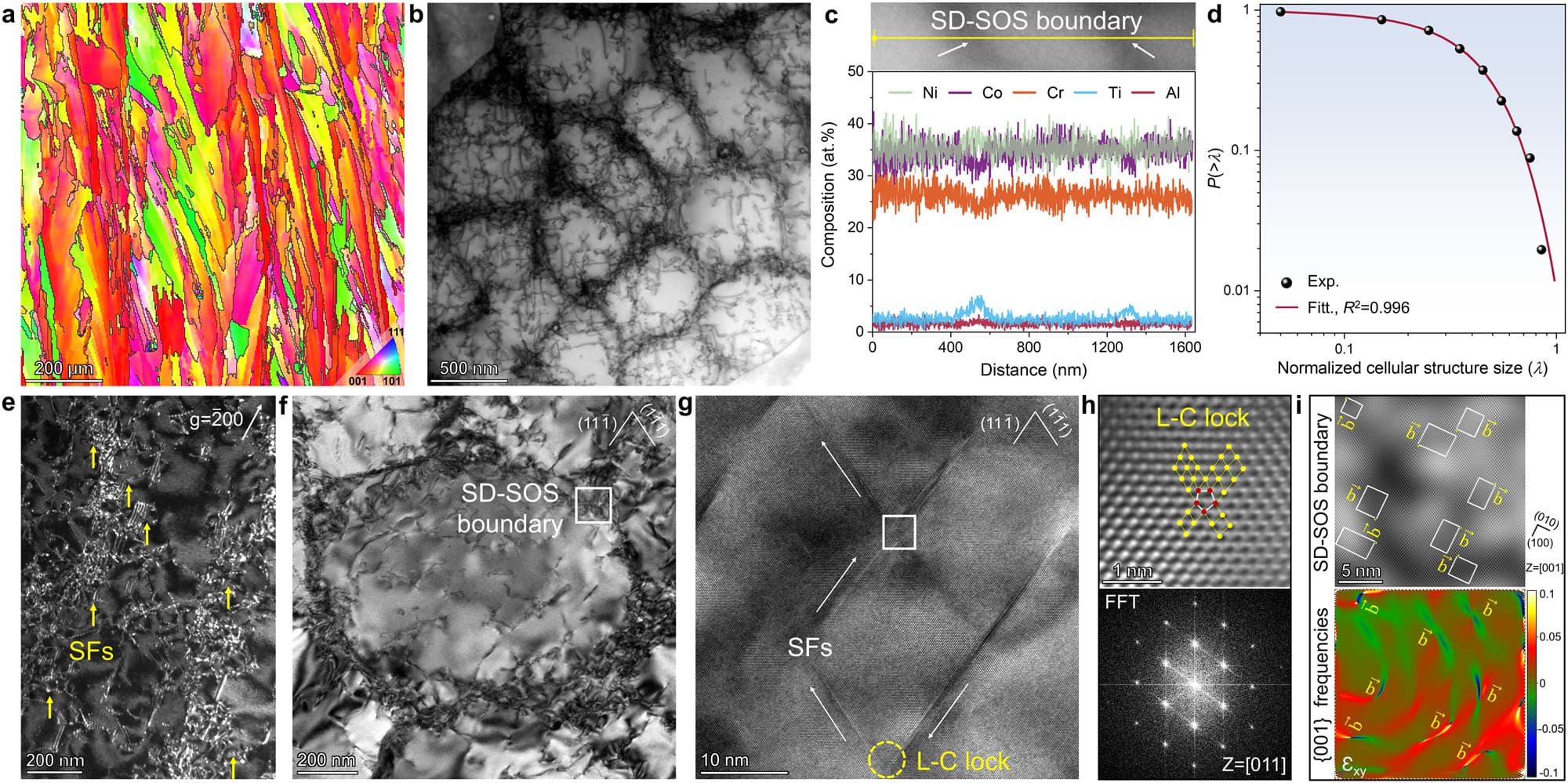
Rys. 2. Obrazowanie mikrostruktury SD-SOS — samoorganizujących się struktur dyslokacyjno-segregacyjnych. Widoczne równomierne rozmieszczenie dyslokacji z płaszczami segregacyjnymi atomów Ti i Al (jasne obszary). Źródło: Guo B. et al., Segregation-dislocation self-organized structures ductilize a work-hardened medium entropy alloy, Nature Communications (2025), DOI: 10.1038/s41467-025-56710-3.
The effect can be seen in the numbers. After 24 percent plastic deformation, the distance between the slip strands in the printed alloy drops to 67 nanometers: less than one-tenth the thickness of a human hair. In the cast alloy, the same parameter stops at 112 nanometers. A difference of one order of magnitude at the nanoscale translates into a twofold advantage at the macroscale.
Guo's team sums it up aptly: "Our results set a precedent for optimizing the mechanical properties of alloys by tuning the dislocation configuration." The point is not to have as many or as few dislocations as possible - this logic has collapsed. It's about architecture. About the spatial configuration in which the defects occur.
The race takes place at the Silesian University of Technology
Poland is not a spectator in this revolution.
At the Silesian University of Technology in Gliwice, the team of Alireza Kalhor and Kinga Rodak has been working on high entropy alloys for years, looking for optimal combinations of strength and plasticity. Their 2024 paper in Progress in Materials Science (134 citations) examines exactly the same problem that Guo solves: how to "tune" strengthening mechanisms so as not to lose plasticity.
At the National Center for Nuclear Research in Świerk, Wenyi Huo and Łukasz Kurpaska research high entropy alloys for extreme applications: from nuclear reactors to the space industry. Their work with Materials Research Letters shows that Poland has competence in designing these materials from scratch: not just in characterizing them.
There is also the Rzeszów University of Technology. Tomasz Trzepieciński, whose team has been working on metal materials for the automotive industry for years, published in Materials in 2024 an overview of current trends in metal materials for body panels and structural elements. Rzeszów is adjacent to the Aviation Valley: one of the largest aviation industry centers in Europe, where Pratt & Whitney, PZL Mielec and several dozen smaller companies produce engine and aircraft components.
Metal 3D printing in the aerospace industry is no longer an experiment - it is standard. GE Aviation has been producing fuel nozzles for LEAP engines using the LPBF method since 2020: the same ones that power the Airbus A320neo and Boeing 737 MAX. Each engine has 19 such nozzles. Over 100,000 of them have already been produced.
Aviation Valley in Podkarpacie employs over 30,000 people in over 150 companies. Pratt & Whitney Rzeszów produces engine parts for Airbus, Boeing and Embraer. MB Aerospace, Hispano-Suiza, Safran: all have plants here. None of these companies can ignore what Nature Communications has just discovered.
600 thousand for a system that prints the future
Barrier? Cost of entry into LPBF. A professional metal 3D printing system costs PLN 400,000-600,000. Plus powder: PLN 200-800 per kilogram depending on the alloy. For comparison: a classic die forging from the same alloy costs a few zlotys per kilogram.
But the calculus changes when we look at the finished part. GE fuel nozzle: Traditionally assembled from 20 separate pieces, requiring welding and machining. In 3D printing: one element, one operation. 25 percent weight savings, five times greater durability.
Polish companies see this. 3D Phoenix from Wrocław and OMNI3D from Poznań sell metal printers all over the world. Sinterit from Krakow has taken over the desktop SLS market. Zortrax (despite restructuring) still has competences in composite printing. Together with technical universities (WUT, PWr, AGH, PŚl, PRz), they create an ecosystem that can absorb discoveries such as SD-SOS, if only it has the means to do so.
PARP in the SMART Path program for 2025–2027 offers PLN 10–15 million for research and development projects in the area of advanced materials. NCBR has competitions under the KPO for the digital transformation of the industry: another dozen or so million. The question is not "do we have scientists?" The question is: "will scientists and companies manage to meet before competition from Asia and the US takes over the market?"
Self-organization that cannot be predicted
There is an irony in this discovery that goes beyond materials science. For a hundred years of metallurgy, we lived in the belief that defects in the crystal lattice were a trade-off - something for something. Better strength = worse plasticity. Choose one.
Guo and his team showed that this is a false dilemma.
It was enough to change not the chemical composition, but the production conditions. and the same defects that destroyed plasticity began to build it. Self-organizing dislocation-segregation structures are not better than classical structures because there are more or fewer of them. They are better because they do something qualitatively different: they combine two functions that were previously considered incompatible.
This is not a coincidence. This is a rule that hasn't been written down in the manual yet.
And this means that the next breakthrough will not come from a better alloy. It will come from a better understanding of how to control not only the composition but also the architecture of defects. Guo opened the door. Now the question is who will enter it first: Xi'an, Gliwice, Rzeszów, or someone who has just started printing.
Sources
- Guo B., Cui D., Wu Q. et al.Segregation-dislocation self-organized structures ductilize a work-hardened medium entropy alloy. Nature Communications, 2025.DOI: 10.1038/s41467-025-56710-3
- Kalhor A., Rodak K. et al.Tailoring the strengthening mechanisms of high-entropy alloys toward excellent strength-ductility synergy. Progress in Materials Science, 2024.DOI: 10.1016/j.pmatsci.2024.101234
- Huo W., Domínguez-Gutiérrez F.J., Kurpaska Ł. et al.High-entropy materials for electrocatalytic applications: a review of first principles modeling and experiments. Materials Research Letters, 2023.DOI: 10.1080/21663831.2023.2186800
- Trzepieciński T. et al.Current Trends in Metallic Materials for Body Panels and Structural Members Used in the Automotive Industry. Materials, 2024.DOI: 10.3390/ma17051024
- GE Additive.The LEAP engine fuel nozzle: how additive manufacturing changed the game. 2020.
Comments· 0
No comments yet. Be the first.