The Trillion Dollar Promise. Why green hydrogen still hasn't taken off - and what does it mean for Poland
The Trillion Dollar Promise
In the spring of 2023, Adrian Odenweller and Falko Ueckerdt from the Potsdam Institute for Climate Research (PIK) sat down for an analysis that no one in the hydrogen industry wanted to do. Instead of another report on the potential of green hydrogen - and there were dozens of them - they decided to count something much simpler: how many of the announced projects are actually being built.
For several months, they collected data on 1,232 hydrogen projects announced globally between 2020 and 2023. Each of them passed through a three-stage filter: media announcement, preliminary investment decision (FEED) and final investment decision (FID). Only this last stage means that the project has secured financing, signed contracts and a construction schedule. Everything before that is a promise.
The result of their work, published in Nature Energy in early 2025, was devastating. Of the 190 GW of electrolyzer capacity announced by 2030 - the amount that would result from the International Energy Agency's net-zero scenarios - less than 10% exceeded the FID threshold. And if we count only projects that already physically produce hydrogen: less than 1 GW. One gigawatt. One hundred and ninety needed.
Odenweller and Ueckerdt's work racked up 337 citations in 18 months — not because it discovered a new physical phenomenon. But because it was the first to replace industry optimism with hard data. And it showed that the gap between the political narrative and engineering reality was wider than anyone wanted to admit publicly.
10 percent barrier
The mechanism of the implementation gap is simple - which is why it is so difficult to question. Green hydrogen produced in electrolysers powered by renewable energy currently costs USD 5-8 per kilogram. Gray hydrogen, produced from natural gas with CO₂ emissions: USD 1.5-2. The difference is three to five times - and this is after taking into account the sharp decline in electrolyzer prices in recent years.
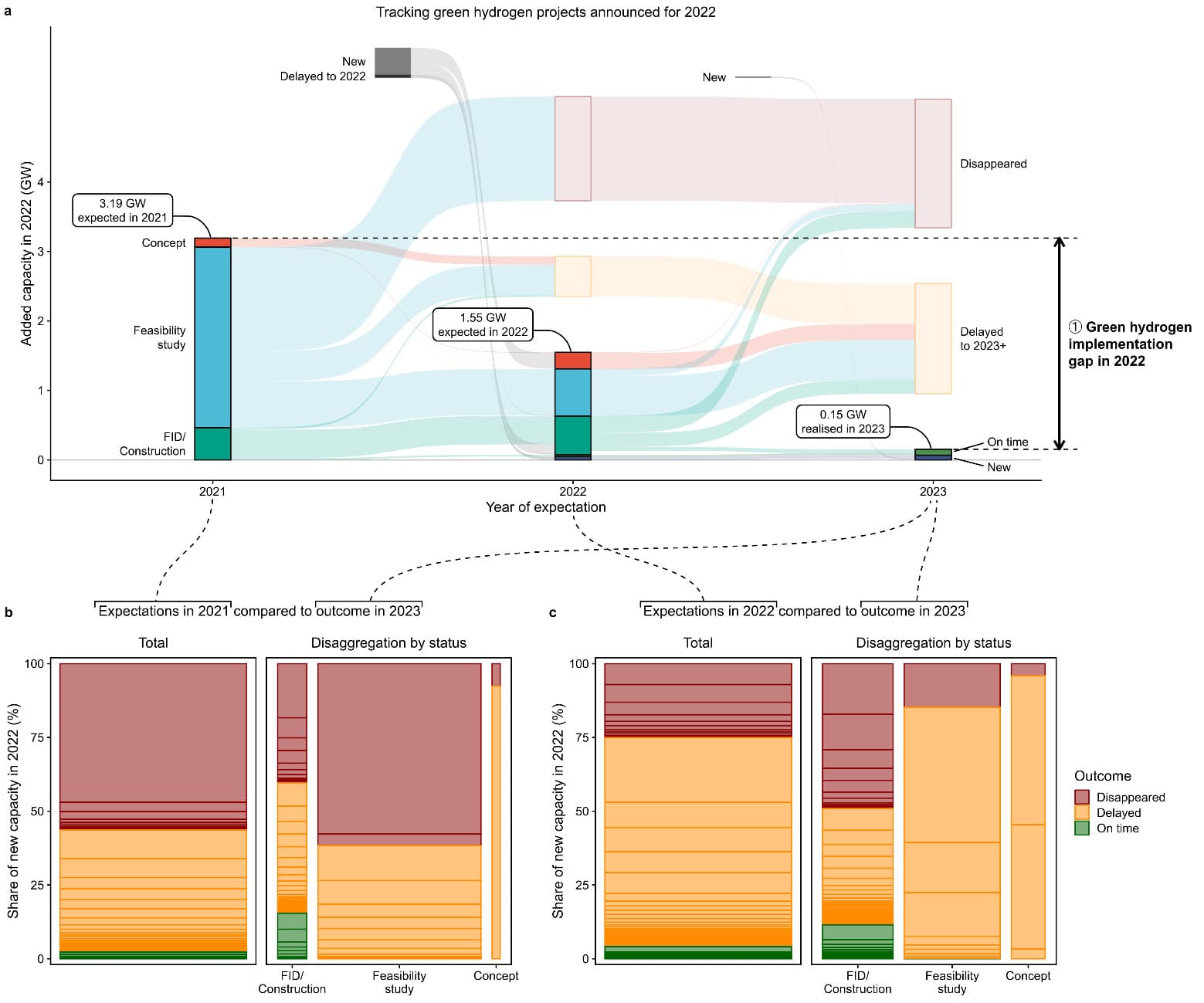
Rys. 1. Analiza 1232 projektów wodorowych ogłoszonych w latach 2020–2023: od ogłoszenia przez wstępną decyzję inwestycyjną (FEED) po finalną decyzję inwestycyjną (FID). Mniej niż 10% projektów przekroczyło próg FID. Źródło: Odenweller A., Ueckerdt F., The green hydrogen ambition and implementation gap, Nature Energy (2025), DOI: 10.1038/s41560-024-01684-7.
The authors show that even with the most aggressive assumptions about learning curves - that is, the rate at which technology becomes cheaper along with the scale of production - the cost gap will not close before 2035. Until then, green hydrogen will remain more expensive than gray unless subsidies intervene. And here comes the second problem: subsidies are there, but not where they need to be.
The United States offers a tax credit of up to USD 3 per kilogram of clean hydrogen under the Inflation Reduction Act. The European Union has launched the European Hydrogen Bank with a budget of EUR 3 billion. Germany has allocated EUR 9 billion. In total, global hydrogen subsidy commitments exceed $300 billion. And yet, the implementation gap is growing.
Why? Because the money flows mainly to early-stage projects - research, pilots, feasibility studies. Not until the final investment decision. And without FID, there is no steel, concrete and EPC contracts (engineering, procurement, construction). Odenweller and Ueckerdt call this the “valley of death between announcement and implementation” — and show that it is deeper than in any other energy transition technology.
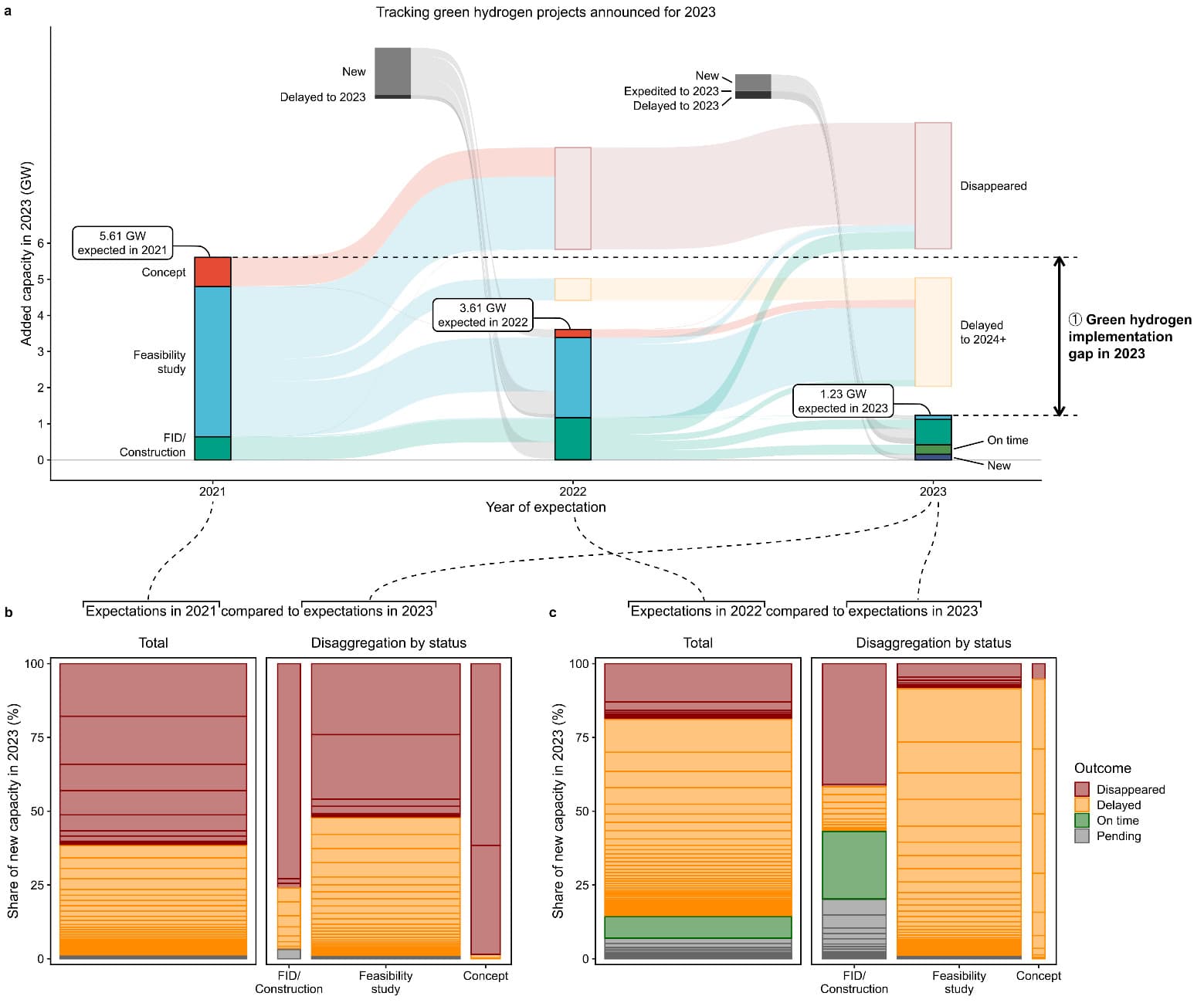
Rys. 2. Luka kosztowa między zielonym a szarym wodorem. Nawet przy optymistycznych krzywych uczenia się elektrolizerów, zielony wodór pozostanie 2–4 razy droższy od szarego co najmniej do 2035 roku. Źródło: Odenweller A., Ueckerdt F., Nature Energy (2025), DOI: 10.1038/s41560-024-01684-7.
There is something deeply disturbing about this analysis. The authors documented a pattern that repeats itself in every technology wave: first, the hype — hundreds of announcements, conferences, white papers. Then disappointment - when it turns out that physics and economics have their own opinions. We saw the same thing with CCS (CO₂ capture) a decade ago. With fuel cells a decade earlier. With solar power in the 1970s
The difference is that the stakes are higher this time. Without green hydrogen, it is impossible to decarbonize heavy industry - steel, chemical, refinery. These three sectors account for approximately 20% of global CO₂ emissions. If hydrogen does not take off, the energy transformation will be stuck halfway - electricity from renewable energy sources will decarbonize the network, but not the industry.
Germany pays, Poland hesitates
Poland is a special case in this puzzle - and a particularly uncomfortable one. On the one hand: the third largest producer of gray hydrogen in the European Union. Approximately 1.3 million tons per year, mainly for the needs of Orlen's refineries and chemical plants (nitrogen fertilizers in Puławy, Police, Kędzierzyn-Koźle). On the other hand: the Polish Hydrogen Strategy of 2021 assumes 2 GW of electrolyzer capacity by 2030 - but to date, not a single project has passed the Odenweller and Ueckerdt sieve.
Orlen announced the construction of a hydrogen hub in Włocławek - ultimately 250 MW. The project has a feasibility study, but the FID has not been passed. PGE signed a letter of intent with Denmark's Ørsted. PGNiG - memorandum with the Japanese JOGMEC. None of these documents are binding. None passed the FEED phase.
There are several reasons - and they are all systemic. The price of electricity in Poland is among the highest in the EU, and energy accounts for 60-70% of the cost of green hydrogen production. Hydrogen transmission infrastructure is practically non-existent - Gaz-System has only just started examining the possibility of injecting hydrogen into existing gas pipelines. The Hydrogen Act, which was supposed to create a legal framework for investments, was stuck in inter-ministerial consultations for over two years. And most importantly - the Polish energy mix is 70% based on coal, so "green" hydrogen produced from the power grid would in practice be hydrogen in name only.
However, there is a path that Poland is not using. Countries that are actually implementing hydrogen – the Netherlands with a hub in Rotterdam, Denmark with Ørsted's projects, Germany with the H2Global program – have done three things at once.
First: contracts for difference. The CfD (Contract for Difference) mechanism consists in the state guaranteeing the producer a fixed price for hydrogen - and if the market price is lower, it pays the difference. In the UK, the same mechanism launched offshore wind energy, reducing its costs by 70% within a decade. In Germany, the H2Global program has just started with a budget of EUR 900 million for the first hydrogen auctions.
Second: infrastructure integration. The Dutch have connected the hydrogen hub in Rotterdam to the existing gas network - and are already pumping a mixture of hydrogen and gas to industrial customers. Poland has an extensive Gaz-System gas network - but there is not a single section certified for hydrogen transmission.
Third: focus on specific applications. Green hydrogen makes economic sense primarily where there is no alternative - in the steel (iron ore reduction), chemical (ammonia, methanol) and refinery (fuel desulfurization) industries. Hydrogen mobility – cars, buses, trains – is currently uneconomical and will probably never be competitive with electric batteries. Poland has all three sectors - steel (ArcelorMittal Poland), chemicals (Grupa Azoty) and refineries (Orlen) - concentrated in three locations: Dąbrowa Górnicza, Police and Płock. These are not scattered experiments. This is a ready-made hydrogen hub map.
The window closes in 2027
Odenweller and Ueckerdt end their analysis with a forecast that should be a point of reference for every decision-maker. If current trends continue - and there is no reason to believe that they will accelerate without radical interventions - by 2030 the world will have not 190 GW, but about 25-40 GW of electrolyzer capacity. It's not a "delay". This means that green hydrogen will not play a significant role in decarbonization before 2040.
This is an alarm signal for Poland. The EU's Carbon Border Adjustment Mechanism (CBAM) will come into full force from 2026 - and will impose fees on imports of goods with a high carbon footprint. Polish fertilizers produced from gray hydrogen, Polish steel from coal blast furnaces, Polish fuels from refineries without green hydrogen - all this will become uncompetitive on the EU market not in a decade, but in 3-4 years.
What exactly needs to happen? The decision on contracts for difference for hydrogen - modeled on the British CfD model for offshore wind - must be made in 2026, so that the first auctions can start in 2027. The location of at least one hydrogen hub - Gdańsk, Włocławek or Police - must be selected and announced with a specific schedule, not another "memorandum of understanding". Poland must submit an application to the European Hydrogen Bank in the second auction round - the first round has already been resolved and there were no Polish projects on the list.
The stakes are higher than ever. The 337 citations of Odenweller and Ueckerdt's work are not only recognized by the scientific community. This is a signal that the industry, policymakers and financial markets are starting to treat hydrogen not as a miracle technology of the future - but as a real engineering project that requires real investment decisions. And which, without such decisions, will remain what it is today: a trillion-dollar promise.
Sources
Odenweller A., Ueckerdt F. (2025). "The green hydrogen ambition and implementation gap." NatureEnergy, 10, 110-123. DOI: 10.1038/s41560-024-01684-7.
IEA (2024). Global Hydrogen Review 2024. International Energy Agency, Paris.
Ministry of Climate and Environment (2021). Polish Hydrogen Strategy until 2030 with a perspective until 2040. Warsaw.
Hydrogen Europe (2024). Clean Hydrogen Monitor 2024. Brussels.
European Commission (2024). European Hydrogen Bank - Terms and Conditions for the First Auction. DG CLIMA, Brussels.
Orlen S.A. (2024). Orlen Group Hydrogen Strategy 2030. Płock.
Comments· 0
No comments yet. Be the first.