The missing atom. How a catalyst defect turns plastic into an amino acid
In a crystal that is meant to work, every flaw is an enemy. A missing atom is a defect that materials engineers spend years removing. And yet the most effective plastic-degradation catalyst described in 2025 works precisely because something is missing from it.
Let us start with a number that keeps chemists up at night. 353 million tonnes — that is how much plastic humanity throws away every year. Most of it ends up in landfills, incinerators, or the ocean. Mechanical recycling, the kind from the yellow bin, degrades the material with each pass: a bottle becomes a flowerpot, a flowerpot becomes a cable, a cable becomes nothing. Chemists call this downcycling. Of the plastic that Nature Communications bluntly calls “white pollution,” less is recovered today than the advertisements promise.
Among this sea of waste there is one material that looks innocent: polylactic acid, or PLA. This is the “green” plastic from coffee cups, salad containers, and 3D-printer filament. It is made from plants, not oil, yet it can take hundreds of years to break down. Every year 0.7 million tonnes of it are produced — that is 31 percent of all bioplastics in the world, and a market worth 3.1 billion dollars that tripled in a single year.
And here the puzzle begins.
Wall number one: a plastic that refuses to become anything else
To understand why this problem has survived for decades, you have to look into the chemistry. A PLA molecule is a long chain of thousands of linked lactic-acid units. Breaking such a chain and recovering valuable molecules is a fight against thermodynamics. The simplest ideas — heat it, dissolve it — give you back lactic acid, which is exactly what the plastic was made from. A closed loop, yes, but a loop without profit: you recover a raw material worth less than the energy you put in.
The real prize would be something else entirely: an amino acid. Alanine is one of the twenty building blocks of proteins. It is sold as an ingredient in medicines, supplements, cosmetics, and animal feed — at a price many times higher than a kilogram of plastic. If waste could be turned into alanine, recycling would stop being a cost and become a gold mine.
For years nobody managed to do it under sensible conditions. The first attempt — by Ma and colleagues — required 140 degrees Celsius and 94 hours to obtain 77 percent alanine. Too hot, too slow, too expensive. The first wall stood untouched.
Sunlight was supposed to settle it. It failed
Then came a solution that promised to be a breakthrough. It is called photoreforming and it sounds like a dream come true: you drop plastic into water, shine sunlight on it, and a catalyst breaks down the polymer and releases hydrogen — a clean fuel. No high temperature, no pressure, free from the sun. Papers piled up, citations grew, grants flowed.
The reader had every right to think: this is it.
Until it turned out the devil was in the details. For photoreforming to even start, the plastic first has to be treated with a solution of sodium or potassium hydroxide at a concentration of 1–10 moles per litre — that is corrosive, energy-hungry chemistry. And then, instead of one clean product, you get a soup of small molecules: a bit of this, a bit of that. You break down the plastic, but the value disappears with it. The carbon that nature spent years arranging into chains goes up in smoke.
It was a dead end that briefly pretended to be a road.
Why it could never work
The problem lay in what photoreforming ignored. Hydrogen is cheap — it is cheaper to make from natural gas. The real value of plastic lies in its carbon and nitrogen, which could be turned into something valuable, such as an amino acid. Except that amination — attaching an amine group to a carbon chain — is one of the hardest reactions in organic chemistry.
After Ma's first breakthrough only one successor remained: the photocatalytic CoP/CdS system of Liu's team, which reached 2.4 millimoles of alanine per gram of catalyst per hour at 80 degrees. Better, but still too hot and too slow for anyone to build a factory on it. Wall number two: even when the reaction works, it is too slow and under too harsh conditions.
And then, in a laboratory at the National University of Singapore, the chemist Ning Yan asked the question that overturned everything.
The missing atom
Instead of building an ever more complicated catalyst, his team started from something banal: cadmium sulfide, CdS — a yellow powder chemists have known for decades. Normally CdS is synthesized in an autoclave at high temperature, and the “defects” — missing sulfur atoms — are then removed by elaborate methods: plasma, hydrogen treatment, atomic-layer deposition.
Yan's team did something almost outrageously simple. At room temperature, slowly dripping a sodium sulfide solution into a cadmium acetate solution, they obtained a series of CdS nanoparticles in which — by adjusting the proportions — they deliberately left different numbers of missing sulfur atoms. Zero defects in sample CdS-6. Thirty-three percent in sample CdS-1.
Then shredded PLA plastic, ammonia, and visible light went into the reactor — and it turned out that the missing atoms were doing something nobody expected.
A volcano nobody predicted
The results arranged themselves into a curve chemists call a volcano curve — the heart of this story. A catalyst with no defect did nothing. With a few vacancies, it began to work. At the optimal number, in sample CdS-3, it produced alanine at a rate of 2.15 millimoles per gram per hour at 50 degrees, and after heating to 70 degrees — 4.95 millimoles.
That is twice as fast as the previous best result, achieved at a lower temperature. And at 30 degrees — almost room temperature — the reaction still ran.
Why is the curve shaped like a volcano rather than a straight line? Because the missing sulfur atom plays two contradictory roles at once. On one hand it is the spot where lactic acid sticks — the more vacancies, the more grips for plastic molecules. On the other hand, an excess of vacancies acts as an electron trap, quenching the whole process. The sweet spot — CdS-3 — is the point where there are enough grips and still no shortage of electrons.
It turned out that the defect was not a flaw. It was the catalyst.
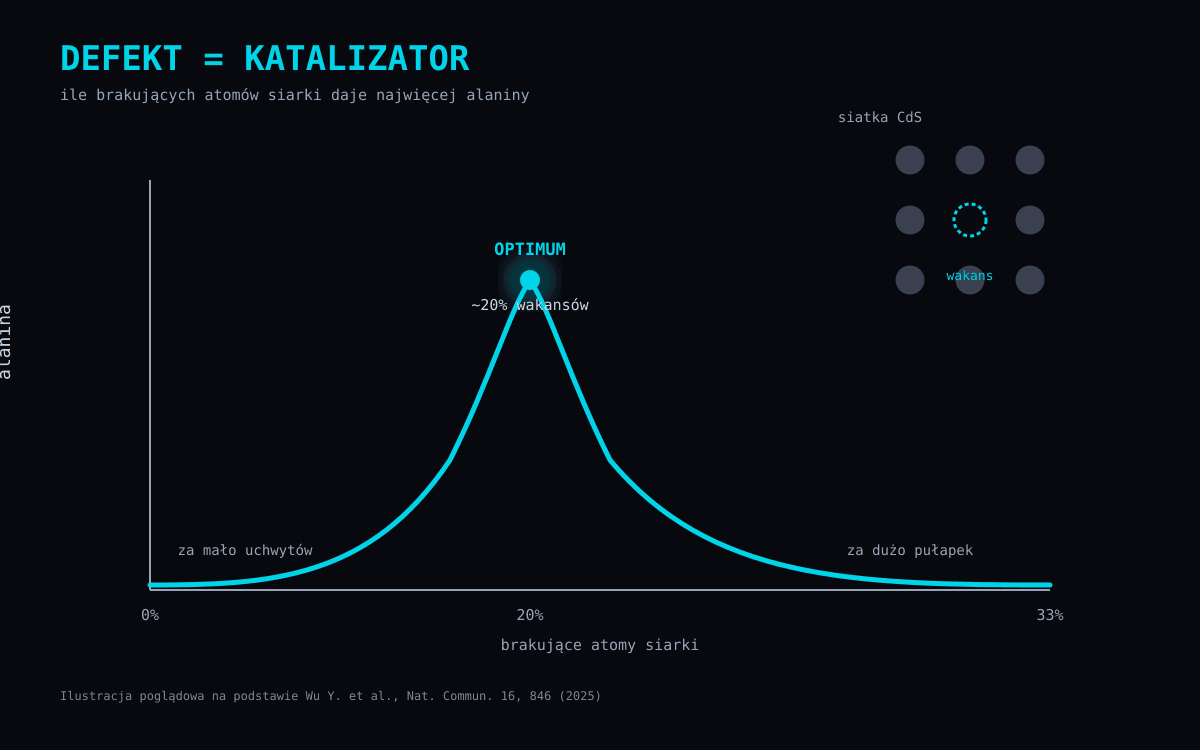
Rys. 1. Krzywa wulkaniczna: wydajność produkcji alaniny rośnie z liczbą brakujących atomów siarki (wakansów) w katalizatorze CdS, osiąga optimum przy ok. 20% wakansów, a potem spada, gdy defekty zaczynają wygaszać reakcję. Schemat własny na podstawie: Wu Y. et al., Nature Communications 16, 846 (2025), DOI: 10.1038/s41467-025-55930-x.
A coffee cup goes into the reactor
To prove this was not a laboratory curiosity, the team took a real PLA plastic cup — the kind you drink takeaway coffee from. Cut into flakes it gave 1.23 millimoles of alanine per gram per hour. Ground into a powder with 90–180 micrometre grains — 2.35 millimoles. That is seven times more than alanine obtained from sugar derived from woody biomass.
After five cycles the catalyst retained 88 percent of its activity and did not change shape. The paper even includes a plant schematic: a sunlight-powered photoreactor, membrane distillation recovering ammonia at 40–46 degrees, and a crystallizer where alanine precipitates as a pure product.
It is still laboratory scale — millimoles, not tonnes. But the direction is clear: waste that only used to litter can become a raw material for medicines and feed.
A race nobody is watching
Singapore is not alone in this. A quiet race is underway worldwide to be the first to turn plastic into higher-value chemicals — and the stakes rise with every EU regulation.
France's Carbios has already built an industrial plant that enzymatically breaks PET back down into monomers — but that is still the same plastic, just rebuilt. America's LanzaTech turns waste gases into ethanol and chemicals using bacteria. Novoloop in Silicon Valley breaks polyethylene into components for adhesives and coatings. Each targets a different slice of the value chain, but none does what Yan's team does: none lifts plastic to the rank of an amino acid, a molecule of biological significance.
The amino-acid market is worth well over 20 billion dollars a year — driven by feed, supplements, and pharma. Alanine — the very molecule that emerges from breaking down PLA — goes into the drips used in enteral nutrition, into the media used to culture cells in the production of biologic drugs, and into cosmetics. Its price per kilogram is orders of magnitude higher than the plastic it is made from.
And here lies an irony familiar to anyone watching European climate policy. Europe tightens rules on recycled content in packaging, but the pioneering chemical-recycling plants are being built in Asia and America. The technology described in Nature Communications is fully available — it is open access, gold standard OA, a PDF anyone can download. The knowledge is public. The deployment is not.
Poland is standing in the doorway. It just does not know the door is open
Why does this story concern Poland? Because our country is one of the largest plastics producers in Europe — the petrochemical complex in Płock runs at full steam — while recycling far less than EU targets require. The Packaging and Packaging Waste Regulation (PPWR) imposes a concrete deadline: by 2030 plastic packaging must contain a set percentage of recycled content, and some single-use plastics will disappear from the market altogether. For a producer without its own recovery technology, that is a straight road out of the market — or a forced purchase of expensive recycled material from abroad.
We already have the skills to enter chemical upcycling. Polish institutes — IChF PAN and IChO PAN in Warsaw, Warsaw University of Technology, Wrocław University of Science and Technology — have worked for years on photocatalysis and catalysis, exactly the chemistry behind turning plastic into an amino acid. Orlen and Grupa Azoty operate plants where such a process could be scaled, and the money is within reach: NCBR and PARP programmes and the National Recovery Plan fund the green transformation of industry. One thing is missing: the courage to build the first pilot instead of waiting for someone in Rotterdam or Shanghai to do it.
And the stakes are concrete and countable. The alanine we import today for pharma and feed could tomorrow be made from our own waste. Whoever turns a coffee cup into an amino acid first captures a market worth billions — and not in a decade, but the moment the first photoreactor stands in the sun. Time is running out: 2030 is closer than it seems.
Sources
- Wu Y., Nguyen P. T. T., Wong S. S., Feng M., Han P., Yao B., He Q., Sum T. C., Zhang T., Yan N., Photocatalytic upcycling of polylactic acid to alanine by sulfur vacancy-rich cadmium sulfide, Nature Communications 16, 846 (2025). DOI: 10.1038/s41467-025-55930-x
Comments· 0
No comments yet. Be the first.