The first nuclear clocks tick in thorium-doped crystals
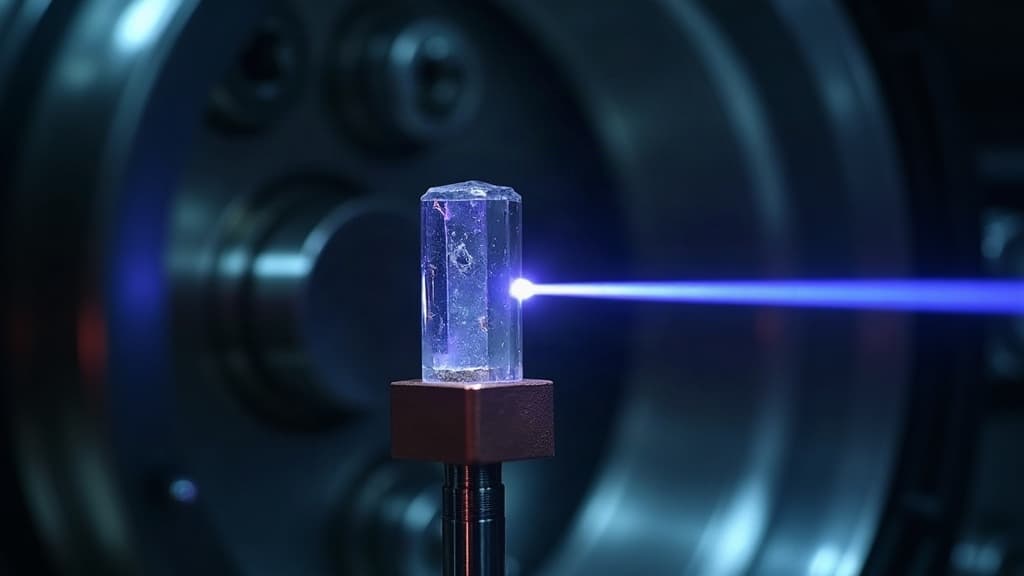
In a laboratory at the Atominstitut of TU Wien, the Vienna University of Technology, stands a clock in which time is kept by the nucleus of an atom. The heart of the device is a calcium fluoride crystal three millimetres across. Thorium-229 nuclei sit in its lattice. A laser shines ultraviolet light with a wavelength of 148 nanometres on them, and the electronics keep checking whether the nuclei are still absorbing that light. If they absorb less, the laser gets a correction.
Every optical clock works this way. What is new is that the reference is not the electrons orbiting the nucleus but the nucleus itself. The team of Thorsten Schumm at TU Wien and Ekkehard Peik of PTB, Germany's national metrology institute, described the clock in Nature on 7 October. In the same issue, the team of Shiqian Ding at Tsinghua University in Beijing presented a similar clock. The two groups worked independently.
For now, both clocks run worse than the best atomic clocks. Still, physicists have waited more than twenty years for this moment. Let us take the Vienna device apart.
Why the nucleus and not the electrons
An atomic clock is, at heart, a pendulum with an extraordinarily even beat. The role of the pendulum is played by an electron jumping between two energy levels in an atom. The laser light locks onto that jump and oscillates at its frequency. A counter counts these oscillations, and the second is built from them.
Electrons have a weakness, though. They are sensitive to their surroundings: to electric and magnetic fields, to heat, to neighbouring atoms. That is why the best optical clocks hold single atoms or ions in a vacuum, in traps made of fields and lasers.
The nucleus is about a hundred thousand times smaller than the whole atom and responds far more weakly to disturbances. The trouble is that jumps in nuclei usually require enormous energies. There are no lasers for such transitions.
Thorium-229 is the exception, the only one known. Its nucleus has an excited state with an energy of only about 8.4 electronvolts. That corresponds to vacuum ultraviolet, light that a laser can produce. In 2003, Ekkehard Peik and Christian Tamm of PTB proposed building a clock on this transition.
The road ahead was long. Physicists noticed the first traces of this state as early as 1976. Its existence was confirmed in 2016, and light emitted by the excited nuclei was first recorded in 2022. In 2024 the team from Vienna and PTB excited thorium nuclei with a laser. One last step was missing: a clock in which the nucleus itself steers the laser.
Part one: the crystal
The best atomic clocks contain a single ion or a few thousand atoms. In Vienna, the thorium nuclei sit in an unassuming crystal at room temperature. There are about 10 to the power of 16 of them in the laser beam, ten million billion. Such a large number gives a strong signal.
The crystal does not even have active temperature control. Its temperature drifted by half a degree around 21.5 degrees Celsius. The clock did not mind. The transition the physicists chose shifts by 1.8 kilohertz per degree. At a frequency of around two million billion hertz, that is very little.
Thorium-229 itself is a rare commodity. The Vienna team obtained it from Oak Ridge National Laboratory in the United States, through the US isotope programme.
Part two: a 148-nanometre laser
Light with a wavelength of 148 nanometres is absorbed by air, and most optical materials do not let it through. That is why the crystal and the detector sit in a vacuum chamber.
Lasers that emit such light continuously appeared only in 2025. The Vienna setup starts with an infrared laser at 1,187 nanometres. Its frequency is first multiplied by four. The final doubling is done by a strontium tetraborate crystal. Only 65 picowatts of ultraviolet reach the detector behind the sample. That is very little. The thorium nuclei absorb 0.75 per cent of it.
The Beijing team took a different route. Their ultraviolet light is produced in cadmium vapour heated to 600 degrees. The process is called four-wave mixing. It delivers 10 microwatts of continuous ultraviolet light.
Part three: the loop that keeps the laser on course
A clock is not just a laser that hits the transition. It is a laser that stays on it. In Vienna, short-term stability comes from an optical cavity, a pair of mirrors between which light bounces thousands of times. The cavity, however, slowly drifts. Without correction, the laser would wander away from the nuclear resonance.
The correction comes from measuring absorption. A photomultiplier behind the crystal counts the photons that pass through the sample. The electronics step the laser alternately slightly above and slightly below the absorption peak. From the difference between the signals, they know which way it has drifted. Each correction takes about a second.
This matters because an excited thorium nucleus in the crystal lives for about ten minutes. Earlier measurements had to wait for the nuclei to emit the absorbed energy as light. Measuring absorption allows an immediate response. The team tested two operating rhythms: a correction every 20 seconds and every 30 minutes.
The test: a day next to an ytterbium clock
Every new clock has to be compared with something. The Vienna nuclear clock was connected by a stabilised optical fibre to an ion clock based on a single ytterbium ion. That clock stands at BEV, Austria's office of metrology and surveying.
The nuclear clock ran for a day without human intervention. Over that time, its fractional instability approached one part in a million billion, or 10 to the power of minus 15. Roughly speaking, that is a spread of about a second in 30 million years. The best electron-based atomic clocks are clearly more stable today. The authors say so plainly.
A problem also emerged. Results from different days agreed less well than results within a single day. Each time, the laser has to be realigned, and the half-millimetre beam hits a slightly different spot in the crystal. The physicists tested this by moving the crystal on purpose. At different points, the centre of the line differed by as much as 1.7 kilohertz. They suspect strain in the crystal. Better-grown crystals and a fixed beam path should reduce the problem.
Beijing in the same issue
At the same averaging time, the Tsinghua team reached an instability about six times lower. A much more powerful laser helped. Another result is more interesting, though. The Chinese physicists grew their own crystal from a solution containing just 1.4 micrograms of thorium-229. They compared two independently made crystals. The transition frequency in them agreed to within 10 to the power of minus 13. It also agreed with earlier measurements by other groups.
This answers a question that has hung over the whole field. A time standard must be reproducible. If every crystal ticked differently, a nuclear clock would be of no use.
So the two groups are not saying exactly the same thing. Vienna showed long, stand-alone operation and a comparison with the clock of a national metrology office. Beijing showed better stability and reproducibility between crystals.
Dark matter in a small crystal
Who needs a clock that is worse than existing ones? The answer lies in the physics of the nucleus itself. The energy of thorium-229's excited state is small by coincidence. It is the difference between two huge contributions, electromagnetic and nuclear, each of the order of millions of electronvolts. They almost cancel out.
As a result, the thorium transition responds very strongly to any change in the constants of nature. According to theorists, several orders of magnitude more strongly than transitions in atomic clocks. Some hypotheses about dark matter predict exactly such changes. Light dark-matter particles could cause tiny, periodic fluctuations in the values of these constants.
The Vienna team searched a day of data for this. It found no signal. For coupling to photons, the new limits are similar to those from the best atomic clocks. For the strong interaction and quark masses, the nuclear clock reached ten to a thousand times deeper than earlier experiments. The physicists also looked for a slow drift. It came out consistent with zero.
What is solid here and what is not yet
Three things are solid. For the first time, an atomic nucleus steers a laser in a closed loop. It works in a crystal at room temperature, without traps for single atoms. Two independent teams reached the same result by different methods.
Everything concerning an advantage over atomic clocks is uncertain. For now, that advantage is a promise. The authors list what can be improved. A more powerful ultraviolet laser, a higher thorium concentration and a narrower line in the crystal could lower the instability by several orders of magnitude. No one has shown this yet.
The exact sensitivity coefficients of thorium to changes in the constants of nature are also unknown. Theorists cannot calculate them yet because data on the structure of the nucleus are missing. The dark-matter measurements therefore give results for several assumed values.
The business layer: lasers, the isotope and applications
The nuclear clock is not a product today. It already has suppliers, though. The Vienna team thanks the German laser maker Toptica Photonics for more than ten years of collaboration. Continuous vacuum-ultraviolet lasers are still experimental equipment. The authors point out that the next jump in power could come from commercially available three-watt ultraviolet lasers.
The second bottleneck is the isotope. Thorium-229 is produced by the decay of uranium-233 and cannot be bought off the shelf. The Chinese result with 1.4 micrograms shows, however, that trace amounts are enough for one crystal.
For now, the applications are of two kinds. The first is fundamental physics: the search for dark matter and for variations in the constants of nature. The second is more down to earth. A clock in a crystal, without vacuum traps for atoms, could one day become a small and robust time standard. Such a standard would be useful in telecommunications networks, in the power sector and in navigation when satellite signals are jammed. Clocks also help in geodesy. Among the co-authors of the Vienna paper are geodesists from Leibniz University Hannover. But this is a plan for years ahead, not an offer.
The project was funded by, among others, the European Research Council. Part of the work was done within the European Partnership on Metrology, co-financed by the European Union.
Poland: clocks from Toruń
Poland has a strong starting position in this field. The National Laboratory FAMO in Toruń operates optical strontium clocks. In 2015, a team of physicists from Toruń, Kraków and Warsaw described in Scientific Reports a measurement of the strontium clock frequency on two such clocks. The result was compared with the local realisation of UTC time via a 330-kilometre stabilised fibre-optic link.
These are exactly the skills a nuclear clock requires: stable lasers, frequency combs and transferring the reference over optical fibre. The Vienna team made its comparison with the BEV metrology office precisely over fibre. The institutions of the co-authors also include the Institute of Scientific Instruments of the Czech Academy of Sciences in Brno. Central Europe is therefore already part of this project.
Polish teams can enter the game in two ways. They can compare nuclear clocks with their own standards over the fibre network. They can also work on crystals and ultraviolet lasers, where mature solutions are still lacking.
TRL 3: why not higher
We have a working laboratory system. The feedback loop closes on the nuclear transition, and the clock ran for a day. That is technology readiness level 3, an experimental proof of concept. To reach level 4, it needs better reproducibility between days and between crystals within one device. It also needs stability that matches atomic clocks. A portable nuclear clock is not yet on the cards.
Physicists have been waiting for this clock since Peik and Tamm's proposal in 2003. Now it is ticking in two laboratories at once. The coming years will show whether it can beat electron-based clocks.
Bibliography
- Toscani De Col L., Riebner T., Morawetz I. et al. (incl. Peik E., Schumm T.). A thorium-229 optical nuclear clock with feedback loop. Nature (2026), published 7 October 2026. DOI: 10.1038/s41586-026-11084-4
- Huang B., Yan G., Xiao Q. et al. (incl. Ding S.). A nuclear clock synchronized to 229Th. Nature (2026), published 7 October 2026. DOI: 10.1038/s41586-026-11122-1
- Peik E., Tamm C. Nuclear laser spectroscopy of the 3.5 eV transition in Th-229. Europhysics Letters (2003). DOI: 10.1209/epl/i2003-00210-x
- Kroger L., Reich C. Features of the low-energy level scheme of 229Th as observed in the α-decay of 233U. Nuclear Physics A (1976). DOI: [10.1016/0375-9474(76)90494-2](https://doi.org/10.1016/0375-9474(76)90494-2)
- von der Wense L. et al. Direct detection of the 229Th nuclear clock transition. Nature (2016). DOI: 10.1038/nature17669
- Kraemer S. et al. Observation of the radiative decay of the 229Th nuclear clock isomer. Nature (2023). DOI: 10.1038/s41586-023-05894-z
- Tiedau J. et al. Laser excitation of the Th-229 nucleus. Physical Review Letters (2024). DOI: 10.1103/PhysRevLett.132.182501
- Morzyński P., Bober M., Bartoszek-Bober D. et al. Absolute measurement of the 1S0 − 3P0 clock transition in neutral 88Sr over the 330 km-long stabilized fibre optic link. Scientific Reports (2015). DOI: 10.1038/srep17495
- Nuclear clocks tick for the first time. Nature (2026). DOI: 10.1038/d41586-026-03060-9
Comments· 0
No comments yet. Be the first.