The wall everyone already knew
Partial oxidation of methane to syngas (a mixture of carbon monoxide and hydrogen near a 2:1 ratio) sounds like a textbook industrial recipe. The reaction is exothermic: at 25 °C the heat effect is about −35.5 kJ/mol. The feedstock is cheap. The product feeds Fischer–Tropsch chemistry, ammonia and methanol. Since the 1940s it has been clear that nickel can open that path. For decades textbooks and reviews also repeated a second part of the legend: for POM (partial oxidation of methane) to work well, the support needs plenty of metallic nickel — often around 10 wt% or more — kept in the reduced state.
That was wall number one. Not because nickel is “bad,” but because industrial catalyst logic closed on a simple equation: more metal → more active surface → higher conversion. In Poland that logic is visible in the Łukasiewicz – New Chemical Syntheses Institute catalogue: steam-reforming catalysts G-0117 and related grades are classic Ni/Al₂O₃, shipped as oxide and reduced to metallic Ni only after loading in the furnace. A different process (steam + methane, not POM with oxygen), the same intuition: nickel should become metal, because metal “does the work.”
False trail: metallic nickel as the obvious hero
For decades the POM literature had a persuasive hero. The indirect mechanism: first complete combustion of methane on oxidized nickel to CO₂ and H₂O, then reforming on metallic Ni to syngas. The direct mechanism: CH₄ dissociation on metallic Ni and reaction with oxygen. In both stories metallic nickel nanoparticles sit at the center. Twenty-first-century reviews, including surveys from 2022–2024, still treat high metal loading as the starting point for the state of knowledge.
A team from the Dalian Institute of Chemical Physics (Chinese Academy of Sciences), Xi’an Jiaotong University and the Cardiff Catalysis Institute (Graham J. Hutchings) chose not to add more nickel. They did the opposite. By a microemulsion route they deposited only 0.8 wt% Ni on Al₂O₃ — catalyst Ni/Al₂O₃-ME. At 650 °C in POM it reached 92.0% methane conversion and 87.0% selectivity to CO and H₂, with a stable H₂/CO ratio of 2.0. That matches an 8.0 wt% Ni catalyst made by classic impregnation — ten times richer in metal.
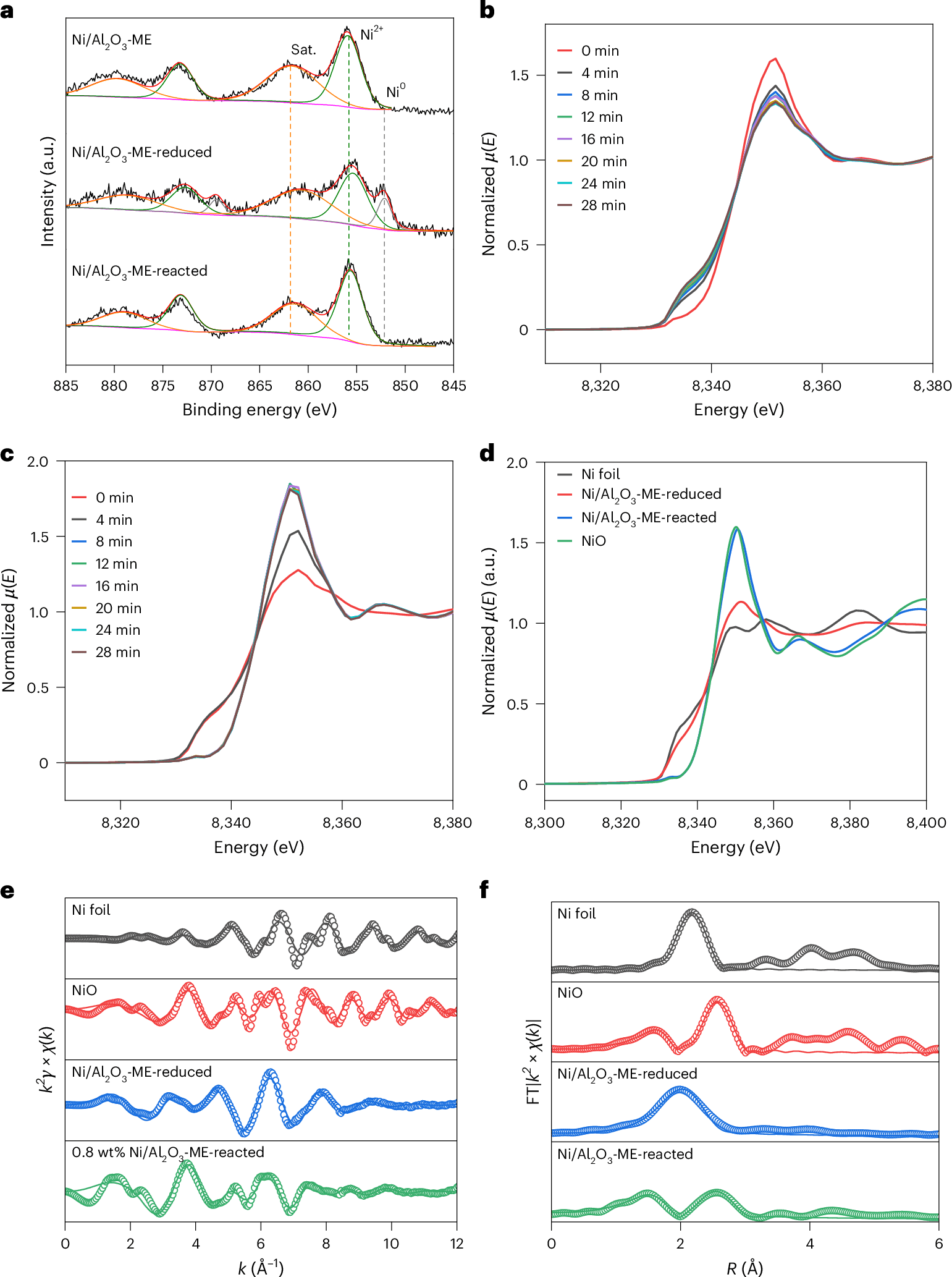
At this stage the story still looks like a win for “better dispersion.” A reader can assume metallic nickel is still working, only better placed. Operando spectroscopy and environmental microscopy showed something awkward for the old hero: under POM conditions metallic Ni quickly oxidizes to NiO. After reaction the low-nickel ME catalyst showed almost no metallic nickel, yet syngas still formed.
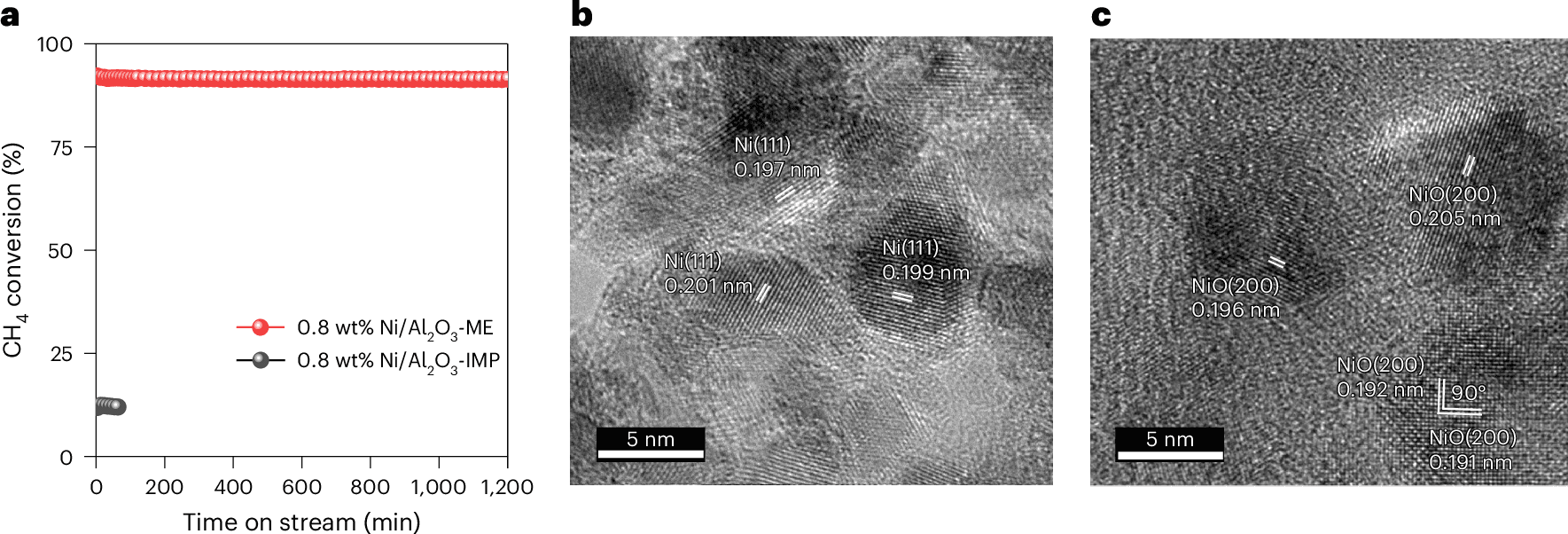
Rys. 1. Wydajność POM i obrazowanie faz niklu dla niskoniklowego katalizatora ME. Źródło: Tan et al., Nature Catalysis 2026, CC BY 4.0.
The control was cruel to intuition. The same 0.8 wt% Ni loading, but impregnated (Ni/Al₂O₃-IMP), did not run POM effectively — complete methane combustion dominated. Pre-formed pure NiO also failed at POM: only total oxidation. So neither “bare metal” nor “bare oxide” is enough. A third element was missing from the textbook list.
Why the old hero failed
Wall number two is not a spectacular reactor explosion. It is a quiet measurement mistake. After reaction it is easy to find metallic nickel — because hot syngas can reduce the oxide. The researcher sees Ni⁰ and concludes: “that catalyzed it.” The problem is that what you see after the process need not be what worked during it. At high metal loadings, excess nickel downstream returns to the metallic form anyway; the story of “indispensable metal” reinforces itself.
For low loading that story breaks. If metallic nickel quickly disappears into NiO and the catalyst still delivers 92% conversion, the active center must form in situ on the oxide surface. The old hero was not a lie in every plant — it was too convenient a mental shortcut. A shortcut that costs: more metal, more sintering and coking risk, higher active-mass cost, less incentive to design the surface instead of “adding nickel.”
Breakthrough: the [Ni₁O₁Ni₄] motif on NiO(100)
Operando high-resolution ABF (annular bright-field) imaging, backed by DFT calculations, pointed to a concrete structure. On the NiO(100) surface during reaction a [Ni₁O₁Ni₄] motif appears: one nickel atom sits on an oxygen atom that bridges four surrounding Ni atoms. This is not “more metal.” It is a local oxide reconstruction.
Rys. 2. Motyw [Ni₁O₁Ni₄] na NiO(100) i bariery aktywacji C–H. Źródło: Tan et al., Nature Catalysis 2026, CC BY 4.0.
C–H activation barriers for methane explain why the motif wins. On reconstructed [Ni₁O₁Ni₄] the barrier falls to 12.5 kcal·mol⁻¹. On intact NiO(100) it is 38.5 kcal·mol⁻¹. On metallic Ni(111) — 15.7 kcal·mol⁻¹. The oxide motif is therefore kinetically better even than the classic metal surface long treated as the obvious target.
The detective metaphor closes physically: the metallic-nickel trail was loud and easy to photograph after reaction. The real culprit left a trace only when someone watched during the run — at 650 °C, in a CH₄/O₂ mixture, on a living surface. Yuanlong Tan, Xiao Yan Liu, Wei Liu, Tao Zhang, Aiqin Wang, Tao Yang and Graham Hutchings showed in Nature Catalysis (14 August 2026, DOI: 10.1038/s41929-026-01580-1) that low nickel loading can match high loading if the surface can build the right motif itself.
Market: syngas without a ten-percent pile of metal
Syngas is not an academic curiosity. It is a bulk-chemical intermediate. POM competes with steam reforming (endothermic, energy-hungry) and with autothermal routes. POM’s edge is reaction heat and a natural H₂/CO ratio near 2 — convenient for Fischer–Tropsch. The bottleneck is the catalyst: coking, sintering, deactivation, metal cost and durability under redox conditions.
The Dalian / Cardiff finding does not yet sell a finished bed for a furnace. It does reset the design axis: not “how to keep Ni⁰ at any cost,” but “how to force and hold an NiO reconstruction that births [Ni₁O₁Ni₄].” For catalyst suppliers that changes the R&D brief. For process licensors it raises the question of less metal at the same duty — and whether microemulsion nanoparticles can be repeated at tonne scale. The TRL of this work is around 4: hard operando and DFT proof in the lab, without a continuous industrial campaign and without thousand-hour durability validation.
For a chemical investor the difference is concrete. High nickel loading is not only metal cost. It is also catalyst mass to replace, regenerate or dispose of, and the risk that a “metal surplus” only hides missing surface knowledge. Low loading with an in-situ active motif promises less nickel per tonne of syngas — provided the motif does not vanish after a hundred hours. The paper does not close that condition. It does close the dispute over whether measuring NiO reconstruction is worth doing before ordering another “richer” catalyst batch.
Competition is not idle. Mo–Ni alloy catalysts, Rh single atoms on oxides, and CeOₓ systems that stabilize metallic Ni keep appearing. Tan and co-authors do not cancel those tracks. They cancel the assumption that “more metallic nickel” is the only sensible lever in POM.
Poland: catalogue reforming and a question about motifs, not percentages
Polish industrial chemistry lives on syngas and hydrogen from reforming. Łukasiewicz – INS in Puławy offers Ni/Al₂O₃ catalysts for first- and second-stage steam reforming; the active component is nickel on a ceramic support, and the oxide form is meant to be reduced in the plant. Orlen in Płock maintains and overhauls reforming lines (including planned 2027 work on Reforming Unit V). Grupa Azoty has for decades burned and reformed gas on the ammonia and fertilizer path. This is not a “nice academic” ecosystem. It is an ecosystem that buys catalyst as part of the furnace.
The gap between POM and steam reforming matters: different stoichiometry, temperature and role of oxygen. So it is wrong to promise that the [Ni₁O₁Ni₄] motif will “replace tomorrow” the G-0117 rings in Puławy. It is fair — and necessary — to ask another question: can Polish catalysis groups (IKiFP PAS, AGH, the technical universities) and Łukasiewicz suppliers carry the in situ lesson from Nature Catalysis into their own redox tests? AGH already publishes on optimizing nickel loading and CeO₂–ZrO₂ supports in dry methane reforming. That is the same language: not “add metal,” but “design the active phase for reaction conditions.”
For Poland the window is practical. Orlen and Azoty will replace catalysts and modernize furnaces with or without one paper. Whoever enters the 2026–2028 conversation with data on low Ni loading, a durable surface motif and lower active-mass cost is not selling a “Chinese POM curiosity.” They are selling a cost and emissions argument in the language a process engineer understands. If we stay with the shortcut “reduce NiO to Ni and it will be fine,” we miss a decade in which competitors design surfaces while we only buy more metal.
Stakes
The detective closes the case without a marketing happy ending. Metallic nickel does not leave chemistry. Its monopoly on explaining POM does. At 0.8% Ni, 650 °C, 92% conversion and 87% CO/H₂ selectivity, the [Ni₁O₁Ni₄] motif on NiO(100) does what was supposed to need a tenfold larger pile of metal. Poland has furnaces, catalyst catalogues and research groups. The question for the next years is whether we can watch a catalyst while it works, or only what remains after the reactor is switched off.
Sources
- Tan Y. et al., In situ generation of active motifs on Ni/Al₂O₃ during partial oxidation of methane to syngas, Nature Catalysis 2026;9:848–857. DOI: 10.1038/s41929-026-01580-1 (CC BY 4.0).
- ScienceDaily / DICP — press summary (9 Sep 2026): sciencedaily.com/releases/2026/09/260909005148.htm.
- Łukasiewicz – New Chemical Syntheses Institute — steam hydrocarbon reforming catalysts (G-0117 / Ni/Al₂O₃ series): ins.lukasiewicz.gov.pl.
- Orlen S.A. — planned overhaul inquiry for Reforming Unit V (2027), Płock production plant (2026 tender notice).
- York A.P.E. et al. / Siang T.J. et al. — POM and methane oxyforming reviews (historical context and high-Ni “state of the art”).
- AGH / Polish Annual Conference on Catalysis — nickel loading and support optimization in methane reforming (Polish academic catalysis context).
Figures: Fig. 1 and Fig. 2 are from source (1) (paper Fig. 1 and Fig. 2), used unchanged under CC BY 4.0; credit: Tan et al., Nature Catalysis 2026.
Comments· 0
No comments yet. Be the first.