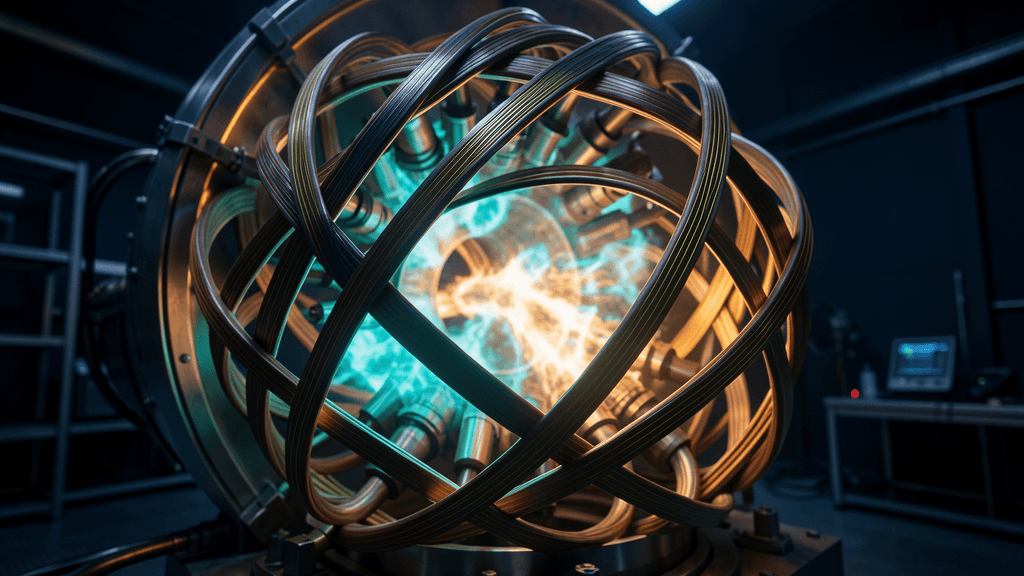
Supposed to Be Better Than the Tokamak. It Lost for 70 Years. Now It's Back
Supposed to Be Better Than the Tokamak. It Lost for 70 Years. Now It's Back
In December 2015, in Greifswald, Germany, physicists from the Max Planck Institute for Plasma Physics gathered in the control room of the world's largest stellarator — Wendelstein 7-X. The machine cost a billion euros and took 20 years to build. When the first plasma current — helium, diagnostic, without fusion fuel — flowed through the vacuum chamber, the screens did not show the catastrophe critics had feared.
The plasma held for exactly as long as supercomputer simulations predicted. Half a second on the first shot. Six seconds a year later. One hundred seconds in 2018 — temperature reached 40 million degrees Celsius. In February 2023: eight minutes of continuous operation, limited only by cooling system capacity, not plasma physics.
Why did the stellarator — which theoretically lacks the tokamak's biggest flaws: it doesn't need a massive current flowing through the plasma, doesn't experience violent shutdowns called disruptions, and operates continuously without restarting — remain in the shadow of its simpler competitor for seven decades? The answer is a story of three technological walls. Each seemed impassable. And each is now cracking — one after another.
Wall #1: "The Tokamak Is Simply Simpler"
In 1968, Soviet physicists at the Kurchatov Institute announced results from the T-3 tokamak: plasma temperature exceeded 10 million degrees — ten times higher than contemporary stellarators. Western scientists initially dismissed this as propaganda. Only when a British expedition from Culham Laboratory confirmed the measurements with a laser did the physics world accept the verdict: the tokamak works, the stellarator doesn't.
For the next half-century, it was the tokamak — a magnetic ring where plasma is simultaneously the secondary winding of a giant transformer — that became the default architecture. JET at Culham, TFTR at Princeton, JT-60U at Naka, KSTAR at Daejeon, and finally ITER in southern France — under construction since 2007 for $22 billion, intended to be the first to achieve Q > 10 (ten times more energy from fusion than put into heating the plasma).
The problem no one foresaw in the 1968 euphoria is that the plasma current — the source of the tokamak's simplicity — is simultaneously its greatest enemy. When plasma loses stability, a current of 15 million amperes (what ITER is designed to carry) dissipates in a fraction of a second, releasing magnetic energy capable of melting the reactor's steel wall. The JET tokamak experienced dozens of such events. In ITER — a machine ten times larger — electromagnetic forces unleashed by a disruption can exceed 100 meganewtons. That's the weight of ten Eiffel Towers focused on the reactor's support structure.
The stellarator doesn't have this problem — it doesn't need current in the plasma, so there's nothing to lose. The price of this stability is geometry: where the tokamak has simple rotational symmetry, the stellarator twists in three dimensions like a Möbius strip.
Wall #2: "Stellarator Geometry Cannot Be Computed"
For a stellarator to confine plasma without current, its magnetic coils must be so precisely shaped that the generated magnetic field exactly compensates for particle drift in the curved torus geometry. For a tokamak, this is one equation — symmetry handles the rest. For a stellarator, it's a system of coupled partial differential equations linking plasma, magnetic field, and coil geometry.
The first stellarators — Model C at Princeton (1962), Wendelstein 7-A at Garching (1988), ATF at Oak Ridge (1988-1992) — had coils designed based on simplified analytical approximations. Plasma leaked at the edges — energy loss rates were 3-5 times higher than in tokamaks. ATF was shut down after four years. In 1993, the U.S. Department of Energy terminated the stellarator program, deeming it a dead end.
In 1988, physicist Allen Boozer of Columbia University published the concept of quasi-symmetry — a mathematical condition guaranteeing that plasma in a stellarator behaves as if it had tokamak symmetry, even though geometrically it doesn't. The problem: finding a coil shape satisfying the Boozer condition was computationally impossible. With the supercomputers of that era, searching the parameter space would have taken decades.
The breakthrough came in 2014. A team from Max Planck IPP, led by Thomas Klinger, used a supercomputer for iterative optimization — the algorithm started from a random coil shape and modified it to minimize fast particle losses. After six months of continuous computation, a shape emerged that theoretically reduced alpha particle escape to tokamak levels. This was the Wendelstein 7-X design — a quasi-isodynamic stellarator that in 2023 operated continuously for 8 minutes.
Wall #3: "Even If It Works, It's Too Big"
Wendelstein 7-X weighs 725 tons, has a diameter of 16 meters, and 50 superconducting coils, each costing €2 million. Its magnets use low-temperature superconductors (LTS) operating at liquid helium temperature — 4 kelvins above absolute zero. LTS materials stop conducting without resistance at magnetic fields above 12-15 tesla.
For a stellarator to be commercially viable — meaning it produces more energy than it consumes, at a construction cost not exceeding a few billion euros — it must be at least 3-5 times smaller than W7-X. A smaller reactor means a stronger magnetic field. A stronger field means more current in the coils. More current — LTS can't handle it. A vicious circle that doomed stellarators to the role of a scientific experiment, never a power plant.
And then REBCO matured. Over three decades.
Breakthrough: The Tape That Changed the Rules of the Game
REBCO — rare-earth barium copper oxide — is a ceramic superconducting material discovered in 1987. Unlike LTS, it retains superconductivity at liquid nitrogen temperature (77 K) and tolerates magnetic fields exceeding 20 tesla. For 30 years, it remained a laboratory curiosity — it was brittle, difficult to produce, unsuitable for forming into superconducting cables.
By 2025, over a dozen companies worldwide produce REBCO tapes with current densities of 1000 amperes per square millimeter at 20 tesla. Japan's Fujikura, America's SuperPower (a Furukawa subsidiary), Britain's Tokamak Energy — each produces kilometers of tape annually. For comparison: the best LTS materials lose superconductivity at 15 T. A 5-tesla difference translates into a 3-4 fold reduction in reactor volume at the same fusion power.
A team led by J. Lion from Max Planck IPP and the American company Plasma Technology asked: what happens if we design a stellarator from scratch for HTS magnets, instead of adapting an LTS design? The answer was published in February 2025 in Fusion Engineering and Design. The Stellaris design — not accidentally named — is the first stellarator concept where plasma physics, magnet engineering, wall cooling, divertor, tritium blanket, magnet quench safety, and remote maintenance were optimized simultaneously.
The key innovation is a multi-objective cost function — the algorithm seeks a minimum not only for fast particle losses (as with W7-X) but simultaneously weights nine parameters: from stresses in the support structure, through port accessibility for a maintenance robot, to coil production cost. The result: a quasi-isodynamic stellarator with a plasma radius of 1.7 meters and a magnetic field of 9.5 tesla. For comparison, ITER's plasma has a radius of 6.2 meters. Stellaris is 3.6 times smaller.
The TRL of this technology is 3 — a concept validated by large-scale simulations, but without experimental demonstration. The next step — building a single HTS coil with stellarator geometry and quench testing — is an engineering challenge no one has yet undertaken.
The Race That Has Just Begun
Global private investment in fusion energy has exceeded $6.2 billion (Fusion Industry Association, 2024). Most flows to tokamaks with HTS magnets: Commonwealth Fusion Systems, an MIT spin-off, raised $2 billion to build SPARC — a compact tokamak intended to achieve Q > 1 (more energy from fusion than input) before 2030. TAE Technologies ($1.2 billion) bets on the field-reversed configuration. Helion Energy raised $500 million for a pulsed reactor that compresses plasma with a magnetic field instead of heating it.
But the stellarator is returning to the game, and with German momentum. Munich-based startup Proxima Fusion — founded in 2023 by engineers from Max Planck IPP who worked on W7-X — raised €20 million for the first commercial stellarator. American Type One Energy secured $82 million and collaborates with Oak Ridge National Laboratory on the Infinity One project. Both companies bet on the same advantage: the stellarator doesn't need plasma current, so there are no disruptions. If HTS magnets with the right geometry can be built — the stellarator will operate maintenance-free for months. It also doesn't need complex real-time plasma control systems that in a tokamak must respond in microseconds to edge-localized mode (ELM) instabilities.
Poland in the Game for Stars
Poland is a member of the EUROfusion consortium with an annual contribution of €8 million. IFPiLM (Institute of Plasma Physics and Laser Microfusion) in Warsaw — the only Polish unit fully dedicated to plasma physics — participates in experiments on Wendelstein 7-X, the JET tokamak, and preparations for ITER. Polish physicists from IFPiLM and AGH University in Kraków collaborate with the Max Planck IPP team on stellarator plasma diagnostics — specifically on the electron temperature measurement system using ECE (electron cyclotron emission), which operates in real time at frequencies of 120-160 GHz.
The industrial potential extends beyond diagnostics. ZTW Explomet in Opole — a world-class specialist in explosive welding — already produces bimetallic plates for ITER's first wall components. A cryosystem company from Wrocław supplies cryogenic installations for particle accelerators — technology closely related to cooling HTS magnets in a stellarator. AGH conducts research on neutron-radiation-resistant materials for the tritium blanket — a key element of any fusion reactor that produces fuel (tritium) during operation.
The problem is not competence — it's scale. €8 million in EUROfusion contributions is one-twentieth of what Germany contributes annually (€240 million), and one-fiftieth of ITER's total European budget. This investment gap translates into the number of PhD students, publications, and patents. In 2024, according to the Scopus database, Polish authors published 28 papers on fusion plasma physics. German authors — 312. The time window: consortia such as Proxima Fusion or Type One Energy plan a fusion power demonstrator before 2035. Countries that build the component supply chain — HTS magnets, cryogenic cooling, shielding materials — will enter the game as suppliers. The rest will buy ready-made technology at prices dictated by those who invested earlier.
Sources
- Lion J., Angles J., Bonauer L. et al., Stellaris: A high-field quasi-isodynamic stellarator for a prototypical fusion power plant, Fusion Engineering and Design, 202 (2025), 114868. DOI: 10.1016/j.fusengdes.2025.114868
- Macchi A., Bottino A., Brunetti D. et al., REBCO coated conductors: enabling the next generation of tokamak reactors, Superconductor Science and Technology, 38 (2025). DOI: 10.1088/1361-6668/ada9d2
- Greenwald M., Density limits in toroidal plasmas, Plasma Physics and Controlled Fusion, 44 (2002), R27. DOI: 10.1088/0741-3335/44/8/201
- Klinger T. et al., Overview of first Wendelstein 7-X high-performance operation, Nuclear Fusion, 59 (2019), 112004. DOI: 10.1088/1741-4326/ab03a7
- Boozer A.H., Physics of magnetically confined plasmas, Reviews of Modern Physics, 76 (2004), 1071. DOI: 10.1103/RevModPhys.76.1071
- Fusion Industry Association, The Global Fusion Industry in 2024, annual report (2024)
- EUROfusion, European Research Roadmap to the Realisation of Fusion Energy (2018)
- Proxima Fusion, Technology Overview: Stellarator Commercialization Pathway (2025)
- Type One Energy, Infinity One Stellarator Project Overview (2025)
- IFPiLM, Report on participation in the EUROfusion 2024 programme, Warsaw (2025)
Comments· 0
No comments yet. Be the first.