A solid electrolyte without toxic gases. It conducts like a liquid
False trail: the sulfide that could conduct
Airports ask you not to put a power bank in checked luggage. The reason is simple: in most lithium-ion batteries, lithium ions swim in a liquid. That liquid is flammable. When a pack ruptures or a cell overheats, the electrolyte turns a fault into a fire.
For years the answer was: make a solid electrolyte. The fastest results came from sulfide and chloride materials. Electrons around large, “soft” anions deform easily, so a lithium ion hops from site to site almost as in a liquid. Labs and startups built a success story around that: high conductivity, thin layers, dense cell packs. It looked as if this path would close the safety problem.
The wall the sulfide did not clear
Humidity and gas chemistry kept coming back. A sulfide exposed to moisture can release toxic hydrogen sulfide. A chloride can release hydrogen chloride. High conductivity was bought at the price of another toxicity and awkward manufacturing. Oxides and oxyfluorides are chemically and electrochemically calmer: they tolerate voltage swings during charge and discharge and do not shed gases on contact with air. For years they were simply too slow. A lithium ion in a rigid, hard-to-deform anion framework paid a high energy barrier for every hop.
Takeshi Yajima of Nagoya University put it plainly: at this stage, safety and ionic conductivity looked like an either–or trade. Oxyfluorides were safer but slow. Sulfides were fast but risky. That was the wall where the whole branch of “safe” solid electrolytes stalled.
A clue that looked like an unexplained exception
In 2024 a crystal with the formula Li₂₋ₓLa₍₁₊ₓ₎/₃Nb₂O₆F — LLNOF for short — appeared. Lithium conductivity around 7 mS/cm, comparable to liquid electrolytes, and therefore startling for oxide–fluoride chemistry. The soft-anion mechanism did not fit: the electron cloud around fluoride does not bend as easily as around sulfur or chlorine. The material worked, but no one could say why. Without millimeter-quality single crystals it was hard to inspect the local arrangement of atoms.
Yajima’s team spent more than a year growing such crystals by the Bridgman method. Only then did X-ray diffraction and electron-density analysis (maximum entropy) show what happens around the fluoride.
Breakthrough: the fluoride that steps aside
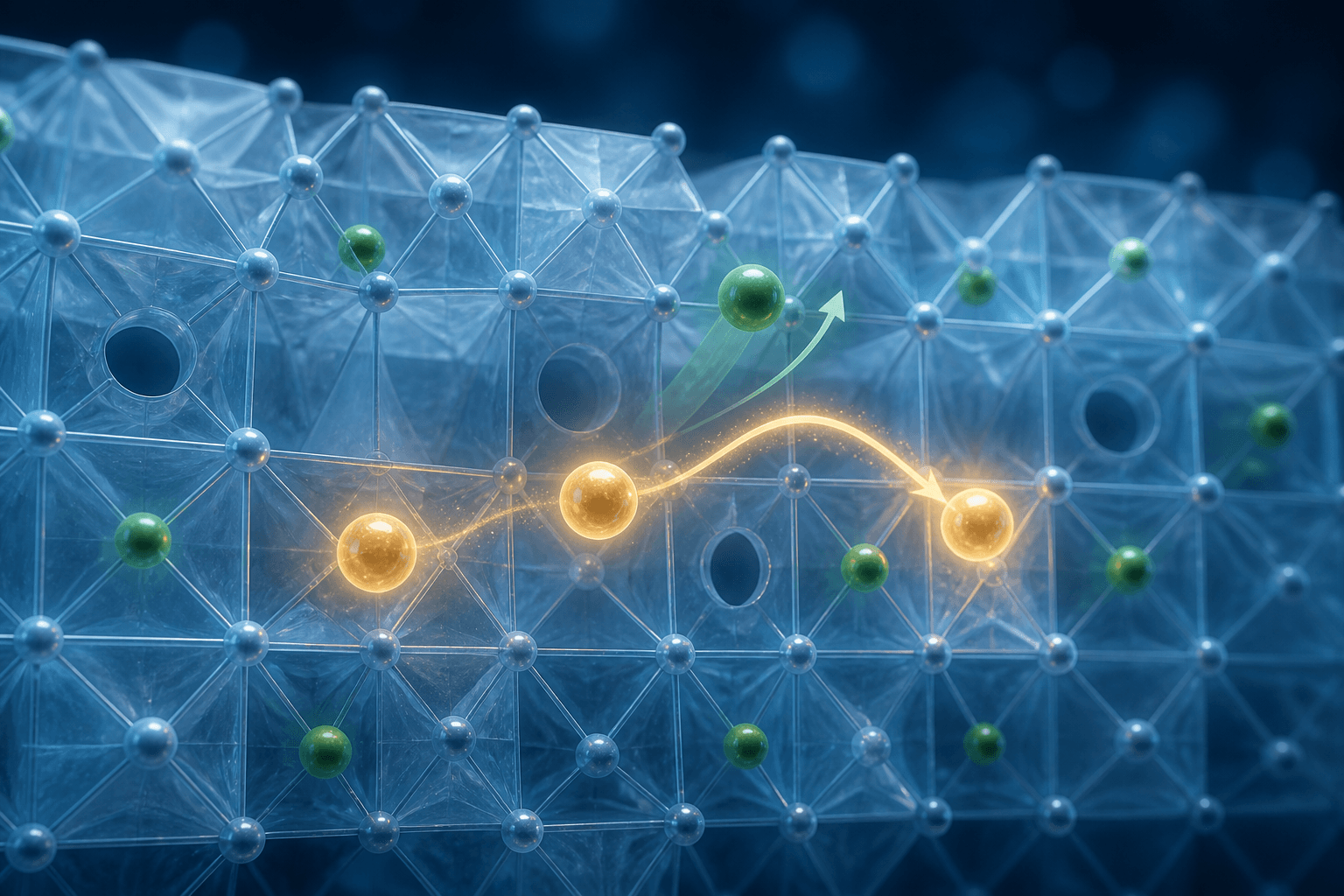
In LLNOF a tetrahedron of four sites surrounds the fluoride ion: lithium, lanthanum, or a vacancy. When lithium hops to a neighboring empty site, the central fluoride shifts slightly the other way — it opens a lane and lowers the hop barrier. This is not textbook soft-anion polarizability from sulfide lore. It is local relaxation coupled to lithium migration: a mechanism that lets a stiff, safer oxide–fluoride framework behave like a fast conductor.
When the researchers lowered the composition parameter x (a more favorable mix of vacancies and lithium), bulk conductivity at 25 °C reached 16.3 mS/cm. According to the authors and Nagoya’s release, that is the highest reported value among oxide- and oxyfluoride-type solid electrolytes. Activation energy fell systematically with composition. The result appeared on 21 August 2026 in the Journal of the American Chemical Society (DOI: 10.1021/jacs.6c08912).
The TRL of this story is around 3 today: the mechanism and the single-crystal record are solid; an industrial cell with cathode, anode and a thin LLNOF layer at factory scale is not there yet. But the dogma that “only sulfide delivers speed” just met a counterexample from Japan.
Who earns on the lane for lithium
The solid-state battery market does not buy a pretty chemical formula. It buys a layer that joins safety, conductivity, voltage stability and a manufacturable process. Sulfides already have licenses, pilot lines and a fear of gases. Oxides had a reputation for being slow. LLNOF — if it keeps its edge when powders are sintered, electrodes contact, and cycles accumulate — becomes a platform candidate: the material, practical know-how on fluoride relaxation, patents on composition and on growth or crystallization.
The margin does not sit only in a cell assembled in Korea or China. It sits in rights to the electrolyte architecture: who licenses “the fluoride that steps aside,” who sells powder with controlled x, who holds the sintering recipe. Nagoya and JST partners are gathering that knowledge capital now — before European factories ask only which electrolyte to buy from a catalog.
Poland: assemble cells, or license the lane?
Poland is already on the map of Europe’s battery chain: assembly, components, interest in energy storage, EU pressure for local value added. It also faces the question that returns with every lithium leap: do we earn on the chemistry of the critical layer, or only on the hall and the labor?
If the next generation of a “safe battery without liquid” rides on a Japanese oxyfluoride with patents around fluoride relaxation, a Polish plant may again buy a semi-finished material and assemble a cell. The alternative looks different: own solid-materials groups, early patents on compositions and processes, partnerships in EU programs before “16.3 mS/cm” becomes only a quote from a Nagoya press note. You do not need to grow Bridgman single crystals in Gliwice tomorrow. You need to know that the contest is about who owns the lane for the lithium ion — not only who owns the hall.
Closing
Sulfide taught the industry that a solid electrolyte can be fast. It also taught what moisture smells like when luck runs out. Oxides were safer and for years too slow. LLNOF showed a third path: a fluoride that makes room when lithium hops, and a 16.3 mS/cm record in chemistry once treated as rigid.
The question for Poland is not whether the solid-state battery will arrive. It is who here will hold the rights to the lane before lithium again flows under someone else’s license.
Sources
- Yajima, T., Takazawa, C., Sato, T. & Iriyama, Y. Migration-Coupled Local Fluoride Relaxation in Li₂₋ₓLa₍₁₊ₓ₎/₃Nb₂O₆F Single Crystals. Journal of the American Chemical Society (2026). DOI: 10.1021/jacs.6c08912.
- Nagoya University. Potential material for safer Li-ion batteries achieves record-high conductivity (31 Aug 2026). en.nagoya-u.ac.jp.
- Nagoya University (JP release). Oxide-based solid electrolyte reaches world-leading Li-ion conductivity in a single crystal (August 2026). nagoya-u.ac.jp.
Comments· 0
No comments yet. Be the first.