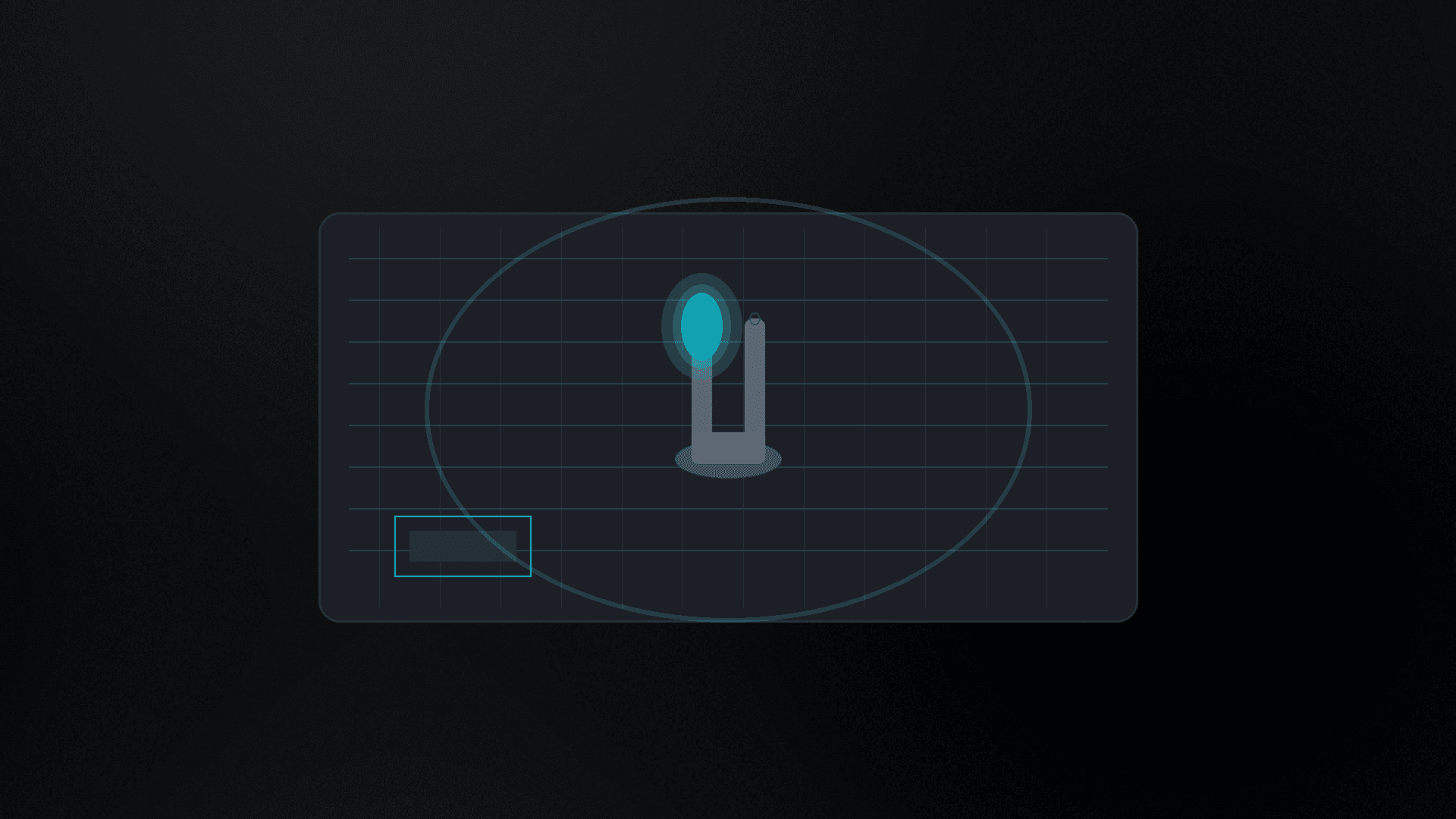
A struck bell fades slowly. The ear hears a smooth decay. On a Stanford chip the same kind of motion — vibration of a massive object — can leave its energy not smoothly, but in a jump: from one quantum of sound to zero. In Science, Amir H. Safavi-Naeini’s team at the Ginzton Laboratory reports the first real-time quantum jumps of sound. A microscopic mechanical resonator loses a single phonon, and a superconducting qubit reads that moment hundreds of times within about two milliseconds.
A scale the ear cannot catch
A phonon is a quantum of sound: the smallest packet of vibrational energy. Unlike a photon — a single particle of light — a phonon describes the coordinated motion of many atoms. That is why sound feels “continuous.” A hammer, a string, a phone membrane: everything looks smooth.
Quantum physics says otherwise. The energy of a vibrating object comes in packets. The catch is that an ordinary position measurement of the membrane does not reveal that discreteness. You need a measurement coupled to energy — to the phonon number — not to displacement. It is the difference between watching waves on a lake and counting how many packets of energy still sit in them.
The historical ladder is simple. Quantum jumps were predicted in the early twentieth century. In 1986 they were caught in trapped ions. In 2007 — in photons. Sound lagged: there were indirect signatures, but not continuous, repeatable registration of a single 1→0 jump in a mechanical resonator. The Stanford paper closes that arc.
A chip-scale tuning fork
The resonator was made with chip fabrication techniques. It is small enough that many could fit on one device. It acts like a microscopic tuning fork. The key is how long it “rings.”
The mechanical lifetime is T₁ = 2.1 ms. Two milliseconds sound short. Stanford’s press note gives a scale comparison: if an ordinary tuning fork held vibration as well relative to its size, it would ring for several hours. That long ringdown lets hundreds of readouts catch the moment when excited-state energy vanishes — a jump from n = 1 to n = 0.
Coupling to the detector: a superconducting qubit dispersively linked to the resonator. The dispersive shift is 2χ/2π = 328 kHz per phonon. The qubit does not “hear” sound with an ear. It repeatedly asks: is the phonon number one, or zero? The measurement is designed as quantum nondemolition (QND) with respect to phonon number — so the act of readout does not instantly destroy the state being tracked.
Integration is not trivial. Makihara and Szakiel (joint first authors) had to join a long-lived vibrating object to a delicate qubit circuit with an aligned transfer-print technique — without ruining either side. Result: single-phonon states prepared (heralded) with 85% fidelity, and trajectories that show discontinuous transitions between the excited and ground states.
This is not a metaphor. It is a record of jumps in a massive vibrating object — exactly what the quantum textbook promised for mechanics, and what the lab long failed to catch in real time.
What you see when sound “dies” in a jump
Bell intuition says amplitude falls smoothly. At the quantum scale energy does not drain like water from a tub. It can leave in packets. In the experiment the device, over a ~2 ms window, checks hundreds of times whether the phonon is still there. When the answer flips from “one” to “zero,” we register a jump.
Safavi-Naeini says in the Stanford release that vibrating objects can show quantum behavior, a prerequisite for many operations needed by quantum computing and sensing. Szakiel adds a layer closer to everyday products: precise control of sound may one day improve devices that already rely on mechanical waves — from smartphones to sensors. That is a horizon, not a shipping list.
The fact boundary must stay sharp. Nobody “heard quantum sound” with a human ear. The setup runs in the cryogenic regime typical of superconducting qubits. Nobody delivers a finished quantum computer or a commercial “phonon protein sensor” on a shelf. We have proof that a jump can be seen in a measurement trajectory, and that the qubit + mechanical resonator platform is clean enough to catch such events.
Why a jumping phonon matters
The science layer is hard: T₁, χ, 85% fidelity, QND, jump trajectories, data and code on Zenodo. The applications layer in Stanford’s press runs on three tracks — all potential, not product.
First: error correction in quantum computing. In many architectures a quantum jump is an error. Catching it in flight is hard. Detecting jumps on a sound platform is a methodological step, not a finished decoder.
Second: precision sensing. A small resonator + qubit give high sensitivity. Safavi-Naeini’s team is working with Michael Roukes’s group at Caltech on detecting and identifying proteins in cells. That is a research program, not a certified diagnostic kit.
Third: improving technologies where sound is already infrastructure. The moral here is cautious. Better phonon control in the lab does not mean a louder smartphone tomorrow. It means a map: what you must be able to measure before anyone promises a “quantum upgrade” to a microphone.
We set TRL at 2–3. We have a repeatable lab setup, numbers from the abstract, jump trajectories, and open data. We do not have an industrial pilot or a standard. Classic deep tech at the threshold: solid enough to change the checklist for hybrid qubit–mechanics labs, too early to sell the phonon as a product.
Why measuring position is not enough
Here the scale paradox returns in lab form. You can track resonator displacement perfectly and still miss the energy steps. Discreteness lives in the Hamiltonian — in energy levels — not in the smooth amplitude curve an ordinary oscilloscope draws.
That is why the qubit is not decoration. It is a detector coupled to phonon number. Each “n = 1 or n = 0?” question builds a trajectory. When the trajectory drops like a step, you get an empirical signature of a jump. The abstract calls these discontinuous transitions a striking manifestation of quantum mechanics in a massive vibrating object. “Massive” matters: this is not an isolated electron, but a collective of atoms in a mechanical structure on a chip.
The photon comparison helps the reader, but must not be stretched. Photons are easier to “count” in many optical setups. A phonon lives in material, meets the substrate, mechanical loss, and noise. Hence the fight for millisecond-scale T₁ and for integration that does not spoil the tuning fork or the qubit. Aligned transfer-print is not a plot detail — it is the condition for the measurement window to open at all.
For an engineer the checklist is concrete:
- Does mechanical lifetime allow many readouts before decay?
- Is the dispersive shift per phonon large versus linewidth and noise?
- Is the measurement close enough to QND to track a jump rather than destroy the state on the first question?
- Is single-phonon heralding fidelity high enough that trajectories are not a post-selection artifact?
The paper’s numbers — 2.1 ms, 328 kHz/phonon, 85% — answer yes under Stanford lab conditions. Porting to another material, temperature, or geometry is a separate project.
Europe reads Stanford without copying the hype
The lead is American: Stanford Applied Physics, Ginzton Lab, SLAC participation, support from AFOSR, ONR, NSF, NSERC Canada, DoD, AWS. Safavi-Naeini and Schuster are Amazon Scholars — funding context, not a consumer endorsement.
For European deep tech and for a Polish reader the angle is not “a Polish patent.” The EU invests in quantum infrastructure and sensing. Poland has quantum physics and photonics groups, but this paper is not a Polish spin-off. It shows what to watch in the next grants and papers: hybrid platforms where mechanics is not only noise, but a carrier of quantum information with a long lifetime.
Scale returns at the end. On one side — a bell that, in imagination, rings for hours. On the other — a chip that in 2.1 ms decides whether one quantum of sound remains. Between them sits a measurement the ear cannot make: a question about energy, not displacement.
Scale verdict
Hundreds of readouts in a millisecond window. 85% heralding fidelity. 328 kHz shift per phonon. A 1→0 jump recorded as a step, not a slope. Science is not selling a magic speaker. It closed the gap between ions, photons, and sound: mass vibrates quantum-mechanically even when we watch in real time.
For an investor and for deep-tech editors, the difference between “quantum sound” and a marketing slogan comes down to three questions. Can you see the jump in raw trajectories? Are T₁ and the χ shift stated outright? Do the authors separate detection from a product promise? This paper passes the first two. The third stays open — and that is fine: TRL09 prefers a measurement map over a sales deck.
For TRL09 readers the moral is simple. When someone promises “quantum sound in a product,” ask first about T₁, fidelity, and whether the jump shows up in a trajectory or only in a model fit. Stanford showed the jump. The rest — protein sensing, error correction, better acoustic devices — is only now entering engineers’ checklists.
Sources
- Makihara T., Szakiel E., Maksymowych M.P. et al. Quantum jumps of sound. Science (2026). DOI: 10.1126/science.aeh7535
- Stanford School of Humanities and Sciences — Researchers observe first real-time quantum jump in sound (17 Sep 2026): https://humsci.stanford.edu/feature/researchers-observe-first-real-time-quantum-jump-sound
- EurekAlert! — same release: https://www.eurekalert.org/news-releases/1144153
- Data and code: Zenodo DOI 10.5281/zenodo.20944616
- OpenAlex / Crossref / Europe PMC — metadata and abstract.
Narration mode: Skala. TRL ~2–3. Categories: Deep Tech, Hardware.
Comments· 0
No comments yet. Be the first.