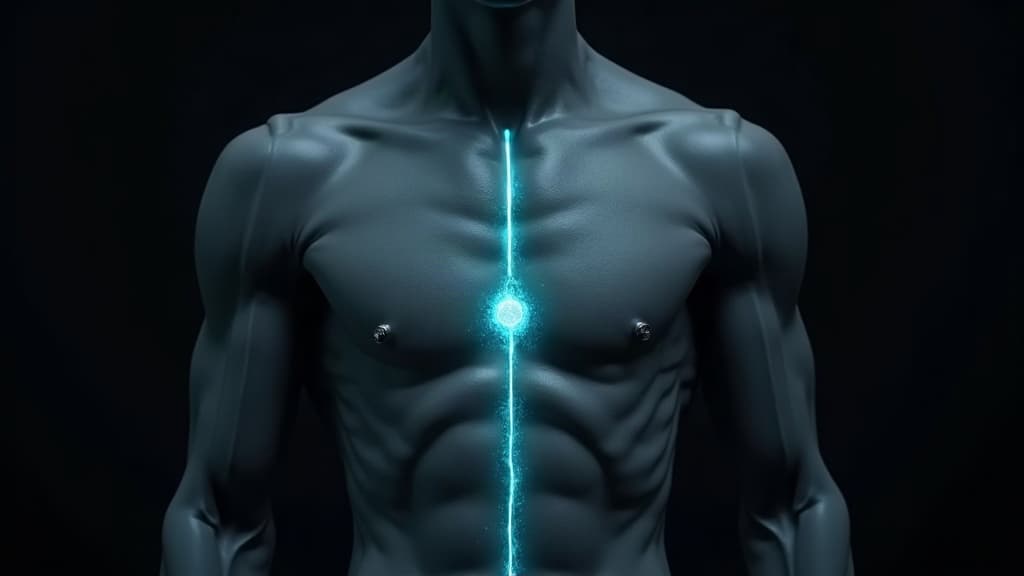
Bluetooth won the home, the phone, and the watch. In tissue it loses to water and salt. A Georgia Tech team shows a second path in Science: the body itself is the wire. They call the system SWANS. A sensor in one part of the body wakes a stimulator elsewhere with a pulse through tissue, without a classic radio antenna.
Round one: radio leads
For two decades, medtech learned to trust radio. Bluetooth Low Energy, NFC, proprietary implant bands — that is the closed loop of "sensor on skin, hub in pocket." A watch measures heart rate. An insulin pump takes a command. A pacemaker reports to a programmer.
The favorite leads because the ecosystem is ready. Chipsets are cheap. Certifications are known. Patients understand pairing. Engineers know the power budget and an antenna the size of a rice grain.
The problem starts under the skin. Tissue attenuates radio waves. The deeper the implant, the larger the antenna or the power — or both. A larger antenna means a larger housing. A larger housing means a larger wound and a battery life that looks longer on paper and shorter in practice when the radio must keep "shouting" through muscle and fluid.
Alex Abramson of Georgia Tech puts it plainly: the body is a poor channel for Bluetooth and NFC. That is why wearables and implants long played separately. They could sit side by side. They could not build a dense network of sensors and actuators scattered across the whole organism.
In clinical practice that radio advantage is real. A programmer is held to the skin and the visit ends. The patient does not think about an "ionic medium." They think about the battery and whether the device "has signal." The favorite wins UX and the supply chain.
Round two: tissue answers
Nerves do not call each other by radio. They carry signals with ions. Abramson's team and first author Ramy Ghanim take that intuition literally. They build a platform in which tissue is the medium. They call it SWANS — Smart Wireless Autonomous Networking System.
Devices generate short, transient electric fields. A receiver wakes only when the pulse has a programmed voltage and duration that switches on its transistor circuit. That is addressing, not noise. One implant can sleep with almost no power draw and wake on "its" pulses.
Range does not stop at the epidermis. The authors show communication in epidermal, subcutaneous, intraperitoneal, and gastrointestinal spaces. In other words: the network is meant to work where radio most often fails.
The paper abstract puts a hard number against Bluetooth: more than ten times greater tissue communication coverage. This is not a sales deck. It is a comparison in a scientific experiment. The fact boundary stays sharp: it is coverage of communication in tissue, not a claim that Bluetooth vanishes from the smartphone market.
Round three: the rat walks on two limbs
The strongest image from the work is not a chart. It is motion.
In living rats the team builds a network of sensors and neural interfaces at whole-body scale. A sensor detects front-paw motion. It autonomously wakes a device that stimulates a hind-leg muscle. The contraction mimics a fragment of a natural walking pattern. Two limbs, one pulse through tissue, no cable between them.
That is a closed loop in miniature: event here, therapy there. Abramson stresses the architecture: place the sensor where the biological signal is best, and the actuator where the clinical action belongs. They need not share one housing. They need not sit in an antenna line of sight.
The implants themselves need not carry a full radio antenna or a large processor. In the listening state they draw almost no energy. They wake on a pulse matched to their circuit. That reverses the classic budget: instead of constantly transmitting through attenuating tissue, a node waits for a short "incoming code" through ions and water in the body.
An important architectural limit is named plainly. SWANS is meant to carry small packets: presence or absence of a signal, a simple yes or no. It does not replace a video link or a full ECG upload to the cloud. Heavy data and computation stay on an external wearable hub. The implant does what radio deep in the body does worst: stay small, sleep cheaply, and act locally.
That design choice explains why the Bluetooth comparison in the abstract concerns tissue communication coverage, not bits per second in a living room. Different medium, different function, different limit.
Implants fit below 3 mm — small enough to deliver by syringe. In the listening state power draw is negligible. In experiments the team estimates that a tiny actuator triggered once a day could run about a year before replacement. The pulses did not damage tissue samples in tests described in the university release.
Large data and heavy computation stay outside. The wearable acts as a hub: it collects readings, coordinates decisions, and sends simple triggers. The implant need not carry a whole radio and a cloud processor. It should sleep, wake, and act.
Result: who leads on which field
Radio still wins where the channel is air and a pocket. Pairing a watch to a phone is not going away. SWANS attacks another field: deep, distributed bioelectronics, where many micro-implants should talk to each other and to a hub on the skin.
On the field of "tissue range and implant size," the challenger leads with numbers from Science. On the field of "certification, manufacturing, clinical protocols," the favorite — classic radio — still has a decade of institutional lead. The duel does not end in a knockout. It ends with a map: another medium, another power architecture, another miniaturization limit.
Ghanim speaks about automation that simplifies treatment regimens. Abramson speaks about coordinating sensors and actuators in distant body sites as a step toward personalized bioelectronic medicine. Those are research goals, not a CE mark. The TRL of this work sits around 3–4: the network works in an animal, not on a hospital ward.
Second battle: who will deliver the closed loop
Communication is only half the problem. The second battle is delivering therapy exactly when and where it is needed.
Examples in the release are deliberately broad: drug release, nerve stimulation, coupling distant physiological dynamics. SWANS does not invent a new pump or a new electrode. It changes the network layer. Without it every implant stays a lonely island or needs a thick radio.
Competitors in that second battle are real. Classic CIEDs and neurostimulators have their own telemetry links. Continuous glucose and closed-loop insulin have their own protocols. NFC in on-demand implants works with a close programmer. SWANS aims at the gap between those silos: many points in the body, small yes/no packets, hub outside.
The barriers are as concrete as the promises. Regulation of active implants. Interference with existing devices. Safety of pulses in tissue under longer exposure. Intellectual property versus BLE/NFC. Lifetime in real metabolism, not only in a once-a-day year estimate. The paper does not close those points. It opens a checklist.
Regulatory tension is visible on the market. An active implant is not a phone app. Every new communication channel enters electromagnetic safety review, compatibility with pacemakers and defibrillators, and failure scenarios. The challenger must prove that a tissue pulse is not a new risk vector before it wins on miniaturization.
For a deep-tech investor the checklist is dry: IP around pulse addressing, durability of electrodes and housings below 3 mm, syringe delivery procedure, hub communication protocol, GLP path and first-in-human. A Science paper opens the conversation. It does not replace a dossier.
Co-authors beyond process chemistry — W. Hong Yeo and Yoon Jae Lee at Georgia Tech, plus Aristide Gumyusenge and Camille Cunin at MIT — close the bridge among materials, electronics, and implant form. This is not one "chip for everything." It is a system: medium + addressing + hub.
What this means for Europe and Poland
The lead is American: Georgia Tech, with MIT participation. For a reader in Poland and the EU the angle is not "a Polish patent." It is a checklist for bioelectronics and digital therapeutics.
If someone in NCBR or Medical Research Agency grants, or in Horizon consortia, is building micro-implants, GI sensors, or stimulators, the questions from this paper are practical:
- Should the channel go through air or through tissue?
- How much power does listening consume?
- Can many nodes be addressed without collisions?
- What stays in the implant, and what stays on the hub?
- What does the safety proof for the pulses look like?
Poland has groups in medical electronics, sensors, and biomedical engineering. This specific paper is not their spin-off. It does show, however, that the next wave of medical hardware may win not with a better radio, but with a different medium.
In practice that means reading the next grant for the network layer, not only for a "better sensor." A sensor without a channel stays an island. A radio channel in deep tissue stays thick. An ionic channel is a product hypothesis with a hard animal demo — and a list of barriers that must not be blurred in a pitch.
Why this is a duel at all
If SWANS were only "better Bluetooth," a Science paper would be a chipset iteration. The stake here is a change of medium. Radio treats the body as an obstacle. SWANS treats it as a wire. From that decision follow size, power, network topology, and where the hub sits.
The radio favorite answers with infrastructure: standards, testers, clinicians, service. The ionic challenger answers with tissue physics and miniaturization. A TRL09 reader need not pick a stock-market winner. They should see on which field who leads after this publication.
Fact boundary before you click "the future of medicine"
SWANS does not mean Bluetooth is leaving the hospital. It also does not mean that from tomorrow an implant mesh in a human works like Wi‑Fi. We have rats, a dual-limb demonstration, range and size numbers, and a power architecture.
For TRL09 that is enough to stage the duel honestly. The radio favorite rules the ecosystem. The ionic challenger wins where tissue attenuates waves and punishes every millimetre of antenna. Who will deliver the first clinical closed loop on this medium remains open.
Sources
- Ramy Ghanim et al., "An in-body networking system for communication between wearable and implantable therapeutics," Science (2026). DOI: 10.1126/science.adz5300
- Tech Xplore / Georgia Tech release: Health wearables and implants body network
Comments· 0
No comments yet. Be the first.