Schrödinger's cat was a joke. Now it fixes quantum computers
In 1935, Erwin Schrödinger dreamed up a cat to show how absurd quantum mechanics is. Sealed in a box, the animal was supposed to be alive and dead at the same time — until someone lifted the lid. Schrödinger meant the thought experiment as a mockery of the Copenhagen interpretation. Today, ninety years later, that same cat — in electronic form — is the best candidate for eliminating the greatest flaw of quantum computers: the fact that they keep making mistakes.
In early 2025, three teams — in Mountain View, Pasadena, and New Haven — began a quiet race toward the same goal. All three published their results in Nature. And all three claim they found a shortcut.
A problem of nine orders of magnitude
A quantum computer works on qubits, which — unlike a classical bit — can be zero and one at the same time. That superposition is their entire strength. But it is as fragile as a house of cards. The slightest thermal noise, the weakest electromagnetic field — and the qubit loses coherence. Before it completes any useful computation, the result dissolves into noise.
The scale of the problem is dizzying. To break today's encryption or design a new catalyst, a quantum computer would have to run trillions of operations without a single error. Meanwhile, today's qubits make a mistake roughly once every thousand operations. Between what we have and what we need yawns a gap of nine orders of magnitude — a billionfold. It is like asking a train driver who fumbles every third lever to drive a train across the whole of Siberia without an accident.
The solution is called quantum error correction. The idea is as old as computing itself: instead of trusting a single qubit, you write the same information into many qubits and then constantly check them. If one suffers an error, the others fix it.
The king of the grid and his thousand soldiers
For two decades, the undisputed leader of this approach was the surface code — in English surface code. Imagine a chessboard made of qubits. Half the squares store information, the other half check it constantly, keeping an eye on their neighbours. In December 2024, Google unveiled its Willow processor — 105 qubits — the first in history to push errors below the threshold at which enlarging the chessboard actually starts to help. It was a milestone. The world exhaled: correction works.
But there was a catch. The surface code corrects both types of error at once — the bit-flip (a zero turning into a one) and the phase-flip (the sign of the superposition inverting). That completeness comes at a horrendous price. To keep one reliable, "logical" qubit alive, the surface code needs as many as a thousand physical qubits. A thousand soldiers to protect a single general. At a thousand logical qubits — the minimum for anything useful — that becomes a million physical ones. And today we can build perhaps a hundred.
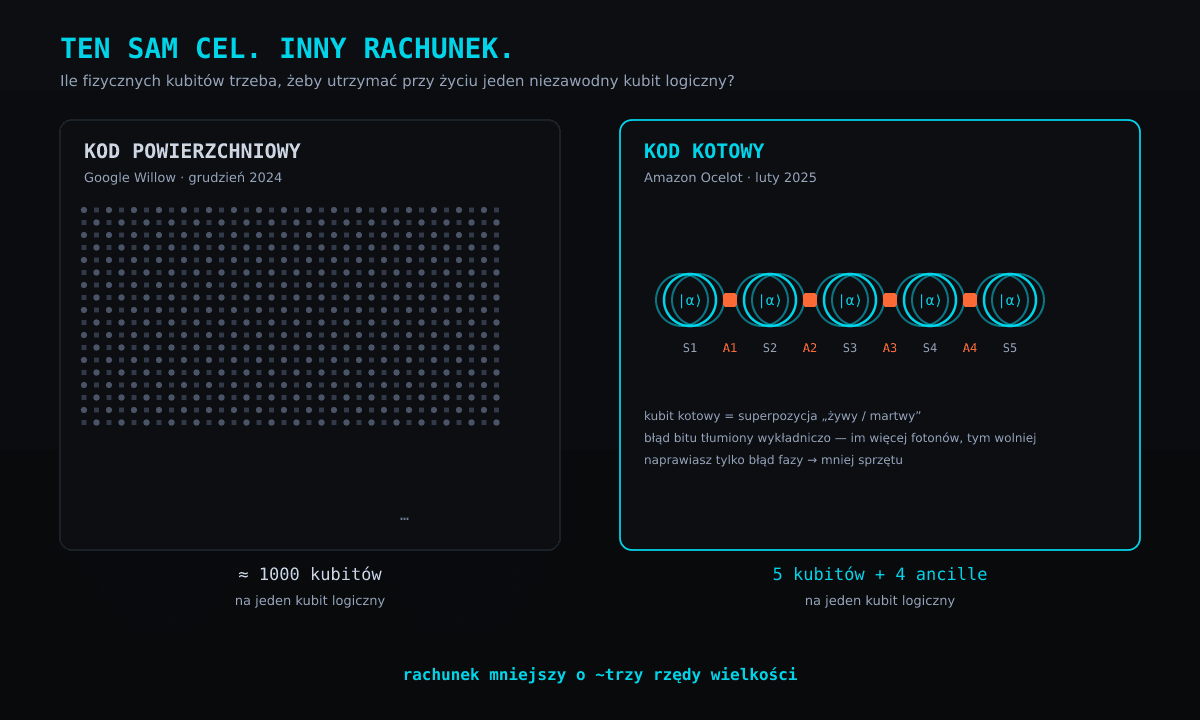
Rys. 1. Kod powierzchniowy potrzebuje około tysiąca fizycznych kubitów, by chronić jeden kubit logiczny. Kod kotowy Amazona (Ocelot) osiąga to samo pięcioma kubitami kotowymi i czterema ancillami. Źródło: opracowanie własne na podstawie Putterman H. et al., Nature (2025), DOI: 10.1038/s41586-025-08642-7.
And this is where the duel begins. Two rivals decided to bypass the grid.
Round one: the cat from Pasadena
In February 2025, Harald Putterman's team at Amazon's quantum computing center in Pasadena showed something that looked like heresy. Instead of ordinary qubits, they used cat qubits — bosonic Schrödinger states.
A cat qubit encodes information in two states that are exactly what Schrödinger described: a superposition of two opposing oscillations of the field in a superconducting resonator. A cat alive and dead at once, only instead of fur — an electromagnetic wave.
The key property of the cat is almost magical. It turns out that such a qubit is naturally resistant to bit-flip errors. Increase the number of photons in the resonator — and the time in which the cat can "accidentally flip" grows exponentially. The bit-flip error simply vanishes. The phase-flip error, meanwhile, grows — but that is the only one you have to fight. This is called noise bias: the asymmetry of noise.
"It's like a bodyguard who is immune to knife blows — he only has to avoid poison. He doesn't need full armour," a theorist might say. In practice: instead of correcting two types of error, you correct one. Half the work disappears.
Amazon's team built a device of five cat data qubits and four auxiliary transmons, woven into a repetition code of distance 5. The result: the logical error per cycle fell to 1.65 percent — and, crucially, the device operated below the threshold. Make the cat bigger and you get better protection. Without a thousand soldiers.
Round two: the qudits from Yale
Three months later, in May 2025, Michel Devoret's team at Yale answered. Their idea was even stranger: abandon bits altogether.
An ordinary qubit has two states — zero and one. But what if you used a qudit — a quantum digit with three or four states? It's like an alphabet that suddenly gains extra letters. A larger alphabet means the same information can be stored more densely, and some operations run more efficiently.
Devoret and his doctoral student B. L. Brock encoded the qudit in the GKP (Gottesman–Kitaev–Preskill) code — a mathematical grid that decomposes one qubit into many wave states. And to optimize it, they turned to artificial intelligence: a reinforcement-learning agent, the same type of algorithm that learned to play Go better than humans. Over thousands of rounds, the AI searched for the best way to lay out the grid.
The result crossed a magic threshold: break-even. That is the moment when a corrected logical qudit lives longer than its best physical component. A gain of 1.82 times for the qutrit and 1.87 for the ququart. For the first time in history, qudit correction not only kept pace with degradation — it outpaced it.
The turning point: don't fight the error, redirect it
Two paths, one shared conclusion. Amazon and Yale, by different methods, arrived at the same idea: instead of building an ever-larger army to fight every error, design the hardware so that one type of error disappears on its own, and then correct only what is left.
This inverts two decades of philosophy. The surface code treated errors as an unavoidable evil and built a fortress around them. Bosonic codes ask: "maybe the error can be eliminated at the source?" In the Pasadena device, the bit-flip error drops exponentially, because the cat's nature suppresses it. At Yale, the larger quantum alphabet does the same — more densely packed information means fewer places where it can break.
Who is winning? On paper — still Google. Willow works, and its results are reproducible and improve with distance. But Amazon and Yale have shown that the soldier count need not grow to infinity. Amazon already estimates that with cycle optimization it will drop to half a percent error per cycle, and in the longer term — to one in a billion, without changing the architecture. That is a promise the surface code cannot make without a million qubits.
A race for billions — and for who builds less
To understand why this is not an academic discussion, one name is enough: Ocelot. That is what Amazon called the physical chip described in the Pasadena paper — the Seattle giant's first silicon device designed with error correction in mind. Ocelot is five cat qubits and four transmon ancillas, exactly the architecture Putterman described in Nature. Amazon is not doing research for research's sake. It is doing it because it knows the bill for error correction will decide whether a quantum computer ever pays for itself.
To put it plainly: if you need a million physical qubits to build one useful computer, the cost becomes astronomical. If, thanks to the cats, a thousand is enough — the bill drops by three orders of magnitude. That is the difference between a multi-billion-dollar machine and one you could put in a corporate server room.
The market is already pricing this in. Consultancies — from McKinsey to BCG — put the economic value of quantum computing in the hundreds of billions of dollars by 2040. IBM is betting on its Heron and Condor processors, Google on Willow, Microsoft on topological Majorana qubits. Each of these giants has chosen a different road to the same goal: a reliable logical qubit. And in the background, China is rising — a team at Zhejiang University, the same one that collaborated with Poland's Institute of Physics of the Polish Academy of Sciences, showed low-overhead codes in 2026, while the Chinese machines Zuchongzhi and Jiuzhang keep breaking records.
This race is not just about computers. It is about who first breaks today's encryption — and who first builds encryption that cannot be broken.
Poland in this race — not in the stands
It would be easy to conclude that this is an American game and Poland is merely watching. Wrong.
Among the authors of the Pasadena paper is Przemysław Bienias — a Polish physicist working for Amazon. At Yale, on the same codes, worked Aleksander Kubica. And that is just the tip. In 2026, in Nature Physics the paper "Demonstration of low-overhead quantum error correction codes" was published — one of its co-authors is Pei-Xin Shen of the Institute of Physics of the Polish Academy of Sciences. Poland is not just buying quantum computers; Poland is helping build their foundations.
On the domestic front, quantum error correction theory has real foundations. Ryszard Kukulski, Łukasz Pawela and Zbigniew Puchała of the Institute of Theoretical and Applied Informatics of the Polish Academy of Sciences in Gliwice work on probabilistic error correction. Piotr Czarnik of the Jagiellonian University develops partial-correction methods for mid-scale computers. Markus Grassl of the University of Gdańsk studies subfield metrics in quantum codes. In Wrocław and at AGH, work is underway on multilevel correction.
And the hardware? PSNC in Poznań has won, within the EuroHPC consortium, the right to host a European quantum computer — EuroQCS-Poland. It is not a machine that will close the nine-orders-of-magnitude gap today. But it is exactly the infrastructure on which tomorrow's error-resistant gates will be tested — the same ones Amazon and Yale have just developed.
The stakes are concrete and dated. Experts estimate that within a decade, an error-corrected quantum computer could break RSA-2048 — the encryption on which the entire internet rests today. EuroQCI — the European quantum communication network — has a deadline of 2030. Whoever first builds a logical qubit that outlives its physical components will set the standards for everyone else. Schrödinger's cat, meant as a joke, has just become the most serious wager in physics.
Sources
- Putterman H., Noh K., Hann C.T. et al., Hardware-efficient quantum error correction via concatenated bosonic qubits, Nature 638, 927 (2025). DOI: 10.1038/s41586-025-08642-7
- Brock B.L., Singh S., Eickbusch A. et al., Quantum error correction of qudits beyond break-even, Nature (2025). DOI: 10.1038/s41586-025-08899-y
- Wang K., Lu Z., Zhang C. et al., Demonstration of low-overhead quantum error correction codes, Nature Physics (2026). DOI: 10.1038/s41567-025-03157-4
- Google Quantum AI, Quantum error correction below the surface code threshold, Nature 638, 920 (2025). DOI: 10.1038/s41586-024-08449-y
- Kukulski R., Pawela Ł., Puchała Z., On the probabilistic quantum error correction, IEEE Transactions on Information Theory (2023). DOI: 10.1109/tit.2023.3254054
Comments· 0
No comments yet. Be the first.