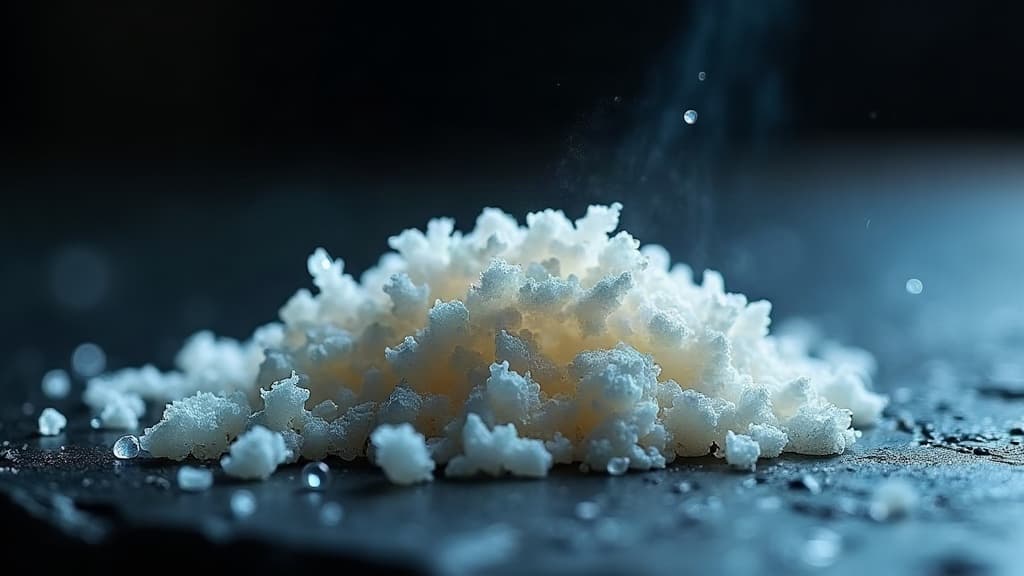
Plastic trash turned into a sponge that pulls water from dry air
Old CDs, polystyrene packaging and LEGO bricks have more in common than meets the eye. All of them are made of plastics whose molecules contain recurring rings of six carbon atoms. Chemists at the University of Vienna took advantage of exactly those rings. They turned several kinds of plastic waste into porous "sponges" that pull water out of the air and, after gentle heating, even by sunlight, give it back.
The paper "Upcycling waste aromatic polymers as adsorbents for atmospheric water harvesting" appeared on 14 October 2026 in the journal Chem Circularity as an open-access article. Its authors are Anastasiia Naryshkina, Paul Schweng and Robert T. Woodward. The university sent out a press release the same day. In this piece we take the idea apart: what the sponge is made of, what happens inside it, how much water it really captures, and what is still missing before it can leave the lab.
Two problems in one jar
The team starts from a simple pairing. The world has too much plastic and too little clean water. According to a 2022 OECD report, only about 9 percent of plastic waste is recycled. The rest ends up in landfills, incinerators or the environment. At the same time, more and more regions suffer from drinking-water shortages, Europe included.
There is always water in the air, even over a desert. Harvesting it from the atmosphere has been an active research field for years. One approach uses an absorbent material that first binds water vapour and then, when heated, releases it. All that remains is to condense and collect it. Such a system needs neither a water network nor a large power plant. It can therefore serve as an extra, local water source where conventional supplies are lacking.
A good material for this job must meet three conditions. It must attract water vapour even from dry air. It must hold a lot of water relative to its own mass. And it must survive many cycles of capturing and releasing water without losing performance. The Vienna team asked whether such a material could be made from something that ends up in the bin anyway.
Anatomy of a sponge, step one: rings as anchor points
Polystyrene, polycarbonate and ABS belong to the so-called aromatic polymers. The word "aromatic" has nothing to do with smell here. Chemists use it for compounds containing flat rings of six carbon atoms, like the one in benzene. In polystyrene such a ring hangs off every link of the chain.
These rings are a convenient place to attach new bonds. The team used them for so-called hypercrosslinking. In this process the long polymer chains are densely stitched together at many points. The result is a rigid, three-dimensional network. The chains can no longer pack tightly side by side, so small empty spaces, or pores, remain between them. Such materials usually have a large internal surface area, even though from the outside they look like ordinary powder.
What is absent matters too. The plastic is not first broken down into the individual molecules it was once made from. That distinguishes this route from chemical recycling, which usually starts with depolymerisation. The Vienna team takes the existing chains and only rebuilds them. The authors speak of giving the plastic a "second service life" without going back to raw material.
Step two: acidic magnets for water
A porous polystyrene network on its own tends to repel water. Plastic is hydrophobic by nature, which is why a coffee cup does not soak through. To make the sponge drink, its chemistry has to change.
This is where the second stage, sulfonation, comes in. The material is treated with sulfuric acid, which attaches sulfonic acid groups to the rings. These are the same groups at work in ion-exchange resins and in some membranes. They strongly attract water molecules and bind them even when there is little water in the air. After this treatment the hydrophobic plastic becomes a material that readily binds water vapour.
The pores provide the space, and the sulfonic groups provide the attraction. Only together do they make a sorbent, a material that binds water on its surface and in its pores and can then release it.
Step three: what it was made from
The researchers did not work with pure polystyrene from a reagent catalogue. They took real waste. It included various polystyrene packaging materials, old CDs made of polycarbonate, and LEGO bricks made of ABS, a copolymer of acrylonitrile, butadiene and styrene. Each of these could be turned into a water sorbent.
The most detailed result concerns a CD case. Such cases are made of general-purpose polystyrene, the same material used for disposable cutlery. The sponge made from this case, at 25 degrees Celsius and 30 percent relative humidity, binds 0.19 grams of water per gram of material. At 90 percent humidity it is 0.57 grams, almost 60 percent of its own mass. It is this result, about 20 percent of its own mass, that the university press release describes as a measurement under dry, desert-like conditions.
The second important result concerns a mixture. The team processed polystyrene and polycarbonate waste together and still obtained a working sorbent. This matters in practice. Sorting plastic is expensive and often decides whether recycling pays off at all. The authors note that because the method tolerates a mixture, less sorting might be needed within compatible waste streams.
Step four: the sponge breathes
Water trapped in a sponge is useless until it comes out. So the team tested the full cycle. First the material binds water from humid air. Then it is heated, the water vapour escapes from the pores and can be condensed. This mode of operation is called a heat-swing cycle. Moderate heat, for example from the sun, is enough to release the water.
According to the press release, most of the uptake and release happens within about an hour. That matters, because how much water a device yields per day depends not only on the material's capacity but also on how quickly it can be emptied and refilled. The CD-case sponge went through at least 20 such cycles without a drop in performance.
For a sense of scale: at 30 percent humidity, a kilogram of this material binds about 190 grams of water in one cycle. That is simple arithmetic based on the measurements, not the output of a finished device. In a real apparatus some water will stay in the pores, some will be lost during condensation, and the number of cycles per day depends on the weather and the design.
How this team knows
Woodward's group is not starting from scratch. In 2023, in the journal Small, it described a low-cost sulfonated hypercrosslinked polymer that bound water from air at humidity as low as 10 percent. It also built its own water-harvesting apparatus and showed that the material releases water under simulated sunlight.
In 2026, in Nanoscale, the same team examined how different atoms in the backbone of such polymers change their water uptake. The conclusion was clear: sulfonic groups are the key, because they shift water binding towards drier air. And in Carbon, the group described sulfonated activated carbons. The best of them bound 0.28 grams of water per gram at 30 percent humidity. The team produced 1.6 kilograms of it and tested it over long-term cycling in a device.
Against this background, the waste-derived result is not a record. At 30 percent humidity the CD-case sponge binds less water than the carbon from the same lab. Its advantage is the feedstock. Activated carbon has to be bought, while a CD case sits in a drawer or in a landfill.
Why this matters at all
Harvesting water from air gained wide attention thanks to MOFs, metal-organic frameworks. In 2017 Omar Yaghi's team described in Science a MOF device that harvested water from air powered by sunlight alone. In 2025 Yaghi received the Nobel Prize in Chemistry for developing these materials, together with Susumu Kitagawa and Richard Robson.
MOFs are excellent, but they often require expensive organic compounds and metals and careful synthesis. Waste-derived polymers go the opposite way. They do not win on performance, but they use a cheap, widely available feedstock that has to be dealt with anyway. In this kind of technology, success is usually decided by the cost per litre of water, not by a record in a table.
What Poland could gain
Poland is among the EU countries with the smallest freshwater resources per inhabitant. Agricultural droughts keep returning. Water from air is unlikely to replace tap water there. Local, grid-independent sources could still be useful in farming, on construction sites, in mountain huts or as a reserve in case of a failure.
The second thread is waste. Poland has a well-developed plastics processing industry and a large stream of polystyrene packaging. Expanded polystyrene, a foamed form of polystyrene, is ubiquitous in construction. The Vienna paper refers to polystyrene packaging, but the press release does not say whether expanded polystyrene was among it. Before anyone starts counting profits from insulation boards, that would need to be checked separately.
For Polish recycling firms one point is interesting: instead of fighting over every cent when selling regrind, they could look for higher-value products. A water sorbent is exactly such a product. For now, though, this is a research direction, not a ready business model.
What this work does not promise
The authors themselves list what is missing. Waste from different sources varies in composition, additives and dyes, so its effect on the sponge has to be checked. The process uses reagents and solvents that would have to be recovered at larger scale. There is no production cost estimate yet, nor an environmental assessment across the whole life cycle. The material also has to be built into a working device and its durability tested far longer than 20 cycles.
There is also the question of the water itself. The work concerns binding and releasing water vapour. The abstract and the press release do not say whether the condensed water is drinkable without further treatment. This is a standard question for any sorbent with acidic groups, and it will have to be answered before deployment.
Finally, scale. Even the best sorbent yields water in amounts counted per kilogram of material and per cycle. Such devices make sense as a supplement, not as a replacement for water intakes. The available materials also contain no information about a spin-off or a patent application.
Maturity: TRL 3
On the technology readiness scale this is TRL 3. The team showed in the lab that several kinds of real waste can be turned into a sorbent, measured its water uptake and repeated at least 20 cycles. Earlier work by the same group already included its own apparatus and kilogram-scale production of a different sorbent, which shortens the road to a prototype. The plastic sponge, however, does not yet have its own device, long-term tests or a cost analysis. The authors see the next steps precisely in studying diverse waste, recovering reagents, costs and durability.
Bibliography
- Naryshkina A., Schweng P., Woodward R. T. Upcycling waste aromatic polymers as adsorbents for atmospheric water harvesting. Chem Circularity (2026), 100175. DOI: 10.1016/j.checir.2026.100175
- Schweng P., Mayer F., Galehdari D., Weiland K. et al. A Robust and Low-Cost Sulfonated Hypercrosslinked Polymer for Atmospheric Water Harvesting. Small (2023). DOI: 10.1002/smll.202304562
- Schweng P., Pammer F., Woodward R. T. Elucidating the role of heteroatoms in hypercrosslinked polymer adsorbents for atmospheric water harvesting. Nanoscale (2026). DOI: 10.1039/D5NR04338G
- Schweng P., Naryshkina A., Glabonjat R. A., Woodward R. T. Scalable sulfonated activated carbons as high-capacity sorbents for atmospheric water harvesting. Carbon 247 (2026), 120964. DOI: 10.1016/j.carbon.2025.120964
- Kim H., Yang S., Rao S. R., Narayanan S. et al. Water harvesting from air with metal-organic frameworks powered by natural sunlight. Science 356 (2017). DOI: 10.1126/science.aam8743
- OECD. Global Plastics Outlook: Economic Drivers, Environmental Impacts and Policy Options (2022). DOI: 10.1787/de747aef-en
- University of Vienna / Phys.org. Waste plastics become molecular sponges that capture water from air (14.10.2026).
Comments· 0
No comments yet. Be the first.