Photon from orbit. A microsatellite just made quantum internet practical
A photon that flies 500 kilometers
Jinan-1 doesn't look impressive. Compared to the Micius satellite - the Chinese pioneer of quantum communication, which in 2017 sent an encryption key from orbit to Earth for the first time - it is almost invisible. Micius weighed 631 kilograms. Its optical payload: a quarter of a ton of guidance systems, mirrors, gimbals and actuators alone. Xinglong ground receiving station: 13 tons of iron, concrete and optics, with a dome like a small astronomical observatory. The installation took months. Each launch required a team of technicians and astronomers.
Jinan-1 weighs 96 kilograms - less than an average washing machine. Its quantum charge: 22.7 kg. Less than checked baggage for two airline passengers. The ground station that Jian-Wei Pan's team from the University of Science and Technology of China (USTC) sets up on the roof of an office building in downtown Jinan in three to five hours: 100 kilograms. A van instead of an observatory. One technician instead of a team. A parking lot next to an office building instead of a mountain peak far from civilization.
What happens next is a triumph of precision over common sense — and perhaps the most important event in quantum cryptography since Bennett and Brassard's first experiment in 1984.
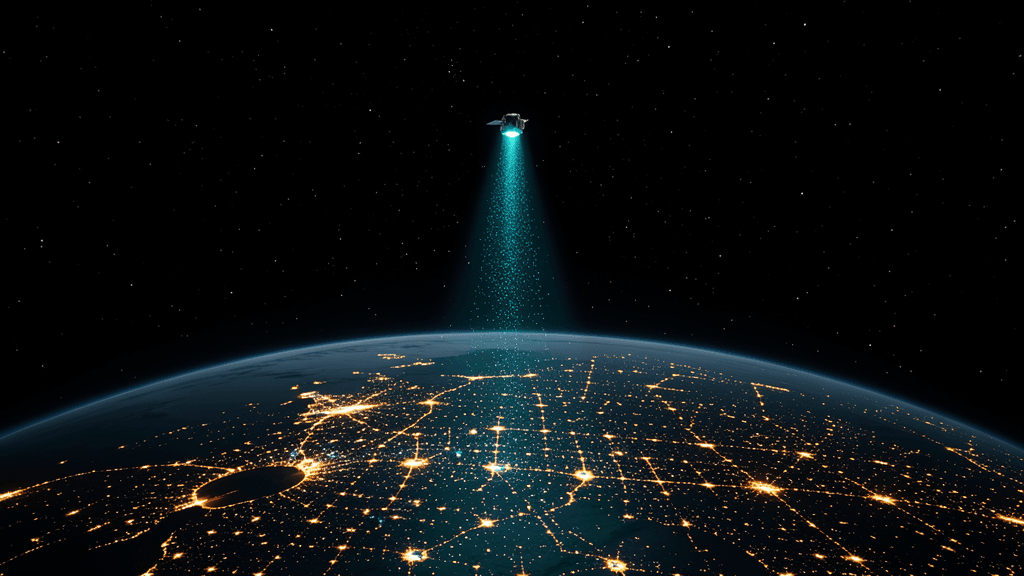
From an orbit at an altitude of 500 kilometers - the distance from Warsaw to Venice, only vertically - the satellite fires a beam of single photons at a 28-centimeter-diameter telescope standing on the roof of an office building in downtown Jinan. Not in a sterile laboratory in the Gobi Desert. Not in a mountaintop observatory, away from light pollution. On the roof, where neon lights, street lamps and car headlights shine under your nose in a city with a million people. Photons from orbit compete with billions of stray photons from the environment - and win.
Each photon carries one bit of quantum information - encoded in its polarization state. Vertical. Horizontally. Diagonally to the left. Diagonally to the right. The sender selects a polarization basis randomly for each photon. The recipient measures in a randomly selected database. Then - via a classic link - they compare which databases were consistent and discard the remaining measurements. If anyone tries to capture a photon along the way - even just by looking - its quantum state will break down irreversibly, introducing errors immediately detectable by both parties. This is not mathematical encryption that can be broken by a faster computer. It's physics. The non-cloning theorem. Heisenberg's uncertainty principle. Laws of nature, not algorithms.
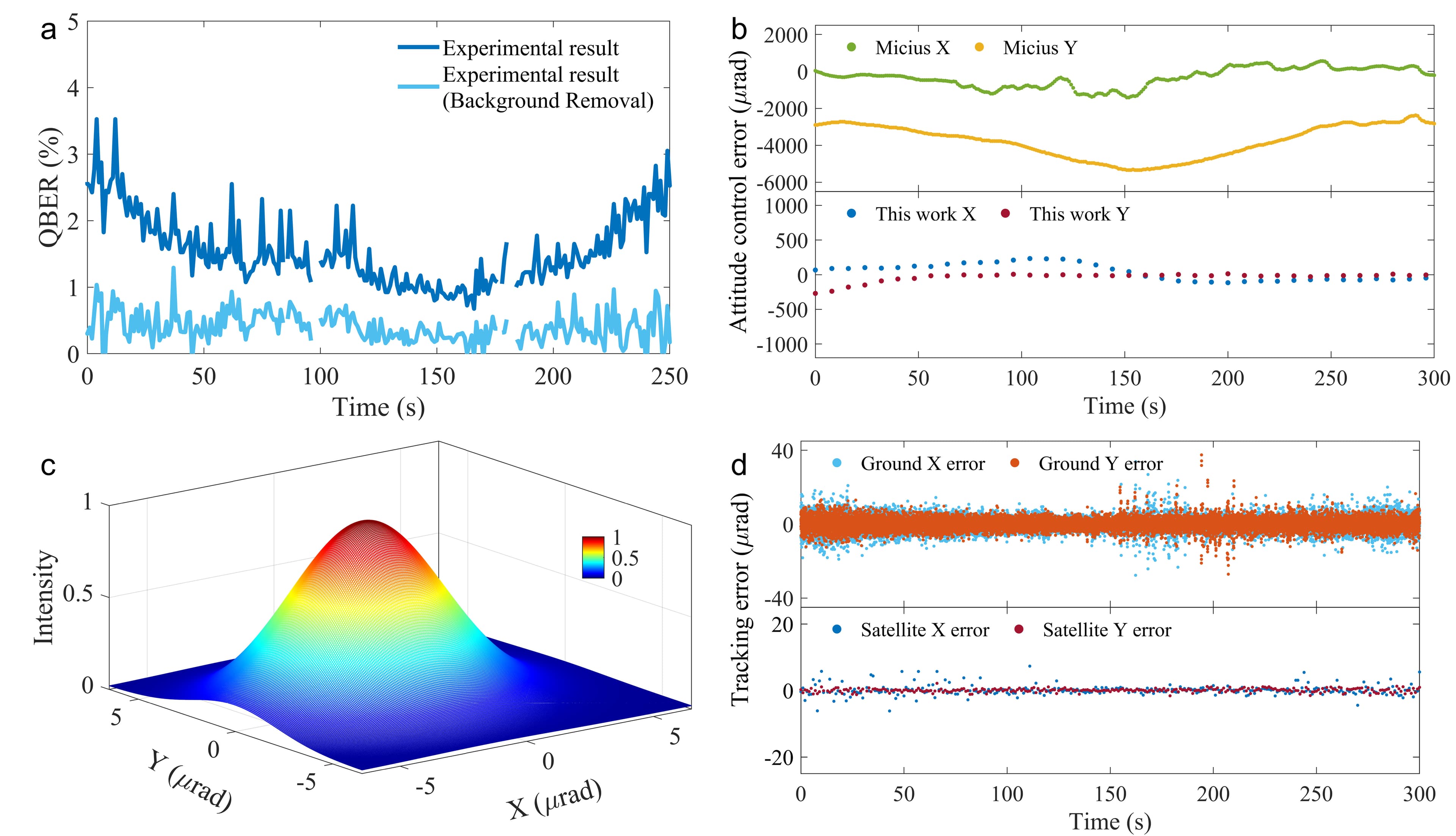
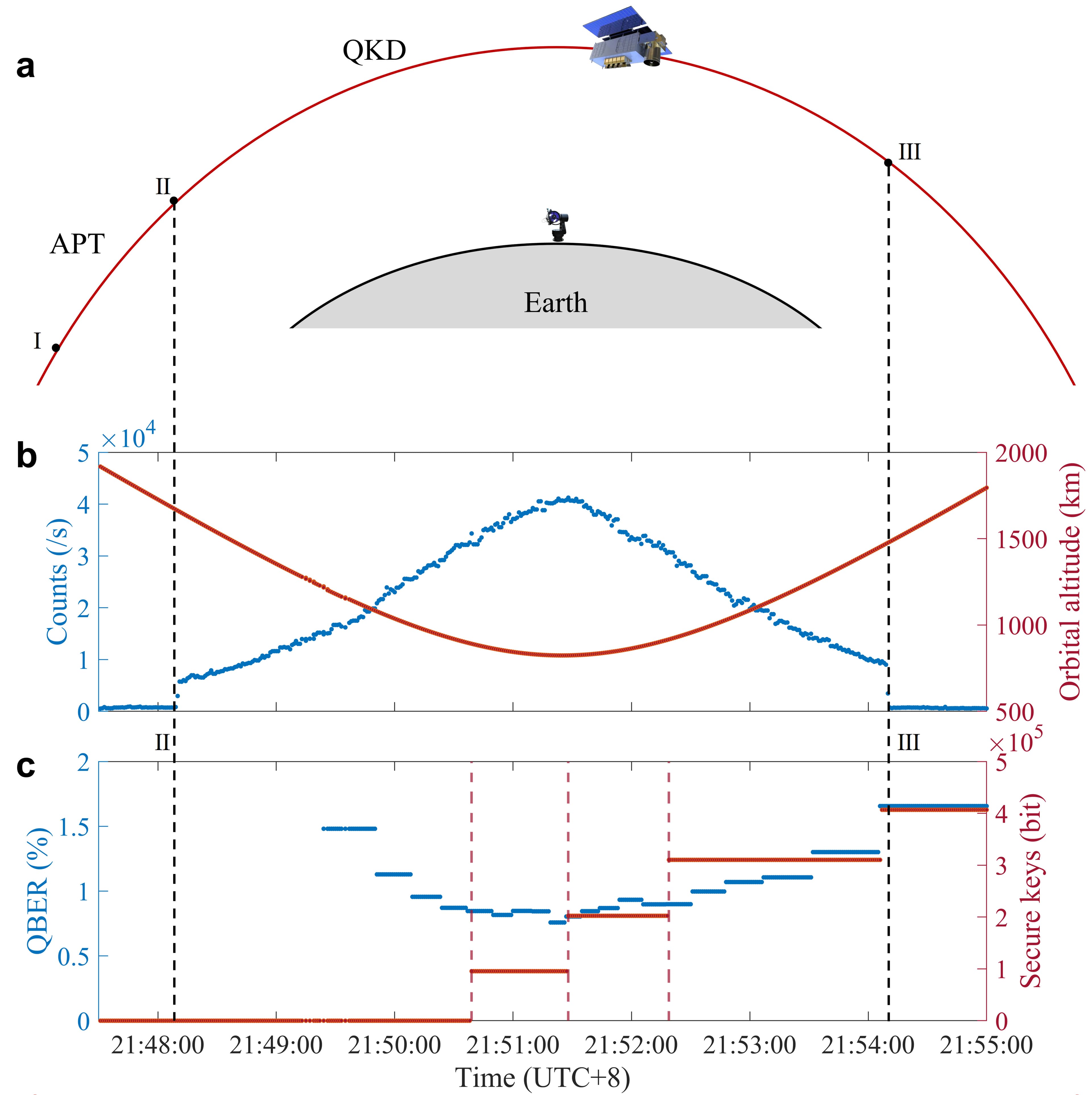
During one flight - 300 seconds, as long as a coffee break - the satellite and the ground station share 406,784 bits of the encryption key. In the best recorded flight, August 31, 2023: 592,384 bits. The numbers sound modest - it's less than one email attachment - but in quantum cryptography, every bit of a key is priceless. The error rate (QBER) remained below 1.8% - low enough to keep the key secure. No known attack - mathematical, physical or quantum - can preview this key without leaving a detectable trace in the error statistics.
23 kilograms that defied physics
To understand why this work — published in Nature in March 2025, collecting 121 citations in its first few months — is groundbreaking, you have to go back to 2017.
The Micius satellite proved that quantum key distribution (QKD) from orbit works. Single photons flew 1,200 kilometers through the vacuum of space and the atmosphere, retaining their quantum states. It was a proof of concept on a scale that had never been achieved before. The problem: Replicating this feat on a global scale would require dozens of satellites the size of Micius and dozens of ground stations the size of astronomical observatories. The economic calculus was brutal. One satellite = hundreds of millions of dollars. One ground station = a building with a dome, a meter-diameter telescope and monthly assembly. A constellation of several dozen such systems - an amount comparable to the budget of the entire space program of a medium-sized country.
In the eight years since Micius, no one has shown how to get off this scale. Until Jinan-1.
Pan's team solved the cost equation problem with three technical innovations that alone would be worthy of publication in Physical Review Letters—but together they create a game-changing system.
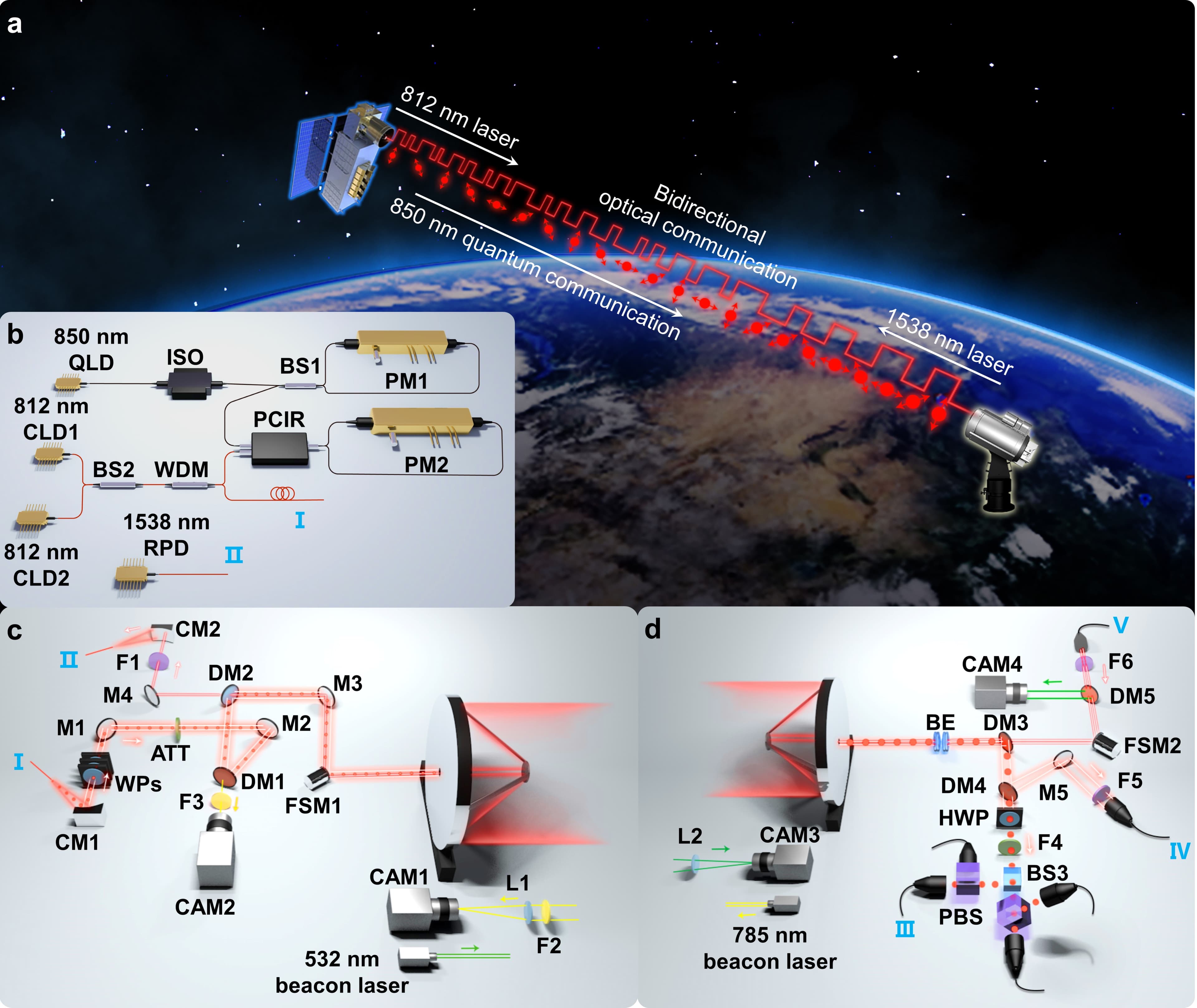
First: light source from one diode.Previous satellite QKD systems — like the one on Micius — used multiple lasers working independently to prepare different quantum states. Each laser is ground, power supply, heat dissipation, failure point. Each required calibration after launch - in a vacuum, at temperatures ranging from minus 40 to plus 80 degrees Celsius, in conditions where no one can approach and correct. Jinan-1 uses a single 850 nm laser diode modulated at 625 MHz. The pulses pass through a Sagnac interferometer - a system of mirrors and phase modulators - which splits them into four polarization states. One laser. One optical fiber. Zero moving parts in the optical path. Extinction coefficient 29 dB. Polarization contrast 25 dB.
Second: accuracy at the level of single microradians.Hitting a 28-centimeter telescope on Earth with a photon from orbit - from a distance of 500 kilometers, at a satellite speed of 7.5 km/s, through a heterogeneous, turbulent atmosphere - requires microradian precision. One microradian: the angle at which a one zloty coin is visible from a distance of 20 kilometers. Or in other words: aiming a laser pointer from the roof of the Palace of Culture at a coin lying on the tarmac of the Berlin airport - and hitting it every time, for 300 seconds, when the satellite glides across the sky at a speed of 27,000 kilometers per hour. Pan's team achieved tracking precision of 0.55–1.6 µrad RMS. How? They connected a camera capturing the guidance beam from Earth directly into the satellite's orientation control loop - without additional engines, without gimbals, without hundreds of kilograms of opto-mechanics. The satellite's orientation error has decreased by an order of magnitude relative to Micius.
Third: the key ready during the flight.Earlier satellite QKD suffered from a bottleneck: After transmitting photons, you had to send ancillary data — which bits arrived, what the error rate was, which bases matched — over slow microwave links. The key distillation process took hours, sometimes days. Jinan-1 multiplexes quantum and classical communications into one telescope and one fiber: 850 nm photons carry the qubits, an 812 nm laser with a power of just 2.4 mW transmits supporting data at 156 Mbps - both ways simultaneously. The encryption key is ready for use even before the satellite disappears over the horizon. Zero external connections. Zero delays. The satellite, which previously remained silent to Earth between passes, now conducts a continuous two-way conversation.
Economies of scale, the most important: Jinan-1 also acts as a "space postman". Two ground stations a thousand kilometers apart - say Jinan and Nanshan - do not need to be able to see each other. The satellite flies over the first one and agrees on the key with it. An hour and a half later he flies over the other one, hands over the same key. Both sides now share a secret - one that is physically impossible to suspect. A constellation of several microsatellites in different orbital planes provides global coverage without building a single observatory.
A race that was no longer an experiment
Jinan-1 isn't the only player in orbit — or even the first to get there.
Three weeks before Pan's team's publication in Nature, in February 2025, Europe's Eagle-1 - a joint mission of ESA and the SES-led consortium - underwent a critical design review. The launch is planned for 2026. Unlike Jinan-1, which remains a scientific experiment, Eagle-1 immediately targets commercial applications: secure transactions between financial centers in Frankfurt and London, protection of critical infrastructure, diplomatic links resistant to interception.
Singapore - a tiny city-state with ambitions to become Asia's financial hub - has already launched the first commercial QKD network connecting bank data centers. The United States is investing through DARPA (QuINESS program), NASA (quantum optical links to the ISS) and academic-industrial consortiums. Japan, South Korea, the UK - each of these economies has its own billion-dollar quantum program. The quantum cryptography market - according to Fortune Business Insights - is growing from $1.2 billion in 2024 to a projected $12 billion in 2032. CAGR above 30 percent.
But Jinan-1 changes the equation not by being technologically superior, but by drastically lowering the barrier to entry. A 22.7 kg payload can be dropped into orbit as a rideshare - an extra passenger on a rocket that's already flying - for a fraction of the cost of a dedicated launch. The ground station is transported by a delivery van. It sets up in one afternoon in the parking lot in front of an office building. No observatory. No monthly installation. No dome.
Poland in quantum orbit
The Polish quantum ecosystem is young and underfunded — but it exists and is growing in the strategically right direction.
As part of EuroQCI - a program worth EUR 1.6 billion that is to connect all EU countries with secure quantum links by 2030 - the NASK consortium is working on the first Polish node. In 2024, a test QKD Warsaw-Poznań link was launched using the national operator's fiber optic cable. This is an infrastructure that, if developed, could one day connect directly to the space segment of the European quantum network.
Scientific background: The University of Warsaw has a quantum photonics group publishing in Science and Nature Physics (Prof. Maciej Molas - single photon emission from two-dimensional materials). Wrocław University of Science and Technology develops integrated photonic systems for quantum communication. Center for Theoretical Physics of the Polish Academy of Sciences - theoretical foundations of QKD protocols and post-quantum cryptography. The Wrocław Quantum Cluster tries to connect these scattered efforts into an ecosystem.
Why isn't this enough? Because the competition never sleeps. China invests billions of dollars annually. Europe - €1.6 billion. Poland - NCN grants of PLN 1–2 million per project. The bridge between a publication in Nature Physics and a quantum charge in orbit requires money, which is simply not available in the Polish science financing system.
However, there is light: the Polish startup Quantum Blockchains - founded by physicists from the Jagiellonian University and the University of Warsaw - is developing the first commercial applications of quantum cryptography for the banking sector. The Wrocław Quantum Cluster, bringing together several companies and institutes, is trying to consolidate scattered efforts. If EuroQCI sticks to the schedule, the first Polish quantum link to European infrastructure should be established before 2028.
At stake: the information security architecture of the next decade. Quantum computers — conservatively estimated by NIST — could crack RSA-2048 within 5 to 10 years. The post-quantum algorithms NIST is working on are promising, but mathematical - and math can be broken by better math. QKD offers unconditional security - not based on computational complexity, but on the laws of physics. The non-cloning theorem does not depend on the computing power of the opponent. It works the same against a laptop and a quantum supercomputer in a decade. A country without its own QKD infrastructure will rely on external communication security providers - and in the era of cyber warfare, this is a risk that cannot be ignored.
Jinan-1, with its 23 kilograms of payload and 100 kilograms ground station, proved that this threshold has just become achievable.
Sources
DOI: 10.1038/s41586-025-08739-z— Li Y., Cai W.-Q., Ren J.-G. et al.,Microsatellite-based real-time quantum key distributionNature(2025). Main work: Jinan-1 satellite description, QKD experiments with four ground stations, key technical innovations.
DOI: 10.1038/nature23655— Liao S.-K. et al.,Satellite-to-ground quantum key distributionNature(2017). Pioneering QKD demonstration from the Micius satellite - the foundation on which the Jinan-1 architecture is built.
DOI: 10.1038/4531023a— Kimble H.J.,The quantum internetNature(2008). A programmatic essay that defined the vision for the quantum internet for the next two decades.
DOI: 10.1103/RevModPhys.95.045006— Azuma K. et al.,Quantum repeaters: From quantum networks to the quantum internetReviews of Modern Physics(2023). The authoritative review of fiber and satellite infrastructure for quantum networks.
EuroQCI— European Quantum Communication Infrastructure, a European Commission program coordinating the construction of QKD infrastructure in all EU Member States.
arXiv:2408.10994— Full text of Li et al. in open access.
Comments· 0
No comments yet. Be the first.