
Photon cloning finally works. 30× faster than a year ago
Berlin, January 2024. Daniel Vajner, a PhD student at Technische Universität Berlin, stares at the oscilloscope screen. For a week he has been trying to measure the same thing - whether two photons emitted by the same quantum system are indistinguishable from each other. The problem is that performing the Hong-Ou-Mandel experiment in the 1550 nm telecommunications band is like trying to hear a whisper at a rock concert. The noise of the detectors drowns out everything. However, Vajner knows that the answer to this question may determine whether we will ever build a quantum internet.
Meanwhile, 350 kilometers east, in Wrocław, Paweł Holewa had just finished his third month of work on what his colleagues at DTU in Copenhagen called "the needle in the quantum haystack problem." Holewa - a graduate of the Wrocław University of Science and Technology who returned to Poland after completing his PhD in Denmark - tried to solve a puzzle that had been keeping physicists around the world awake at night for 20 years: how to produce identical photons in the telecommunications band in a way that could be scaled.
The results of what Holewy's team did were published in April 2024 in Nature Communications. And they are so good that the quantum community stopped asking "if it's possible" and started asking "when will they implement it?"
28 billion reasons not to be overheard
Let's start with the numbers, because they are staggering. The quantum communications market—including quantum key distribution (QKD), quantum repeaters, and ultimately the quantum internet—is expected to reach $28 billion by 2035 (McKinsey, 2024). This is not money for the distant future. Deutsche Telekom is testing QKD on existing fiber optic links between Berlin and Bonn. China already has a quantum network connecting Beijing and Shanghai - 2,000 kilometers away.
But for all this to work outside the laboratory, a basic building block is needed: a source of single photons that are indistinguishable from each other. Why does indistinguishability matter? Because the quantum internet doesn't transmit data - it transmits entanglement. And entanglement between distant network nodes only works when photons from two different sources are so identical that the receiver can't tell which is which. That's not a metaphor - it's a tough physical requirement. If two photons differ by even a fraction of a wavelength, the entanglement disappears.
This is where the problem Holewa and his team set out to solve arises.
Why can't anyone make two identical photons
The source of single photons are usually quantum dots - nanometer-sized islands of semiconductor that act like artificial atoms. When excited by a laser, they emit exactly one photon at a time. The problem is that the dots grow in an epitaxial process, i.e. they self-organize on the substrate - a bit like water drops on glass. Each has a slightly different size, different tension, and therefore emits light with a slightly different wavelength.
Over the years, physicists have dealt with this problem in two ways. They either produced thousands of devices and hoped that one would hit a dot with the right parameters (efficiency: less than 1%), or they used expensive scanning techniques that located the dot and precisely placed an optical cavity around it. The latter method worked, but was as slow as assembling a watch by hand - one device a day, zero scalability.
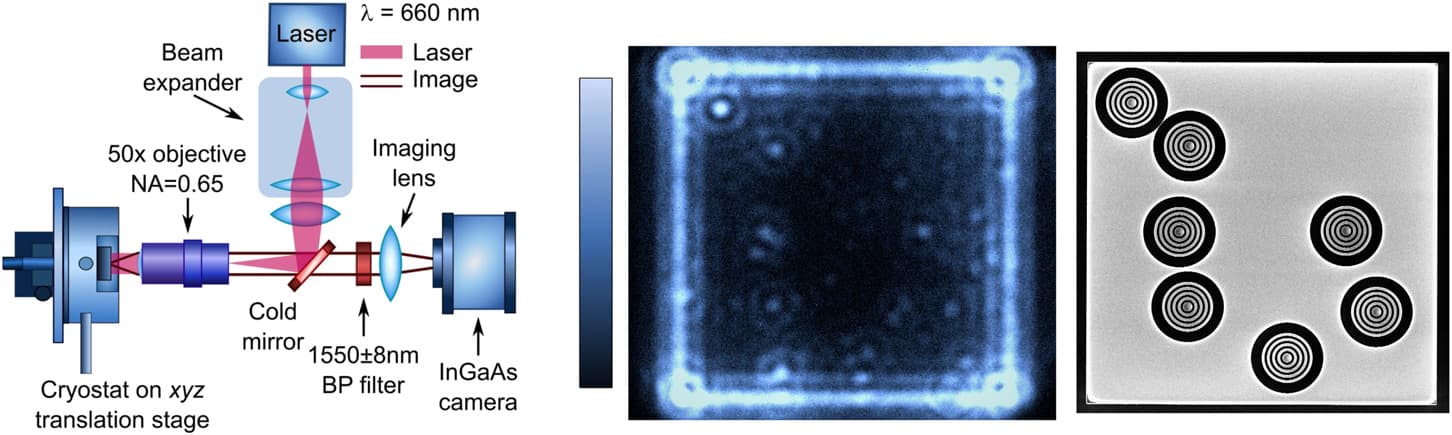
Rys. 1. Wnęka optyczna CBG (circular Bragg grating) wykonana w fosforku indu — obraz z mikroskopu elektronowego. Źródło: Holewa P. et al., Nature Communications 15, 3358 (2024), DOI: 10.1038/s41467-024-47551-7.
Holewa's team came up with a third solution. They refined the geometry of the sample so that the quantum dots glowed 7 times brighter, then used an infrared camera to photograph the entire wafer and select the best dots - the 10% brightest - before they even built anything. Only then, knowing the exact positions, did they place optical microcavities in the shape of circular Bragg gratings around the selected dots using two steps of electron lithography.
Effect? Production efficiency jumped from less than 1% to 30%. A thirty-fold increase. What about positioning precision? 90 nanometers - that's about the width of a flu virus.
Wrocław has the answer. And more than one
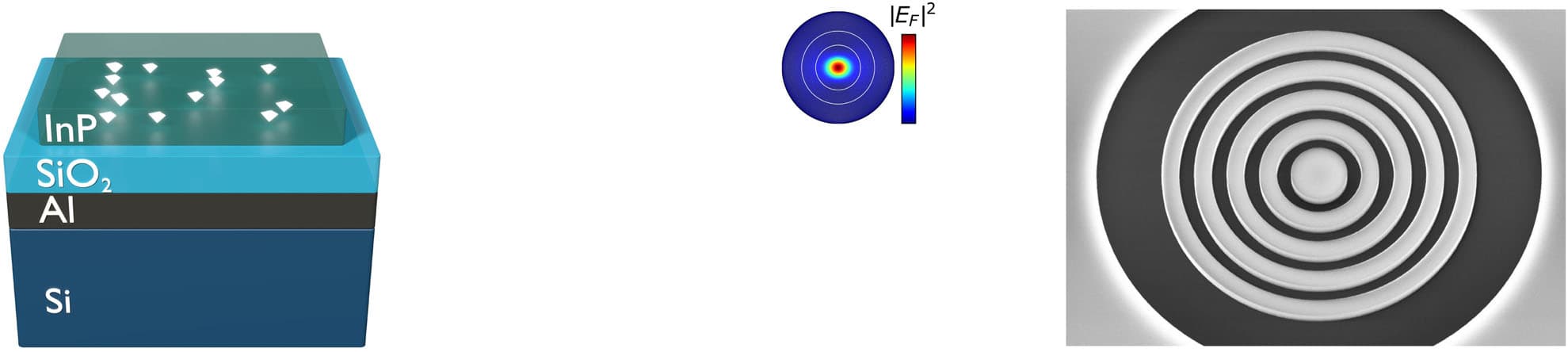
Rys. 2. Obrazowanie mikrofotoluminescencyjne — jasne punkty to pojedyncze kropki kwantowe emitujące w paśmie telekomunikacyjnym 1550 nm. Źródło: Holewa P. et al., Nature Communications 15, 3358 (2024), DOI: 10.1038/s41467-024-47551-7.
What is particularly important for Poland in this story is not just a single publication in Nature Communications. Among the 17 authors of the work, the names from Wrocław and Kraków dominate. Paweł Holewa, Emilia Zięba-Ostój, Maja Wasiluk, Marek Burakowski, Paweł Mrowiński, Bartosz Krajnik - all from Wrocław University of Science and Technology or AGH. Senior author, Marcin Syperek, is a professor at the Faculty of Fundamental Problems of Technology of Wrocław University of Science and Technology. Anna Musiał, also from Wrocław University of Science and Technology, is a recognized specialist in quantum optics.
Wrocław didn't come out of nowhere. Wrocław University of Science and Technology has been building competences in quantum photonics for a decade - partly thanks to cooperation with the Danish DTU (Technical University of Denmark), which has one of the best nanophotonics centers in Europe. Holewa completed his PhD there, working at the NanoPhoton center under the supervision of Elizaveta Semenova and Kresten Yvind, and then returned to Poland, bringing with him his knowledge and network of contacts.
This is a classic model of knowledge transfer: a Polish scientist goes to a leading center, publishes in Nature Communications, comes back and builds a team in the country. The problem is that for now this team operates mainly in grant mode. Holewa's work was financed by a grant from the National Science Center (OPUS) and the Danish Innovation Fund Denmark. There is currently no Polish company that would try to commercialize the technology for producing quantum photonic devices.
And it should be. Because the numbers speak for themselves: the purity of single photon emissions was g²(0) = 0.0032 - this means that out of 10,000 photons emitted, only 32 were mistakes. Photon indistinguishability, measured by the visibility of Hong-Ou-Mandel interference, reached a record for the C band of 19.3%. The Purcell coefficient - a measure of the emission gain by the cavity - was 5. Photon extraction efficiency into the first lens: 16.6%.
Is that a lot? For the layman: imagine that you are trying to catch individual grains of sand falling from a height of 10 meters. In random mode you get one in a hundred. Using the Wrocław method - every third.
At stake: infrastructure that cannot be seen
Quantum internet will not replace the classical one - it will operate in parallel, on the same optical fibers. The C band (1530-1565 nm) is the so-called transmission window in which the attenuation of silica fiber is the lowest - about 0.2 dB/km. This is why all of today's fiber-optic telecommunications operate in this band. If quantum photon sources operated in a different band, we would need a separate infrastructure. And that would increase costs by an order of magnitude.
Therefore, the Wrocław breakthrough has practical significance: it shows that it is possible to produce quantum sources of photons in the C band in a way that begins to resemble industrial production. 30% efficiency is still not the 95% required in a semiconductor factory, but the direction is clear. "Further improvement in performance and coherence properties will pave the way to the implementation of nonlinear single-photon devices and advanced quantum networks," the authors write in their summary.
What's next? The team points in three directions. First, charge stabilization - getting rid of the electrical noise around the dot that currently limits the coherence time to about 100 picoseconds. Secondly, integration with electrical systems (so-called p-i-n structure), which should improve the indistinguishability of photons. Third - and this is an engineering challenge, not a scientific one - increasing the scale of production.
For Poland, this is the moment when it is worth asking the question: do we want to be only a supplier of publications or also a supplier of technology? Quantum photon sources are a component, not a system — an ideal product for a spin-off company that could supply them to quantum network integrators around the world. The market is still being created, and the entry barrier - in the form of specialist knowledge - is high. Wrocław has already defeated it.
Sources
Source work: Holewa P., Vajner D.A., Zięba-Ostój E. et al.,High-throughput quantum photonic devices emitting indistinguishable photons in the telecom C-band, Nature Communications 15, 3358 (2024). DOI:10.1038/s41467-024-47551-7
Market context: McKinsey & Company,Quantum technology monitor(2024); Cao Y. et al.,The Evolution of Quantum Key Distribution Networks,IEEE Commun. Surv. Tutor. 24, 839–894 (2022); Kimble H.J.,The quantum internet, Nature 453, 1023–1030 (2008).
Comments· 0
No comments yet. Be the first.