One robot instead of a laboratory. The AI chemist just got a job
One robot instead of a laboratory. The AI chemist just got a job
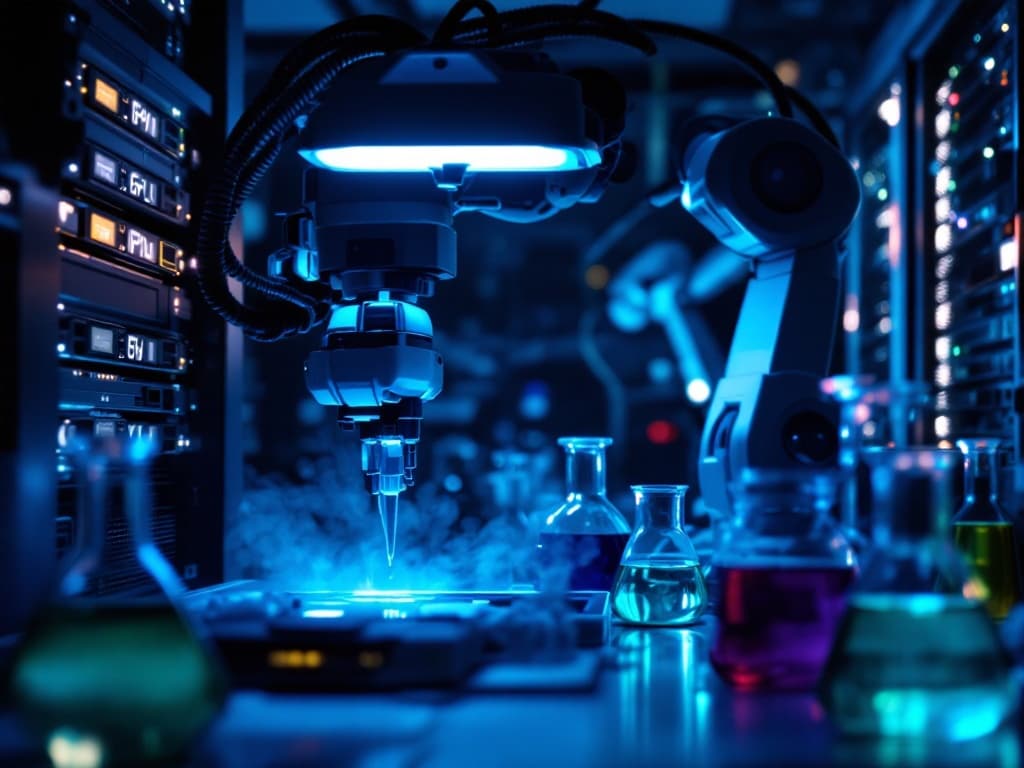
On Friday at 6:30 p.m., as USTC graduate students in Hefei were leaving for dinner, the lights came on in the lab — but not for humans. The robot manipulator reached for the pipette. On the monitor screen, Llama-3.1-70B, a language model weighing 140 GB and occupying four H100 cards, has just analyzed 200 recent publications on MOF catalysts and proposed an experiment that no one had ever considered before. At 10:15 p.m. the result was ready. The graduate student returned in the morning to find a report written in academic English on his desk - with a hypothesis, a procedure, XRD spectra, and a suggestion for the next step. In the meantime, the robot went into standby mode.
This is not a science fiction scenario. This is how ChemAgents works - the first fully autonomous, multi-agent AI chemist, just described in the Journal of the American Chemical Society. Unlike most lab breakthroughs that only exist in a simulator, this one has already undergone six real-world wet experiments: from synthesizing metal-organic crystal networks to optimizing the conditions of the classic Suzuki reaction. Without a single call to the promoter.
Four agents in one robot - a laboratory on a desk
The architecture of ChemAgents is surprisingly clear: a hierarchical system of five specialized agents, each based on the same Llama-3.1-70B model - crucially - running locally, without a connection to the cloud. No experimental data leaves the laboratory.
Task Manager talks to a human researcher in natural language. The sentence "optimize coupling reaction efficiency, budget: 24 hours, max 50 trials" is enough to trigger an autonomous loop. The Task Manager breaks down the goal into partial tasks and delegates them to four functional agents. Literature Reader searches a database of 200,000 publications and extracts protocols for the target reaction class. Experiment Designer arranges a sequence of experiments - the first five are exploration of the parameter space, the next twenty are Bayesian optimization with a surrogate model. Computation Performer models transition structures in DFT and predicts performance using the trained ML model. The Robot Operator translates the plan into commands for the physical manipulator with microliter accuracy.
This is not a system that only pipettes according to a rigid script. When experiment 6 unexpectedly yields 22% performance instead of the predicted 60%, Literature Reader automatically checks whether a similar decline has been reported in the literature. Computation Performer proposes a modified transition mechanism - a competing reaction path with a byproduct that blocks the catalyst. Experiment Designer redesigns the remaining 14 experiments in the series on the fly with the new hypothesis in mind. No phone call to the doctoral student. No break for sleep.
The first micro→macro contrast: one desk-sized robotic station — a manipulator, four GPU cards, a spectrometer — replaces a team of three PhD students working in shifts. And because the agent works 24 hours a day without fatigue, without mistaken repetitions and without a week-long delay when someone gets sick, the real speed-up factor is 7-10x compared to an experienced chemist working alone.
10⁶⁰ particles, one robot
The chemical space - the set of all theoretically possible molecules with drug properties - is estimated at 10⁶⁰ structures. Number of atoms in the observable universe? About 10⁸⁰. So far, humanity has synthesized about 200 million compounds - about the number of grains of sand that fit in a truck, while the entire chemical space is all the beaches on Earth multiplied by the number of stars in the Milky Way. Each new drug, catalyst or functional material is the result of a tedious, manual search of this space by PhD students armed with flasks and pipettes.
Autonomous laboratories - "self-driving labs" - are not a new idea. The first high-throughput screening systems were created in the pharmaceutical industry in the 1990s. But they were stupid machines in the algorithmic sense: the robot administered 1,000 variants, the human analyzed the results, after a week of deliberation made a decision about the next series, the robot waited. What ChemAgents brings to the table is closing the decision loop. The system does not wait for a human between iterations - it reads the literature itself, designs the experiment itself, interprets the results itself, and corrects errors itself.
The second contrast: one $15,000 GPU server and a $50,000 manipulator result in a system that does about $300,000 worth of lab work per year (three postdoc positions in experimental chemistry). Return on investment: less than three months. For comparison, the cost of training one doctor of chemistry (5 years of doctoral studies, reagents, equipment) in Poland is approximately PLN 600,000 from public and grant funds. One ChemAgent costs the same - but works 24/7 for 5 years without vacation.
Song's team isn't alone in this race. In parallel, a work by a team from MIT and the Broad Institute (Singh et al., 2025) was published in Nature Communications describing a platform for autonomous enzyme engineering - also based on LLM agents and automatic biofoundry. The system evolved an enzyme with 50 times higher activity within 48 hours by conducting 12 rounds of mutagenesis and selection fully autonomously. In both cases, the common denominator is a fundamental shift: from "AI as an analytical tool that gives suggestions to humans" to "AI as a researcher performing physical experiments in the material world."
Poland: excellent computational chemistry, the laboratory sleeps after 5 p.m
Polish theoretical and computational chemistry has been playing in the first league for years. Professor Andrzej Sokólski's group from the Wrocław University of Science and Technology develops DFT methods used in catalyst modeling - exactly the tools that are included in the ChemAgents Model Library. Professor Bartosz Trzaskowski's team from the Center for New Technologies at the University of Warsaw publishes papers on ligand design supported by quantum calculations, which are regularly published in JACS - the same journal in which ChemAgents was published. Professor Tomasz Puzyn from the University of Gdańsk heads the QSAR laboratory, which has been using machine learning for years to predict the properties of chemical compounds - a competence that directly translates into the Computation Performer layer in the autonomous system.
One element is missing: a physical robot with a closed decision-making loop. Polish high-throughput laboratories - the Synthesis Automation Laboratory at the IChO PAN or the screening platform at the Center for Molecular and Macromolecular Research of the Polish Academy of Sciences in Łódź - automate dosing and analysis, but still require a human to look at the results and decide on the next move. Open loop. The gap to be closed: language model, agent layer, hardware integration.
How much would it cost to build Polish ChemAgents? Manipulator with pipetting tip - 100-150 thousand. PLN (KUKA or Universal Robots, available through Polish integrators such as Astor). Server with four 70B inference GPU cards - 60-80 thousand. zloty. Spectrometer for ongoing analysis - 200-400 thousand. zloty. In total, approximately 400-600 thousand PLN - equivalent to the two-year cost of one experienced chemist with full reagent facilities. For institutions such as the Łukasiewicz Research Network (annual budget ~ PLN 1.2 billion) or NCN programs (OPUS up to PLN 2 million, MAESTRO up to PLN 3 million per project) - these are not astronomical amounts. This is a strategic decision.
There is also an industrial path. Polish pharmaceutical and biotechnology companies - Selvita (revenues PLN 324 million in 2025, laboratories in Kraków and Poznań, 900+ employees), Molecure (GPW, pipeline of arginase inhibitors and YKL-40 in the clinical phase), Ryvu Therapeutics (Kinase Library platform, partnerships with Merck and Exelixis) - each spend tens of thousands of man-hours annually on optimizing syntheses and testing compound libraries. ChemAgents in Selvita would mean the ability to conduct lead optimization 24/7, which in practice shortens the discovery project time from 18 to 6 months. Considering the cost of capital and the race for patents - an advantage worth tens of millions of zlotys. The question is not "is it worth it", but "who will be first".
Three barriers between the laboratory and the revolution
The technology works. But three barriers stand between publication in JACS and routine use in industry—and none of them are scientific.
First: interoperability. Each laboratory equipment manufacturer uses its own communication protocol - Hamilton, Tecan, Eppendorf, Thermo Fisher do not speak the same language. ChemAgents works with one specific manipulator. Creating a universal translator—the abstraction layer between an AI agent and any hardware—is a 12-18-month engineering task, but one with enormous commercial potential. The startup that builds "ROS for chemistry" will capture the market before large equipment manufacturers wake up.
Second: trust in the black box. EMA and FDA require full reproducibility and auditability of the drug discovery process. A system based on LLM - a model that is not fully deterministic by nature - will have to undergo validation that is unprecedented today. Song's team partially addresses this problem by recording every prompt and response in a logbook, but there is a long way to go before a drug discovered autonomously by AI is approved.
Third - and the most specific for Poland: there is a lack of dedicated bridging financing between science and implementation. Horizon Europe has instruments for "digital twins for chemistry" in cluster 4, the National Science Center announces competitions for "AI in science", NCBR has a Fast Track - but no program is tailor-made for "we buy a robot, load the 70B model, employ a chemoinformatician and launch an autonomous laboratory". A project worth PLN 1–1.5 million in the proof-of-concept phase is too large for OPUS and too small for the NCBR consortium.
However, there is a signal that the gap may be closing. In 2026, PARP is launching the "SMART Path" program with a digital transformation component of the industry - the first instrument under which a pharmaceutical company can apply for funding for an autonomous laboratory as an element of R&D digitization. For Selvita, Molecure or Ryvu, this means potentially PLN 10-15 million in funding for implementation - if only someone submits an application before competitors from Germany or Switzerland.
Meanwhile, autonomous laboratories are being established in China (USTC Hefei - the same team as ChemAgents), the USA (MIT, Broad Institute, LBNL), Switzerland (ETH Zurich - ARES platform) and the UK (University of Liverpool - Materials Innovation Factory). Each month of delay is a month in which a competing laboratory operates 24/7, while the Polish chemist finishes the last pipette at 5 p.m. and turns off the lights. In two years, the choice will be simple: join a team that has ChemAgents, or compete with a system that works non-stop, without time off and without pay.
Sources
DOI: 10.1021/jacs.4c17738— Song T., Luo M., Zhang X. et al.,A Multiagent-Driven Robotic AI Chemist Enabling Autonomous Chemical Research On Demand, Journal of the American Chemical Society (2025). 141 citations.
DOI: 10.1038/s41467-025-61209-y— Singh N., Lane S., Yu T. et al.,A generalized platform for artificial intelligence-powered autonomous enzyme engineering, Nature Communications (2025). 81 citations.
DOI: 10.1038/s41467-025-57831-xScience acceleration and accessibility with self-driving labs, Nature Communications (2025). Overview of the state of autonomous laboratories.
Comments· 0
No comments yet. Be the first.