Iron laced with tungsten stores hydrogen without fusing into a lump
Iron laced with tungsten stores hydrogen without fusing into a lump
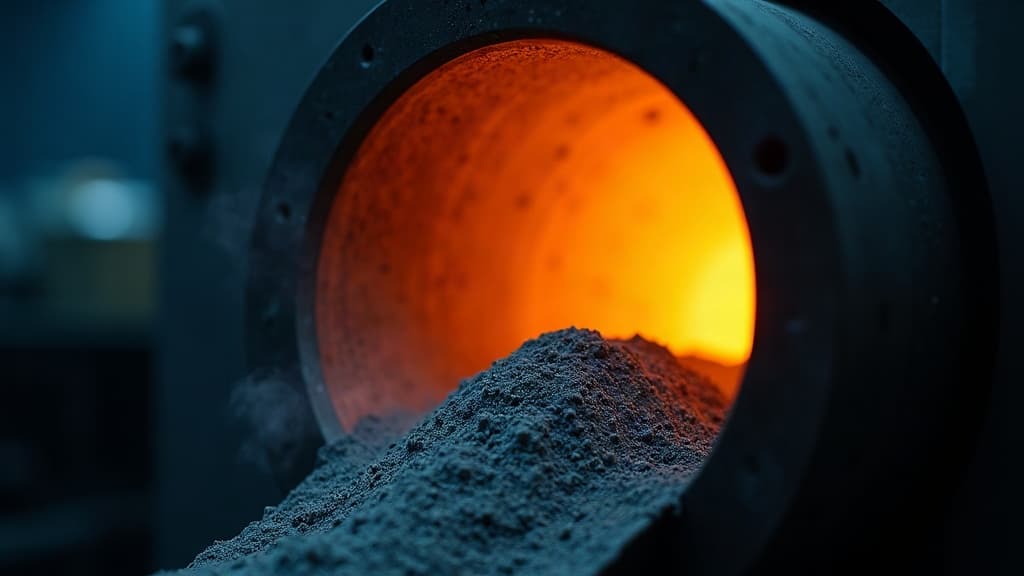
In a tube furnace at Northwestern University near Chicago sits a steel basket holding a kilogram and a half of grey powder. Hydrogen and steam flow through the powder in turns. After thirty such switches the powder works almost as well as it did at the start. In a similar run, a powder of pure iron fused into a hard lump and gave back only a tenth of its hydrogen.
The difference is tungsten. Jie Qi and David Dunand added it to iron and described the result on 5 October in Nature Communications. Their powder bed stores 43.8 grams of hydrogen and, after thirty cycles, uses on average 93 percent of its capacity.
It sounds modest. But it is a problem engineers have known about for more than a hundred years.
1903: iron, steam and airships
The idea itself is old. In 1903 the British engineer Howard Lane built a hydrogen generator based on a simple reaction. Steam flows over hot iron. The iron takes oxygen from the water and rusts, and hydrogen comes out of the pipe. Then the iron oxide is reduced back to metal and the cycle starts again.
The first commercial generator of this kind started up in 1904. By 1913 the method was producing about 24 million cubic metres of hydrogen a year. Some of it went to British airship stations, which filled their envelopes with gas on site.
The plants, however, were large and temperamental. They needed skilled operators and had to run almost without a break. When simpler ways of making hydrogen arrived, later including natural-gas reforming, the steam-iron method was pushed to the margins.
Decades of silence: a powder that clumps
Today the same reaction is coming back in a different role. The point is no longer to make hydrogen but to store it. Hydrogen has to be kept somewhere between the moment an electrolyser has cheap power from wind or sun and the moment a fertiliser plant or refinery needs it.
Iron does this in a clever way. Hydrogen reduces iron oxide to metal and itself combines with oxygen to form water. The energy of the hydrogen is stored in metallic iron. When gas is needed, steam is passed through the bed. The iron rusts again and releases hydrogen. There are no pressurised cylinders and no tanks of liquid hydrogen close to absolute zero.
There is one problem, and it is a serious one. At 650–800 degrees Celsius, iron grains swell and shrink with every cycle. They touch and grow together. Metallurgists call this sintering. The pores close, gas no longer reaches the interior and the bed's capacity melts away. The authors state plainly that this problem has blocked scaling of the method for decades.
2003–2020: scaffolds that only postponed the problem
The first idea was intuitive. If iron grains grow together, keep them apart. In 2003 Japanese chemists added other metals to iron oxides. In 2010 a group at Cambridge looked for additives that would stabilise the oxide over repeated cycles.
Researchers tried nickel and copper, which steam does not oxidise. They also tried cerium oxide and zirconium oxide, which hydrogen does not reduce. Such additives act like scaffolding. They separate the iron grains and slow sintering down.
The key word is "slow". Over many cycles, sintering came back anyway. And the scaffold stores no hydrogen. It is dead weight that takes up space and adds cost.
2023–2024: tungsten in a foam
Dunand's laboratory took a different route. Instead of an inert scaffold, it added a metal that itself takes part in the reaction. First came molybdenum, then tungsten. In 2024 the team described in the journal Small an iron foam with added tungsten. It withstood steam-hydrogen cycles at 800 degrees far better than pure iron.
The catch was the form. The foam was made by directional freezing of a powder slurry, removing the ice and firing. It is a good laboratory technique, but hard to scale to tonnes of material. The tests also involved grams, not kilograms. Loose powder in a large bed is another matter. Under their own weight, the lower layers sinter more easily.
2026: a powder that foams itself
The new paper answers both objections. Qi and Dunand no longer build a foam. They mix cheap iron oxide with tungsten oxide in a mill, dry it and pour it into a steel basket 84 millimetres across and 18 centimetres long. The basket goes into a tube furnace. Hydrogen comes from an electrolyser; steam comes from water dripped straight into the hot zone.
Then something counterintuitive happens. From cycle to cycle the bed does not get denser; it becomes more porous. The powder foams by itself.
X-ray diffraction explains the mechanism. The researchers scanned the powder as it was heated and watched which crystals appeared and disappeared. Steam pulls a volatile compound out of tungsten oxide. It travels in the gas and settles on neighbouring iron grains, where hydrogen reduces it to metal. The tungsten combines with iron. With every cycle, atoms therefore migrate between grains. Where they left, nanopores remain. When the reaction is idle and the bed is only held at temperature, a second mechanism takes over. Tungsten-containing phases sit between the iron grains like spacers and stop them from growing together.
The numbers show the effect. Pure iron in the same reactor dropped to 11 percent of capacity. The tungsten mixture held 93 percent on average after thirty full cycles. In separate tests the team charged the bed only partly, to a quarter, a half and three quarters of capacity. Each series ran up to 90 such cycles. Full check-up cycles still showed almost all of the capacity.
The kilogram scale matters. Typical studies of this chemistry deal with grams. Here the bed is about a thousand times larger, and the weight of the powder did not manage to compact it.
What is solid and what is not yet
The capacity measurements and the microscope images are solid. So is the authors' candour in the peer reviews that Nature Communications publishes alongside the paper. In the first version of the work, posted in February as a preprint, the mixture contained 25 atomic percent tungsten. A reviewer asked whether tungsten escapes from the bed. The team measured the composition and found there had been less from the start, about 19 percent. The composition at the inlet, in the middle and at the outlet of the bed was the same. At most a few grams of an iron-tungsten deposit settled on a hot part downstream of the basket. Against a kilogram and a half of powder, that is little.
The efficiency is less certain. The authors estimate that about 80 percent of the hydrogen's energy can be recovered over the full cycle. That, however, is a thermodynamic calculation. It assumes that three quarters of the heat goes back into the process thanks to good heat exchangers. Nobody has built such a reactor yet.
There are practical limits too. Charging with hydrogen took up to about 20 hours in the lab, because the electrolyser supplied little gas. After the thirtieth cycle the powder was so fine that it began to smoulder when taken out into air. Thirty full cycles is still few if a store is to run for years. The authors argue that the growing porosity bodes well. Proof for a thousand cycles does not exist yet.
The competition is not asleep. But it is racing in another direction.
Hydrogen can be stored in several ways today, and each has its price. Compressing it to 700 bar takes a lot of energy and requires expensive tanks. Liquefying it at minus 253 degrees takes even more. Ammonia and liquid organic carriers are easy to ship, but getting hydrogen back out of them costs heat and equipment.
Metal hydrides work at lower temperatures. A reviewer asked outright: why not those? The authors reply that iron with tungsten holds more hydrogen per litre, and is mid-table on mass and raw-material cost. Hydrides often need catalysts and special processing. Iron with tungsten only has to be mixed from ready-made oxides. In the authors' view it is a complement rather than a replacement.
At the largest scale, salt caverns count. Chambers washed out of salt deposits hold enormous volumes of gas, but they are not everywhere. A basket of powder can be placed right next to a factory.
In Europe, Eindhoven University of Technology is also developing iron as an energy carrier. There the iron powder is burned, and the resulting rust is regenerated with hydrogen. It is a close cousin, but the goal is different. Eindhoven wants to deliver heat; Northwestern wants to store the hydrogen itself.
The business layer: tungsten costs money
Iron is one of the cheapest metals in the world. Tungsten is not. In their reply to reviewers, the authors calculated that the raw material to store a kilogram of hydrogen costs about 13 dollars with pure iron oxide and about 310 dollars with the tungsten mixture.
That gap is misleading, though. Pure iron loses almost 90 percent of its capacity after a dozen or so cycles. To get the same usable store, you would need eight times as much of it. The material cost then rises to about 118 dollars, and the reactor becomes eight times larger. The authors also assume that spent powder can be recycled into new powder.
There is also raw-material risk. The European Union lists tungsten as a critical raw material, and most of the world's mining is in China. Anyone wanting to build such stores at scale would have to factor that in.
The first steps towards the market are already visible. The research was supported by the university's commercialisation office and Northwestern's accelerator programme. Dunand discloses in the paper a financial interest in IROX, a US company that applies iron powders to redox processes. The authors propose a modular design, much like batteries. A module with a hundred kilograms of powder would have roughly the volume of a laboratory gas cylinder. A larger store would be built from many such modules connected in parallel.
Poland: hydrogen it already has
The authors point out that more than 90 percent of hydrogen today is used by stationary industry: fertilisers, methanol and refineries. In such places the mass of the store does not matter. Safety, footprint and cost do.
That describes Poland's situation. According to the government's 2021 hydrogen strategy, Poland produces about a million tonnes of hydrogen a year and is one of the largest producers in the EU. Almost all of it is made from natural gas today. It is used mainly by the Grupa Azoty nitrogen plants in Puławy, Police, Kędzierzyn-Koźle and Tarnów and by Orlen's refineries.
When part of that production switches to electrolysis powered by wind and sun, an uneven-rhythm problem will appear. The electrolyser runs when the wind blows; a fertiliser plant runs all the time. Poland has salt caverns, in which natural gas is stored at Mogilno and Kosakowo. But not every plant sits next to a salt deposit. A store made of iron powder, working at ordinary pressure, can stand right beside the installation. Large chemical plants also have heat, and this technology needs it.
Polish universities have strong teams in powder metallurgy and materials engineering. Durability tests of a bed over thousands of cycles and at the scale of hundreds of kilograms are work they could join before the technology matures elsewhere.
TRL 4: why not higher
We have a working, automated laboratory reactor with a kilogram-scale bed, thirty full cycles and partial series of up to ninety cycles. That is technology readiness level 4: a solution validated in the laboratory. What is missing is a measured efficiency for the whole system, a reactor with heat recovery and a trial in an industrial plant.
History has come full circle. Howard Lane made hydrogen from iron and steam for airships. A hundred and twenty years later, the same reaction may serve to store hydrogen for factories. This time the iron grains do not have to clump.
Sources
- Qi J., Dunand D.C. Self-foaming sintering-resistant iron-tungsten powders enable high-cycle thermochemical hydrogen storage. Nature Communications (2026), published 5 October 2026. DOI: 10.1038/s41467-026-78337-8. Including the Transparent Peer Review File.
- Qi J., Dunand D.C. Self-foaming, Sintering-resistant Iron-Tungsten Powders Enable High-Cycle Thermochemical Hydrogen Storage. arXiv:2602.22807 (preprint, February 2026). DOI: 10.48550/arXiv.2602.22807
- Pennell S., Chen M., Dunand D.C. Tungsten Strongly Inhibits Sintering of Porous Iron During High-Temperature Redox Cycling. Small (2024). DOI: 10.1002/smll.202402174
- Lane hydrogen producer (history of the steam-iron process): https://en.wikipedia.org/wiki/Lane_hydrogen_producer
Comments· 0
No comments yet. Be the first.