Detective: who put out the smoke in hydrogen
Industry has known for decades that the world needs hydrogen. Fertilizer, refineries, methanol — all of them run on H₂. The question is not whether to make it, but how much carbon dioxide we leave behind. Classic steam methane reforming (SMR) yields hydrogen and releases CO₂ at the same time. Against that backdrop, methane pyrolysis looked like an obvious fix: solid carbon instead of gaseous carbon dioxide. For years that fix stayed stuck in the lab. On 3 September 2026 a team from Stanford, UCSB and the Karlsruhe Institute of Technology showed in Science why it stuck — and how to get around the heat wall (DOI: 10.1126/science.aed4911).
Wall no. 1 — the reform that feeds half the world
Henry Moise of Stanford recalls something easy to miss: a few percentage points of GDP rest on hydrogen, and ammonia fertilizers help feed roughly half the world’s population. Hydrogen is everywhere, so it becomes invisible. As long as it comes mainly from steam reforming, its price and carbon footprint are the price and footprint of much of chemistry.
Industry’s answer was: catch CO₂ and store it (carbon capture and storage, CCS), or switch to electrolysis powered by clean electricity. Both paths are real — and both have their own walls: capture cost, clean power availability, build-out speed. Methane pyrolysis promised a third route: CH₄ → H₂ + C(solid). No reforming smoke. A byproduct you can sell or store instead of pumping into the atmosphere.
False trail — a bigger furnace, heated from the outside
On paper it was enough to “just scale.” You build a bigger reactor, heat it to about 1000 °C, methane splits, you collect hydrogen and carbon. Labs showed chemically clean results. Investors saw a map: pipelines already exist, local plants can sit closer to customers, and solid carbon looks like a sustainability-report bonus.
Matteo Cargnello of Stanford names the stage plainly: if you want to cover hydrogen markets, reactors have to be very large. And large vessels heated from the outside have a physical problem. Heat soaks into the walls and slowly reaches the middle of the bed. The larger the diameter, the harder it is to hold the temperature the reaction needs. An external heating jacket that works on a lab bench becomes a bottleneck at plant scale — slow, costly and energetically wasteful.
The trail looked credible because it matched industrial intuition: “do the same thing, only bigger.” That is why methane pyrolysis collected papers and prototypes for years without becoming the standard. A second problem — how to pull solid carbon out of the reactor — was also known. The new Science article aims at the heat wall: without efficient delivery of high temperature, there is no point talking about a factory.
Why the trail failed — and what it taught
The team’s modeling and kinetic measurements showed that at commercially relevant bed diameters, external heating kills throughput. This is not “a bit lower efficiency.” It is an order of magnitude: heat cannot keep up with chemistry. You can build more and more small furnaces, but then you lose the economics of scale. You can pump more energy into the jacket — and then indirect emissions and capital costs rise.
The lesson from the false trail is simple: the barrier was not in the CH₄ → H₂ + C reaction itself. It sat in heat engineering. As long as heat entered from the outside, methane pyrolysis was elegant chemistry trapped in the wrong reactor.
Breakthrough — burn a little hydrogen inside
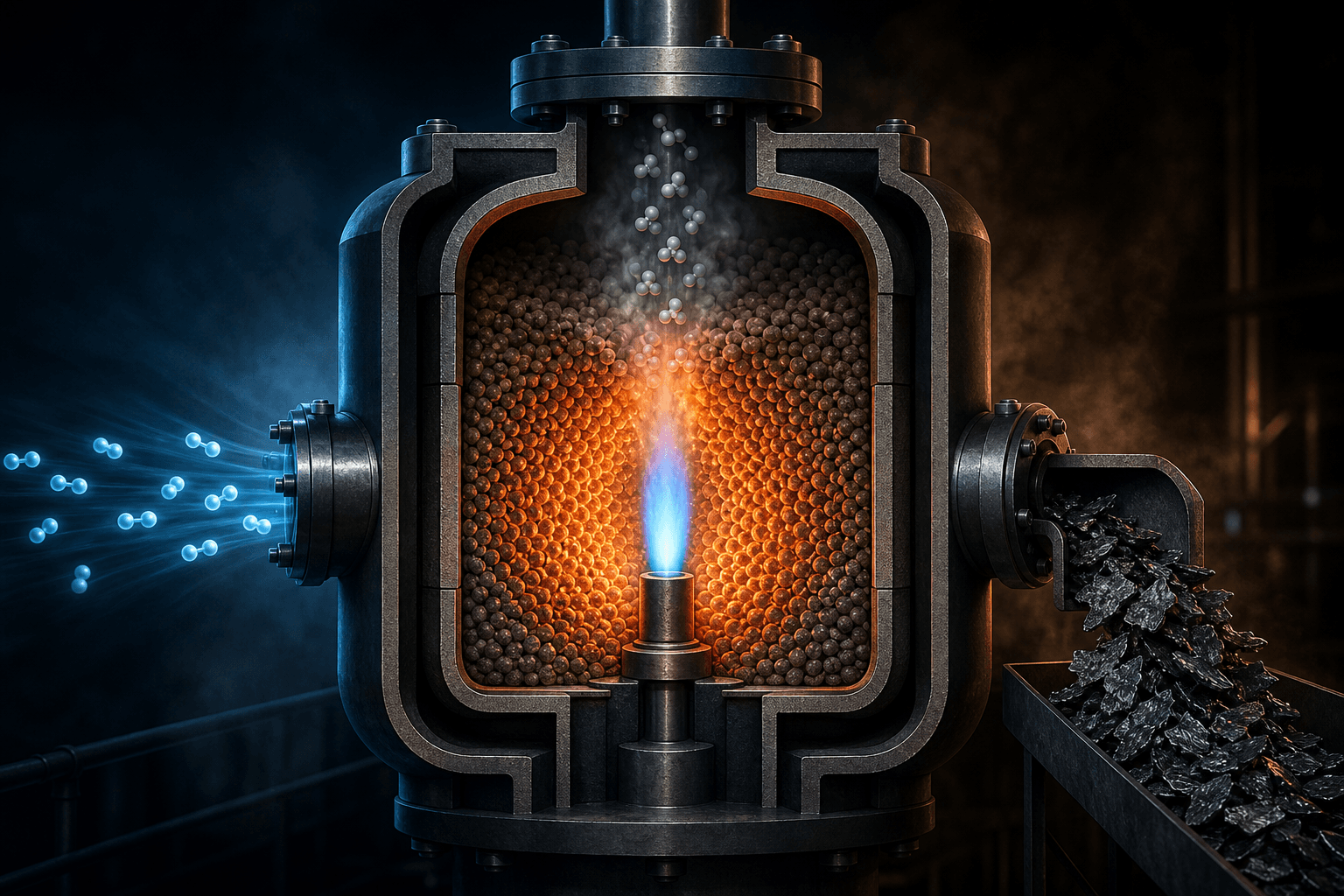
Stanford proposed autothermal heating: a burner inside the reactor selectively combusts part of the hydrogen produced. Instead of burning natural gas (and making CO₂ again), you burn H₂ and get mostly water vapor. Heat forms where the reaction needs it — in the bed volume, not in the jacket.
According to Moise, the efficiency gain is roughly tenfold: with the same energy, one autothermal reactor yields as much product as ten externally heated furnaces. The Science abstract goes further — it speaks of a throughput increase of several orders of magnitude for commercially relevant diameters. In a CERAWeek presentation Moise even cited up to 100× at 1000 °C when kinetics are coupled with heat-transfer models.
Then comes the business surprise. The solid carbon was not “just any carbon.” The degree of graphitization reached 96.0% — graphite-precursor grade, achieved on low-cost iron oxide catalysts. Graphite is a feedstock for batteries, electrodes and electronics; the United States imports it at scale. Cargnello warns plainly: the material is not yet pure enough for the most demanding battery uses. This is a step, not the end of the road. For an investor, though, the gap between “soot to bury” and “a graphite precursor for further processing” changes the plant’s entire balance sheet.
The team also showed how to suppress autothermal self-emissions (carbon gasification in the combustion zone) nearly to zero in a lab fluidized bed, with an H₂:CO ratio as high as 19. A process-level life-cycle assessment estimates carbon intensity of about 1.9 to 4.5 kg CO₂eq per kg H₂ — far from classic gray reforming, though still dependent on assumptions about methane, oxygen and auxiliary energy.
The TRL of this story today sits around 4: lab proof of concept, scale-up models, a provisional Stanford patent, collaboration with UCSB (larger reactors) and involvement from CZero among others. A commercial plant is not standing yet. What is standing is a map: whoever masters internal heat and carbon quality collects margin from two products at once — hydrogen and graphite.
Poland: hydrogen in the strategy, graphite in imports
Poland has a hydrogen strategy, plans for hydrogen valleys and a chemical industry that already consumes H₂. It also has rising demand for battery materials and Europe’s sharp dependence on graphite imports. If the answer to “where will we get clean hydrogen and anode carbon” is “from California, under license,” autothermal pyrolysis becomes an anatomy of dependence: we have pipelines and demand; they hold the rights to how the furnace is heated.
There is no need to plant a copy of Stanford’s reactor in Police tomorrow. What is needed is to know that the game is about patents on internal heat, partnerships with firms such as CZero, and process-engineering groups at technical universities — before “methane without smoke” is only a neat chart from Science, and a Polish battery maker buys graphite from someone else’s catalog.
Closing
The false trail said: build a bigger furnace and heat it from the outside. The physics wall said: the heat will not reach the core. The September 2026 breakthrough says: burn a little hydrogen inside, heat the bed from within, collect ten times more product — and pull out carbon at 96% graphitization. Poland’s question is no longer only “do we have hydrogen.” It is: who here will earn on a furnace that feeds chemistry and batteries at the same time.
Sources
- Moise, H., Moll, S. et al. Autothermal methane pyrolysis: Scalable heat integration for hydrogen and graphite production. Science 393, 1014–1020 (2026). DOI: 10.1126/science.aed4911.
- Stanford University / EurekAlert. Stanford researchers develop an improved method for producing sustainable hydrogen (3 Sep 2026). eurekalert.org.
- Stanford Precourt / ENERGY. CERAWeek drop-in: Henry Moise — Process Intensification & Domestic Graphite Production Via Autothermal Methane Pyrolysis. energy.stanford.edu.
Comments· 0
No comments yet. Be the first.