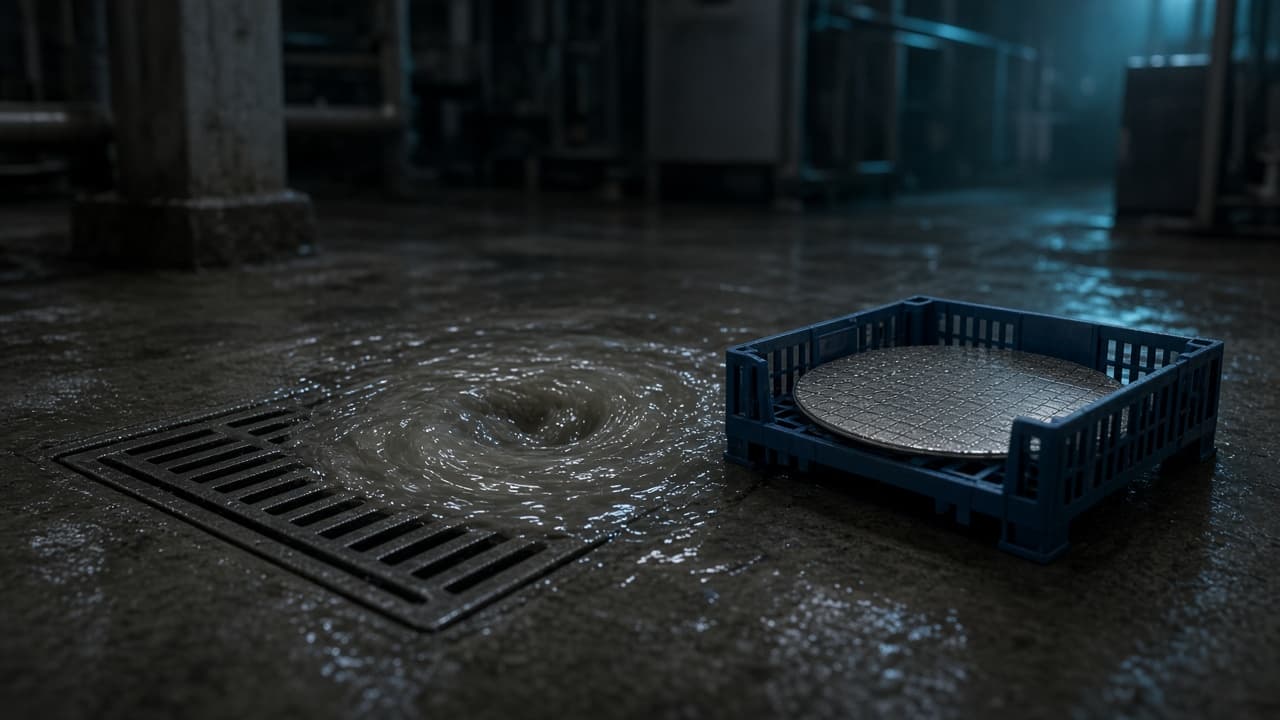
Europe imports gallium. Factories pour it down the drain
Paradox: Europe buys gallium while chip factories pour it away
Europe pays between €2,270 and €2,900 per kilogram for gallium. Germanium costs more: €9,450–€10,210. Indium sits around €840 (Shanghai Metals Market quotes cited by HZDR in August 2026). The same elements sit on the EU critical raw materials list: without them there are no GaAs and GaN wafers, lasers, LEDs, or many optical devices. And yet European semiconductor plants have for years discharged them in process wastewater — at concentrations too low for classical hydrometallurgy to pay off, and high enough to make the water expensive to treat. Both statements cannot be true at once. And yet they are.
On 28 August 2026 the Helmholtz-Zentrum Dresden-Rossendorf announced the spin-off Siderogain: a company that turns that paradox into a product. At the heart of the technology sit siderophores — biomolecules that bacteria produce to steal iron from their surroundings. Those same “iron claws” also latch onto gallium, indium and germanium, because chemically they resemble iron. Wastewater stops being only a disposal problem. It becomes a mine.
Why the wastewater looked useless
Gallium is a companion element. In nature it rarely forms its own deposits; industry gets it mainly as a by-product of smelting. End-of-life recycling (e-scrap, panels, connectors) covers only a fraction of demand. A GaAs wafer plant generates streams after etching and polishing: little metal per litre, but the process never stops. To a classical chemist that means “too little to mine.” To a biologist it is ideal ground for a ligand with very high affinity.
Rohan Jain and the team in the biotechnology department of the Helmholtz Institute Freiberg for Resource Technology (HIF/HZDR) showed this already in 2019 in Water Research (DOI: 10.1016/j.watres.2019.04.005). The siderophores desferrioxamine B (DFOB) and E (DFOE) complexed 100% of the gallium in two real wafer-fab wastewaters. After separating the complex and decomplexing with acid, more than 95% of the gallium was recovered as a siderophore complex; molar purity versus other metals reached 92.9% for DFOE. A German patent application ran in parallel. The paradox began to crack: “too little to mine” does not mean “too little to fish out with a biomolecule.”
Aha: evolution built the selector; industry plugged in the pipe
Siderophores evolved to bind Fe(III). Gallium(III), indium(III) and germanium form similar complexes — not magic, just coordination chemistry. The HZDR team added process engineering: bind the metal, separate the complex from the wastewater matrix, split metal from ligand, return the siderophore to the loop. In lab tests the biomolecules ran more than ten cycles without loss of function; the company’s goal is one hundred cycles. Later DFT and ligand screening extended the map to indium and germanium (DOI: 10.1016/j.jhazmat.2024.135523). In 2024 a DFOB-assisted nanofiltration route also appeared, with a model pointing toward recovery above 90% (DOI: 10.1016/j.watres.2024.122892).
In autumn 2025 a pilot plant started at semiconductor manufacturer Freiberger Compound Materials (FCM) in Freiberg. Throughput: up to 2,000 litres of process wastewater per day. According to HZDR Innovation, German high-tech alone could save on the order of two tonnes of gallium per year by recovering it from wastewater — and cut import dependence. That is no longer a conference poster. It is a pipe, a valve and a daily metal balance.
Who earns when the paradox closes
Siderogain grew out of the Helmholtz Enterprise programme, and since August 2026 it also draws EXIST Research Transfer funding: automation, first customers, scaling the pilot into a full prototype. HZDR Innovation GmbH holds a stake — this is already the centre’s 21st spin-off and the fourth from HIF’s biotechnology department. Rohan Jain leads the technology; the team includes Aratrika Ghosh (pilot), Peter Boelens (new applications) and Jonathan Engelhardt (business development).
The earning model is clear for a fab: instead of paying to dispose of toxic metal-bearing wastewater and buying fresh gallium on an Asian exchange, you recover your own feedstock at a price competitive with primary supply. The first customer is a wafer and compound-semiconductor producer. The second ring is any industrial stream with low-concentration Ga/In/Ge. The third is policy: the Union is building raw-material resilience (CRMA, RESourceEU), and process recycling counts toward circular-economy targets faster than new mines outside Europe.
Poland: low priority for drilling, high priority in the drain
On 2 September 2026 the Council of Ministers adopted the National Critical Raw Materials Exploration Programme (KPPSK) for 2026–2033, with a budget of about PLN 185.7 million from NFOŚiGW. Gallium and germanium landed in the low-priority group for deposit exploration: documentation prospects are limited. The climate ministry also notes that gallium and germanium occur in Polish zinc-lead ores that are not currently mined, and that spoil heaps and smelter residues are a separate map.
Here the paradox returns in a national version. If geology will not deliver a quick gallium mine, the only fast mine left is waste and wastewater. Poland has zinc smelters (including hydrometallurgical germanium threads), a growing electronics sector and CRMA recycling goals. It does not yet — publicly — have an FCM×Siderogain-style plant next to domestic wafer production or large post-processing semiconductor streams. The window is simple: before German and Dutch integrators lock contracts across Central Europe, Polish chemical firms, industrial water utilities and spin-offs from Łukasiewicz / technical universities can license siderophore recovery or enter joint ventures on local streams. KPPSK funds drilling. The question for NCBR and deep-tech funds: who will finance the first Polish pipe at 2,000 litres a day?
Stakes
The paradox does not vanish by magic. It vanishes when an evolutionary ligand gets a patent, a pilot and a customer with a real pipe. Siderogain sits around TRL 6: the technology works in an industrial setting, at pilot scale, with transfer funding aimed at first customers. Europe still imports gallium. Factories still produce wastewater. The difference is that between the drain and the exchange now stands a biomolecule and a company that knows how to sell it. Poland can treat this as a Saxon curiosity — or as a checklist: wastewater, ligand, patent, pilot, customer. The third line on the critical-raw-materials list will not come from a new shaft. It will come from a pipe someone finally connects.
Sources
- Helmholtz-Zentrum Dresden-Rossendorf / idw — Siderogain spin-off release (28 Aug 2026): https://idw-online.de/en/news876492
- HZDR Innovation — Siderogain technology profile (pilot 2,000 L/day; ~2 t Ga/year in DE high-tech): https://hzdr-innovation.de/en/startups/siderogain-metal-recovery-from-industrial-wastewater/
- R. Jain et al., Water Research 158 (2019) — Ga recovery from wafer wastewater via DFOB/DFOE: DOI: 10.1016/j.watres.2019.04.005
- C. Hintersatz et al., Journal of Hazardous Materials 478 (2024) 135523 — siderophore selection for In/Ge: DOI: 10.1016/j.jhazmat.2024.135523
- A. Ghosh et al., Water Research (2024) — DFOB-assisted nanofiltration: DOI: 10.1016/j.watres.2024.122892
- MKiŚ / ISBnews — National Critical Raw Materials Exploration Programme (2 Sep 2026); gallium and germanium in the low-priority deposit-exploration group.
Comments· 0
No comments yet. Be the first.