A safe made of four atoms opened. No fire.
Four atoms that no one could separate
Imagine a safe. Tetrahedral, atomic - carbon surrounded by three hydrogens, each bonded with a bond strength of 439 kJ/mol. To open it, the industry has been using an oven heated to 600-800°C for decades. You need a giant plant, pressurized oxygen and a rare earth catalyst. Effect? Methanol (a lower value product), which is often completely oxidized to CO₂ anyway.
What if you could open this safe with light?
Junwang Tang's team from University College London has just shown that it is possible. In MarchNaturedescribed a catalyst that, at room temperature, under an ordinary 365 nm LED, converts methane directly into ethanol - a liquid fuel that can be poured into the tank. No furnace. No pressure. No waste.
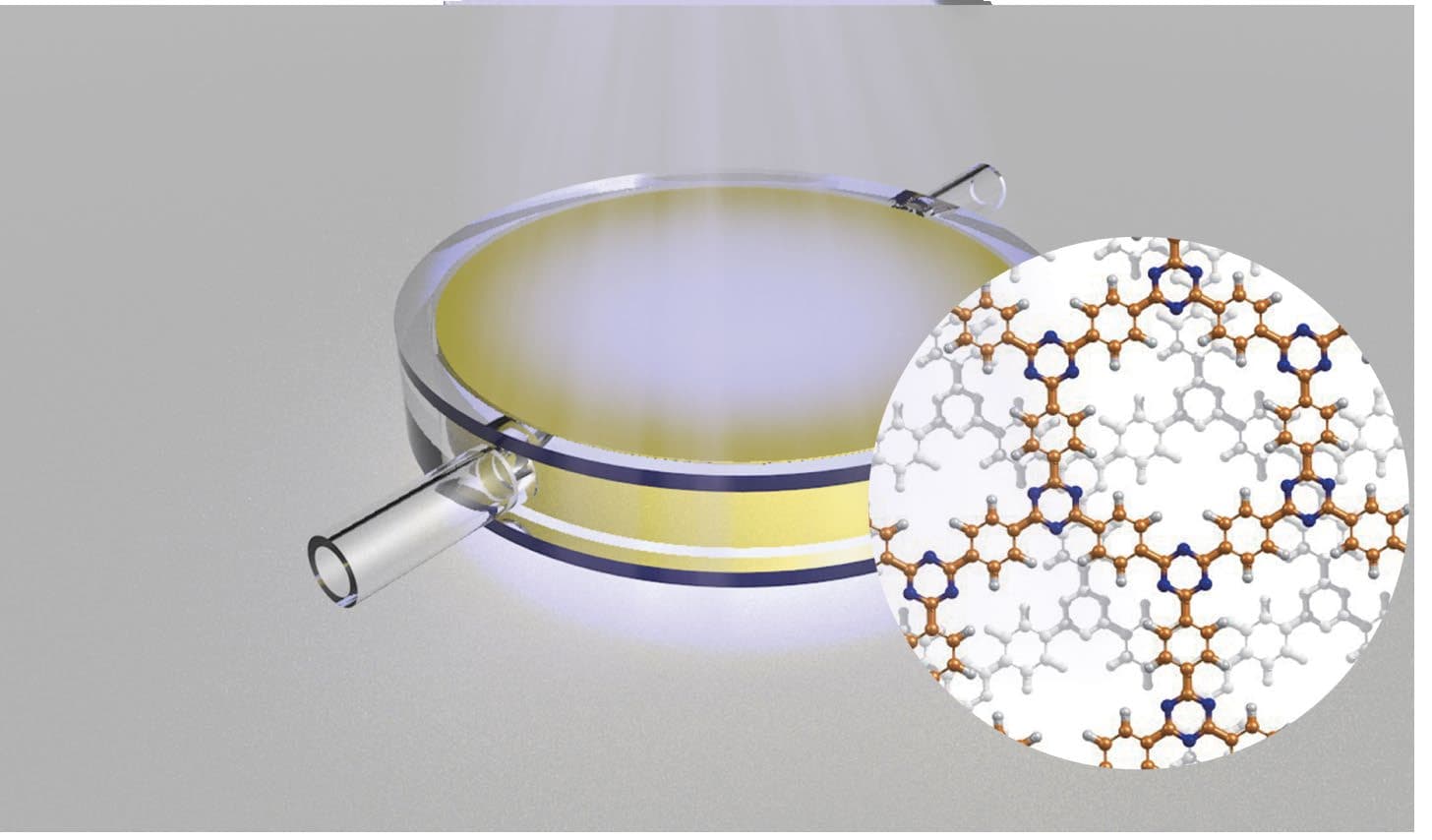
Rys. 1. Struktura katalizatora CTF-1 — naprzemienne pierścienie triazynowe (miejsce generowania rodników •OH) i benzenowe (miejsce sprzęgania C–C). Ta przestrzenna separacja zapobiega nadmiernemu utlenianiu produktów. Źródło: Xie J. et al., Methane oxidation to ethanol by a molecular junction photocatalyst, Nature 639, 368–374 (2025), DOI: 10.1038/s41586-025-08630-x.
This is not a gradual improvement. It's a paradigm shift.
Methane (the main component of natural gas) is also the largest unused chemical raw material on Earth and the second greenhouse gas after CO₂. We emit 37 billion tons of CO₂ equivalent annually. Most just... run away. From pipes, from mines, from landfills. We burn it in torches in oil fields, turning the sky orange, because it's cheaper to burn it than to transport it.
One molecule of methane weighs 16 daltons (atomic mass units). Let's multiply by trillions of tons.
78.6 percent. And why it's harder than it seems
The problem with methane is not that it cannot be converted. The problem is that everything we've come up with so far is like using a hammer: you break the safe, but you destroy the contents.
Thermocatalytic methane oxidation requires temperatures of 600–800°C. Under these conditions, the products (methanol, ethanol) are unstable and immediately undergo complete oxidation to CO₂. To obtain acceptable selectivity, you need to work at low conversion. It's like trying to take one page out of a book with a flamethrower - technically possible, but the waste of material is colossal.
Photocatalysis solves the temperature problem: light provides energy without heating the entire system. But existing photocatalysts achieved quantum efficiency (AQE) below 0.5%. This means that for every 200 photons that entered the reactor, only one was used productively. The remaining 199 were wasted.
Tang's team achieved an AQE of 9.4%. An almost twenty-fold jump.
How? The answer lies in the architecture of the CTF-1 catalyst: a covalent triazine structure that resembles a honeycomb of two alternating motifs: triazine and benzene rings.
This is where the safe metaphor comes into play.
A key made of two parts
CTF-1 is not the first methane photocatalyst. He is the first to solve the spatial problem.
Imagine a production line where two processes (cutting and folding) take place in the same place. The operator cuts the methane into methyl radicals, which immediately fall back under the knife before they can combine to form ethanol. This is how existing catalysts worked: the place where •OH radicals were generated (which cut the C–H bond) was the same place where methyl radicals tried to pair. Result? Excessive oxidation - the product disappears before it can be formed.
CTF-1 distributes these functions spatially - this is its key innovation. Triazine rings retain electron holes (generated by light) and produce •OH radicals - this is the "knife" that cuts methane. Benzene rings accumulate electrons and serve as a landing pad for methyl radicals - a "stage" where two radicals combine to form ethane and then ethanol.
These two zones are a few angstroms apart - a distance smaller than the thickness of a single atom in our safe. But that's enough. Methyl radicals migrate from triazine to benzene before they can be attacked by another •OH.
This is the "intramolecular junction" (intramolecular junction) by title - architecture that does exactly what the industry needs: cuts and folds in two different places, at the same temperature.
The numbers from work speak for themselves. At a methane to oxygen ratio of 16:1 (i.e. in oxygen-poor conditions - exactly the opposite of in thermocatalysis), the selectivity to ethanol reaches 78.6%. Methane conversion: 1.7%. For comparison: thermocatalysis gives similar selectivity to C₂ products, but requires 600–800°C and involves a conversion of ~25%. In photocatalysis, however, the conversion can be increased by increasing the contact time or photon density - without the risk of excessive oxidation, because the temperature does not change.
And when platinum was added to CTF-1 as a cocatalyst, the efficiency jumped once again. Platinum acts as an amplifier: it collects electrons accumulated on benzene and transfers them more effectively to the oxygen reduction reaction. Effect: more •OH radicals on triazine, more C–C coupling on benzene. The process, which in thermocatalysis requires an installation the size of a refinery, takes place here in a flow-bed reactor the size of a shoebox.
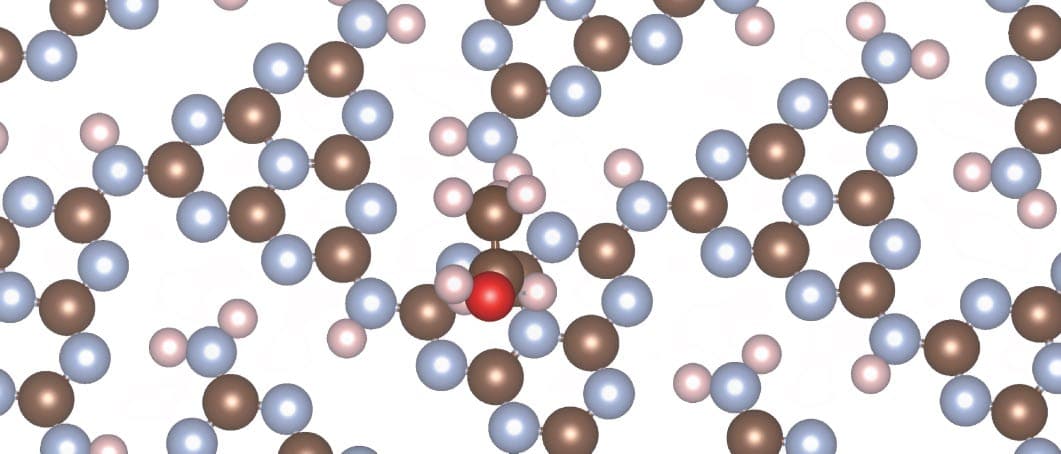
Rys. 2. Wydajność fotokatalitycznej konwersji metanu do etanolu w reaktorze przepływowym CTF-1. Szczyt sygnału etanolu przy obecności zarówno tlenu, jak i pary wodnej — warunki zbliżone do rzeczywistych. Źródło: Xie J. et al., Nature 639 (2025), DOI: 10.1038/s41586-025-08630-x.
9.4% efficiency per photon. What does this mean on a planetary scale?
Lab numbers always need to be scaled carefully. But even cautiously: this is a breakthrough.
An AQE of 9.4% means that every tenth photon falling on the catalyst participates in the reaction. For heterogeneous photocatalysis, this is a result that would have been considered impossible three years ago. For comparison: natural photosynthesis (a process honed by evolution over 3.5 billion years) has an efficiency of converting solar energy into biomass of 3-6%.
One methane molecule → one photon → half an ethanol molecule.
We scale: According to the International Energy Agency, we flare approximately 143 billion cubic meters of natural gas annually - equivalent to the entire annual gas consumption of Central and Eastern Europe. It is a gas that literally goes up in smoke because it is not profitable to liquefy and transport it.
A photocatalyst that operates at room temperature under LED light changes the economic calculus. Instead of building a pipeline or an LNG installation, you build a container with a flow reactor, a set of LEDs and a CTF-1 catalyst. Methane comes in from the well, ethanol comes out.
Is it worth it? Let's do the math: ethanol as a fuel costs ~EUR 0.60 per liter on the wholesale market. Methane at the point of extraction, especially "flared" methane, has an effective negative price (you pay an emission penalty. The difference between the penalty and the revenue from ethanol sales is the markup. And CTF-1 can be synthesized from cheap organic precursors in a microwave-assisted process. No precious metals except optional platinum.
The race that has just begun
Tang is not the only one. There is a silent race in the world to be the first to commercialize the photocatalytic conversion of methane.
At MIT, Yogesh Surendranath's team has been working since 2024 on the electrocatalytic oxidation of methane to methanol at room temperature — but this approach requires electricity, not light, and stops at C₁. In China, Can Li's group at the Dalian Institute of Chemical Physics is developing photocatalysts based on titanium oxide and zinc oxide - cheaper than CTF-1, but with selectivity below 50% and zero C–C coupling ability. At ETH Zurich, Javier Pérez-Ramírez's team is investigating the direct conversion of methane to methanol by copper zeolites. It works, but it needs 200°C and activation with oxygen.
None of these approaches combine the three features that Tang's CTF-1 has: room temperature, C–C coupling to ethanol, and spatial separation of active sites.
There is also a question about scalability. The flow bed used in Tang's experiment was operated for 10 hours without any drop in performance. This is not enough to talk about an industrial installation. However, it is enough, enough to talk about proof-of-concept for a technology that did not exist a year ago. Next step? Scale up the reactor a hundred thousand times - from milligrams of catalyst to kilograms. This is an engineering challenge, not a scientific one. This means that companies, not only universities, can take up them.
One of them is already doing it. British startup SolCata (founded by UCL graduates, although without Tang's direct involvement) is working on the commercialization of photocatalysts for the conversion of CO₂ and methane. American Syzygy Plasmonics raised USD 70 million for photocatalytic reactors for hydrogen production; same principle of operation, different gas. If Tang and his team patent CTF-1 (and Nature suggests they do - the patent filing date precedes publication), we could see the first demonstration container in the oil field within 2-3 years.
Poland has competences. There is no application yet
The Polish ecosystem of photocatalysis and methane conversion is dispersed but real.
At the University of Warsaw, the team of Krzysztof Bieńkowski and Renata Solarska is researching halide perovskites for photodecomposition of water and CO₂ reduction - materials related to CTF-1, also based on semiconductor architecture. At the Institute of Physical Chemistry of the Polish Academy of Sciences in Warsaw, Vishal Shrivastav is working on covalent organic frameworks (COFs) for energy storage - cousins of CTF-1, similar chemistry, similar engineering challenges.
At the Wrocław University of Science and Technology, Bartosz Dziejarski and Renata Krzyżyńska analyze CO₂ capture and management technologies - complementary competences, because methane and CO₂ are two ends of the same hydrocarbon problem. At the Institute of Fluid-Flow Machinery of the Polish Academy of Sciences in Gdańsk, Adam Cenian and his team work on biofuels and the conversion of lignocellulosic biomass to bioethanol.
One thing is missing: the app. No one in Poland combines photocatalysis with methane. No one is trying to scale CTF-1 or similar structures to a flow reactor.
And he should. Poland is the fourth largest consumer of natural gas in the EU (after Germany, Italy and France), with annual consumption of ~20 billion m³. Gas port in Świnoujście, Baltic Pipe, interconnectors with Lithuania and Slovakia. The infrastructure is there. There is no technology that would allow this gas to be converted into a liquid without giant steam reforming installations.
PKN Orlen, the largest petrochemical company in the region, is already investing in green hydrogen and chemical recycling. Green ethanol from methane fits into this portfolio like a missing puzzle: it can be used as a fuel (E85, biocomponents), as a raw material for further chemical synthesis (ethylene, ethyl acetate, polyethylene) or as a hydrogen carrier in logistics.
Funding path? In 2026, NCBR announced competitions under the KPO for hydrogen technologies and the circular economy - photocatalysis of methane to ethanol qualifies for both. PARP in the SMART Path program offers up to 80% co-financing for SMEs for R&D work on low-emission technologies. Budget of a single project: PLN 5–15 million. Price of CTF-1 synthesis on a laboratory scale: less than PLN 200,000. zloty.
The safe is open. The key is on the table. It's a few angstroms wide and works under any LED. The question remains: will Poland reach for it before others do? Because this race is not about publishing in Nature. The point is who will be the first to put a container with a reactor in an oil field and say: "They burn methane. We make fuel from it."
Sources
DOI: 10.1038/s41586-025-08630-x— Xie J. et al., Methane oxidation to ethanol by a molecular junction photocatalyst,Nature 639, 368–374 (2025).
DOI: 10.1016/j.fuel.2022.127220— Dziejarski B., Krzyżyńska R. et al., Current status of carbon capture, utilization, and storage technologies in the global economy,Fuel(2023).
DOI: 10.1021/acscatal.4c04232— Bieńkowski K., Solarska R. et al., Halide Perovskites for Photoelectrochemical Water Splitting and CO₂ Reduction,ACS Catalysis(2024).
DOI: 10.1002/aenm.202403564— Shrivastav V. et al., Unveiling the Potential of Covalent Organic Frameworks for Energy Storage,Advanced Energy Materials(2024).
Market data: IEA Global Methane Tracker 2025, IEA Flaring Estimates 2025, Eurostat Natural Gas Statistics 2025.
Comments· 0
No comments yet. Be the first.