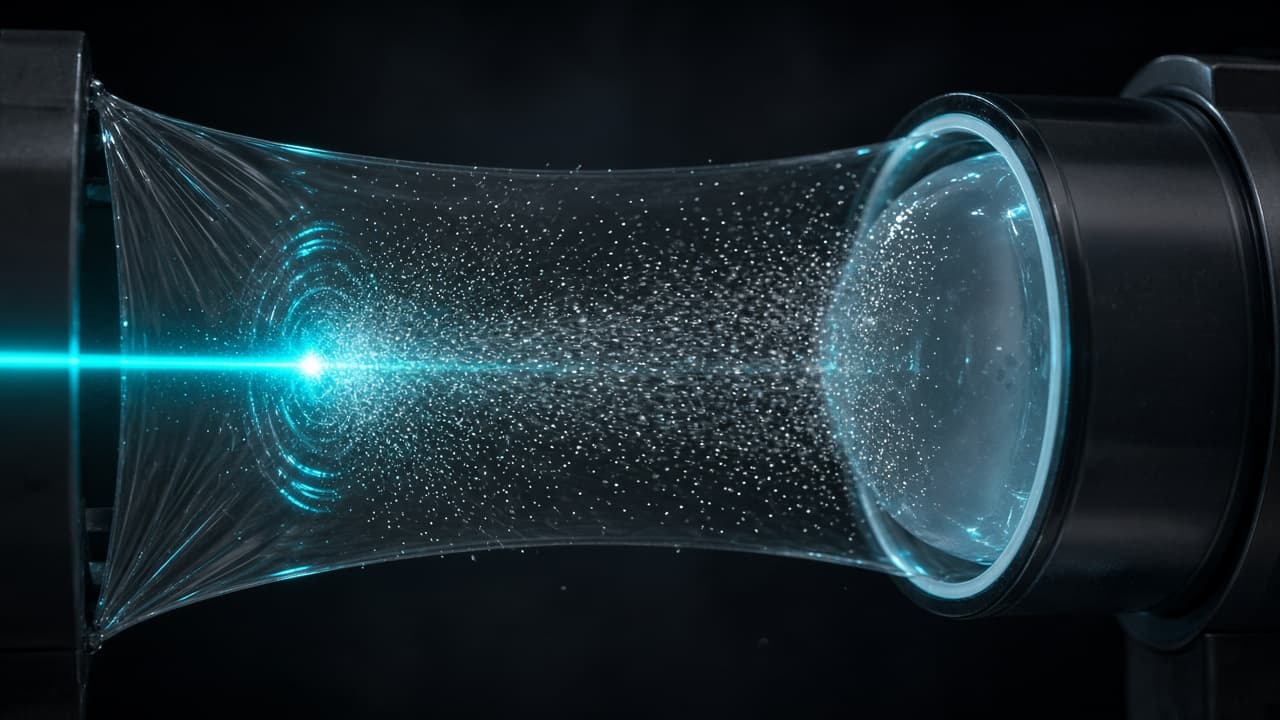
A laser pulse hits a thin PET plastic film. For a fraction of a second the material reaches conditions like those deep inside Neptune or Uranus: pressures around 100 gigapascals and temperatures near 4000 kelvin. In that moment some of the polymer’s carbon rearranges into a diamond lattice. Then the shock wave flings the newborn grains into vacuum at more than ten kilometers per second — like debris from a meteorite impact.
A team at Helmholtz-Zentrum Dresden-Rossendorf (HZDR) and the University of Rostock, working with ELI Beamlines south of Prague, showed that those diamonds can be caught, cleaned, and imaged in an electron microscope. The paper appears in Diamond and Related Materials (DOI: 10.1016/j.diamond.2026.114091, CC BY 4.0). First author is Ben Heuser; corresponding author is Dominik Kraus, founding director of HZDR’s HEDI institute and a professor in Rostock.
The trail started with planets
This story does not begin in a materials factory. It begins in planetary physics. Kraus and colleagues have long driven high-power lasers into plastics to recreate the interiors of icy giants, where carbon can rain out of a C–H–O mixture as diamond. They expected nanodiamonds. What surprised them was the speed: the grains form fast enough to suggest a technical route, not only a Neptune model.
Until now they mostly saw diamonds “in flight,” via X-ray probing during compression. Whether the grains would survive the return to ordinary pressure and temperature stayed open. The new work answers: yes — if you catch them in a soft enough medium.
Anatomy of a shot
The runs took place at the L4n-P3 station at ELI Beamlines. A high-power laser fires three times per minute into a 100-micrometer PET film, raster-scanning the sample. Nanodiamonds form in the shock wave; when the wave reaches the end of the foil, the material expands abruptly into vacuum and the grains fly like projectiles.
“When the compression wave reaches the end of the sample, it abruptly enters a vacuum, accelerating the nanodiamonds to speeds of more than ten kilometers per second — comparable to a meteorite impact,” Kraus says in the EurekAlert release. A hard collection-cylinder wall would destroy them on impact. So the team used an ionic gel: vacuum-compatible, water-soluble, soft as a cushion.
Each shot sends roughly ten trillion nearly same-sized grains into the cylinder. That sounds like a lot of mass; it is only a fraction of a milligram. Mean diameter is about 3 nanometers (under 5 nm, with a standard deviation below 1 nm). One such diamond holds on the order of 3,000 carbon atoms. After about 100 shots the team collected a few hundred micrograms — enough to extract the grains from the gel, purify them, and image them in the ELMI-MV electron microscope at the University of Rostock.
“After extracting the nanodiamonds from the catcher material and purifying them, we were able to see them for the first time directly,” Heuser says. “That was a special moment we had been working towards for years.”
Why detonation is not enough
Industrial nanodiamonds mostly come from explosive detonation or high-pressure high-temperature routes. Those methods work, but struggle to deliver ultrasmall grains with a narrow size distribution and high purity. An explosion mixes carbon with contaminants; size scatter is often wide. Many uses — quantum sensors, medical contrast, catalysis — want small, uniform, clean particles.
Laser compression of PET offers another path: a cheap feedstock (polymer film), a controlled pulse, a narrow size distribution, and the option to dope foreign atoms already in the plastic. Doping can improve, for example, MRI contrast agents or catalysts that split CO₂ under sunlight — a larger combined surface area of tiny grains helps the reaction.
Scale and barriers
Today this is still a big-science lab process. ELI is a unique high-energy, high-repetition-rate laser facility. A hundred shots yield hundreds of micrograms, not kilograms. Kraus points to a direction of travel: fusion research is driving energy-efficient high-energy lasers at high shot rates. More pulses per unit time means higher yield. Follow-on work in Rostock and at large facilities aims at the milligram range — closer to conventional process scales.
We put this path at about TRL 3: recovery and characterization of ultrasmall NDs from PET near 100 GPa are demonstrated, but there is no production line yet and no validation in a specific product (sensor, contrast agent, abrasive). Barriers are clear: laser cost and access, energy per gram of product, safety around pulsed megabar conditions, gel purification, doping repeatability, and competition from detonation and HPHT.
What nanodiamonds already do — and what is missing
Nanodiamonds are not a new idea. They already go into polishing pastes, coatings, drug carriers, and research on nitrogen-vacancy (NV) color centers that act as nanometer-scale magnetic sensors. The market question is not “do nano-scale diamonds exist?” but “can you buy a batch with controlled diameter below five nanometers, without detonation contaminants, at a price a product can bear?”
Detonation yields a lot of material cheaply, but cleaning and fractionation eat margin and time. HPHT and CVD give better control at other size scales. The ultrasmall window — under 5 nm, narrow distribution — remains a bottleneck. Laser compression of PET aims exactly there: it does not compete with tons of abrasive; it competes with grams and milligrams of “specialty” grains.
For catalysis and sensing, surface area and uniformity matter. For medicine, purity, surface repeatability, and controlled doping matter. The team’s release stresses that a plastic precursor makes it easier to introduce foreign atoms before the shot. That is a process promise, not a finished medical product: between micrograms from ELI and a batch for preclinical work sit toxicology, suspension stability, and regulation.
A detective trail of mass
The lab investigation has a simple success metric: after catching in gel, dissolving, and purifying, does the microscope show diamond rather than amorphous carbon or graphitic “onions”? Heuser describes the moment ELMI-MV resolved the grains atom by atom — after years when diamonds were seen mainly in X-ray signals during compression.
The release numbers form an evidence chain: 100 µm PET, three shots per minute, ~10¹³ grains per shot, ~3 nm mean size, ~100 shots → hundreds of micrograms. OpenAlex and Crossref confirm the abstract: recovery of ultrasmall (<5 nm), high-purity NDs from PET near 100 GPa and ~4000 K, with a standard deviation below 1 nm, using a vacuum-compatible, water-soluble ionic gel catcher.
We do not invent what the paper and release omit: mass fraction of diamond in the foil, a full energy balance per milligram, or a price per carat. Those gaps are an honest part of a TRL 3 story.
A market that will not wait for ELI
Abrasives and polishing pastes already buy nanodiamonds. Quantum sensors and MRI contrast are a longer horizon, but they pay a premium for quality. Europe has demand on both sides: tooling industries in Germany and Czechia, and a growing deep-tech stack in Poland (university photonics and quantum labs, sensor and imaging spin-offs).
For a Polish reader, a sensible 3–7 year scenario is not “we build our own petawatt laser” but “we buy or co-develop material from a European pilot line.” If Rostock’s milligrams become higher-repetition lines — driven by the same laser progress fusion wants — then PET feedstock becomes a cost and ESG argument. If not, the work remains an important high-energy-density physics result with a clean bridge into materials.
Poland and Europe angle
Europe is strong in high-power lasers and research infrastructure (ELI in Czechia, German centers). Poland will not build its own L4n overnight, but it has carbon-materials labs, abrasive suppliers, and a growing quantum-sensing and medical-imaging track. If laser NDs reach milligrams and beyond, natural buyers include polishing-materials vendors, NV-sensor startups, imaging CDMOs, and photochemical catalysis groups. Waste PET as feedstock fits the EU circular-economy story — though for now this is a scientific demonstration, not a recycling plant.
Press notes call it a “scalable technology.” Scalability hinges on lasers, not on film. Film is abundant; megajoule pulses are not.
Next: BC8
The team wants to go beyond diamond. BC8 is a theoretically predicted carbon allotrope: denser than diamond, similarly hard, less brittle. It does not form naturally on Earth — the conditions are missing. Kraus plans attempts to make BC8 from plastic with lasers at still higher pressure; a first experiment is scheduled for November.
That is a separate story. For today the documented fact is enough: from PET film, under a ~100 GPa shock, you can recover ultrasmall diamonds about 3 nm across — and resolve them atom by atom.
Sources
- B. Heuser et al., Recovery of ultrasmall nanodiamonds from plastics shock-compressed to pressures around 100 GPa, Diamond and Related Materials 169 (2026) 114091. DOI: 10.1016/j.diamond.2026.114091. License CC BY 4.0.
- Helmholtz-Zentrum Dresden-Rossendorf / University of Rostock, Nanodiamonds by laser shock, EurekAlert, 17 September 2026. https://www.eurekalert.org/news-releases/1144387
Comments· 0
No comments yet. Be the first.