Squeeze to cool. 200 years of physics in search of a better refrigerator
Milestone #1: 1824 - Carnot draws an impossible machine
Paris, 1824. Sadi Carnot, a 28-year-old military engineer, publishes a pamphlet that almost no one reads. "Réflexions sur la puissance motrice du feu" - considerations on the driving force of fire - is 118 pages of text that in 150 years will become the foundation of all thermodynamics. Carnot describes the ideal cycle: compression, heating, expansion, cooling. This is a mathematical limit - you will not get more efficiency from any heat machine.
Refrigerators, air conditioners, heat pumps - everything that cools your homes and server rooms today works on principles that Carnot wrote down when he was 28 years old. Carnot would die of cholera eight years later, at the age of 36. His notes will be burned in accordance with sanitary procedures. The booklet survives in several copies.
Milestone #2: 1834–1928 - The refrigerator works, but no one is looking for a better one
Jacob Perkins builds the first compressor refrigeration machine in 1834. Works. And for the next hundred years it works on the same physical idea: you take a gas, you compress it (it heats up), you give it heat to the outside, you expand it (it cools), you take the heat from the inside. And again.
It worked so well that for decades no one seriously looked for an alternative. Freons (CFCs) were introduced in the 1930s, then they were replaced by HFCs (because CFCs destroyed the ozone layer), and HFCs turned out to be 1,300 times more potent a greenhouse gas than CO₂. The Montreal Protocol in 1987 saved the ozone layer. But he left us with factors that - although harmless to ozone - are a disaster for the climate. The circle has closed.
Day 0 - 2025:10% of global electricity consumption goes to cooling. The world has 2 billion air conditioners and refrigerators - by 2050 there will be 5.5 billion of them. Each with R-134a refrigerant, which, if leaked, has a greenhouse potential 1,300 times greater than CO₂. In its Net Zero scenario, the International Energy Agency calls for improving the efficiency of air conditioning by 50% by 2030. Nobody knows how to do it with steam compressors.
Milestone #3: 1917–1997 - The Magnet That Cools (But Too Expensive)
In 1917, Weiss and Piccard discover the magnetocaloric effect: some materials heat up in a magnetic field and cool when it is removed. For 60 years - nothing.
In 1976, NASA builds the first prototype of a magnetic room refrigerator. It works, but no one can commercialize it. In 1997, Pecharsky and Gschneidner discover a "giant magnetocaloric effect" in a gadolinium alloy - the material heats up by several degrees in a magnetic field. The world of science thinks:this is it. Refrigerator without gas, without compressor, silence, no leaks.
The problem is that the magnets needed to generate the appropriate field weigh as much as a car engine. And they need rare earth metals (neodymium), the supply chain of which is controlled by China. Prototypes work. The price is many times higher than any conventional refrigerator. After 80 years of research, magnetocaloric has still not left the laboratory.
Milestone #4: 1997–2019 - Barocalorics enters. At the wrong address.
In the late 1990s, the first reports of the barocaloric effect appear: you use pressure instead of a magnetic field. You squeeze the material and it heats up. You release the pressure - it cools down. No magnets. No rare earth metals. Just pressure - the same physics that Carnot described in 1824, but applied to a solid instead of a gas.
Over the next 20 years, scientists discover materials with "colossal" entropy changes - above 100 J/(kg·K), bringing them closer to the performance of today's refrigerants. Problem? Phase transition temperature. All of these materials undergo changes in temperatureaboveroom temperature - 40°C, 50°C. To cool a refrigerator to 4°C, you need a material that changes phasebelowthis temperature. And all the colossal barocalories did the above.
Imagine an engine that has great torque and great power - but only runs in fourth gear. It won't move.
By 2019, several teams are building the first barocaloric prototypes. They work. But the temperatures are still too high.
Milestone #5: 2025 - The crystal that changes everything
A team from Deakin University led by Jennifer Pringle and Douglas MacFarlane publishes inSciencework that turns the table. They turn out to be the keyorganic ionic plastic crystals(OIPC) - materials that have been studied for decades solely as battery electrolytes. No one looked at them for cooling.
OIPC are structures composed of organic cations and anions. They resemble molecular LEGO bricks that can be assembled in hundreds of ways. At low temperatures they form an ordered crystal lattice. When heated (or, crucially, under pressure), the ions begin to rotate, "melting" the structure without actually melting. This is a solid-solid phase transition. And it occurs at temperaturesfrom –37°C to +10°C— perfect for your home refrigerator and air conditioning.
The numbers the team published in Table 1 of their paper are staggering:
- Entropy change:from 92 to 240 J/(kg·K). For comparison, conventional R-134a refrigerant gives approximately 180 J/(kg·K).
- Pressure sensitivity:to 23.7 kelvin per kilobar - one of the highest ever recorded. This means that a small change in pressure (of the order of several hundred bars - achievable in a compact pump) shifts the transition temperature by several dozen degrees.
- Volume change on transition:from 2.5% to 6.2% - large enough to drive an efficient refrigeration cycle.
And most importantly: it is not one material. This is a whole new class. The authors tested four prototype OIPCs — but showed that by changing the structure of the cation or anion, they could tune the transition temperature, entropy, and pressure sensitivity. Hundreds of potential combinations. Each with different characteristics - like a color palette from which you can choose exactly the shade needed for a specific application.
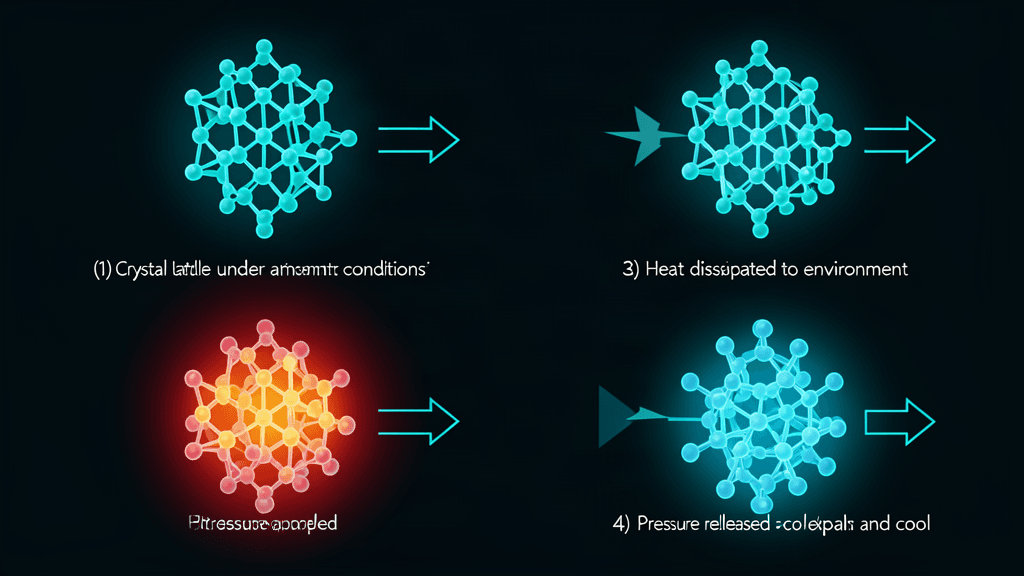
Rys. 1. Cykl barokaloryczny w organicznych jonowych kryształach plastycznych (OIPC). Przyłożenie ciśnienia powoduje przejście fazowe ciało stałe–ciało stałe: struktura krystaliczna ulega częściowej rotacji jonów, wydzielając ciepło. Po zwolnieniu ciśnienia materiał powraca do stanu uporządkowanego, pochłaniając ciepło z otoczenia — to jest właśnie efekt chłodzący. Źródło: opracowanie własne na podstawie Piper S.L. et al., Science (2025).
The breakthrough was not about the discovery of a new physical phenomenon. It involved a change of perspective: looking at an old class of materials - studied for 30 years, with hundreds of publications - from a completely new angle. Pringle and MacFarlane did not invent OIPC. They were the first to ask, "what if these battery electrolytes were the perfect cooling materials?"
"OIPCs share the same beneficial properties as molecular plastic crystals, with an additional advantage: they have a negligible vapor pressure," the authors write. In human translation: they do not leak. They do not escape into the atmosphere. They have no greenhouse potential. What was a disadvantage for batteries (solid instead of liquid) is an advantage for refrigeration.
The competition doesn't sleep. But he's racing in a different direction.
The global race for the refrigerator of the future has three main competitors. Magnetocalorics - the oldest, best funded, but most expensive (requires rare earth magnets). Elastocaloric - harnesses mechanical stress in shape memory alloys (Nature, 2024: first kilowatt prototype). And barocaloric - the youngest, cheapest in potential mass production, but the least researched.
In 2024, a team from Hong Kong and mainland China published inNaturework on an elastocaloric refrigeration system reaching the kilowatt scale - this was a milestone for the entire field of solid-state cooling. He showed that it is possible to build a working demonstrator that actually cools, and does not just exist on paper.
But OIPC's barocaloric has an advantage that no competitor has: temperature. Elastocalories and magnetocalories require complex heat management to get down to temperatures suitable for a home refrigerator. OIPCs are just there - their natural phase transitions range from a frigid -37°C to a cool +10°C. There is no need to "bend" them. They are already working where they need to be.
Scientists at Deakin University are already working on optimization - testing further combinations of cations and anions, looking for materials with even greater pressure sensitivity and even greater entropy changes. If one of these variants reaches the prototype in the next 2-3 years, the barocaloric will leapfrog the competition.
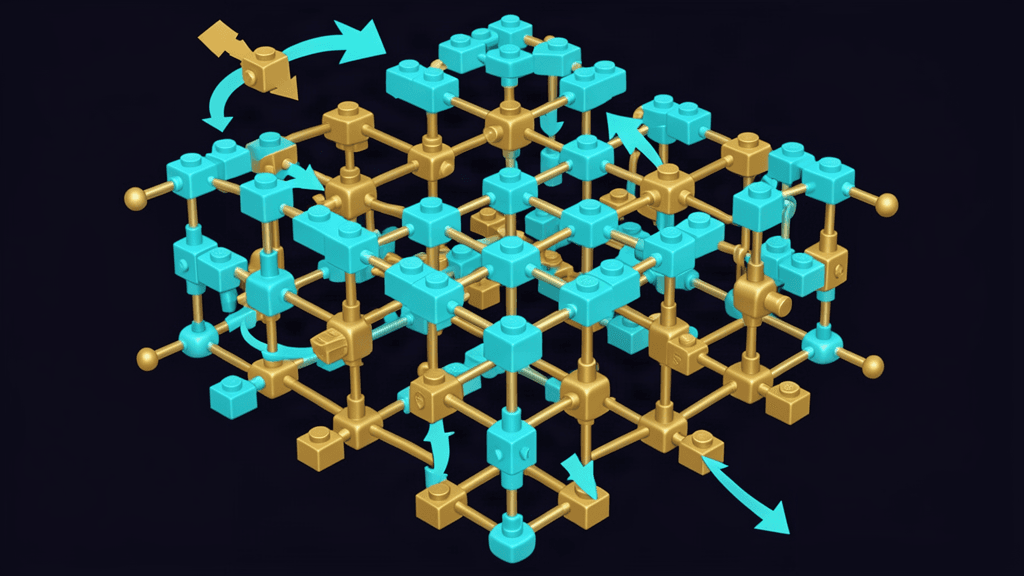
Rys. 2. Struktura OIPC — organiczne kationy i aniony tworzą elastyczną sieć krystaliczną przypominającą molekularne klocki. Zmieniając strukturę jonów, można dostrajać temperaturę przejścia fazowego w zakresie od –37°C do +10°C — idealnym dla domowych lodówek i klimatyzacji. Źródło: opracowanie własne na podstawie Piper S.L. et al., Science (2025).
Poland: we have competences. We don't have a program.
Poland is in a surprisingly good position in this race - if it is willing to take advantage of it.
Firstly: we are one of the largest producers of household appliances and refrigeration in Europe. BSH plants in Łódź and Rzeszów, Whirlpool in Wrocław, Amica in Wronki, and, above all, an extensive ecosystem of sub-suppliers - compressors, heat exchangers, control electronics - employ over 30,000 people. If barocaloric modules entered mass production, they could be manufactured in these factories.
Secondly: Polish science has competences in related fields. The team of Jarosław Krzywański and Karol Sztekler from AGH has been working on adsorption refrigeration systems for years - it is a different branch of solid-state cooling, but using similar phase transition physics. There are thermodynamic laboratories at the Gdańsk and Wrocław University of Science and Technology that could test prototype modules. Polish scientists are co-authors of works on caloric effects in magnetic materials (IFM PAN Poznań).
And thirdly, the regulatory factor. The EU F-gas regulation (2024/573) requires the phasing out of HFCs by 2050. This is a blow to the Polish household appliances industry - because the entire line of refrigerants will have to be replaced and production lines will have to be adjusted. But it is also an opportunity: instead of investing in another patch on the old system (replacing HFCs with "less bad" factors), you can skip the technological generation and enter solid-state.
Barrier? Financing. NCN and NCBR do not have a single competition aimed at barocaloric refrigeration. PARP, as part of FENG (European Funds for a Modern Economy, budget of EUR 7.9 billion by 2027), has paths for industrial innovations - "SMART Path" worth up to PLN 80 million per project. But no one has applied to be a barocaloric refrigerator demonstrator. Because no one in Poland knows that OIPC exists.
Day +365:Will a Polish refrigerator cool more quietly, cheaper and without warming the planet in a year? The answer depends on whether someone at BSH, Whirlpool or Amica reads the article by Piper, Melag, Kar and the team. And will there be a grant that will finance the first Polish prototype?
Sources
DOI: 10.1126/science.adq8396— Piper S.L., Melag L., Kar M., Sourjah A., Xiao X., May E.F., Aguey-Zinsou K.-F., MacFarlane D.R., Pringle J.M.,Organic ionic plastic crystals having colossal barocaloric effects for sustainable refrigeration, Science (2025).
DOI: 10.1038/s41586-024-08549-9 — Achieving kilowatt-scale elastocaloric cooling by a multi-cell architecture, Nature (2024).
DOI: 10.1038/s41467-025-68278-z — Refrigeration down to 0.16 K using a frustrated magnet Gd₂B₂MoO₉, Nature Communications (2025).
International Energy Agency,Net Zero by 2050: A Roadmap for the Global Energy Sector (2021).
UNEP, Kigali Amendment to the Montreal Protocol (2016).
EU F-gas Regulation (EU) 2024/573.
Comments· 0
No comments yet. Be the first.