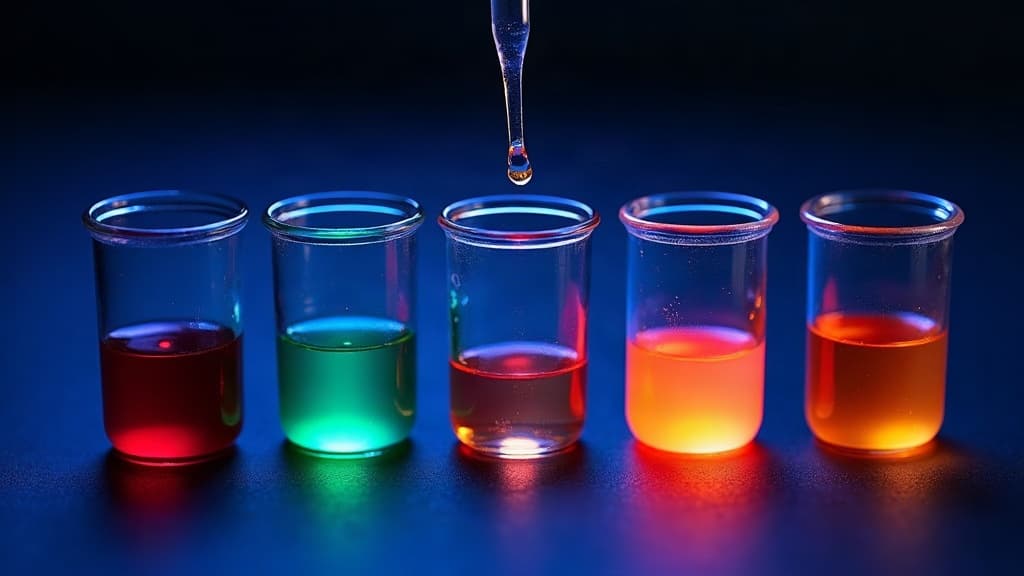
Chemists mix glowing liquids and get new anti-counterfeiting marks
Two sheets of paper lie side by side under an ultraviolet lamp. Both glow with the same warm orange-red light. To the eye they are twins. Only a spectrometer shows that one was soaked in a liquid containing a single element, and the other in a mixture of four. Chemists at Nottingham Trent University want to build a new kind of anti-counterfeiting protection on exactly this difference, invisible to the naked eye.
Anthony Fitzpatrick's team has described in the journal RSC Advances four liquids that stay fluid at room temperature, glow under ultraviolet light and can be mixed like paints. Each contains a different element from the lanthanide group: europium, terbium, dysprosium or samarium. Every mixture glows with its own set of colours, in other words it has its own optical fingerprint. For now this is laboratory work, tested on dyed paper. It is still worth following step by step, because it shows how the logic of today's security features could be turned around.
The case: fakes that look like the original
Start with the scale of the problem. According to a 2025 report by the OECD and the European Union Intellectual Property Office (EUIPO), counterfeit and pirated goods were worth about 467 billion dollars in 2021, or 2.3% of world imports. In imports into the European Union their share reached 4.7%. The authors of the report point to a worrying rise in dangerous fakes, such as car parts and medicines.
Counterfeiters use the same tools as honest manufacturers. The authors of the new paper state plainly that advances in digital printing and graphics have made it easier to forge banknotes and important documents. That is why security features based on the properties of the molecules themselves, which can be checked quickly, matter more and more. Many banknotes and documents carry elements that change appearance or start to glow under a UV lamp.
The trouble is that a colour visible to the naked eye is weak evidence. If a security feature only has to glow red, a counterfeiter simply looks for another substance that also glows red. It is much harder to fake an entire spectrum, the exact pattern of narrow bands of light at different wavelengths. This is where the lanthanides come in.
First clue: elements that glow in "lines"
The lanthanides are a family of fifteen metals at the bottom of the periodic table. Some of them glow in a very characteristic way. An ordinary organic dye gives a broad, blurred band of light. A europium or terbium ion, by contrast, glows in a few narrow, sharp lines whose positions follow from the structure of the atom itself. Jean-Claude Bünzli, one of the leading researchers of these compounds, has for years described how to choose the molecules around the ion so that this glow is as strong as possible.
In the new work each lanthanide ion is surrounded by three molecules of dipicolinic acid. They act as an antenna: they absorb ultraviolet light and pass the energy to the metal ion, which releases it as visible light. The europium liquid glows red, the terbium one green, the dysprosium one aqua, and the samarium one orange. The spectra match what chemists expect from these elements. Europium has its strongest line at 615 nm, terbium a set of lines between 490 and 623 nm.
Lanthanides in security features are nothing new. The problem so far has been the forms in which they were used. As the authors write, interesting luminescent materials often fell at the production stage. The obstacles were solubility, miscibility, robustness and the limits of printing techniques. A solid has to be ground, dissolved or suspended in an ink, and each such step can spoil the effect.
Second clue: a salt that is a liquid
The Nottingham team got around this problem by turning the luminescent compound into an ionic liquid. Ionic liquids are salts that melt below 100 °C and are often fluid already at room temperature. They hardly evaporate and mix well with other substances. Chemists have known them for decades as solvents, among other things for synthesis and catalysis.
The trick lies in swapping the partner. The negatively charged lanthanide complex pairs up with a large, positive phosphonium ion that has four carbon chains, one of them very long. Such an ion does not easily pack into a crystal, so the whole salt stays liquid. In this way the researchers obtained four fairly viscous liquids, one for each lanthanide.
A detective checks an alibi; a chemist checks whether a liquid really is a liquid. The team cooled the samples to −90 °C and warmed them slowly. They saw only one reversible transition around −78 °C, typical of salts with this kind of phosphonium ion. Above −50 °C and up to room temperature nothing else happened. The material did not crystallise, so under ordinary conditions it stays fluid. Thermal tests showed in turn that below about 170 °C the liquids lose only a little mass. That is water, which ionic salts readily pick up from the air. Real decomposition starts only at 240–250 °C. All four liquids behave similarly in this respect, with the europium one slightly more resilient.
Third clue: mixing instead of synthesis
The key step of this work is surprisingly simple. Since all four materials are liquid, they can be measured out with a pipette and mixed in known proportions. The researchers combined them in equal proportions. Four liquids give six two-component mixtures, four three-component ones and one with all four elements. Together with the four pure liquids that makes fifteen different systems.
Each mixture kept the lines of its components. For example, combining europium with terbium gave clear terbium bands at 495, 545 and 650 nm and europium bands at 592, 615 and 695 nm. Such a spectrum is much denser than that of either liquid on its own. The authors converted the positions of the main lines between 400 and 750 nm into a simple barcode. Every new spectrum can be compared with such a template to check whether it matches.
Fitzpatrick puts it like this: a more complex security signature does not require more complicated materials. It is enough to combine different liquids. Today a new feature often means a new synthesis and a new process. Here a new code means a different ratio in the mixer.
There is also a second kind of trace. After a flash, each lanthanide glows for a different length of time. For europium it is about 2.3 milliseconds, for terbium 0.25 ms, and for dysprosium and samarium about 0.06 ms. In mixtures these times change, because the ions pass part of the energy to each other. In the europium–dysprosium pair the europium glow time shortened to 1.6 ms, corresponding to a transfer of about 30% of the energy. For a counterfeiter this is another layer to reproduce, and for an inspector a future way of reading the mark. The authors list lifetime measurement among their next steps.
The paper test
Finally the researchers dyed paper with the four pure liquids and with two mixtures: a three-component and a four-component one. They examined it in ordinary light and under three UV lamps: short-wave 254 nm, medium 312 nm and long-wave 365 nm. They used a Foster + Freeman VSC-40 for this, a document-examination instrument known from forensic laboratories.
The best contrast came from the 254 nm lamp, the wavelength of common commercial UV lamps. Another result is more interesting, though. The sheet with europium alone and the sheet with the four-element mixture glowed very similarly to the eye. Their spectra, however, were different. This is exactly the scenario security designers want to exploit. Someone who fakes the colour will not hit the spectrum by doing so.
What the investigation has not yet explained
An honest detective's report also lists the weak points. This work has several, and the authors themselves write about them.
First, the phosphonium ion itself glows a little, around 500 nm. Under excitation with a 254 nm lamp this extra band blurs some of the terbium and dysprosium lines. They can still be recognised, but it makes analysis harder.
Second, some lines overlap. Europium and terbium glow close to each other around 600–620 nm, and europium and samarium near 600 nm. In the mixture of all four elements the overlap is so strong that the spectrum becomes no more readable than in the three-component mixtures. More components therefore do not always mean a better code.
Third, the liquids glow with very different efficiency. For every hundred absorbed ultraviolet photons, the europium liquid gives back about 62 photons of light, while the terbium, dysprosium and samarium liquids give back only one to five. That is why mixtures with europium and terbium look mainly red, orange or green to the eye, while the contribution of dysprosium and samarium shows up mostly in the spectrometer. The authors want to improve this by choosing a better excitation wavelength and other molecules around the ion.
The fourth problem is the most important. Nobody has yet checked how these liquids behave in real printing. The paper was simply soaked. The authors announce durability tests under realistic production and ageing conditions. Only such tests will show whether the mark survives sunlight, abrasion, moisture and years in a wallet. The liquids bind water from the air, which will also have to be taken into account.
That is why we rate this technology at TRL 3. The working principle is confirmed in the laboratory, and the first paper test looks promising. What is missing is a printing ink, tests on a press and a comparison with security features already on the market.
What this means for Poland
In Poland, the banknotes of Narodowy Bank Polski as well as passports and identity cards are printed by Polska Wytwórnia Papierów Wartościowych (PWPW), the state security printer. It is a company that lives off the race against counterfeiters, and new optical features that are hard to copy are most interesting precisely for customers like this. The strength of the described method is simplicity. With four base liquids, the code can be changed by changing the proportions, without ordering a new compound.
The second natural customer is the pharmaceutical industry. Since February 2019, prescription medicines in the European Union have carried a unique code and a tamper seal on their packaging, as required by the EU directive on falsified medicines and its implementing rules. A glowing mark in the ink could be an extra physical layer next to the digital code. The same applies to spare parts and luxury goods, which the OECD and EUIPO report lists among frequently faked products.
There is also a raw-materials thread. Europium, terbium, dysprosium and samarium are rare earth elements. The EU classifies them as critical raw materials and since 2024 has had a dedicated regulation meant to reduce dependence on imports. Any new use of these elements, even a niche one, is therefore worth viewing through the lens of the supply chain as well.
Krzysztof Pawlak is among the seven authors. The research was supported, among others, by the Royal Society of Chemistry research fund and by the UK's Henry Royce Institute, funded by the EPSRC research council. Scientists from the universities of Liverpool and Manchester also took part.
Verdict
The British team did not invent a new glowing element or a miracle ink. It did something more modest and perhaps more practical. It locked well-known luminescent lanthanide ions into liquids that can be mixed like paints, and showed that each mixture leaves its own trace in UV light. The complexity of the code no longer depends on the complexity of the synthesis.
Whether this becomes a security feature on banknotes or medicine packs will be decided only by tests in a printing plant and years of ageing. For now we have a strong lead. A colour can be faked, but the spectrum will be much harder for a counterfeiter.
Bibliography
- Prasad A., Hart G., Menon-Dizon G. C., Pawlak K., Smith C., Morsch S., Fitzpatrick A. J. Room-temperature luminescent lanthanide ionic liquids for optical tagging and anti-counterfeiting. RSC Advances 16, 56155–56165 (2026). DOI: 10.1039/d6ra06049h
- Bünzli J.-C. G. On the design of highly luminescent lanthanide complexes. Coordination Chemistry Reviews 293–294, 19–47 (2015). DOI: 10.1016/j.ccr.2014.10.013
- Welton T. Room-Temperature Ionic Liquids. Solvents for Synthesis and Catalysis. Chemical Reviews 99, 2071–2084 (1999). DOI: 10.1021/cr980032t
- OECD, EUIPO. Mapping Global Trade in Fakes 2025. Illicit Trade, OECD Publishing (2025). DOI: 10.1787/94d3b29f-en
- Directive 2011/62/EU of the European Parliament and of the Council on the prevention of the entry into the legal supply chain of falsified medicinal products. EUR-Lex
- Regulation (EU) 2024/1252 of the European Parliament and of the Council establishing a framework for ensuring a secure and sustainable supply of critical raw materials. EUR-Lex
- Rogers D. Glowing liquids could help protect products from counterfeiters using distinctive ultraviolet light signatures. Phys.org / Nottingham Trent University (16 Oct 2026). Phys.org
Comments· 0
No comments yet. Be the first.