The cheapest greenhouse gas becomes a drug building block. Light instead of expensive reagents
On a medicinal chemist’s shelf, the CF₃ group — three fluorine atoms on carbon — is often the difference between “almost works” and “in the pharmacy.” For years the race for that group looked like a duel with a favorite: expensive, activated catalog reagents won. Fluoroform lost — a cheap waste gas from Teflon production, a potent greenhouse gas, chemically stubborn as concrete.
In August 2026 a Hokkaido University team (WPI-ICReDD) reported in the Journal of the American Chemical Society that this underestimated rival can release a CF₃ radical under purple light, a ketone, and a Brønsted base — without exogenous redox reagents. This is not another “green chemistry” note. It changes who leads on which field: catalog versus industrial waste.
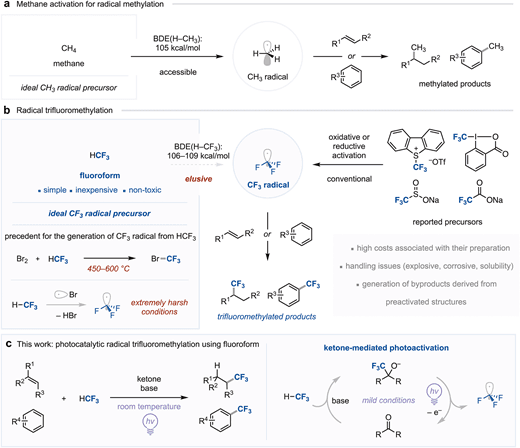
Rys. 1. Tło i wyzwania rodnikowej trifluorometylacji z fluoroformu. Źródło: Zhou et al., JACS 2026, CC BY 4.0.
Round one: the catalog leads
For decades radical trifluoromethylation was driven by activated precursors: Togni, Umemoto, and Langlois reagents, sometimes gaseous CF₃Br or CF₃I. The chemist gets a ready CF₃ “cartridge” — and pays in cost, corrosion, waste, and logistics. For CDMOs and API labs that is convenient: the reaction works, documentation exists, scale is predictable.
The favorite looked like a sure thing. Fluoroform (CHF₃, HFC-23) is inexpensive, relatively low-toxicity to humans, and arises in bulk as a byproduct of Teflon manufacture. On paper it is an ideal CF₃ source. In practice the C–H bond is so stable that under mild conditions the gas prefers to stay a gas. The atmosphere collects the bill: fluoroform’s global warming potential is about 14,800 times that of CO₂ (value from Zhou et al.). Emission rules have tightened, yet global emissions still rise — so turning the gas into a valuable product is more than an academic curiosity.
For a long time fluoroform won only in another league: anionic and metal chemistry. Classic work by Prakash and Olah, or Grushin’s cupration, showed that CHF₃ can yield a CF₃⁻ nucleophile or metal–CF₃ complexes. Those are powerful tools — but not the same sport as radical trifluoromethylation of alkenes and arenes that many drug routes need.
A January spent in the catalog looked like a knockout: who wanted a radical bought Togni. Who wanted CHF₃’s cheapness took anions. Almost no bridge existed between them.
Round two: the challenger answers — not as expected
The gap was concrete. A CF₃ radical from fluoroform remained “elusive” — a word that in the JACS abstract is a diagnosis, not decoration. Without an activated precursor it is hard to break CHF₃ so that a radical forms, rather than an anion or a dead complex.
The team of Shun Zhou, Hiroki Hayashi, Satoshi Maeda, Tsuyoshi Mita, Kosaku Tanaka and coworkers in Sapporo did not start with another bottle from the shelf. They used AFIR (Artificial Force Induced Reaction) — computational reaction-path search developed at WPI-ICReDD — to find an activation that lab intuition might miss.
Calculations suggested something simple in outline: an alkoxide derived from thioxanthone (TX) and a trifluoromethyl anion can, in its triplet excited state (T₁), cleave a C–C bond with a barrier of about 10.7 kcal/mol. That is enough to release a CF₃ radical. The hypothesis reversed the usual order: first deprotonate CHF₃ at a ketone with a base, then use light instead of a strong oxidant.
Experiment confirmed the direction. Under purple LED irradiation (390 nm), with a catalytic amount of potassium tert-butoxide, trifluoromethylated product 2 formed in 83% yield, and mediator TX was recovered in 92%. Without light or without base — no product. This was not a mild photochemistry “boost.” It was the boundary condition of the duel.
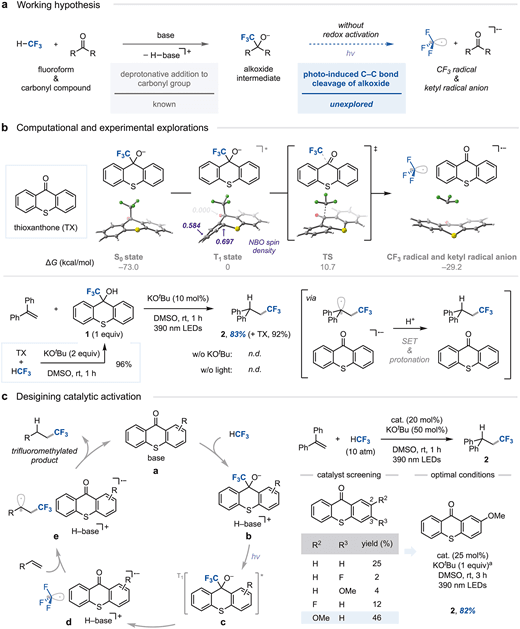
Rys. 2. Projekt generowania rodników CF₃ z fluoroformu (hipoteza, obliczenia, protokół). Źródło: Zhou et al., JACS 2026, CC BY 4.0.
Round three: scale, late-stage, and bulk feedstock
The duel stops being abstract when lab-bench numbers appear that a purchasing department also understands.
The team showed hydrotrifluoromethylation of alkenes and alkynes under stoichiometric and catalytic conditions. In catalytic mode, compound 3 was obtained in 75% yield on gram scale — a signal that the method does not end at an NMR tube. Reactions also covered arenes and complex bioactive molecules and derivatives, including methyl isoeugenol, threonine, estrone, fenofibrate, and bexarotene (products 30–34). That is the language of late-stage modification: adding CF₃ to an already elaborate scaffold instead of building a fluorinated molecule from scratch.
The challenger’s second blow: upgrading bulk chemicals. Fluoroform (only 5 equivalents relative to methyl methacrylate, without a balloon of excess gas and without a high-pressure reactor) plus cheap MMA gave a valuable pharmaceutical intermediate in about 65% yield, with nearly quantitative TX recovery. Recovered ketone performed like the first run. For a process that matters more than a one-off yield record: the catalyst returns, and the gas need not flow “just in case.”
Mechanistically the system is photocatalytic: TX and base deprotonate fluoroform, an alkoxide forms, excitation gives the triplet, cleavage releases a CF₃ radical that attacks an alkene or arene — without exogenous redox reagents. Catalog rivals still win on SOP convenience. Hokkaido wins on cost and GHG narrative: the same gas regulations push to limit becomes a reagent.
For a reader outside the lab, one analogy helps. A classic CF₃ reagent is like a factory-made cartridge: expensive, but ready to fire. Fluoroform is like a feedstock barrel on the plant yard — cheap, awkward to handle, and until now useful mainly when someone could make an anion or a metal complex from it. Hokkaido did not invent a new barrel. It invented a way to release a radical from that same barrel under light control.
That is the duel’s axis. Round one belonged to the cartridge. Round two showed the barrel can do more than “be a GHG.” Round three moved the argument onto the cost sheet: gram scale, late-stage on fenofibrate and bexarotene, 65% from MMA at five gas equivalents with recovered ketone. If those numbers hold when moved into a flow photoreactor, the catalog will not vanish — but it will stop being the only sensible line in the materials balance.
Result: who leads — and on which field
The race did not end with one knockout. The catalog (Togni, Umemoto, Langlois and successors) still leads in clinical and process convenience: you know what to buy, how to scale, how to validate. Fluoroform under light leads where precursor price, greenhouse footprint, and late-stage without heavy redox chemistry matter.
That is a classic Pojedynek outcome: not “one method kills the other,” but a split of the field. Who builds a discovery library may stay with the shelf reagent. Who thinks about tons of API and HFC-23 emissions must look at Sapporo.
Limits are real and worth naming. The work is organic chemistry at lab/gram scale, not an industrial continuous process. Substrate scope is broad for a first paper, but a CDMO will still ask about process toxicology, solvents, photoreactors, and intellectual property versus existing CF₃ platforms. The publication itself does not “cut” fluoroform emissions — only deployment in the fluorochemistry chain could change the balance.
TRL estimate 3–4: gram-scale proof, late-stage on drug-like molecules, catalyst recovery, no factory standard yet.
Second battle: who builds the photoreactor before Asia does
Even when the chemistry works, the duel moves to delivering light and gas. Fluoroform is a gas; five equivalents without a balloon sounds elegant in JACS, but on a plant floor it means metering, a safety analysis, and recycling the gas tail. Purple 390 nm LEDs are cheaper than they were, yet continuous flow with CHF₃ is a separate engineering project — and separate capital outlays.
Here AFIR and ICReDD return: Japan couples reaction-space search to experiment faster than the classic “guess and check” cycle. For European competition the question is not only “do we have ketone TX,” but “do we have a team that will find the next alkoxide doorway before the next ERATO does.”
Kosaku Tanaka III, a co-author, put the stakes without marketing: fluoroform is an attractive CF₃ source, but chemical stability blocked its use as a radical source — combining computation and experiment opened the path. That sentence is a brief for an investor: value sits in activation, not in the gas alone.
Poland: fluorine, APIs, and a regulatory window
Poland does not make Teflon like the global giants, but it sits in a chain that buys fluorinated chemistry for drugs, agrochemicals, and materials. Domestic and CEE API/CDMO plants already pay for CF₃ reagents and for compliance pressure on fluorinated gases. If HFC-23 is to be not only an “emission problem” but an input feedstock, natural counterparts are:
- organic and photochemistry groups at universities (UW, UJ, PWr, WAT) that can reproduce and extend the scope to local molecular scaffolds;
- API/CDMO firms that can cost a gram of CF₃ in a registration process;
- climate–industry projects hunting GHG valorization rather than thermal destruction alone.
The window is short, as with any deep-tech process chemistry: 24–36 months for a continuous-process proof of concept with a measured gas balance and mediator recovery, before Asian platforms turn JACS into a license pack. Poland need not win the whole CF₃ duel. It can win a slice: late-stage for a specific API class, or a gas photoreactor tied to a local LED and automation supplier.
Investment vocabulary matters. This is not another “green press release,” but intellectual property around photocatalytic CHF₃ activation and capital outlays for safe gas metering. A spin-off that closes LEDs, HFC-23 dosing, and ketone recovery in one skid will speak to both pharmaceutical chemistry and firms accounting for fluorinated greenhouse gases.
The question at the end of the round is not “is fluoroform a nice GHG.” It is: who first turns Teflon-plant waste into a standard line in a drug’s materials balance — the catalog, or the light.
Sources
- Zhou, S. et al. Photocatalytic Activation of Fluoroform for Radical Trifluoromethylation. J. Am. Chem. Soc. (2026). DOI: 10.1021/jacs.6c10939. License CC BY 4.0.
- Phys.org / Hokkaido University — popular summary (2026-09-14): Turning a potent greenhouse gas into a valuable pharmaceutical building block using light.
- Prakash, G. K. S. et al. Taming of fluoroform… Science 2012 (anionic CHF₃ chemistry) — historical context of the duel.
- Zanardi, A. et al. / Grushin, V. V. Direct cupration of fluoroform. J. Am. Chem. Soc. 2011 — metal–CF₃ context.
Comments· 0
No comments yet. Be the first.