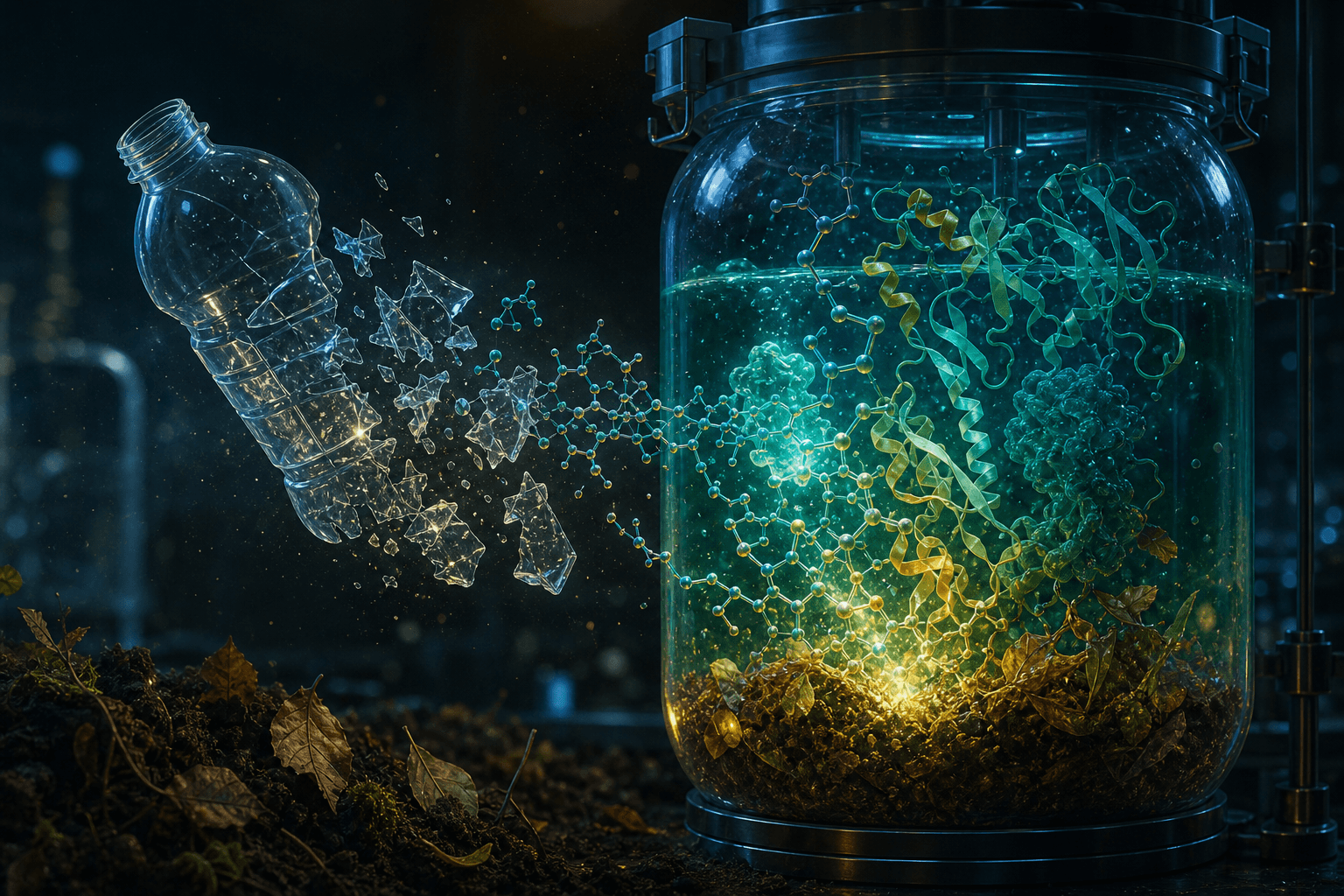
The cemetery compost paradox: who profits when PET dies in 16 hours
The cemetery compost paradox
At Leipzig’s Südfriedhof, compost smells like compost everywhere: damp earth, leaf litter, the quiet work of bacteria. No one expected that from there would come an enzyme able to “eat” amorphous PET in about sixteen hours — and that this enzyme, not a giant pyrolysis plant, would become today’s argument in the fight over who profits from Europe’s packaging recycling.
The paradox is simple. Poland and much of the region still bet on thermal chemical recycling — costly, capital-intensive, politically legible. Meanwhile in Leipzig a company was born from a compost metagenome that sells not a production line but an enzyme as a service. The question is not only whether PET dies in sixteen hours, but who will collect the margin when Brussels mandates recycled content in packaging — and intellectual property plus major capital expenditure already sit in Germany and France.
Discovery: PHL7 from cemetery compost
The story starts with a compost sample from Leipzig’s Südfriedhof. From the metagenome researchers isolated the polyester hydrolase PHL7 — naturally hyperactive against PET. In the lab the enzyme degraded about 90% of amorphous PET in roughly 16 hours near 70 °C, reaching roughly twice the activity of the then-standard LCC. The discovery was published in ChemSusChem (DOI: 10.1002/cssc.202101062).
This was not yet an industrial product. It was proof that nature had already “invented” a tool for cutting polyethylene terephthalate chains — and that sometimes you need to find it, not only design it from scratch. For TRL09 one more point matters: discovery alone does not earn money. Money goes to whoever closes the loop from compost to patent, patent to bioreactor, bioreactor to a customer asking: “can your enzyme eat my kind of plastic?”
Earlier work also showed a closed-loop path: enzymatically recovered terephthalic acid (TPA) could return to virgin-quality PET. That motif — not “destroy plastic,” but “recover monomers at virgin feedstock quality” — makes PHL7 a rival not only to mechanical sorting but to the whole logic of chemical recycling.
Engineering 2026: mutations that turn a find into an industrial candidate
Wild-type PHL7 was fast, but too unstable and too salt-sensitive to enter a plant. The breakthrough came with computational engineering.
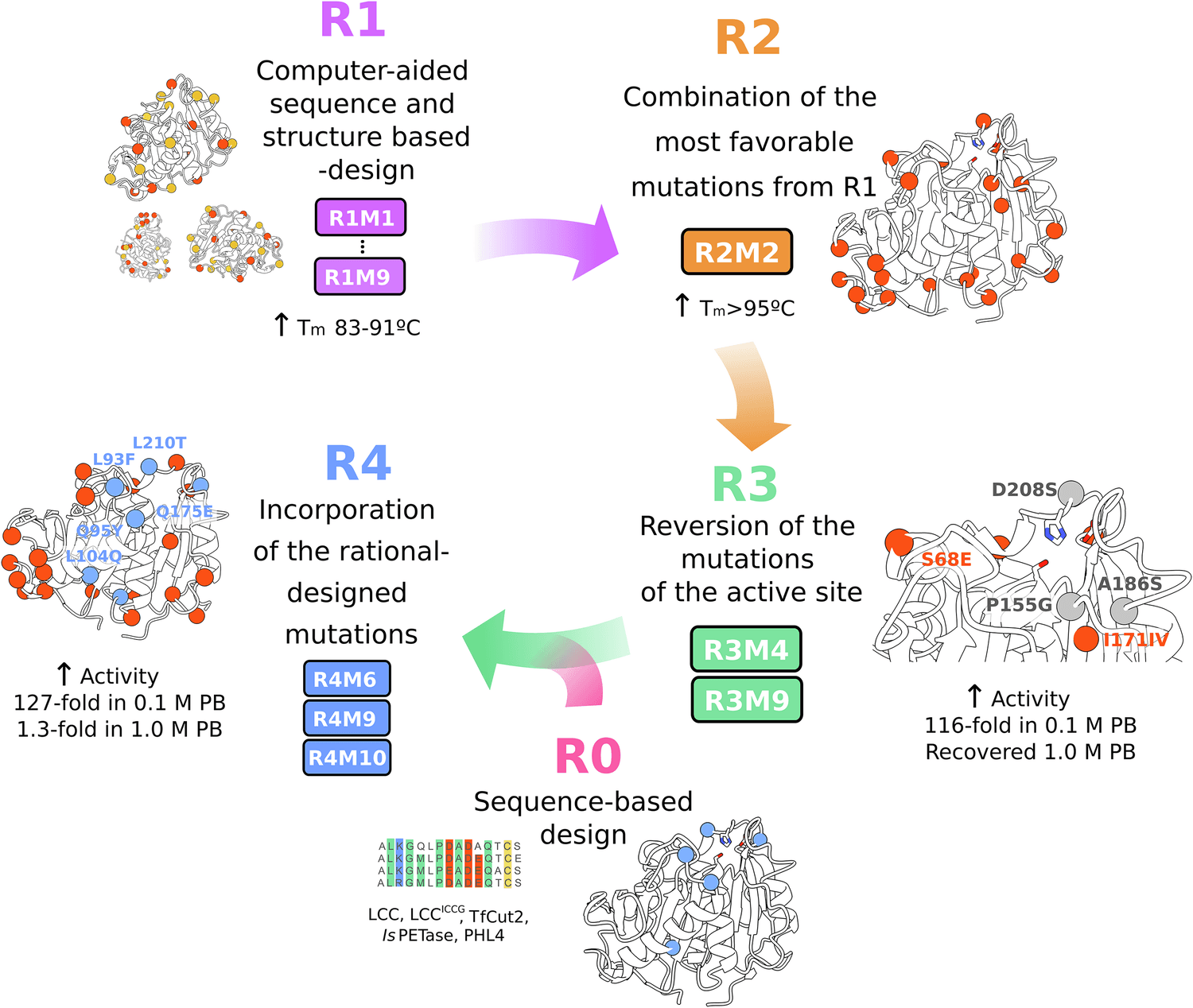
Rys. 1. Schemat workflow inżynierii PHL7 (etapy R1–R4). Źródło: Blázquez-Sánchez et al., Nature Communications 2026, CC BY 4.0.
The team of Georg Künze and Christian Sonnendecker at Leipzig University, using among other tools Rosetta PROSS, introduced up to about 24 mutations. Variants R4M6, R4M9 and R4M10 often raised melting temperature from around 88 °C to above 95 °C, and in 0.1 M phosphate buffer activity versus the parent enzyme rose more than a hundredfold.
In a bioreactor the variants degraded about 76–79% of a 10% (w/w) low-crystallinity PET load in 24 hours at 65 °C; variant R4M10-H185Y reached about 84% at 20% (w/w). Equally practical: weaker salt dependence — the enzyme can also work in ordinary tap water. Results appeared in 2026 in Nature Communications (DOI: 10.1038/s41467-026-70868-4); the university also described them as “enzymes as recycling heroes” (uni-leipzig.de, May 2026).
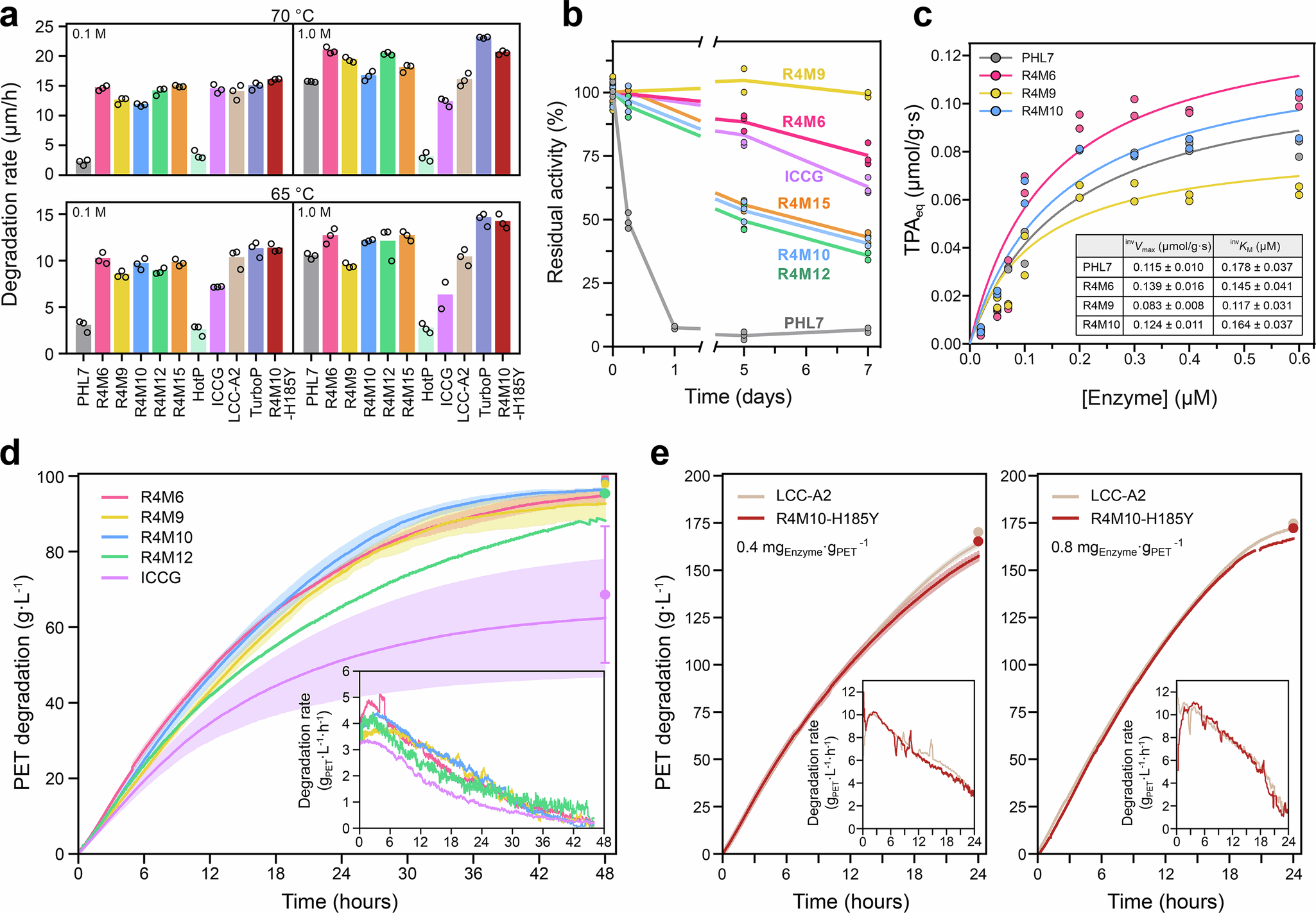
Rys. 2. Aktywność wariantów R4 względem enzymów referencyjnych oraz degradacja PET przy wysokim obciążeniu substratu w bioreaktorze. Źródło: Blázquez-Sánchez et al., Nature Communications 2026, CC BY 4.0.
Here lies a second paradox. A public Nature Communications paper looks like the finish line of a scientific race. In business the finish came earlier: patent before publication. Researchers who want to earn on PHL7 had to think like entrepreneurs first — and like authors second.
ESTER Biotech: who earns when PET dies in a bioreactor
In 2025 biochemists Christian Sonnendecker and Ronny Frank — with partners — founded ESTER Biotech GmbH, a Leipzig University spin-off. The company grows out of EXIST Research Transfer, earlier SAB validation and the SMILE culture: intellectual property first, scale later. The university stated the path from compost to company plainly: patent before publish, build a reactor, test bags of shredded supermarket PET trays (uni-leipzig.de, April 2025).
The model does not sound like “we will build a PET factory for Europe.” It sounds like enzyme-as-a-service: a customer asks whether the enzyme can handle their fraction; the start-up says yes or studies how. Enzyme production runs via microbial fermentation; the reactor process works around 65–70 °C with water and pH buffer — without pyrolysis’s spectacular flame. Industrial scale will need investors “at the latest for large plants,” but the intellectual margin — sequences, variants, measurement methods, optimisation know-how — stays with the patent and know-how owners.
That is the “from lab to firm” axis: not PET breakdown speed alone, but that Germany harvests knowledge capital (patents, EXIST, spin-off) before Poland harvests concrete capital (thermal plants). France and Germany have long built enzymatic and chemical recycling ecosystems around IP; Leipzig adds a concrete asset from cemetery compost.
Poland: Orlen’s pyrolysis, EU pressure and waiting for someone else’s tech
In Poland the strategic story of chemical recycling still often runs through pyrolysis and other thermal routes — legible in oil-and-energy conglomerates’ logic and in Orlen Strategy 2035. A pyrolysis plant fits the language of “feedstock security” and large CapEx. An enzymatic bioreactor at 65 °C sounds less like critical infrastructure and more like a lab — even though that lab now mints the patents that will decide tomorrow’s licences.
Meanwhile the European Union tightens recycled-content rules for packaging. Regulation does not ask whether Poland “likes” enzymes. It asks where we will get rPET and virgin-grade monomers when content targets bite. If the answer is “imported technology and IP from DE/FR,” the compost paradox becomes an economic one: a country with a strong petrochemical industry may become a licence payer instead of a process owner.
This is not about mocking pyrolysis. It is about portfolio. Mechanical recycling will not cover every fraction; thermal chemistry has niches; enzymes — especially after PHL7 engineering — target low-crystallinity PET and closed monomer loops at lower temperature and a different energy profile. Whoever funds only one track today buys the second from a neighbour tomorrow.
Closing: compost, capital and the Poland question
PHL7 from Leipzig cemetery compost, its R4M variants from *Nature Communications 2026 and ESTER Biotech from 2025 draw one line: from metagenome to company, from 16-hour breakdown to a service model, from publication to patent (in business, the order is reversed). Poland can still enter — via licences, joint-venture companies, its own metagenomic programmes, by requiring an enzymatic track in corporate circular strategies. Or it can wait until “PET dies in sixteen hours” is only a pretty foreign headline, and the margin stays beyond the Oder.
The compost paradox is not that nature is smarter than engineers. It is that nature’s cleverness pays only when someone — with an EXIST grant, a patent and a customer in the inbox — turns it into a service. The question for Warsaw, Płock and Gdańsk is therefore not “does the enzyme work,” but: who here will earn before Leipzig does.
Sources
- Blázquez-Sánchez, P. et al. Computational engineering of the polyester hydrolase PHL7 for efficient poly(ethylene terephthalate) degradation in biocatalytic recycling processes. Nature Communications (2026). DOI: 10.1038/s41467-026-70868-4. Open Access, CC BY 4.0.
- Sonnendecker, C. et al. Low Carbon Footprint Recycling of Post-Consumer PET Plastic with a Metagenomic Polyester Hydrolase. ChemSusChem 15, e202101062 (2022). DOI: 10.1002/cssc.202101062.
- Richter, P. K. et al. Structure and function of the metagenomic plastic-degrading polyester hydrolase PHL7 bound to its product. Nature Communications 14, 1905 (2023). DOI: 10.1038/s41467-023-37415-x.
- Universität Leipzig. PET recycling: Biochemists found start-up (9 Apr 2025). uni-leipzig.de.
- Universität Leipzig. Enzymes as recycling heroes (19 May 2026). uni-leipzig.de.
Figures: Figure 1 and Figure 2 correspond to the first and seventh illustrations in source (1), used unchanged under CC BY 4.0; credit: Blázquez-Sánchez et al., Nature Communications 2026.
Comments· 0
No comments yet. Be the first.