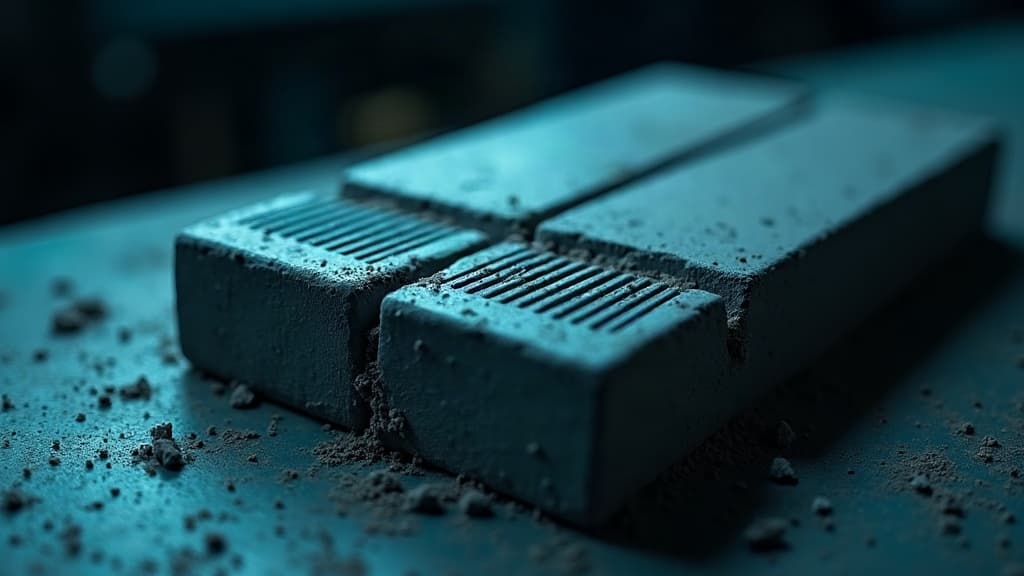
A capacitor printed from cement lights LEDs
In a laboratory in China lies a piece of cement that lights LEDs. No battery is connected to it. The current sits in the cement itself, in two interlocking combs of printed paste that set together with the mortar. The same element withstands a load comparable to what ordinary concrete can bear. The Chinese researchers have made a material that carries a load and stores energy at the same time.
Haiping Wu, Jing Zhong and Wencai Ren described it on 17 August 2026 in ACS Nano. The team comes from the Harbin Institute of Technology and the Institute of Metal Research of the Chinese Academy of Sciences in Shenyang. They built a supercapacitor out of cement. In the title of the paper it is "monolithic" and "interdigitated". Behind those words is a simple idea: instead of pushing ions through the whole thickness of a slab, shorten their road to the neighbouring finger.
Two hands clasped finger to finger
A supercapacitor does not work like a battery. There is no chemical reaction in it that changes the material. Charge gathers on the surface of the electrodes, like static electricity on a comb. That is why it charges fast and survives many cycles, but holds little energy. It needs two electrodes separated by a divider through which ions travel.
In a typical layout, an electrode, a separator and a second electrode lie one on top of another. The thicker the element, the longer the road for the ions. There is a second problem too: at the junction of electrode and separator the material is mechanically weak. The authors name both problems directly: a brittle boundary between layers and slow ion transport through the thickness.
The Chinese group did it differently. They printed the electrodes side by side, like two hands with fingers clasped in a single plane. An ion no longer has to cross the whole thickness of the slab. It hops between neighbouring fingers. The road changes from long and deep to short and sideways. In addition, the area where the electrode meets the electrolyte grows, and that area decides how much charge fits.
The first scale contrast is therefore this: from a road through the whole slab to a hop across the gap between fingers. The second is in the numbers, and I will come back to it shortly.
A printer that writes with paste
The electrodes were made by direct ink writing. It is a 3D printer that squeezes paste through a nozzle and draws a pattern with it. The ink was cement mixed with nanocarbon. According to the New Atlas report, it was carbon nanotubes and carbon black. Carbon conducts current, and cement keeps the shape and the strength.
The separator was made of cement mortar. The electrodes were embedded in it so that the whole forms a single block. The authors stress that this eliminates the risk of delamination. After hydration the pores of the material fill with water, and ions can move through it. Cement is therefore not just a housing here. Its own porosity, the same one that draws moisture up a wall, becomes a track for charge.
The idea is close to what a group from MIT published in 2023. Chanut, Ulm, Masic and colleagues showed in PNAS that cement, water and carbon black make a supercapacitor. As the cement sets, the carbon arranges itself into a branching, fractal conducting network. The work from Harbin deals with a different problem: how to lay such electrodes into a pattern that can be printed, and join them to the separator without a seam.
Numbers at the scale of a centimetre
The best device reached an areal capacitance of 162.14 millifarads per square centimetre at a current of 0.46 milliampere per square centimetre. The operating window was 1 volt. The energy density was 22.52 microwatt-hours per square centimetre, and the power 0.49 milliwatt per square centimetre.
These numbers look modest, and they are. Let us convert them to a metre. A square metre is 10,000 square centimetres. This is my calculation, not the authors', because they give values only per centimetre, and I assume they scale linearly. It comes to about 0.23 watt-hour of storage and about 5 watts of instantaneous power per square metre. A typical phone battery holds a dozen or so watt-hours. A metre of this material would not charge even one phone.
The second scale contrast looks better. The same material that holds charge also holds load. The device kept a compressive strength of 23 megapascals. That is about 230 kilograms of pressure on every square centimetre. For comparison, ordinary structural concretes start at classes such as C20/25, that is about 20 megapascals. The strength therefore falls within the range of ordinary concretes. It is still a laboratory sample, though, not a tested floor slab.
According to New Atlas, three such devices connected on one slab powered a small array of LEDs. It is a good demonstration. Whoever expects more will be disappointed.
How to read these numbers
It is worth remembering what was actually measured. Areal capacitance says how much charge fits on a square centimetre at a given voltage. Energy density says how much work can be recovered from it. Power says how fast.
These three values are not enough to compare the result with a lithium-ion battery, because batteries are quoted in watt-hours per kilogram. The direction is clear, though. This is not an accumulator. It is an element that takes in current fast, gives it back fast and holds little. For surplus from a roof it would be too small to last an evening. Whether it is enough for a particular sensor depends on the sensor's draw, and the authors did not check that.
Frost spoils the show
The authors briefly checked how the device handles temperature changes. Under moderate heating and cooling it worked stably. At minus 18 degrees Celsius its performance dropped sharply. They write plainly that the culprit is the freezing electrolyte and a moisture problem. They call it one of the key challenges.
For Poland this is not a detail. Such temperatures occur here in harsher winters, and many parts of a building work outdoors or in unheated sections of the structure. As long as the electrolyte in the pores freezes, this material suits interiors better than a facade, a foundation or a post outside. According to New Atlas, the team plans to work on the cold. For now there is no evidence that a solution exists.
The abstract of the paper and the New Atlas report also lack several things an engineer would ask about. There is no durability result after thousands of charge cycles. There is no price per cubic metre. There is no test with real reinforcement either, which corrodes in concrete, and corrosion depends on moisture and ions, exactly what the supercapacitor stands on. These are gaps, not accusations. The work is only at the stage of showing that the idea works.
Why a building would want its own capacitor
A supercapacitor makes sense where a quick burst of power matters, not a large reserve. The New Atlas author imagines powering emergency lighting, sensors and fire alarms. Such devices use little current, but they must work when the grid goes down. In that vision the supercapacitor is connected to photovoltaic panels that keep charging it. The result would be quiet auxiliary power, built into the wall instead of screwed onto it.
Professor Jing Zhong, the corresponding author, says that if building materials not only supported the structure but also stored energy, sensed their surroundings and interacted with people, buildings would become more than passive shelters. It is a promotional sentence, but its core is sound: a structural element with a second function.
In the European Union this has a regulatory context. The Energy Performance of Buildings Directive of 2024 (EU 2024/1275) requires new public buildings to be zero-emission from 2028 and all new buildings from 2030. Such a building has very low energy demand and does not burn fossil fuels on site. In Poland, rooftop panels of prosumers add to this, so the question of what to do with a momentary surplus of power is an everyday one. Nobody claims today that cement will replace a home energy store. The question is rather about small loads that could be powered without an extra device.
What it would have to pass
At technology readiness level TRL 3 we have a proof of concept in the laboratory. The road to deployment leads through several steps the authors have not yet shown.
First, durability. Concrete stands for decades, and a supercapacitor at this scale would have to survive at least part of that period without losing capacity. Then scale. From centimetres one has to move to elements that can be poured on site or prefabricated. Only here can printing offer more than a show effect, because prefabricated parts are printed in a plant, not in a frost.
Then safety and standards. A structure with built-in electronics must meet requirements for load-bearing capacity, fire protection and electrical installations.
Finally, cost. Cement is cheap, and carbon nanotubes are not. The composition of the ink will therefore decide the bill. The authors do not give a cost.
The limits of this story
Little can be said. There is evidence that a printed, uniform cement structure has a capacitance of over a hundred millifarads per square centimetre, keeps a strength close to ordinary concrete and lights LEDs. There is also an admitted weakness: frost. There is no evidence that a wall made of such a material would charge a car, power a flat or replace a store in the basement. There is also nothing about companies, spin-offs or orders.
It is best to read this work as a question about what a building can do besides standing. The first scale contrast shortens the ions' road from the thickness of a slab to the gap between fingers. The second shows that the same material carries 230 kilograms per square centimetre and at the same time stores a fraction of a watt-hour. Both numbers say the same: a material with two functions, neither of which is ready for a building site. Only winter will show whether someone makes of it an element that survives Polish frosts.
Bibliography
- Wu H., Zhong J., Ren W. Monolithic 3D-Printed Interdigitated Cement-Based Supercapacitors for Structural Energy Storage. ACS Nano 20(34), 24078–24090 (2026). DOI: 10.1021/acsnano.6c09927
- Chanut N., Stefaniuk D., Weaver J. C., Zhu Y., Shao-Horn Y., Masic A., Ulm F.-J. Carbon–cement supercapacitors as a scalable bulk energy storage solution. PNAS (2023). DOI: 10.1073/pnas.2304318120
- Coxworth B. Supercapacitor cement is key to buildings that store their own power. New Atlas, 8 October 2026. newatlas.com
- Directive (EU) 2024/1275 of the European Parliament and of the Council on the energy performance of buildings. eur-lex.europa.eu
Comments· 0
No comments yet. Be the first.