As stiff as cartilage, heals like skin. The anatomy of a gel that should not exist
A gel as stiff as a shoe sole that stitches itself back together
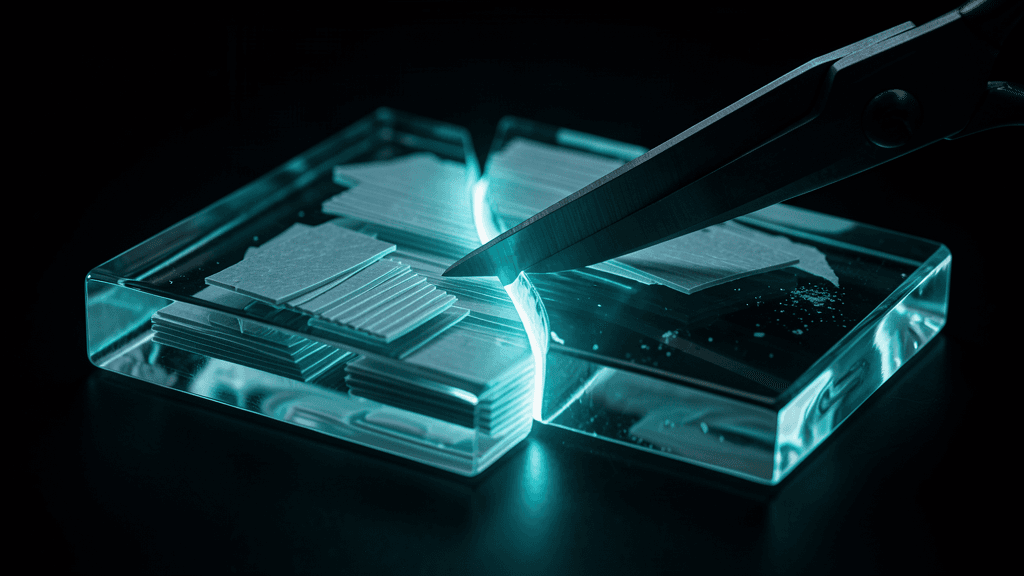
In a lab at Aalto University in Espoo lies a piece of transparent gel. It looks like jelly, but it is as stiff as plastic. Liang Chen cuts it in half with scissors, presses the two halves back together, holds them for a few hours — and sets it aside.
The next day, the gel is a single piece.
Not glued. Healed. On a thin ribbon half a millimetre thick, Chen hangs a 250-gram weight. The ribbon holds it without a tremor, and the cut has vanished.
The scar is gone.
This has no right to work. The gel has an elastic modulus of 50 megapascals — as stiff as a shoe sole, like the cartilage in your knee. And yet it repairs itself, with an efficiency reaching 100 percent.
Where do we know this material from? From our own bodies. Your skin has a modulus on the order of tens of megapascals and heals after every cut. Articular cartilage is stiff, elastic — and alive. Biological tissues have always done something synthetics cannot: they combine stiffness with self-repair.
Synthetic gels, called hydrogels, have been stuck at a dead end for sixty years. The self-healing ones are soft as a sponge — below 100 kilopascals, a thousand times weaker than skin. The stiff ones exceed 100 megapascals, but they fracture irreversibly. Half the problem could always be solved. Both at once — never.
How is it that nature can pull off this trick, and sixty years of polymer chemistry cannot? The answer lies in a single word that for decades nobody in the labs took seriously: entanglement.
Chen's paper, published in Nature Materials, breaks this deadlock. The answer lies not in a new chemical compound, but in architecture: packing polymer chains into gaps just a few nanometres thick. To understand how it works, the gel has to be taken apart layer by layer.
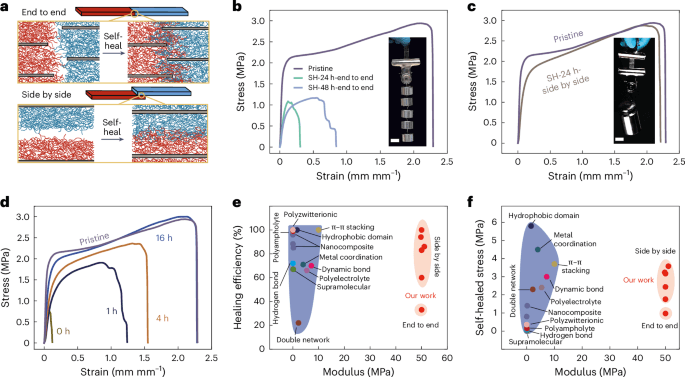
Rys. 1. Samoleczenie żelu przez splątanie polimerów w nanokonfinowaniu. Po przecięciu i ponownym dociśnięciu połówek żel odzyskuje wytrzymałość — wstawka pokazuje zrośniętą wstążkę żelu (grubość 0,5 mm) trzymającą odważnik 250 g. Źródło: Chen L. et al., Stiff and self-healing hydrogels by polymer entanglements in co-planar nanoconfinement, Nature Materials (2025), DOI: 10.1038/s41563-025-02146-5.
Seven layers of a single gel
Layer one: water. A hydrogel is mostly water — yet here 62 percent of the mass is polymer, which is itself an extreme; a typical gel is over 90 percent water. Water provides softness and lets nutrients through. But water does not hold shape. Something has to.
Layer two: chains. Polyacrylamide — the same polymer that has been separating DNA fragments in electrophoresis gels since the 1950s. Long threads that tangle with one another. And here is the first crucial decision: Chen does not crosslink them chemically. No permanent bonds between the threads. Only physical knots through which the thread must squeeze.
Layer three: clay. Into the water with the monomer, Chen adds synthetic hectorite — an artificial clay, a cousin of the natural mineral from the Hector desert in California. Its flakes are monolayers one nanometre thick and 20 micrometres across. Width-to-thickness ratio: twenty thousand. Imagine a sheet of paper the size of a football pitch, one atom thick. Such flakes, negatively charged, repel each other in water and line up in parallel on their own — like panes of glass in a window.
Layer four: flow. A gentle shear flow aligns the flakes in one common direction, into a domain stretching across centimetres. The effect is visible to the naked eye in polarized light: a chaotic mosaic turns into a uniform, dark plate. The plate keeps its order without any electric field.
Layer five: nanoconfinement. Between the parallel flakes remain gaps on the order of tens of nanometres. It is in these that the acrylamide polymerizes. A polymer chain, shut inside the gap, cannot coil freely — squeezed from above and below, it tangles with its neighbours harder than in open volume. And here a surprising thing turns out: the crowding that usually weakens a material this time strengthens it. Confinement breeds entanglement, and entanglement gives stiffness without a single permanent bond.
Layer six: entanglement as a seam. When you cut the gel, the chains at the edge of the cut remain intact. Press the halves together, add a drop of water — and the threads from both sides intertwine again, like unravelled and re-braided cords. No glue. No chemical reaction. Pure diffusion physics. After an hour the gel recovers 60 percent of its strength; after a day, from 94 to 100 percent.
Layer seven: function. Into the same architecture one can admit colloids — for instance MXenes, two-dimensional metal carbides discovered in 2011 — and get a thermally camouflaging gel. Swap water for glycerol, and you get an organo-gel whose single square centimetre holds 35 kilograms in a shear test.
Each layer is its own story: from the 1960 hydrogels of Wichterle and Lím, who turned a hydrogel into the first soft contact lenses, through Pierre-Gilles de Gennes's 1971 reptation theory, for which he received the Nobel Prize in 1991, to nanoconfinement studied intensively only in the last decade. Only stacking all seven layers yields what never existed before: a gel that is stiff and heals itself.
A lantern, a Möbius strip and 35 kilograms
The most elegant proof is not a number but an object. Chen cuts the gel into ribbons and assembles them — as if from paper — into a lantern, a kirigami-style figure and a Möbius strip, a loop with a single surface. Self-healing joins everything: you press the edges together and wait. The gel becomes a construction material, not a plastic mass.
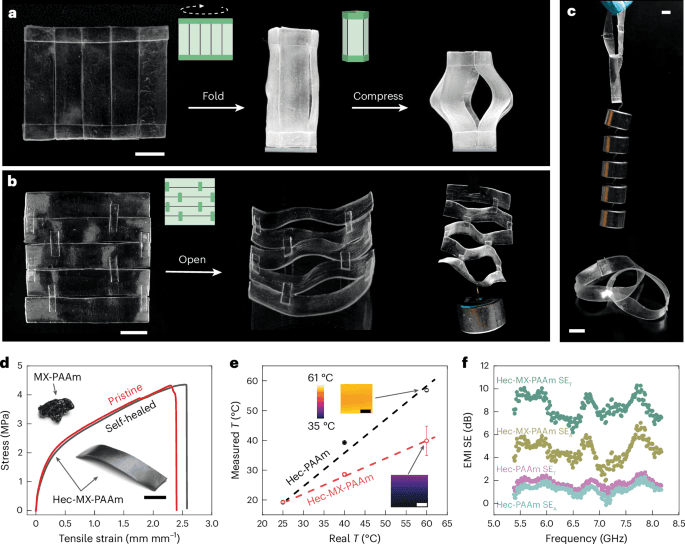
Rys. 2. Samoleczenie w złożonych kształtach: lampion, figura kirigami i wstęga Möbiusa złożone z żelowych wstążek połączonych samozszyciem. Źródło: Chen L. et al., Stiff and self-healing hydrogels by polymer entanglements in co-planar nanoconfinement, Nature Materials (2025), DOI: 10.1038/s41563-025-02146-5.
This changes the rules of the game in three markets. In soft robotics, grippers and actuators must withstand loads and not fall apart at the first cut — today every soft silicone gripper that tears ends up in the bin. In additive manufacturing, a self-healing gel opens the way to printing structures that repair microcracks before they grow. In medicine, hydrogels are already lenses, dressings and scaffolds for cells — but all of them are soft. A stiff gel that heals like tissue is a new level: from cartilage to load-bearing implants.
The competition on this shelf is not asleep. Jian Ping Gong's Japanese school has been building double-network hydrogels since 2003 — tough, but without self-repair. American labs, led by Zhigang Suo's group at Harvard, have for two decades been squeezing out new records in stretchability, also without healing. Self-healing hydrogels, in turn — based on hydrogen bonds, electrostatic interactions or host–guest chemistry — are soft by definition. The Finnish–German team took a step none of these schools completed: they combined both worlds in a single material.
Hydrogels, for that matter, are already big business — but only in their soft version. The soft contact lenses worn by over 150 million people are hydrogels. Wound dressings, ultrasound gels, superabsorbents in nappies — all from the same family. The trouble is that all these products sit in one corner of the chart: soft, stretchable, but devoid of stiffness. A stiff, self-healing gel enters the corner that until now was occupied only by cartilage.
There is a bottleneck, too. Synthetic hectorite and ultra-thin monolayers are laboratory chemistry, not industrial. Polyacrylamide is cheap, but processing a gel with a 62-percent polymer content in an industrial process — where polymerization occurs between the nanosheets under controlled flow — is engineering that no one has yet mastered at the tonne scale. The technology readiness level of this discovery is four: a phenomenon validated in the lab, still far from a production line. Whoever first builds a reactor in which flow aligns the nanosheets will turn the physics of Nature Materials into a product.
Finland found it. Poland has the ingredients
The team is Finnish–German: Aalto University in Espoo and the University of Bayreuth, with Josef Breu — one of Europe's leading chemists of layered materials — as corresponding author. That is no accident. Finland has been investing in bioinspired soft materials for years, and Bayreuth hosts one of the strongest polymer institutes in Europe.
Poland does not have to start from scratch. We have three ingredients of this recipe, scattered across different laboratories.
The first is hydrogel chemistry. Professor Marcin Karbarz of the University of Warsaw has for years been designing stimuli-responsive hydrogels — materials that swell and shrink on command. The Centre of Polymer and Carbon Materials of the Polish Academy of Sciences in Zabrze and the Institute of Physical Chemistry of the PAS in Warsaw have worked on polymer networks for decades. It is not the same chemistry as Chen's hectorite gel — but the competence in designing entangled networks is transferable.
The second is printing. Wrocław's 3D Phoenix, Poznań's OMNI3D and Kraków's Sinterit sell 3D printers all over the world. Zortrax, despite restructuring, still has competence in composite printing. On top of that, Marcin Słoma of the Warsaw University of Technology prints electronics from nanomaterials. A self-healing, stiff gel as printing ink is a natural extension for this ecosystem.
The third is funding, which exists but is not coherent. NCBR funds materials projects, PARP's SMART Path grants 10 to 15 million złoty for implementation through a university–industry consortium, and FNP's TEAM programme grants several million for an international team. What is missing is a bridge: an institution that would connect Karbarz's hydrogel chemistry with 3D Phoenix's machines and a market-facing project.
The stakes are clear. In five years, self-healing, stiff hydrogels will be in grippers, dressings and implants — the only question is whose. If Poland wants to count in this race, it must build its own bridge between the layers before Finland, Germany and China build a factory.
The first move is cheaper than it seems. Recreating Chen's gel does not require a new laboratory: synthetic hectorite, acrylamide and a simple shear flow are a recipe that can be reproduced in the existing infrastructure of the IChF PAN or the Warsaw University of Technology. There is no need to wait for a decision from Brussels. All it takes is one team that connects hydrogel chemistry with 3D printing and files an application to PARP. The rest is a matter of who gets there first.
Sources
- Chen L., Dudko V., Khoruzhenko O. et al., Stiff and self-healing hydrogels by polymer entanglements in co-planar nanoconfinement, Nature Materials (2025). DOI: 10.1038/s41563-025-02146-5
- Wichterle O., Lím D., Hydrophilic Gels for Biological Use, Nature 185, 117–118 (1960). DOI: 10.1038/185117a0
- de Gennes P.-G., Reptation of a Polymer Chain in the Presence of Fixed Obstacles, The Journal of Chemical Physics 55, 572–579 (1971). DOI: 10.1063/1.1675789
- Gong J. P., Katsuyama Y., Kurokawa T., Osada Y., Double-Network Hydrogels with Extremely High Mechanical Strength, Advanced Materials 15, 1155–1158 (2003). DOI: 10.1002/adma.200304907
- Naguib M. et al., Two-Dimensional Nanocrystals Produced by Exfoliation of Ti₃AlC₂, Advanced Materials 23, 4248–4253 (2011). DOI: 10.1002/adma.201102306
Comments· 0
No comments yet. Be the first.