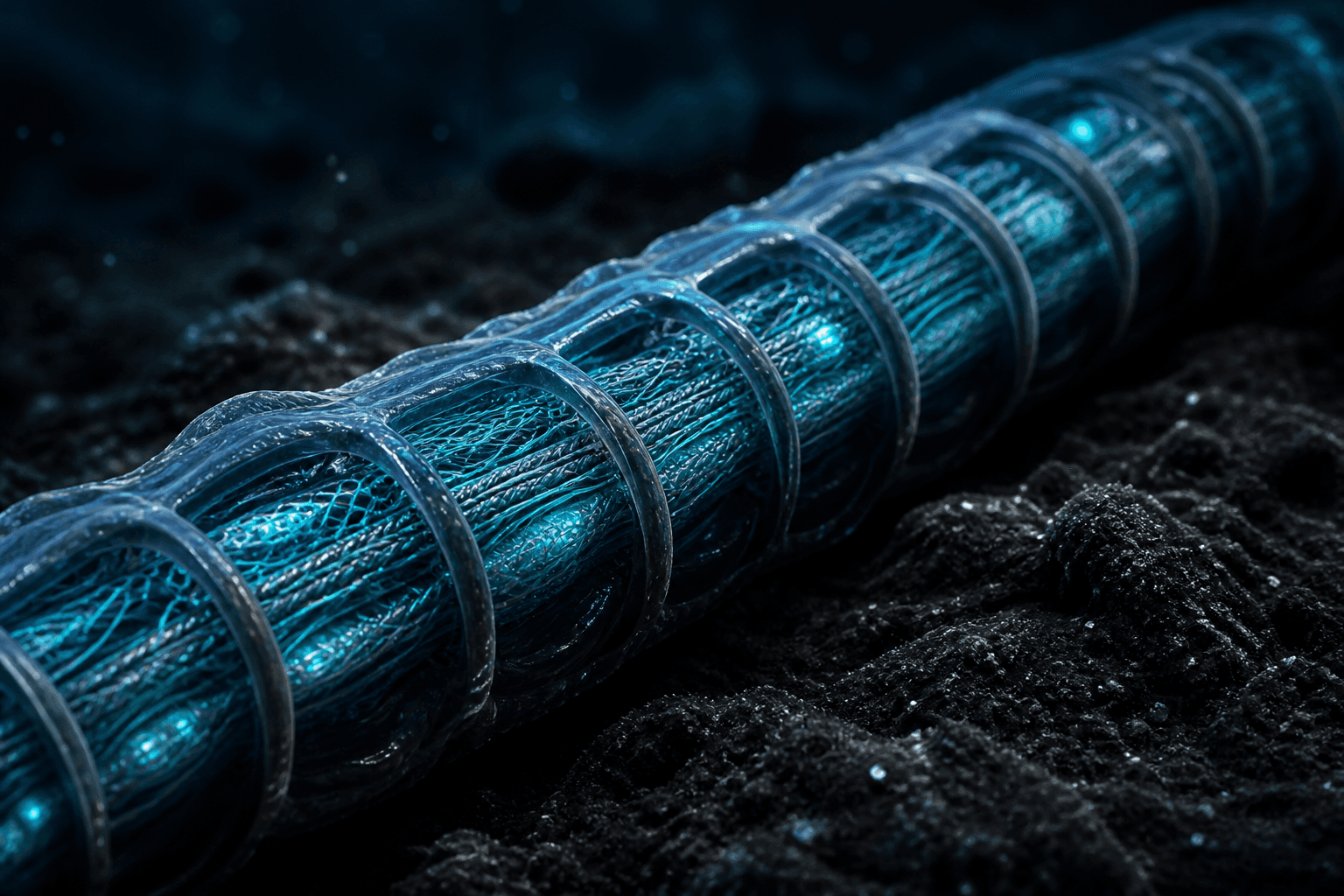
Living cable from the seafloor. Taken apart layer by layer
Living cable from the seafloor
Take an ordinary power cord in your hand. Under the insulation runs a braided copper vein: many thin wires that together carry current and still tolerate bends. On the seafloor and in freshwater sediments, the cable bacterium (Candidatus Electrothrix gigas) built something similar, except the vein is not copper. It is proteinaceous, nickel–organic, and sits in the cell wall like a continuous conductor along the filament.
On 1 September 2026 Nature Communications published the anatomy of that system (DOI: 10.1038/s41467-026-76989-0). Filip J. R. Meysman’s team at the University of Antwerp and TU Delft peeled the periplasmic fibre layer by layer: from a centimetre-scale biogeochemical bridge, through a bundle of 20–70 parallel fibres in the wall, through a cross-section about 49 nm across with copper rings at cell junctions, down to a core of roughly 11 nanotubes about 1.4 nm in diameter and NiBiD chemistry. Europe is already funding this design template as proteonics, not as a mud curiosity.
Filament in the sediment: a centimetre-scale bridge
Cable bacteria couple processes that a classical geochemistry textbook would keep spatially apart. Deep in the sediment they oxidise sulphides. Near the surface they reduce oxygen. Between those zones stretches a filament centimetres long. Electrons must therefore travel a distance no canonical membrane respiratory chain can cover.
The mechanism at this scale is simple to state and hard for biology: the filament acts as a living cable. Cells lined up in series form a continuous conducting channel in the wall, and the whole chain moves charge from the reducing zone to the oxidising one. The surprising number for this layer is the reach itself: centimetres, not nanometres. In 2021 Boschker and colleagues showed in Nature Communications that long-range conduction in cable bacteria runs through nickel protein fibres (DOI: 10.1038/s41467-021-24312-4). The 2021 date closes the question “does anything conduct over cm at all.” The 2026 anatomy answers “what does the vein look like inside.”
For an engineer the braid metaphor has practical bite. A household cable tolerates bends because many thin strands share the strain. The bacterial filament crawls through sediment, flexes, and still conducts. Centimetre scale means the biological conductor is not a local bridge between two cofactors. It is cellular infrastructure.
A wall of 20–70 parallel protein fibres
Drop from filament scale to cell-wall scale and the picture looks like a bundle of veins in one sheath. The wall carries 20–70 parallel protein fibres. Not a single thread, but a multi-core cable. That is a redundant design: damage to one fibre need not break the whole biogeochemical bridge.
This layer was first described by measurements, not molecular anatomy. Whole-fibre conductivity sits around 5–500 S/cm. That is the range of conductive inks for printed electronics, not of a typical haem-iron protein. In 2021 Boschker et al. put nickel at the centre of the model: Ni-rich protein fibres, rather than classical iron-based thermally activated electron hopping.
The surprising number here is 20–70: that many parallel conductors fit in the wall of one cell in the chain. For materials chemistry it signals that evolution chose a multi-core cable architecture, not a single nanowire. For an industrial project the second lesson follows: if fibres are ever extracted from bacteria or assembled in vitro, product logic may track a bundle rather than a single thread.
What was missing was the cross-section. Nickel was known to be key, and the fibre was known to conduct. Where exactly the metal sat, what the core looked like, and why iron does not build this conductor remained open.
Fibre cross-section around 49 nm and copper rings at junctions
In September 2026 the anatomy entered single-fibre scale. Electron microscopy and nano-XRF mapping show a fibre about 49 nm across. That thickness is comparable to the thinnest coatings and traces in organic electronics, yet it is still a biological object embedded in the wall.
This layer separates metal roles. Nickel forms continuous lines along the fibre: a conductor trace, not scattered islands. Copper concentrates in a ring-like structure (the paper’s “cartwheel”) at junctions between successive cells of the filament. The ring interconnects fibres across cells, like a coupler between cable segments. Iron is not enriched in the conductor itself. That matters, because canonical bioelectrochemistry long looked to iron for conduction.
The surprising number is 49 nm. The whole “vein” in the wall is under 50 nanometres across, yet it carries current over centimetres along the filament. The date 1 September 2026 anchors this cross-section in Meysman et al. Anatomy stops being a metaphor and becomes an elemental map: Ni in the line, Cu at the joint, Fe outside the conducting core.
For the braid metaphor this layer adds the couplers. A household cable has connectors and soldered joints. The cable bacterium has copper rings at cell boundaries. Without them, a fibre bundle inside one cell would not translate into continuity of the whole filament.
Core of about 11 nanotubes and Ni/S lines
At the centre of the fibre sits the true vein: a bundle of roughly 11 nanotubes about 1.4 nm in diameter, rich in nickel and sulphur. Here anatomy moves from “protein cable” to “metal–organic nanocable.” The rest of the fibre (the protein sheath ~49 nm across) looks like insulation and scaffolding; the core carries electron delocalisation.
The mechanism shows up in elemental maps: Ni and S form continuous lines along the nanotubes. That is not a loosely scattered cofactor. It is a conducting track. When whole-fibre conductivity (5–500 S/cm) is restricted computationally to the core bundle alone, the estimate for a single nanoribbon reaches 150–15 000 S/cm. The upper end of that range places the biosynthetic core among the best metal–organic structures reported in the materials literature.
The surprising number is 1.4 nm. Eleven such tubes in the fibre centre explain the flexibility: intertwined channels behave like a braid, not a rigid rod. The date stays September 2026, because only nano-XRF anatomy and cross-section microscopy closed the 2021 model. Earlier, nickel “was in the fibre.” Now nickel has an address: lines in the core nanotubes.
NiBiD: a one-dimensional MOF in biology
The deepest layer is core chemistry. Raman, EPR and XAS spectroscopy point to an oligomeric nickel complex with ethene-tetrathiolate-type ligands: NiBiD (nickel bis(dithiolene)), close to the synthetic polymers pNi(ett). Planar units with multiple Ni centres link into a one-dimensional metal–organic framework. A MOF that materials chemistry hunts in the lab, evolution assembled in sediment.
The mechanism flips an enzymology dogma. Nickel in proteins usually catalyses reactions. Here it becomes the backbone of electron delocalisation. The S/Ni ratio and the low spin concentration per Ni support longer oligomers rather than monomeric islands. Conduction does not come from thermally activated hopping between distant iron centres. It comes from a continuous nickel–sulphur π network.
The surprising number for this layer is 150–15 000 S/cm for a single nanoribbon. The 2026 date ties that chemistry to fibre anatomy: without Ni/S maps and the 49 nm cross-section, NiBiD would remain a spectroscopic hypothesis. With anatomy it becomes a design template: low metal content, a rigid π system, production under biological conditions.
For a materials engineer the takeaway is concrete. One need not grow kilometres of filament overnight. One needs to see that nature already optimised a 1D MOF for flexibility and conduction. The industrial question is whether that core can be extracted, copied or assembled in vitro without the whole bacterium.
From anatomy to a product path: PRiNGLE and proteonics
Anatomy without a product path would be only a beautiful cross-section drawing. Filip J. R. Meysman coordinates PRiNGLE (EIC Pathfinder, grant 101046719): a consortium of Antwerp, TU Delft, VIB–VUB, Forschungszentrum Jülich, the University of Cyprus and IBEC. The goal is engineering: pull conductive fibres out of the bacteria, learn in vitro assembly, tune properties and build the first fully protein-based electronic components under the PROTEONICS banner.
The project’s market ambition is clear on the consortium site: biodegradable RFID and NFC in packaging, conductive films, medical sensors, skin patches, and longer-term metal-free implants and electronic textiles. Production in water, at ambient conditions, without precious metals and aggressive solvent chemistry. That is a language deep-tech investors understand better than “yet another protein from mud.”
TRL for this story today sits around 3: the structural proof and physical model are solid; a scalable factory of protein wires does not yet exist. The intellectual-property and grant map already sits in the Benelux and Germany. Whoever masters in vitro NiBiD assembly and patents on fibre patterns will collect the margin before anyone builds a production line on the Vistula. A spin-off or spin-out from a Pathfinder consortium is the natural next institutional move here, not a slogan.
The competitive history is short and sharp. Until 2021 the picture was “nickel protein fibres” without a molecular address. After 1 September 2026 the address is known: Ni/S nanotubes, NiBiD chemistry, Cu couplers. The race shifts from “did nature do this” to “who first assembles it outside the cell.”
Poland: packaging, e-waste and licences on the vein
Polish electronics and packaging industries know the cost of metal traces, the pressure for biodegradable labels and the growing burden of e-waste. EU targets for packaging and electronics do not ask whether we like bioelectronics. They ask where cheaper, lighter and less toxic sensing solutions will come from. If the answer is “from Antwerp and Jülich,” the anatomy of a nickel cable becomes an anatomy of dependence: assembly and market on our side, rights to the conductor template on the consortium’s.
It is not honest today to name a Polish company already producing NiBiD nanoribbons from cable bacteria. The public trail in this narrow niche is still foreign. A realistic domestic map looks different: bioelectronics and materials-engineering groups at technical universities, sensor and active-packaging labs, and Pathfinder licensing routes. Market pressure (RFID/NFC in logistics, conductive films, medical sensors) exists. An open-source trail of a ready nickel–organic vein factory in Poland does not.
There is no need to grow Candidatus Electrothrix gigas in Gdańsk overnight. What is needed is to recognise that the game is about licences on the base material, partnerships in EIC calls and home competence in assembling protein conductors — before the “mud vein” becomes only a figure in a foreign Nature Communications, and protein RFID is bought like any other catalogue component.
Back to the braid
From the centimetre-scale filament, through 20–70 veins in the wall, through the 49 nm fibre with copper rings, down to 11 nanotubes of 1.4 nm and NiBiD chemistry: the September 2026 anatomy assembles into one cable. The household copper braid taught electricians that flexibility and conduction can be reconciled by multi-core architecture. The cable bacterium added a biosynthetic MOF to that lesson.
The question “is this even possible” is closed. The business question stays open: who will turn NiBiD into a product. The PRiNGLE consortium, another spin-off from Flanders, or an actor in Poland that still thinks electronics means only silicon, copper and an Asian supply chain.
Sources
- Meysman, F. J. R. et al. Highly efficient long-range conduction through a biosynthetic nickel-organic framework. Nature Communications 17, 8814 (2026). DOI: 10.1038/s41467-026-76989-0. Open Access, CC BY-NC-ND 4.0 (figures from the paper are not reproduced here — the licence excludes commercial use without permission).
- PRiNGLE project (EIC Pathfinder 101046719). Protein-based Next-Generation Electronics. pringle-project.eu.
- PRiNGLE. Ambition — PROTEONICS, applications and market path. pringle-project.eu/ambition.
- Deepsync. Microbial fiber power: big things have small beginnings (on PRiNGLE and EIC funding). deepsync.eu.
- Boschker, H. T. S. et al. Efficient long-range conduction in cable bacteria through nickel protein wires. Nature Communications 12, 3996 (2021). DOI: 10.1038/s41467-021-24312-4.
Comments· 0
No comments yet. Be the first.