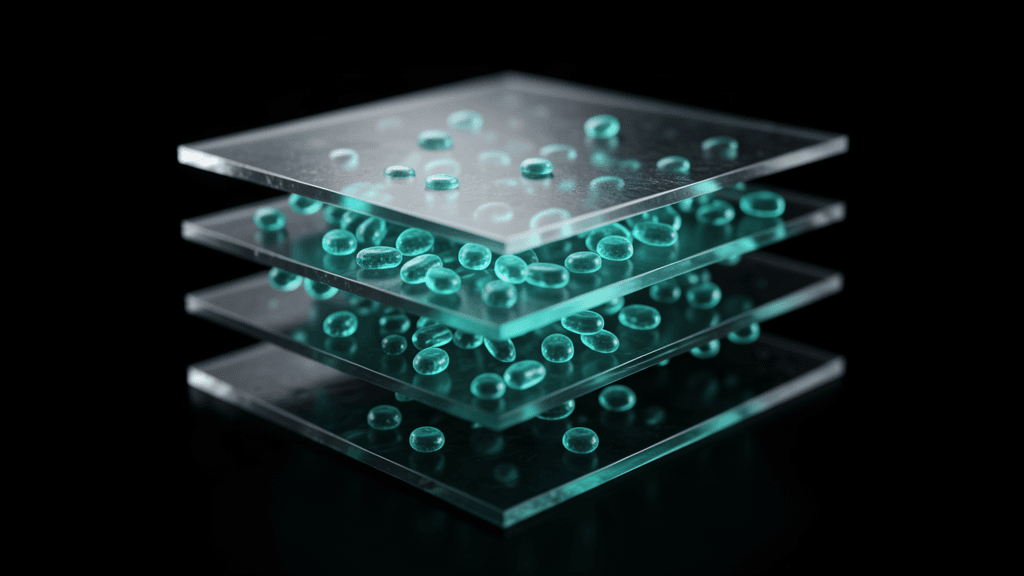
Anatomy of a lithium-free battery. Four layers no one could stack
Hold it in your hand
A cathode particle. Two micrometers wide, a hundred nanometers thick. Thinner than a soap bubble, lighter than a speck of dust.
This is where the race to end the lithium battery is being decided.
Instead of lithium — sodium. The same element you have on the table in the salt shaker. There is over a thousand times more of it in the Earth's crust than lithium. Lithium has to be dug up in Chile, Argentina, Australia — and you pay more and more for it. Sodium is everywhere. Including under Poland, a kilometer and a half underground, in the salt deposits at Kłodawa.
And yet for two decades nobody built a sodium battery that didn't die after a few hundred charge cycles.
The problem wasn't in the chemistry. It was in four layers.
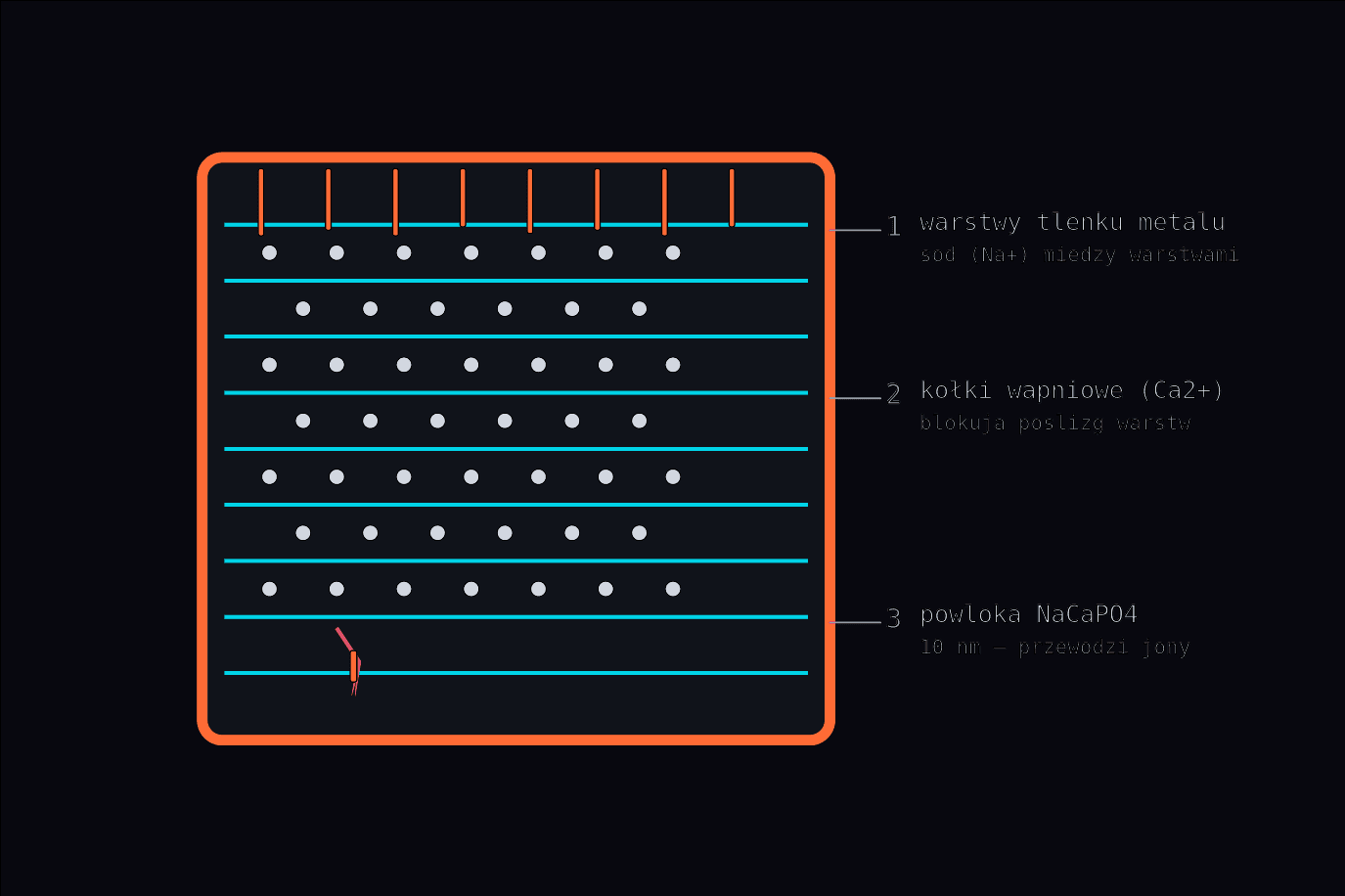
Rys. 1. Przekrój cząsteczki katody sodowej O3: warstwy tlenku metalu przedzielone jonami sodu, wapniowe „kołki” stabilizujące strukturę przy powierzchni oraz zewnętrzna powłoka NaCaPO4. Schemat własny na podstawie: Liang X. et al., Nature Communications 16, 3505 (2025), DOI: 10.1038/s41467-025-58637-1.
Figure 1. Cross-section of an O3 sodium cathode particle: metal-oxide layers separated by sodium ions, calcium "pegs" stabilizing the structure near the surface, and the outer NaCaPO4 coating. Own diagram based on: Liang X. et al., Nature Communications 16, 3505 (2025), DOI: 10.1038/s41467-025-58637-1.
Four layers of a single particle
The team of Yang-Kook Sun at Hanyang University in Seoul — one of the most-cited battery researchers in the world — took this particle apart. Each layer is its own story of failure that blocked lithium's successor for years. And its own breakthrough.
Layer one: an oxide sandwich
Let's start in the middle. The particle's core is a so-called O3 layered oxide — not ozone, just the name of the atomic arrangement. Picture a stack of playing cards: layers of metal oxide interleaved with layers of sodium. Sodium travels between the cards during charging and discharging, like a ball bearing rolling through a narrow gap.
The distance between the cards is 0.535 nanometers. Twenty thousand times thinner than a human hair.
This structure gives the sodium battery its biggest advantage: you can build it from nickel, iron and manganese. No cobalt. No lithium. Raw materials that cost a fraction of what lithium-battery ingredients cost.
But the cards have a fatal flaw. At high voltage, they start to slide.
Layer two: cracks no one saw
When sodium leaves the cathode too fast, it doesn't leave evenly. Near the surface, sodium ions run low; in the middle, an excess remains. The surface shrinks, the interior expands. Tensile stress on the outside, compressive stress inside.
The result? Microcracks. Hundreds of invisible fissures that tear the particle apart from within.
The first charge betrayed the scale of the disaster. A plain sodium cathode lost 32.4 milliamp-hours per gram — as if every fifth electron vanished without a trace before the battery even started working. After a few hundred cycles, the capacity dropped so far the battery was fit for the bin.
For years researchers tried to fix this with doping. They added potassium, zirconium, magnesium ions to the cathode — to prop up the structure. It worked. But never fully. Because none of those elements landed exactly where the cracks formed.
It turns out the problem wasn't in the material. It was in what happened at the boundary between the particle and the outside world.
Layer three: calcium pegs
Sun bet on calcium. But not scattered evenly through the whole particle — driven in exactly where the material works hardest: just beneath the surface.
Picture a bookshelf that's about to tip over. Instead of bracing the entire library, you drive a peg exactly into the spot where the shelf is pulling away from the wall. Calcium ions play the role of those pegs. They enter the sodium layer right at the particle's edge and hold the cards so they can't slide.
The researchers called it the "pinning effect".
And here is the most beautiful number in the whole study. They measured the distance between the cards right at the surface and in the middle of the particle. At the surface: 0.532 nanometers. In the middle: 0.535. A difference of three thousandths of a nanometer — three picometers.
That microscopic contraction is proof that calcium really grips the structure. Three picometers that decide whether the battery survives three hundred cycles or dies after fifty.
Layer four: skin that conducts
On the very top, Sun laid the final layer: a coating of NaCaPO4, sodium calcium phosphate. Ten nanometers thick. It's like lacquer on a car body — except this lacquer doesn't just protect, it also conducts sodium ions.
The coating forms at 650 degrees Celsius. At that temperature, calcium phosphate reacts with the sodium residue that normally lingers on the cathode surface and causes trouble — it binds moisture from the air and spoils the material before it even reaches the battery. The coating eats that residue and turns it into a conductive skin.
The result? First-charge efficiency jumped to 97.9 percent. Instead of losing 32.4 milliamp-hours, the battery loses just 3.2.
This skin solves one more problem nobody talks about. Sodium cathodes are notoriously sensitive to air. One humid day is enough for the sodium residue on the surface to bind water and carbon dioxide, and the material starts degrading before it's even placed in a battery. In a factory that means pricier transport, climate-controlled warehouses, production losses.
Sun's coating changes that. After a week lying in air at 55 percent humidity — conditions that would kill an ordinary cathode — the material showed degradation at the limit of measurement. This isn't a lab curiosity. It's the difference between a technology that needs sterile conditions and one you can produce on a normal line.
Four layers. An oxide sandwich, microcracks, calcium pegs, conductive skin. Each was known for years on its own. But only stacking them together — in the right order and at the right depths — solved the problem that blocked sodium for twenty years.
Why sodium lost for twenty years
To grasp the weight of this breakthrough, you have to go back three decades. Layered sodium oxides were discovered back in the 1980s — Claude Delmas's team in France described the O3 structure before anyone seriously thought about a lithium battery in a phone.
Then lithium won. More energy-dense, lighter, faster to develop. Sodium went into a drawer. It only came back when the price of lithium exploded — in 2022 lithium carbonate rose tenfold in two years, and carmakers started nervously hunting for a plan B.
Plan B had one flaw. Sodium is bigger than lithium — its ion has a diameter a third larger. A bigger ball fits between the cards with more difficulty. A bigger ball presses harder on the structure. Hence those microcracks that for years seemed impossible to remove.
That's why Sun's work isn't cosmetics. It's proof that a problem that looked fundamental for twenty years can be solved with patient engineering at the boundary of atoms.
Numbers that hold up
The effect is measurable in numbers that can't be dismissed.
After 300 cycles the battery keeps 82.9 percent of its capacity — in a full-size pouch cell, the same kind that goes into cars. After 500 cycles at fast charging — still three quarters of the capacity. It works from minus 10 to plus 50 degrees Celsius, at 4.5 volts. And after a week lying in humid air — minimal degradation.
Is this the end of lithium? Not so fast.
A sodium battery still has lower energy density than the best lithium ones. Lithium will stay in premium cars and electronics. But sodium wins where cost matters, not weight: grid storage at wind and solar farms, city buses, forklifts, scooters. Everything that doesn't need to fly or do three hundred kilometers an hour.
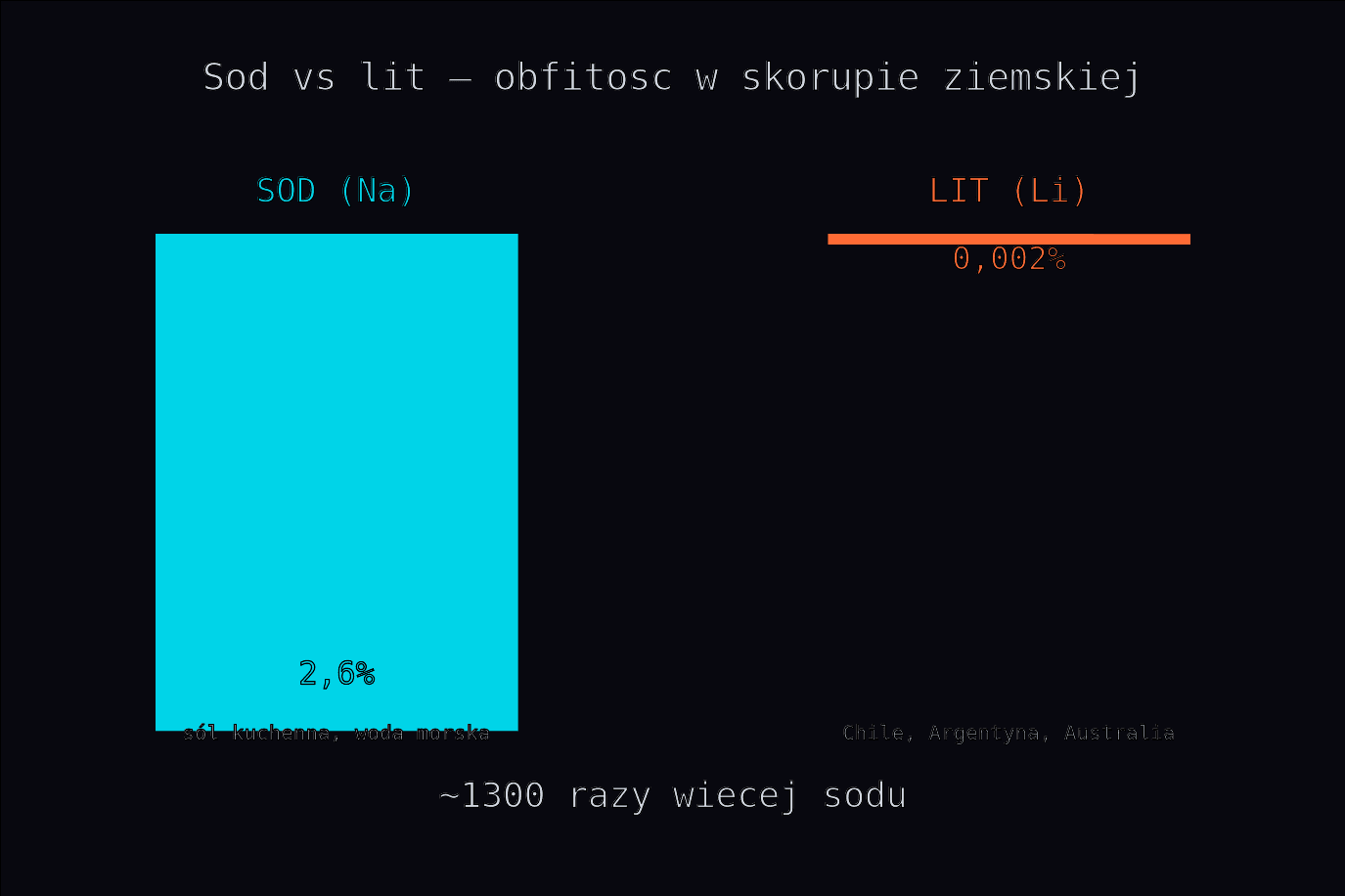
Rys. 2. Sód jest około 1300 razy obfitszy w skorupie ziemskiej niż lit (2,6% wobec 0,002%). Schemat własny na podstawie: Liang X. et al., Nature Communications 16, 3505 (2025), DOI: 10.1038/s41467-025-58637-1.
The math is simple. Lithium carbonate peaked in 2022 at over 80 thousand dollars a ton. Sodium — in the form of sodium carbonate, an industrial raw material produced in millions of tons — costs pennies. A cathode without cobalt and nickel cuts cell cost by tens of percent. And for a wind-farm storage unit that has to sit and charge for twenty years, purchase cost matters more than weight.
Figure 2. Sodium is about 1,300 times more abundant in the Earth's crust than lithium (2.6% vs 0.002%). Own diagram based on: Liang X. et al., Nature Communications 16, 3505 (2025), DOI: 10.1038/s41467-025-58637-1.
They're already doing it. Just not in Europe
For now China leads this category. CATL, the world's largest battery maker, showed the first generation of sodium cells in 2021 — 160 watt-hours per kilogram. In 2025 the second generation reached two hundred. BYD is fitting sodium cells into budget city cars, and HiNa Battery is building sodium-based energy storage.
Europe is asleep. Faradion of the UK — bought by India's Reliance — is still hunting for mass scale. France's Tiamat promises a factory, but for now it counts in megawatt-hours, not gigawatt-hours. Northvolt, Europe's battery hope, is teetering on the edge of collapse.
That leaves the door open for a player who enters with sodium technology just as the Chinese prove it pays off. And the raw material — sodium — needs no lithium mine.
Poland is sitting on a battery it doesn't know about
This story has a Polish dimension that's easy to miss.
Poland is today the largest producer of lithium-ion batteries in the European Union. The LG Energy Solution factory near Wrocław, in Kobierzyce, is one of the biggest on the continent — tens of gigawatt-hours a year, thousands of workers. That entire industry runs on lithium, which Poland doesn't have and never will.
Sodium is a different story. Under Kłodawa lies one of the deepest salt deposits in Europe — a kilometer and a half underground, rock salt, that is, sodium chloride. The raw material for a sodium battery literally lies under Polish soil.
It's not about building cathodes from table salt — that's a simplification. The point is that Europe, including Poland, gets with this material an exit from dependence on China's lithium supply chain. The EU's Critical Raw Materials Act, the CRMA, explicitly forces diversification. A sodium battery is one of the few paths that needs neither cobalt from Congo nor lithium from Chile.
Polish companies are already taking the first steps. Impact Clean Power Technology from Warsaw builds battery systems for buses and trams. GigafactoryX in Gdańsk assembles modules. And the universities — AGH in Kraków, Warsaw University of Technology, Łukasiewicz-IMN — are working on cathode materials that could power Poland's first sodium-cell line.
The stakes are concrete. The European Union has set itself a goal: by 2030, energy storage with total capacity that compensates for shutting down coal power plants. Poland — with one of the highest rates of solar installation growth in Europe — will need that storage the most. The question is who builds it and from what.
If Poland's battery industry — today a hundred percent lithium — doesn't shift at least part of its capacity to sodium, in five years we'll be importing sodium cells from China, just as we import lithium ones today. With one difference: the raw material for those cells is under our own feet.
The race is on. And in it, what counts isn't who has the most expensive technology. It's who can stack four layers in the right order.SourcesLiang X., Song X., Sun H.H., Kim H., Kim M.-C., Sun Y.-K., High-energy and long-life O3-type layered cathode material for sodium-ion batteries
Comments· 0
No comments yet. Be the first.