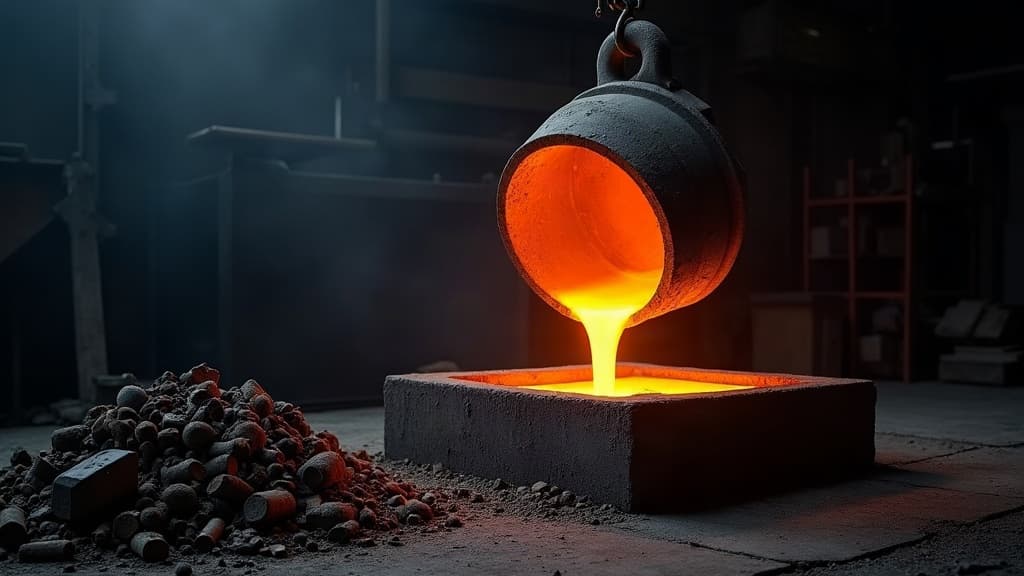
For five thousand years, smelters and founders have followed the same rule: the cleaner the metal, the better the alloy. Impurities must be removed, and if that is impossible, diluted with fresh raw material. An international team from Shanghai, Hong Kong and Düsseldorf decided to do the opposite. Instead of fighting the impurities in scrap, they had an algorithm design a cast iron that benefits from them. The result, published in Science Advances: cast iron made entirely from scrap turned out stronger, more ductile and cheaper than iron made today from a blend of scrap and primary raw material.
In their abstract the authors write that they reverse "a five-millennia-old metallurgical injunction". Those are strong words, but they are backed by melts on a real casting line, not just simulations.
Why scrap is a problem
The world produces more than 2 billion tonnes of metals and alloys a year. According to figures cited by the authors, mining and processing ores account for about 40% of industrial greenhouse gas emissions and 10% of global energy use. Recycling could cut those numbers sharply, because remelting scrap takes far less energy than making metal from ore. The researchers cite forecasts that by around 2030 production of recycled metals will exceed primary production.
Scrap, however, has a flaw you cannot see with the naked eye. Every batch has a different composition. The furnace receives stainless and alloy steel scrap, car parts, machining turnings and worn-out castings, along with residues of additives and coatings. Together with iron, nickel, molybdenum, titanium, aluminium, vanadium, tin and a dozen other elements end up in the melt. Some of them usually weaken the material and make it brittle.
Foundries deal with this by brute force. They add fresh raw material to the charge, meaning pig iron from ore, coke and fluxes, until the impurities are diluted to a safe level. In the classic recipe for ductile iron, primary raw material makes up more than 30% of the charge. The authors point out that once scrap exceeds roughly 70% of the charge, conventionally designed iron loses strength and ductility at the same time. Dilution works, but it eats up the benefits of recycling: you have to buy and smelt the raw material with the heaviest climate burden.
Cast iron as a proving ground
The team chose ductile iron as its test case. It is used, among other things, for machine and car parts. Graphite forms tiny spheres in it instead of flakes, so it does not crack as easily as ordinary grey iron. The world makes about 120 million tonnes of it a year, which the authors say is 28% of all cast iron consumption. It also has one property the researchers liked very much: it tolerates impurities well. That same property makes classic design difficult, because with so many elements in the melt, thermodynamic calculations stop predicting what will come out of the mould.
The work was led by Liuliu Han of the Max Planck Institute for Sustainable Materials in Düsseldorf, Ye Wei of City University of Hong Kong and Dierk Raabe, one of the institute's directors. The first author is Chao Yang of Shanghai Jiao Tong University. Data collection and the melts were supported by the Chinese construction machinery maker XCMG.
How the algorithm searches for a recipe
The method is called DAS-DAO. It relies on two datasets. The first contains 330 melts of iron made from scrap only. For each, the team recorded chemical composition, process parameters, microstructural features seen under the microscope and the result of a tensile test. The second dataset is larger, about 2,400 melts, but covers iron made from primary raw material and contains only composition and properties.
The algorithm works like a player who plays through many variations in their head. It starts from the best known recipes and changes them slightly: a little more copper, a lower furnace tapping temperature, a longer nodularisation time. Two neural networks estimate the tensile strength and the elongation at fracture of each variant. The first network, trained on the richer scrap data, picks the hundred best candidates. The second, trained on the larger dataset, narrows the list to fifty. From those, three to six recipes per round go into the furnace.
The last step is the most important. Results from real melts go back into the database, the models retrain on them and propose the next series. The experiment–model loop improves with every round. The authors admit that outside the range of known data the networks' predictions are less accurate. They checked, however, that the errors stay bounded and do not change the ranking of the best candidates, and that further rounds of experiments shrink the gap.
The way candidates are scored matters too. Steel and cast iron usually force a choice: either stronger or more ductile. The team built an objective function that stops the algorithm from escaping to one extreme. It makes it look for recipes spread evenly along the whole frontier of best trade-offs, and then push that frontier outward.
Seventeen melts and fourteen hits
Finally, the team cast 17 alloys proposed by the algorithm. They did it on an automated casting line with an induction furnace, a nodularisation station and automatic mould pouring. The line was supervised by a digital twin that collected sensor data ten times a second and made sure actual temperatures and times matched the design. Each alloy was cast as a bar 200 mm in diameter and 800 mm long, the same as all samples in the database, and tensile specimens cut from the bars were tested in triplicate.
Fourteen of the seventeen alloys pushed beyond the previous frontier of best trade-offs set by the database of scrap-based irons. Compared with it, tensile strength rose by up to 15.2% at similar elongation, and elongation at fracture by up to 73.2% at similar strength. Two alloys performed worse than the model predicted. The authors compared them with the successful ones and derived simple rules: carbon must be above 3.2%, silicon between 2 and 3%, copper above 0.15%, the tapping temperature should not exceed 1435°C, and nodularisation must not take less than 30 minutes.
Then there is money. A charge made entirely of scrap lowered production cost by 8.1% compared with the conventional route, in which scrap is blended with fresh raw material.
Where the strength of dirty iron comes from
To check this was no fluke, the team prepared control versions of three reference alloys. In one, they kept the algorithm's process but swapped the composition for one typical of the database. In the other, they did the reverse: kept the composition and set the process to typical values. Each time the control version did worse. The most ductile alloy, labelled DAO1, withstood about 590 MPa and stretched 18.5% before breaking. The same alloy with typical composition reached 575 MPa and 15.5%, and with a typical process 551 MPa and 17.1%. The strongest of the three, DAO3, exceeded 790 MPa.
The microscope shows what is going on. The impurities from scrap do not disappear; they go to work. Copper and silicon dissolved in the iron stiffen its crystal lattice. The authors estimate this contribution at about 148 MPa. Several impurity elements also form nanoparticles that block the movement of defects in the crystal and, according to calculations, add another 114–152 MPa. The graphite spheres in DAO1 are finer and more numerous than in typical iron from the database, and pearlite, the harder part of the structure, takes up 34.6% of the volume instead of 13.9%. A well-chosen ratio of hard pearlite to soft ferrite makes the material strong while cracks do not spread through it easily.
The key word is "well". The same nanoparticles distributed unevenly start acting as crack seeds. Too high a furnace temperature prolongs solidification, elements segregate and the graphite spheres lose their round shape. In the version with a typical process they were 30% less spherical and 20% larger. It is hard to keep track of so many dependencies by hand. The algorithm does not discover new laws of physics; it simply finds good solutions faster in a space with an astronomical number of possibilities.
Where this result ends
The technology is at TRL 4. The alloys were made on a real, industrial line, but as standardised test bars, not finished parts. The paper does not yet show fatigue tests, corrosion resistance or certification of castings for specific uses, and foundries and their customers will require those.
The method depends on data. Every foundry has its own scrap and its own furnaces, so moving it to another plant requires building a local database of melts. It helps that the code and data are open, on GitHub and in the Zenodo repository. The authors are also honest about the limits of the idea itself. Dirty alloys make sense where a moderate amount of impurities can be handled by metallurgy. They are not suitable for semiconductors or some medical implants, where even a trace of contamination is a disaster.
Steels, aluminium alloys and copper alloys are the next targets. The team also wants to connect the algorithm with autonomous laboratories in which several cooperating AI programs would plan melts, control the process and assess the results. For Raabe this continues years of work. Back in 2022 he and colleagues described the scientific basis of "dirty" recycled aluminium alloys.
What this means for Poland
Poland is one of Europe's significant casting producers. According to the European Foundry Federation, Polish foundries produced 418,600 tonnes of iron and steel castings in 2024, 15% less than a year earlier. In 2022 the country made about 115,000 tonnes of ductile iron alone. A market analysis from the European NETCAST PL 4.0 project, published on AGH University's website, states that about 65% of Polish castings go to the automotive industry and almost half of production is exported, mainly to Germany.
Foundry work uses a lot of energy, and primary raw material is the most climate-intensive part of the charge. A recipe that allows dropping primary raw material without losing quality therefore hits the industry's most sensitive spot. It does not need a new furnace. It needs good data from one's own production, sensors on the line and people who can combine metallurgy with machine learning. Polish universities have a strong tradition in this field, led by AGH's Faculty of Foundry Engineering.
The biggest change, though, is in the mind. For millennia, contamination meant a defect to a metallurgist. This work shows that with the right recipe it can become an ingredient.
Bibliography
- Yang C., Peng B. et al. From scrap to prime: Designing high-performance alloys from dirty feedstocks with machine learning. Science Advances 12, eaeg9183 (2026). DOI: 10.1126/sciadv.aeg9183
- Wei Y., Peng B. et al. Deep active optimization for complex systems. Nature Computational Science (2025). DOI: 10.1038/s43588-025-00858-x
- Raabe D., Ponge D., Uggowitzer P.J. et al. Making sustainable aluminum by recycling scrap: The science of “dirty” alloys. Progress in Materials Science 128, 100947 (2022). DOI: 10.1016/j.pmatsci.2022.100947
- Raabe D., Tasan C.C., Olivetti E.A. Strategies for improving the sustainability of structural metals. Nature 575, 64–74 (2019). DOI: 10.1038/s41586-019-1702-5
- DAS-DAO code and data. Zenodo (2026). DOI: 10.5281/zenodo.21613930
- Max Planck Society. AI turns scrap impurities into useful ingredients for stronger recycled iron. Phys.org, 15 Oct 2026. phys.org
- European Foundry Federation. Production of ferrous castings 2024 (annual report, December 2025). eff-eu.org
- Branża odlewnicza – aktualny stan, przyszłość i wyzwania. Magazyn Przemysłowy. magazynprzemyslowy.pl
- NETCAST PL 4.0 (grant agreement no. 101159771). D6.1 Market analysis and needs (AGH, 2025). netcastpl4-0.agh.edu.pl
Comments· 0
No comments yet. Be the first.