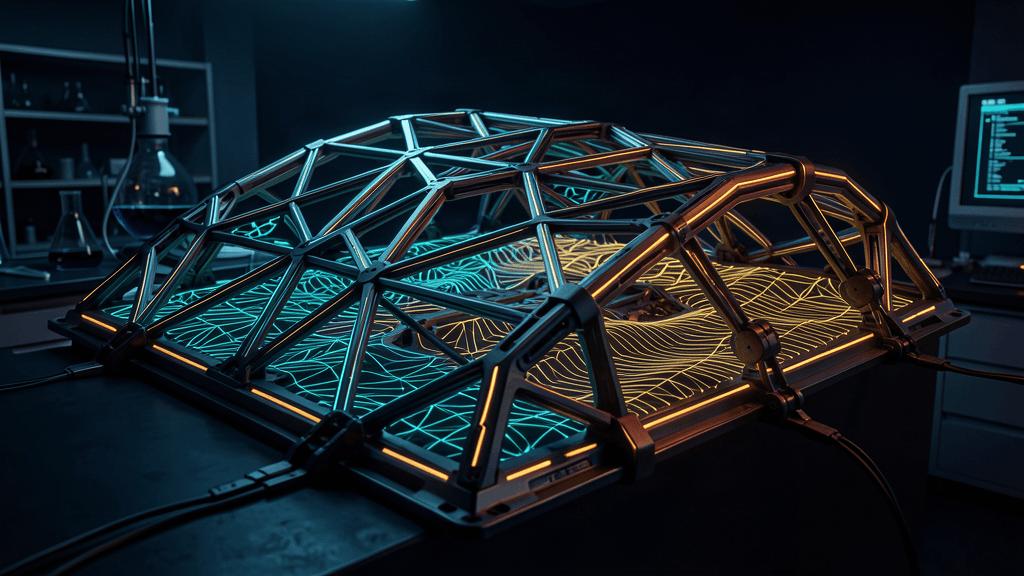
The Berkeley Chameleon. How geometry replaced chemistry in the race for adaptive stealth
Dahyun Daniel Lim stares at the screen at 4:37 am. A data-driven design algorithm that has been searching the space of mechanical geometries for weeks has just returned a structure that no materials engineer could draw with a piece of paper and a pencil. It resembles origami frozen in mid-motion: a regular truss composed of interlinked trusses. When unfolded, it absorbs electromagnetic waves in the 4-18 GHz band like a black hole. One turn of the joints by a few degrees. The structure collapses and compresses. And suddenly it becomes almost transparent to radar - it transmits waves instead of stopping them.
In Grace Gu's lab at UC Berkeley, no one shouted "eureka" that evening. They just said: "it works like a chameleon".
This is not a metaphor used for effect. The team consciously reproduced the mechanism by which the chameleon changes its skin color. The reptile doesn't do this with pigment. Its skin contains photonic crystals that, under the influence of mechanical tension, physically change the distances between the plates. The band of reflection and transmission of visible light shifts. Green becomes red not because a new pigment has appeared, but because the structure has changed.
Lim, Ibarra, Lee, Jung, Choi and Gu transferred the same principle from the domain of light waves to the domain of microwaves. Instead of changing the colors they reflect, their structure changes the absorption and transmission of centimeter-long wavelengths. The result was described inScience Advancesin 2025 — and in less than a year they collected 57 citations.
The difference from everything that came before is fundamental. Classic microwave absorbers are static. They are designed for one band, one characteristic, one purpose. Stealth paint on the F-35 fuselage suppresses X-band (8-12 GHz) reflections. If the enemy switches the radar to the Ku band (12-18 GHz), the paint loses its effectiveness. This is not a design defect. This is a physical limitation of a homogeneous material: it is impossible to build a substance that absorbs and transmits the same frequency at the same time. Unless the substance can switch.
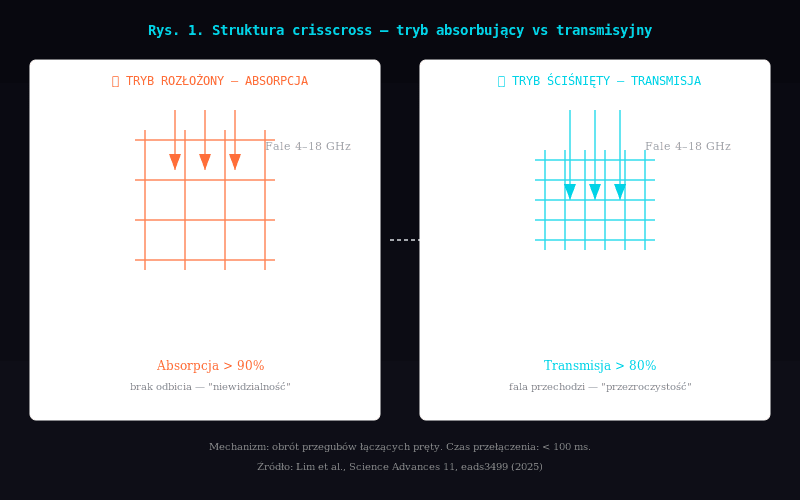
Fig. 1. Crisscross structure — absorbing vs transmitting mode. Source: Lim et al., Science Advances (2025)
This is where the crisscross structure comes in. The key innovation does not lie in the base material (ordinary polymer) or in the electromagnetic properties per se. It lies in geometry. The joints connecting the truss rods act like switches: a turn of a few degrees changes the distances between conductive elements throughout the matrix. The electromagnetic response changes. And all this without exotic alloys, without electric fields, without cryogenic temperatures. You turn the engine and switch the mode.
This is a reversal of the logic that has governed this field for decades. Instead of asking "what material will give us the desired properties," Gu's team asked: "what geometry will give us the ability to switch between the two extreme states." The material may be common if the architecture is brilliant. This approach has another consequence that is not overestimated in the literature: scalability. Because the tuning mechanism does not depend on the material properties but on the geometry, it works the same for a 5×5 cm laboratory matrix and for a 1×1 m panel. The only difference is the size of the actuator.
To precisely determine the optimal geometry, Gu's team used an optimization algorithm. The space of possible bar arrangements, angles, distances and thicknesses is gigantic. A human won't search it in any reasonable amount of time. The algorithm looked through thousands of variants and found the one that maximizes the contrast between the absorbing and transmitting modes in the 4-18 GHz band. In the unfolded mode, the structure achieves an absorption coefficient above 90% for almost the entire band. In compressed mode, the transmission exceeds 80%. Switching between these extremes takes less than 100 milliseconds.
Act 2: Landscape - Three Paths to Adaptive Stealth
To understand why this work is groundbreaking, you need to look at the architecture of the problem. The modern electromagnetic battlefield is governed by one ironclad rule: an active system emits a signal, and therefore unmasks itself. A jammer that jams an enemy's radar is itself a source of radiation - that is, a target for an anti-radiation missile. A passive absorber does not emit anything. He's quiet. But this silence is paid for with a lack of flexibility.
Since 2008, when Landy, Sajuyigbe, Mock, Smith and Padilla published inPhysical Review Lettersconcept of an ideal metamaterial absorber, the world of science knew that artificial periodic structures could achieve almost 100% absorption in a narrow band. In 2012, Watts, Liu and Padilla showed inAdvanced Materials(over 1,680 citations) that appropriate design allows you to expand the bandwidth. The problem was that for the next decade all demonstrations were for static absorbers. Broadband, yes. But not tunable.
Three lines of attack on the tunability problem have developed in parallel over the last ten years.
The first path is electrical switching. Materials such as vanadium oxide (VO₂) or graphene change their dielectric permittivity under the influence of applied voltage. In 2018, Zhang's group at MIT demonstrated a VO₂-based absorber that switched between "on" and "off" modes in sub-picoseconds. Problem? It only works for a narrow range of incident angles and requires continuous power. The second path is phase-change materials (PCM), most often alloys based on germanium, antimony and tellurium (GST). Padilla's lab at Los Alamos has demonstrated absorbers that can be thermally switched between an amorphous and a crystalline state. Switching times in the order of microseconds - impressive for data storage, but too slow for a frequency-hopping radar that changes frequency several hundred times per second.
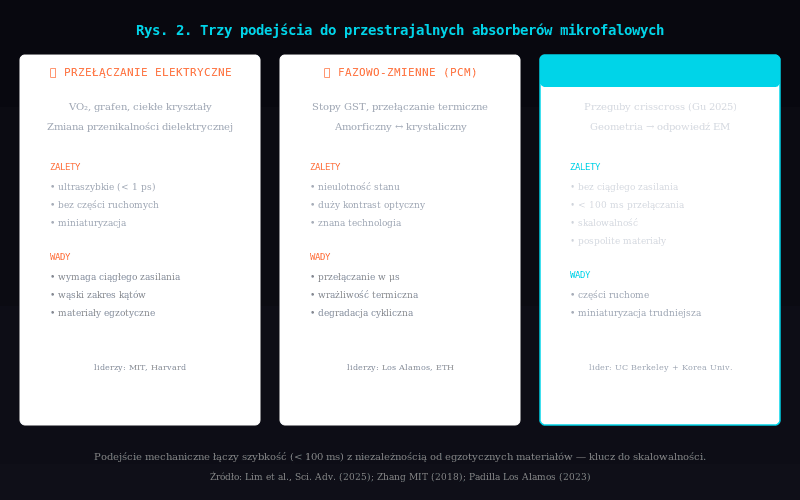
Fig. 2. Three approaches to tunable microwave absorbers. Source: Lim et al., Sci. Adv. (2025); Zhang MIT (2018); Padilla Los Alamos (2023)
The third path - mechanical - remained a theoretical possibility that no one turned into a working prototype. Team Gu did just that. And he did it in a way that, at first glance, seems too simple to work: by changing geometry instead of chemistry. The key advantage of the mechanical approach is paradoxical: it is both the simplest and the most scalable. You don't need exotic materials or precise temperature control. You need precise geometry and one actuator. Rotating the joints by a few degrees adjusts the entire matrix - 10×10 cm or 1×1 m, the principle of operation is identical.
The competition is not idle. In 2024, Xu's group from Zhejiang University published wScience Advancesabsorber based on metal-organic frameworks (MOF) with atomically precise control of interlayer distances. An impressive material achievement. But the structure is static. Once optimized for one band, it does not detune. Gu's team focused on architecture, not chemistry. The result: the first metamaterial absorber that switches between full absorption and full transmission in less than 100 milliseconds. No thermal limitations and no continuous power supply for the absorption mechanism itself.
Act 3: Poland - the path that is closing
Poland has the competence to enter this game. It has laboratory and scientific facilities. But the window won't be open for long. Very long.
Let's start with specifics. The Military University of Technology in Warsaw has been conducting research for years on materials that absorb electromagnetic radiation: carbon composites, ferrite paints, conductive foams. The Warsaw University of Technology (Faculty of Materials Science and Engineering) has a 3D printing laboratory, which is crucial for the production of three-dimensional crisscross structures. Wrocław University of Science and Technology (Department of Electromagnetic Compatibility) can simulate the electromagnetic response of periodic structures in the band up to 40 GHz. The High Pressure Institute of the Polish Academy of Sciences has developed technologies for sintering conductive ceramics - potential base materials for absorbers operating at high temperatures, for example in engine exhaust nozzles.
There is a lack of integration. Polish laboratories test materials separately, simulate the electromagnetic response separately and optimize the geometry separately. No one has assembled these three layers into a single adaptive metamaterial prototype. And integration – mechanics plus electromagnetism plus data-driven design – is exactly what Gu's team was the first to do in the world.
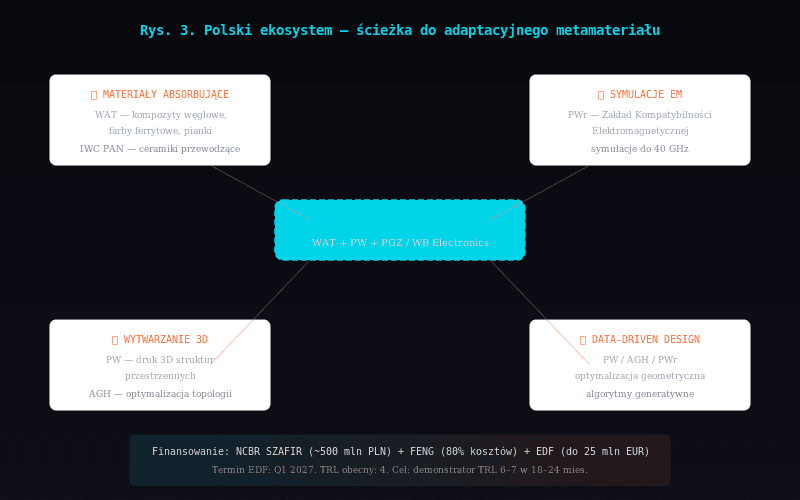
Fig. 3. Polish ecosystem — path to an adaptive metamaterial
The financing path exists and is specific. NCBR, under the SZAFIR (defense technologies) program, provides for financing projects in the area of stealth and camouflage materials. This program has a budget of approximately PLN 500 million for the years 2021–2028, a significant part of which remains to be used in the last recruitments. FENG offers a path for scientific-industrial consortiums in the field of advanced materials, with co-financing of up to 80% of eligible costs. The European Defense Fund announced a call for applications for adaptive camouflage technologies in 2025, with a budget of up to EUR 25 million per consortium. Application deadline: Q1 2027.
I rate the TRL of this technology as 4: prototype validated in the laboratory, mechanism of action confirmed. A demonstrator in conditions similar to real ones (TRL 6–7) requires 18–24 months and approximately PLN 8–12 million. Scale, environmental testing (humidity, temperature, vibration), military certification - these are known, predictable steps. The most difficult step - the concept and the first working prototype - has already been completed and described in open access.
The global market for materials for managing electromagnetic waves (EMI shielding plus radar absorbers) was worth USD 7.8 billion in 2024 and is growing at a rate of 6.7% per year. It's not just the military that's driving it. 5G and 6G networks require selective shielding between antennas on a single mast - without this, densely packed antennas lead to mutual interference. Data centers need absorbers for anechoic chambers for EMC testing. The automotive industry is looking for materials that reduce interference between radar sensors in autonomous vehicles. In each of these domains, the static absorber is a compromise. Adaptive is the solution.
Can this be done in Poland? Yes. Under three conditions. The first: a consortium consisting of WAT, Warsaw University of Technology and an industrial partner (PGZ Stocznia Wojenna, WB Electronics or PIT-RADWAR) must be established within the next six months. The German Fraunhofer FHR and the Swedish FOI have their own metamaterial programs. Whoever submits an application to EDF first will receive financing. Second condition: the project cannot be a copy of the crisscross structure. It must be a variation adapted to Polish operational requirements (2-18 GHz band, resistance to weather conditions, compatibility with existing platforms). Third: the algorithmic part of the project (data-driven geometry optimization) requires competences in machine learning, which are available at Polish universities, but they need to be actively included. Not as a subcontractor. As a full partner.
This is not a race with the Americans and Koreans. It's a race against time. In 24 months, someone - in Berkeley, Seoul, Stockholm or Warsaw - will demonstrate the first adaptive metamaterial absorber on a demonstration scale. The question is not "is it possible?" The question is: who will be first and where "Made in" will be written.
Sources
- Lim D.D., Ibarra A., Lee J., Jung J., Choi W., Gu G.X.A tunable metamaterial microwave absorber inspired by chameleon's color-changing mechanism.Science Advances 11, eads3499 (2025). DOI:10.1126/sciadv.ads3499
- Watts C.M., Liu X., Padilla W.J.Metamaterial Electromagnetic Wave Absorbers.Advanced Materials 24, OP98–OP120 (2012). DOI:10.1002/adma.201200674
- Teyssier J., Saenko S.V., van der Marel D., Milinkovitch M.C.Photonic crystals cause active color change in chameleons.Nature Communications 6, 6368 (2015). DOI:10.1038/ncomms7368
- Landy N.I., Sajuyigbe S., Mock J.J., Smith D.R., Padilla W.J.Perfect Metamaterial Absorber.Physical Review Letters 100, 207402 (2008). DOI:10.1103/PhysRevLett.100.207402
- Xu X., Li H., Li S., et al.Metal-organic frameworks with fine-tuned interlayer spacing for microwave absorption.Science Advances 10, eadl6498 (2024). DOI:10.1126/sciadv.adl6498
- Iqbal A., Shahzad F., Hantanasirisakul K., Kim M.K., Kwon J., Hong J., Kim H., Kim D., Gogotsi Y., Koo C.M.Anomalous absorption of electromagnetic waves by 2D transition metal carbonitride Ti3CNTx (MXene).Science 369, 446–450 (2020). DOI:10.1126/science.aba7977
- Schurig D., Mock J.J., Justice B.J., Cummer S.A., Pendry J.B., Starr A.F., Smith D.R.Metamaterial Electromagnetic Cloak at Microwave Frequencies.Science 314, 977–980 (2006). DOI:10.1126/science.1133628
- Qin F., Brosseau C.A review and analysis of microwave absorption in polymer composites filled with carbonaceous particles.Journal of Applied Physics 111, 061301 (2012). DOI:10.1063/1.3688435
- Grand View Research.Electromagnetic Shielding Market Size Report, 2025–2030. (2025). grandviewresearch.com
- Chen H., Chan C.T., Sheng P.Transformation optics and metamaterials.Nature Materials 9, 387–396 (2010). DOI:10.1038/nmat2743
Comments· 0
No comments yet. Be the first.