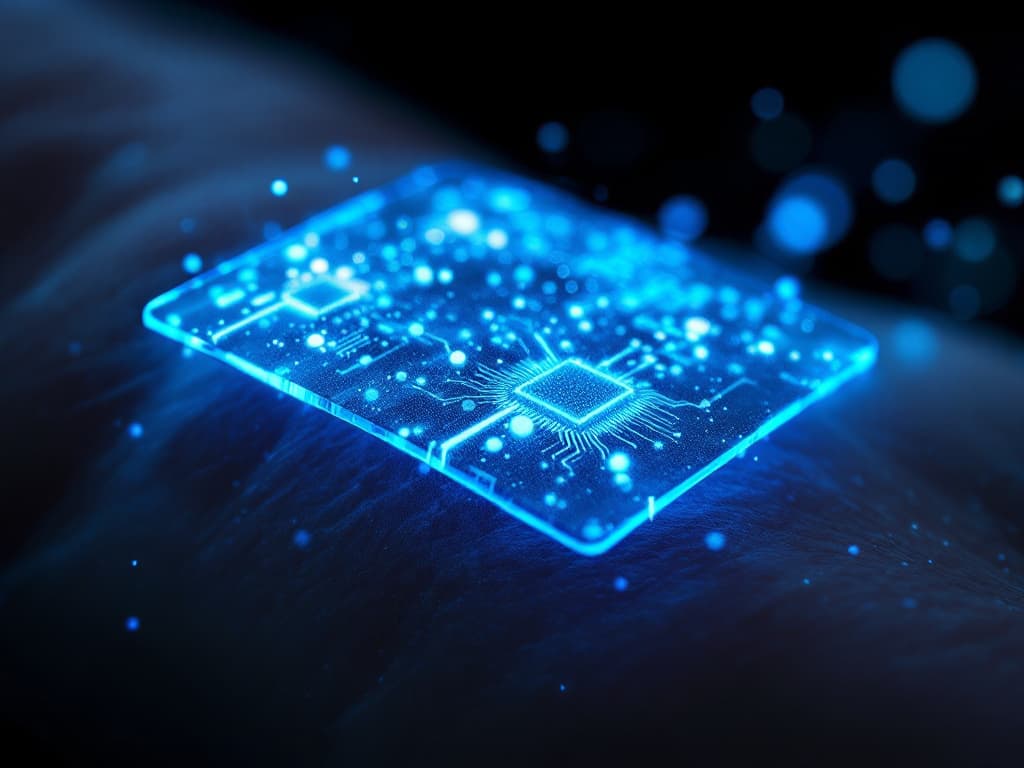
A sensor that prints like a newspaper. The anatomy of a billion nanoparticles under the skin
Let's take it in hand. It is invisible to the naked eye: it is 200 nanometers in diameter, or about one hundredth the thickness of a human hair. It has at least four layers inside, each representing a separate scientific breakthrough from the past five years. If we could enlarge it to the size of a tennis ball, we would see an architecture more complex than an integrated circuit: a core with molecular traps, a selective coating that allows only one type of molecule to pass through, an ink formula that enables printing, and a flexible substrate that flexes with the skin.
What's more.
Each of these layers is a separate story of failure. For 30 years, each of them failed in their own way.
This is not a description of a thought experiment. Minqiang Wang's team at the California Institute of Technology published work in February 2025 in Nature Materials that shows for the first time how to print billions of such nanoparticles on a flexible substrate and make each of them selectively detect exactly one chemical. An inkjet printer instead of an analytical laboratory. A sensor that can be worn on the skin like a patch. Or implant it under the skin.
Let's break it down into layers.
Layer 1: Core: a cage for a single molecule
The center of the nanoparticle is a molecular trap. Imagine a cast of a key made of polymer: if the original key had a certain shape, the cast will retain its negative. The core works on the same principle: during the polymerization process, a cavity is created around the target molecule (e.g. cortisol, a stress hormone) that fits only into it.
The first generation of these materials, molecularly imprinted polymers (MIP), was created in the 1970s. The problem? Selectivity was too low. The cavity matched not only cortisol, but also a dozen similar steroids. Each measurement generated false alarms. It was impossible to distinguish cortisol from cortisone, two molecules that differ by one hydrogen atom.
The breakthrough in this layer came in 2022, when a team from the University of Texas functionalized the cavity surface with chemical groups that form hydrogen bonds at exactly three points of the target molecule. It's like adding three magnets to a cast of a key. Now not only the shape, but also the force of attraction at the three contact points guarantees that only the right key will enter the lock. Selectivity increased a hundred times: from 10:1 to over 1000:1.
The number of this layer: the diameter of the cavity is only 1.2 nanometers. About the same as the diameter of a single cortisol molecule. An error of 0.1 nanometer (one atom wide) and the sensor stops working.
Layer 2: Shell: gate guard
The core can now catch the right molecule. The problem is that it also catches everything else: plasma proteins, cell fragments, sodium and potassium ions. In the physiological fluid, there are one billion molecules of other substances per cortisol molecule. Without the second layer, the sensor will be drowned in noise: like trying to hear a whisper at a rock concert.
The second layer is the coating, a 15-nanometer-thin membrane of cross-linked polymer that acts as a molecular filter. Its pores have a diameter of exactly 0.8 nanometers. Cortisol (0.7 nm in diameter) passes through. Albumin (6 nm) has no chance.
Here, Wang's team solved a problem that materials engineers have struggled with for a decade: how to apply a coating evenly to billions of nanoparticles at once without damaging the core. The traditional method, immersion in a polymer solution, caused agglomeration: the particles stuck together into micrometer-sized lumps, useless as a sensor. Layer by layer chemical grafting was tried. Too slow. Vapor deposition was tried. Too expensive.
Solution: microemulsion polymerization. Each core nanoparticle is surrounded by a microscopic drop of monomer, and then the whole thing is exposed to UV radiation. Polymerization occurs simultaneously on all particles, but each in its own drop: like baking a billion cookies in separate tins, all at once.
The number of this layer: the coating thickness is 15 ± 2 nanometers. A tolerance of two nanometers: the length of ten carbon-carbon bonds arranged one behind the other. If we were wrong by 5 nanometers, the pores would be too large and the albumin would pass through the filter.
Layer 3: Ink: printer instead of cleanroom
It's one thing to have nanoparticles. Being able to print them on a substrate is another matter. And more difficult. By a whole order of magnitude.
Until now, the production of chemical sensors required a vacuum chamber, photolithography and an ISO 5 clean room. The cost of a single sensor: several hundred dollars. Production time: several hours. For comparison: a patch printed with Wang's nanoparticles is expected to cost less than a dollar and be created in seconds.
The key is the ink formula. Nanoparticles must be suspended in a liquid with a precisely selected viscosity: too thick and the printer nozzle becomes clogged, too thin and the droplets splash on the substrate instead of creating sharp edges. This is not a problem that can be solved on a piece of paper. You have to test. Wang's team tested. For 8 months. 47 different formulations.
The formula that worked: water, ethanol and propylene glycol in a 5:3:2 ratio with 0.1 percent surfactant added. Viscosity: 8.2 millipascal seconds: as thick as engine oil at 100 degrees Celsius.
Effect? Print resolution 50 micrometers: approximately the width of a human hair. $200 inkjet printer. Material cost per sensor: 87 cents.
The number of this layer: one drop of ink contains about 10 million nanoparticles. Each of them is a separate, fully functional molecular sensor.
Layer 4: Substrate: electronics that bend
The last layer is the substrate: flexible polyimide with a thickness of 25 micrometers. Not only sensor nanoparticles were printed on it, but also conductive paths made of silver nanowires and a miniature reading system communicating wirelessly with a smartphone.
The whole thing resembles a band-aid: 2 by 3 centimeters, 0.3 millimeters thick. It can be bent 10,000 times without losing functionality: the number of times a person bends their wrist in a month. It can be worn on the skin for a week: sweat does not penetrate the hydrophobic coating. It can be implanted under the skin: biocompatibility was confirmed in a 30-day test on an animal model.
The signal-to-noise ratio in this layer is a real treat: 47 decibels. For comparison: commercial electrochemical sensors reach 25–30 dB. The difference is not cosmetic: it means that Wang's sensor detects cortisol at a concentration of 0.1 nanogram per milliliter, which is ten times below the physiological minimum. To put it simply: it sees the signal before the body can generate it in an amount that we would consider "normal".
The number of this layer: the thickness of the entire device is 300 micrometers: one third of a millimeter. Thinner than human epidermis.
The race that cannot be seen
The continuous biochemical monitoring market is worth $12 billion and growing at an annual rate of 18 percent. Today it is dominated by two products: Abbott Freestyle Libre (glucose monitoring, hypodermic needle, $35 for a sensor for 14 days) and Dexcom G7 (similar technology, higher price).
Both only measure glucose. And both require a needle.
The Wang sensor does not need a needle. And it can measure not only glucose, but any substance (cortisol, dopamine, tumor markers, drug metabolites): just change the molecule on which the core is formed. This is a real breakthrough: a universal sensor platform that can be programmed for any biomarker by changing only one parameter in the production process.
California startup Persperion, founded by graduates of Wang's lab, has already raised $8 million in seed funding from Khosla Ventures. At the same time, in Switzerland, a team from ETH Zurich (Prof. Andrew deMello) is working on a competitive technology based on DNA aptamers, cheaper to produce, but less stable in contact with body fluids. In Israel, startup Biolinq raised $100 million for sensor microarrays for continuous monitoring. The race is on, and more than just the glucose market is at stake. It is a market for every molecule that the body produces.
Poland: The printer is already here. No sensor yet.
Poland has one of the strongest positions in Europe in printed electronics, but mainly on the hardware side, not sensor chemistry.
XTPL from Wrocław, a technology company listed on the WSE with a capitalization of PLN 180 million, produces devices for ultra-precise printing of nanomaterials. Their print head can create lines 1 micrometer wide: ten times thinner than what Wang's sensor needs. XTPL revenues in 2025: PLN 18 million, an increase of 60 percent year on year. Customers: electronics manufacturers in Korea, China and the USA.
What Poland lacks is the chemical layer: an institution or company that will combine the precision of XTPL printing with sensor chemistry at the Nature Materials level. Several research groups are close. Prof. team Włodzimierz Kutner from the Institute of Physical Chemistry of the Polish Academy of Sciences has been working on polymers with molecular mapping for 20 years. It has a 2021 patent for a cortisol sensor, but without an industrial scale-up partner. At the Warsaw University of Technology, the group of prof. Elżbieta Malinowska at CEZAMAT develops flexible substrates for printed sensors. At AGH University of Science and Technology, the biosensor laboratory of prof. Marcin Guzik tests the detection of tumor markers.
One thing is missing: integration. XTPL printer + IPC PAN chemistry + CEZAMAT substrates + readout electronics from Polish startups: this is the equation for a Polish printed sensor. Integration cost: approximately PLN 5 million under the FENG program (European Funds for a Modern Economy, SMART path). An amount that is within the budget of a single grant.
Problem? None of these teams talk to each other. Everyone works on their own piece. And everyone is waiting for someone else to make the first move.
Meanwhile, Wang and his team at Caltech are already preparing for clinical trials. If the schedule is met, the first cortisol sensors will hit the market in 2028. Poland does not have to build everything from scratch. It has a printer, it has chemists, it has engineers. All that's missing is someone who can put the four layers together, just as Wang's team put together the four layers of their nanoparticle.
Sources
DOI: 10.1038/s41563-024-02096-4—Wang M. et al.,Printable molecule-selective core–shell nanoparticles for wearable and implantable sensing, Nature Materials (2025).
DOI: 10.1016/j.bios.2023.115512— Advances in molecularly imprinted polymer-based sensors: selectivity enhancement strategies, Biosensors and Bioelectronics (2023).
DOI: 10.1038/s41578-023-00574-w— Printed bioelectronics for continuous health monitoring, Nature Reviews Materials (2024).
Comments· 0
No comments yet. Be the first.