A sensor that feeds on waves
A sensor that feeds on waves
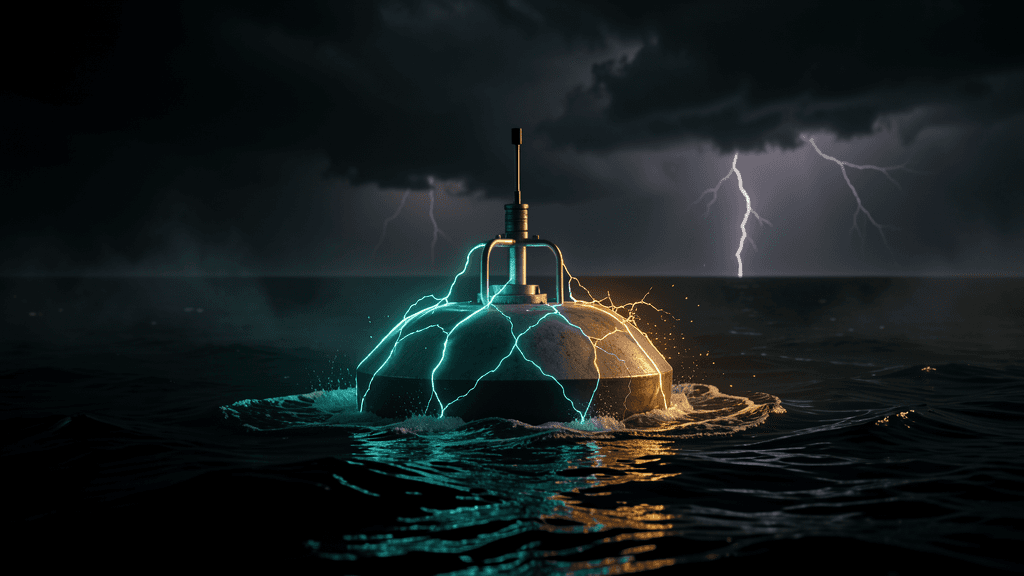
Let's imagine a monitoring buoy in the middle of the Baltic Sea. It measures water temperature, salinity, current speed - a standard set of parameters that help scientists track sea conditions. The problem is that every three months someone has to swim to it and replace the battery. Each such exchange involves a ship, fuel, crew and a bill counting in thousands of euros. There are tens of thousands of such buoys in the world - and each one is a small, expensive logistical operation repeated endlessly.
If the sensor could power itself - drawing energy from the same wave motion it measures - all logistics would disappear from the equation. Kequan Xia's team from Southwest University and the National University of Singapore just showed how. Their solution - a Faraday cage-inspired triboelectric nanogenerator - produces 1,276 volts just by swinging on a wave. No battery, no cable, no replacement. Only movement.
50 percent planet, zero percent attention
Oceans cover 71 percent of the Earth's surface, but our sensory coverage of this area is woefully sparse. Most oceanographic measurement buoys - those that provide data for climate models, weather forecasts and tsunami early warning systems - are located mainly along the coasts of North America, Europe and Japan. The rest of the ocean is a blank spot. The North Pacific between Hawaii and Alaska, the southern Indian Ocean, most of the South Atlantic - from an oceanographic data perspective, these areas are virtually non-existent.
The global smart marine sensor market is growing 7 percent annually and is expected to reach $3.8 billion by 2028. It's not just science that's driving it - offshore wind, autonomous shipping, aquaculture and monitoring of undersea telecommunications cables all need real-time data. Every offshore wind farm requires constant monitoring of foundations, cables and hydrological conditions. Except there is no socket on the open sea. There is also no budget for replacing batteries in hundreds of sensors scattered over an area of several dozen square kilometers.
So far, attempts to power marine sensors with ambient energy have hit several fundamental barriers. Solar cells are cheap and mature, but they don't work underwater - and during storms, when monitoring is needed most, they're completely useless. Thermoelectric generators require a temperature difference that rarely exceeds a few degrees Celsius in the ocean—not enough to generate useful power. Piezoelectrics, which convert mechanical stress into electricity, offer microwatts of power at high material costs.
And classic triboelectric nanogenerators (TENGs), which convert mechanical energy into electrical energy by rubbing two materials — the same ones that make a balloon rubbed against a sweater stick to a wall — suffer from a chronic problem: electrostatic charge dissipates at the edges of the device before it can be collected. Each edge of the material is an escape route for electrons.
A cage that holds electrons
Triboelectricity is a phenomenon known since the times of Thales of Miletus - rubbed amber attracts hair. Modern TENGs use the same mechanism, but in a controlled way: two surfaces with different tendency to give off electrons rub against each other, generating a measurable electric charge. With the right design, TENG can turn even slow, irregular motion — like the rocking of a buoy on a wave — into direct current.
The problem is that this charge wants to escape. Especially at the edges of the material, where the electric field is the strongest. It's a bit like trying to keep water in a colander - the more you collect, the faster it flows out the sides. Over the years, engineers have tried various tricks: changing the geometry of the electrodes, adding insulating layers, optimizing the chemical composition of the surface. None of them have fundamentally solved the problem—until now.
Xia's team solved this in a way that an electrical engineer would immediately recognize: a Faraday cage. Michael Faraday discovered in 1836 that if you surround a space with a conductive grid, the electric field inside disappears - the charge has nowhere to go because there is no field to push it out. This is why a car acts like a Faraday cage during a storm - the lightning flows down the body without entering the interior.
Instead of a metal mesh, the researchers used a powder layer of FeCoCrNiAl alloy — five metals (iron, cobalt, chromium, nickel, aluminum) that together create a quasi-closed, conductive architecture at the microscopic level. Each microscopic alloy ball acts as a miniature Faraday cage, trapping charge within the volume of the triboelectric material. The effect is cumulative - millions of micro frames in one device.
The numbers speak for themselves. The open-circuit voltage increased by a factor of 4.86—from approximately 260 to 1,276 volts. The short-circuit current increased by 3.57 times - to 63.69 microamps. The transferred charge increased by 2.76 times - to 29.55 nanocoulombs. The peak power of the device reached 4.08 milliwatts at a load of 60 megohms. For comparison: a typical temperature and humidity sensor with a Bluetooth Low Energy module consumes about 0.5 milliwatts in continuous mode and much less when transmitting periodically. FC-TENG produces eight times more than the sensor needs.
There's another problem that kills marine electronics faster than anything else: moisture. Seawater is an electrolyte - it conducts electricity, corrodes contacts and shorts circuits. The team coated the surface of the FC-TENG with a hydrophobic layer, creating a barrier that repels water droplets without blocking the mechanical movement of the device. Thanks to this, the FC-TENG remains stable even at humidity levels above 90 percent - exactly conditions that immobilize traditional TENGs within hours.
Final test: Researchers integrated the FC-TENG with a wireless communication module and signaling diodes, then placed the whole thing in a wave tank. The device not only generated electricity from water movement - it also measured the parameters of this movement and transmitted them in real time. The same element that produces energy is also a sensor. No need for two devices. No batteries needed. No periodic service visits are needed.
4 milliwatts that change the rules of the game
Four milliwatts is not much. For comparison, a phone charger delivers about 5 watts, or 1,250 times more. An LED bulb in a home lamp consumes 8 watts - 2,000 times more. But it's not about power. It's about autonomy.
A typical oceanographic buoy sends data once an hour. For the remaining 59 minutes, he gathers energy. Four milliwatts for an hour is 14.4 joules - enough to power a LoRa module to transmit data over several kilometers. Enough to send a full packet of measurements to the satellite once a day. Without a battery that needs replacing every 90 days. Without solar panels, which become overgrown with algae after a month at sea and lose 40 percent of their efficiency. No cables that corrode in salt water.
The scale of this solution becomes visible only when we think about the number of sensors that could work in the ocean. There are currently around 4,000 Argo measurement buoys operating around the world - drifting sensors that dive to 2,000 meters and resurface every 10 days to transmit data via satellite. Their batteries run out after 4 years. Replacing an entire fleet is a logistical operation costing hundreds of millions of dollars, spread over decades.
FC-TENG won't replace Argo - these sensors need power to pump ballast, which requires tens of watts, not milliwatts. But it can power tens of thousands of simpler surface sensors: temperature, salinity, pH, wave, dissolved oxygen concentration, and even basic underwater acoustics. Each of them the size of a soda can, floating freely or anchored to the bottom. Each self-sufficient. Anyone producing data non-stop, for years - without a single service visit.
That's the contrast this study is all about: One palm-sized device, drawing power from the same movement it's meant to monitor, can cover an area of the ocean that's currently blind. One square centimeter of triboelectric material - the entire Baltic Sea under constant surveillance. One wave that has just crashed on the beach in Gdynia - converted into sea state data and sent to the server in Sopot.
Gdańsk has data. There are no sensors
Poland has access to 500 kilometers of coastline and its own economic zone in the Baltic Sea with an area of 30,000 square kilometers. This is an area larger than the Lesser Poland Voivodeship - and equally poorly researched in terms of continuous environmental monitoring in real time.
The Institute of Oceanology of the Polish Academy of Sciences in Sopot, the University of Gdańsk and the Maritime Institute in Gdańsk have been measuring the Baltic Sea for decades. They have research ships - "Oceania", which sails every month on a measurement cruise in the South Baltic Sea. They have laboratories and competences recognized throughout Europe. What don't they have? A dense network of autonomous sensors that would provide data continuously - not once a quarter during a scheduled cruise, but every hour, day and night, 365 days a year.
The Baltic Sea is not only a laboratory - it is the arena of the largest maritime investment in Poland's history. Offshore wind farms: PGE Baltica is building Baltica 2 and 3 farms with a total capacity of 2.5 GW. Polenergia and Equinor are developing Baltic II and III - another 1.4 GW. Orlen is planning a farm with a capacity of 1.2 GW. In total, by 2030, over 400 wind turbines will be built in the Baltic Sea - each on a steel foundation driven 30-50 meters into the seabed.
Every foundation requires monitoring: settlement, corrosion, impact on local sea currents and the benthic ecosystem. Each submarine cable - and the total length of cables on Baltic farms will exceed 600 kilometers - requires temperature and mechanical stress testing. Every farm needs a meteorological and hydrological station operating 24 hours a day. Today, these measurements are performed periodically - by ship, divers, and remotely operated underwater vehicles (ROV). Each inspection costs from several to several dozen thousand euros. And each only provides a snapshot—one point in time, not a continuous curve of data.
Technology such as FC-TENG – a self-powered sensor that operates for years without changing batteries – could change this picture dramatically. Instead of planning an inspection cruise for two weeks: an alert on the phone of the engineer on duty as soon as the parameter exceeds the threshold. Instead of guessing why turbine number 17 is vibrating more than usual: a continuous record of foundation vibrations over the last six months, ready for analysis.
The Polish research ecosystem has strong cards in this game. The Center for Offshore Wind Energy operates at the Gdańsk University of Technology - a unit that has been developing technologies for monitoring marine structures for a decade. At the Maritime University of Gdynia - marine electronics laboratory with experience in the construction of autonomous measurement buoys. At the Institute of Fluid-Flow Machinery of the Polish Academy of Sciences - a team working on piezoelectric and triboelectric energy generators from the environment. At the AGH University of Science and Technology in Kraków - research group developing new metal alloys for energy applications, including high entropy alloys similar to FeCoCrNiAl.
The pieces of the puzzle are in place. Materials scientists know alloys. Electronic engineers know TENGs. Oceanographers know the Baltic Sea. Offshore wind needs monitoring. All that is missing is a decision and money to combine these four worlds into one project - the Polish equivalent of FC-TENG, optimized for the conditions of the Baltic Sea: low salinity, short waves, long storm periods.
The problem is not technological. It is systemic and cultural: Polish offshore companies - like most companies in the world - do not have a culture of investing in monitoring beyond the regulatory minimum. Until the law requires a sensor on every foundation, there will be no sensor. Until the Maritime Office includes continuous monitoring in the conditions of the location permit, no one will pay for autonomous sensors.
But the Baltic Sea will not wait for the law. Nor until the batteries in the existing measurement buoys stop working. In 2025, the Baltic Sea was the fastest warming sea in Europe, with surface temperatures rising twice as fast as the global average. We need more data, not less. We need them now, not five years after the amendment to the regulation. The Xia sensor won't solve this problem alone - but it shows that there is a solution. It doesn't require a breakthrough in physics. It just requires a decision.
Sources
- Xia K., Hao Y., Luo P. et al.,A Faraday Cage‐Inspired Triboelectric Nanogenerator Enabled by Alloy Powder Architecture for Self‐Powered Ocean Sensing,Energy & Environment Materials (2025).DOI: 10.1002/eem2.70040
- Wang Z.L.,Triboelectric Nanogenerators as New Energy Technology for Self-Powered Systems, Faraday Discussions (2014).DOI: 10.1039/C4FD00159A
- Global Smart Ocean Sensor Market Report 2024-2028, MarketsandMarkets Research.https://www.marketsandmarkets.com
- The Argo program - a global network of floating oceanographic profilers:https://argo.ucsd.edu
- PGE Baltica - Offshore Wind Farms:https://pgebaltica.pl
- Polenergia - Baltic II and III Offshore Wind Farms:https://www.polenergia.pl
- Offshore Wind Energy Center, Gdańsk University of Technology:https://cmes.pg.edu.pl
- HELCOM - Baltic Sea Environment Fact Sheets:https://helcom.fi/baltic-sea-trends/environment-fact-sheets/
Comments· 0
No comments yet. Be the first.