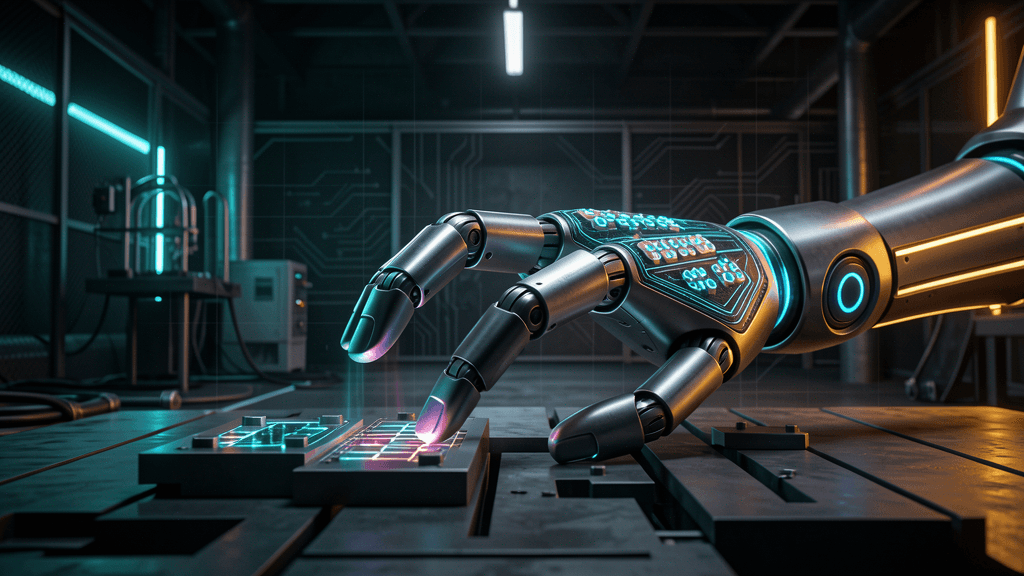
A robot that feels what it is holding
Kunwei Bao stood in front of a test bench in the laboratory of the Harbin Institute of Technology and watched as the robot touched the glass ball.
The problem wasn't that the robot couldn't hold it. He held her steady. The problem was that the robot didn't know what it was holding. A glass ball, a wooden cube, a steel cylinder - they were all the same to the robot's fingers. Pressure, slippage, end.
Bao, a materials engineer from Shanghai who came to the Harbin Institute through the research program of the Shenzhen Institute of Information Technology, had been trying for two years to solve a puzzle that seemed trivial to any three-year-old. How can you make a machine sense the shape and material of an object—simultaneously?
The answer his team — consisting of Yaguang Guo, Nan Li, Liwu Liu, Yanju Liu and Jinsong Leng — found, published in 2026Advanced Materials. It's an electronic skin. Dual mode. One layer detects the shape of an object before the robot touches it. The other recognizes the material once it is held. This is the first system that does both things at once.
Two senses, one patch
Human skin has approximately 17,000 mechanoreceptors. Touch, pressure, temperature and vibration sensors. When you pick up a cup, your brain knows within 50 milliseconds that it is ceramic, that it is hot, that it weighs about 200 grams, and that you should hold it by the handle, not by the side.
Robots don't have any of these sensors. They have force gauges in their joints - they measure torque, not touch. They have cameras - they can see geometry, but not texture. They have lidars - they scan distances, but they don't recognize whether the floor is concrete, wood or ice.
Bao's team approached it differently. Instead of trying to build one universal sensor, they split the problem into two physical mechanisms.
The first one isnon-contact electrostatic sensor. A layer of electret — a material that holds an electric charge like a magnet holds a field — generates a signal when an object appears nearby. The closer and the larger the area, the stronger the signal. The robot "sees" the shape before it touches it. Like a bat, only with an electric field instead of ultrasound.
The second one iscontact triboelectric sensor. When two different materials come into contact and separate - for example, a robot finger and a glass ball - an electrostatic charge is generated. Each material produces a different signal pattern. Glass gives a sharp peak and rapid decay. Wood - Low plateau. Steel - a sudden jump. The system learns these patterns and after several dozen attempts recognizes the material with an accuracy of over 90%.
Together: the robot approaches the object, the non-contact sensor maps the shape, the fingers tighten, the contact sensor analyzes the material. Time: less than a second.
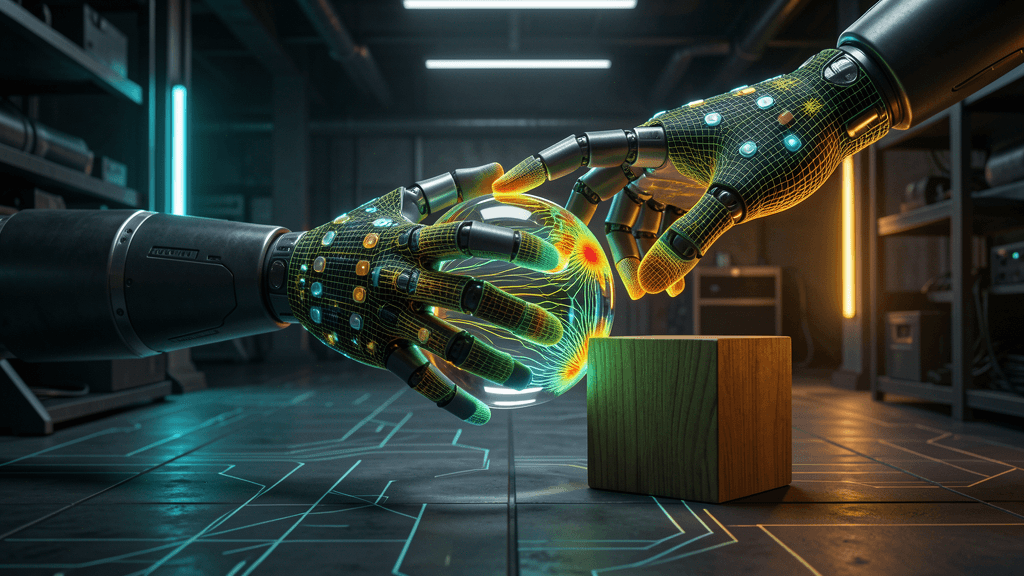
Rys. 1. Dwutrybowa elektroniczna skóra: tryb bezdotykowy (elektrostatyczny, 94,3% dokładności kształtu) i tryb kontaktowy (triboelektryczny, 91,7% dla 12 materiałów). Źródło: Bao et al., Advanced Materials 2026.
45 billion and no feeling
This is not an academic exercise. The global robotics market was worth $45 billion in 2024 - International Federation of Robotics (IFR) forecasts put it at $95 billion by 2030. But the robots sold today are touch blind.
FANUC, the world's largest manufacturer of industrial robots (35% of the market), sells arms capable of welding, assembling and packaging with micrometer precision. Neither of them has fingers that can tell whether they are holding an egg or a steel screw.ABB i KUKA— the same. They all use grippers with one degree of freedom: open/close.
The market for touch sensors — what Bao does — was worth $3.2 billion in 2024 and is expected to grow to $8.5 billion by 2030. It's one of the fastest-growing segments of robotics. The reason is simple: every robot manufacturer needs hands that feel something, and no one yet sells a ready-made solution.
The competition is working on the same problem.SynTouchin California has developed BioTac, a robotic finger with a hydraulic sensor that measures force, vibration and temperature. Tesla uses similar technology in the Optimus.Shadow Robot Companyfrom London sells a hand with 24 degrees of freedom and 129 sensors - for $120,000. None of these solutions combine non-contact and contact modes in one patch.
This is Bao's advantage - and this is also his limitation. The electronic skin from the Harbin Institute is a laboratory prototype. Operates at room temperature and 40-60% humidity. No one has yet tested it in the factory, with metal dust, vibrations and temperatures of 40 degrees.
Bao knows it. In the work, he notes that the tests were carried out on 12 materials - from glass and steel to wood and silicone. Recognition accuracy: 94.3% for non-contact mode (shape) and 91.7% for contact mode (material). That's more than what an average industrial grapple needs for sorting garbage - the applications Bao cites as his first commercialization target.
“Waste sorting is the ideal first market,” he argues in the discussion of the work. "You don't need medical sterility, you tolerate errors, and the savings from automation are measurable with just 50-100 robots."
The global robotic waste sorting market was worth $2.1 billion in 2024. Colorado-based AMP Robotics has 300 sorting robots in 80 plants. FANUC sells a dedicated Waste Robotics line. None of these systems use touch sensors - they sort only by images from cameras. Bao's e-leather would add a second dimension: material.
Krakow has an arm. He has no hands.
Poland is one of the largest industrial robotics markets in Central Europe. IFR reports that 3,200 new robots will be installed here in 2023 - more than in the Czech Republic and Hungary combined. Robotization density in industry: 71 robots per 10,000 employees, above the world average (58).
ASTORfrom Krakow - 300 employees, PLN 150 million in revenue - has been integrating Kawasaki robots in Polish factories for 30 years. Their clients include: Volkswagen Poznań, Whirlpool Wrocław and Mlekovita.FANUC Polandnear Warsaw sells 500-700 robots a year, mainly for the automotive sector.KUKA CEEfrom Katowice operates the LG Energy Solution battery assembly line near Wrocław.
But none of these companies produce touch sensors. None have a materials science laboratory that could produce Bao's electret layer. They integrate the arms. They don't build hands.
However, there is research facilities. The Warsaw University of Technology has the Department of Robotics and Automation, which has been working on adaptive grippers for a decade. AGH in Krakow - Laboratory of Robotics and Artificial Intelligence. Wrocław University of Science and Technology - team of prof. Krzysztof Tchoń, who published works on controlling manipulators in conditions of sensory uncertainty. In 2025, NCBR allocated PLN 45 million for the project "Intelligent robotic systems for Industry 4.0" - a consortium of PW, AGH and PIAP.
What's missing? Material transfer. Bao's electronic skin uses electrets, materials that hold an electrostatic charge. Their production requires clean rooms and thin layer deposition. This technology is available at Polish institutes of solid state physics - IF PAN in Warsaw, INTiBS in Wrocław. But no one has combined solid-state physicists and roboticists into one project.
"Robotics in Poland means assembly," an engineer from ASTOR told us, asking for anonymity. "We buy the arm from the Japanese, the controller from the Germans, we integrate it at the customer's. Nobody makes components here. And touch sensors are just a component."
The window is open. The touch sensor market is growing by 17% annually. Arm manufacturers - FANUC, KUKA, ABB - are looking for partners who will provide them with ready-made hands with feeling. Poland has engineers, material resources and 3,200 new robot installations per year - a test market right under its nose. If ASTOR, PIAP and AGH form a consortium and complete the prototype before the end of 2027, there is a chance for their own component, not just the integration of someone else's. If not, touch sensors will be imported from Shenzhen in two years.
Sources
- Bao K., Guo Y., Li N. et al. "Electrostatic Enhanced Dual-Mode Electronic Skin for Multifunctional Robotic Hands Capable of Object Shape and Material Recognition."Advanced Materials, 2026. DOI: 10.1002/adma.202521409
- International Federation of Robotics. "World Robotics 2024 - Industrial Robots." Frankfurt, 2024.
- MarketsandMarkets. "Tactile Sensor Market - Global Forecast to 2030." Report Code: SE 1234, 2024.
- SynTouch Inc. "BioTac: Biomimetic Tactile Sensor." Technical Whitepaper, 2023.
- IFR. "Robot Density by Country 2023." International Federation of Robotics Statistical Department.
- NCBR. "Intelligent robotic systems for Industry 4.0." Strategic program, budget PLN 45 million, 2025.
- ASTOR Sp. z o. o. "Annual Report 2024 - Robotization of Polish industry." Krakow, 2025.
- Polish Agency for Enterprise Development. "Polish robotics and industrial automation market - analysis 2024."
Comments· 0
No comments yet. Be the first.