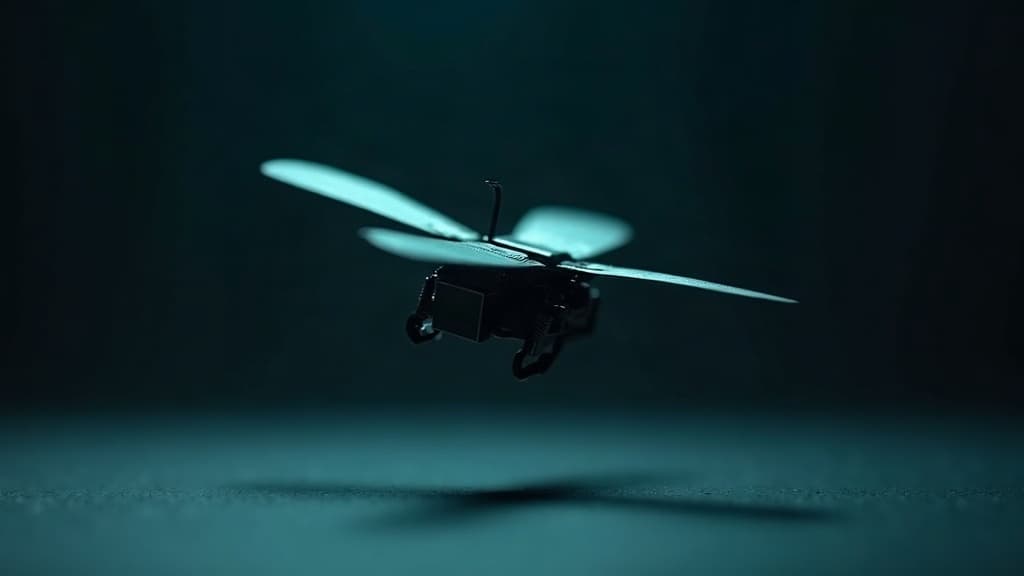
A robot lighter than a paperclip does ten somersaults in eleven seconds
Engineer: the control brain is smaller than a paperclip, and the robot still somersaults in the wind
Insects fly differently from drones. They brake in mid-air. They dart sideways. They flip head over heels and hold course through a gust. Until recently, insect-scale robots could mostly stay on a smooth, calm path. Accelerations were small. Maneuvers were cautious. That was not the wings' fault. The wings could be improved. The bottleneck was the control "brain": the algorithm that, in real time, works out where the robot is and what it should do in the next fraction of a second.
A team at MIT describes in Science Advances a controller that clearly closes that gap. The machine weighs 750 milligrams. Soft artificial muscles drive larger wings. On that hardware a neural network runs. It was trained on an expert planning algorithm: predictive control with an uncertainty corridor. The abstract's numbers are these. In a sharp sideways dart the robot reaches 197 cm/s and an acceleration of 11.7 m/s². That is +447% and +255% better than earlier results from the same line, respectively. In a 160 cm/s wind the robot still makes those darts. In an aerobatic series it does 10 somersaults in a row in 11 seconds.
This is not a promise that tomorrow such machines will crawl across earthquake rubble. It is an engineering proof. An aggressive trajectory can be tied to a limited computer and to the aerodynamics of fingernail-sized wings, which cannot be fully predicted.
A scale you do not see in a drone video
The robot is roughly the size of a microcassette. It weighs less than a paperclip. The wings beat thanks to soft actuators. The contraction is fast enough that the wings flap at a high frequency. YuFeng "Kevin" Chen leads the Soft and Micro Robotics Laboratory in the Research Laboratory of Electronics. For years that lab has built machines with beating wings. Jonathan P. How, of the Laboratory for Information and Decision Systems, is responsible for the control. Lead author Yi-Hsuan Hsiao and co-leads Andrea Tagliabue and Owen Matteson join both layers into one system.
Earlier, the controller had to be tuned by hand. For calm flight that was enough. During a somersault, errors accumulate. How says it plainly in the ScienceDaily account. If a small error creeps into one flip and there are to be ten, the machine falls. What is needed is control that stands up to disturbances, not only a neat hold on the path.
This is the classic conflict in microrobotics. Model predictive control, MPC for short, can plan hard maneuvers: somersaults, sharp turns, sudden changes of angle. It respects force and torque limits, so it does not ask the wings for something physically impossible. Such a planning algorithm is computationally heavy. On a 750 mg machine there is no room for a server. Something has to compute quickly.
Two steps: the expert plans, the network flies
The solution in the paper has two stages. First a demanding MPC planning algorithm runs, in the variant with an uncertainty corridor. It predicts how the robot will behave. Then it picks a safe sequence of controls inside that corridor. Next, that expert teaches a neural network by imitation. In flight the network receives position information. It returns thrust and torque commands. Those are the network's decisions, not the heavy algorithm.
Learning by imitation packs the behavior of a slow but capable controller into a model that fits what the machine has time to compute. How treats robust training as the key. You need enough data on aggressive maneuvers, and you must not let the dataset grow without end. Chen stresses the loop between the hardware and the control program. Better wings and muscles give the controller more to do. A better controller, in turn, lets the machine use what it can already do.
The result is not just a nice recording. The abstract gives concrete speed and acceleration thresholds, and the gain over the group's earlier results. Add a 1.6 m/s wind during sideways maneuvers. For a machine lighter than a banknote that is a serious disturbance, not a light studio breeze.
Who needs an insect-sized robot
Chen states the goal plainly. It is places a classic multirotor enters badly and an insect enters well. Gaps in rubble. Narrow ducts. Spaces where a large drone's rotors do not fit, or where they kick up dust that is dangerous to people. ScienceDaily repeats the vision of search after disasters. This is still a direction, not a product on a shelf. The TRL of this demonstration is about 3–4. There is a full flight path and there are measurable results. There is not yet sensor autonomy in the field, nor a certified mission.
For business and for research policy, the point is not the spectacle of a somersault. A micro-drone with beating wings is a niche of its own, apart from cheap multirotors. It needs a soft drive, small electronics, and control that will not blow the battery or the processor. Whoever masters that set has a machine for inspecting infrastructure: cables, pipes, and the spaces between machines. They also have a field for dual-use research and for academic soft-robotics programs. The EU and the US already fund those programs separately.
Poland does not have an MIT-class soft microrobotics lab in every city. It does have robotics and AI-control labs at Warsaw University of Technology, AGH, and Poznań University of Technology. It also has a growing layer of drone companies. Taking the method over does not have to mean copying 750 mg wings tomorrow. It can mean the recipe itself. An expensive MPC algorithm teaches. A light control law stays on the device. That pattern also works in other systems with a tight computing limit, not only at insect scale.
Numbers you have to know how to read
197 centimeters per second is almost two meters. For a person walking, that is not much. For a robot weighing three quarters of a gram, whose wing area is microscopic next to a classic drone, it is another league of drag and inertia. An acceleration of 11.7 m/s² approaches a load on the order of 1.2 g. At insect scale that is a violent change of vector, not a light turn. The improvement of hundreds of percent refers to earlier results from the same group. It is an honest engineering comparison. The same kind of machine, a better controller, and better hardware. It is not a Guinness World Records entry in the style of "faster than every insect in the world."
A series of ten somersaults in eleven seconds tests something other than one showy flip. It tests whether the conditions at the start of the next maneuver repeat. The planning algorithm must leave the machine in a state from which the next somersault can begin. The network must hold that when wind and model error push the path out of the safety corridor. That is the point of the method. Not one ideal path, but a corridor in which the flight stays safe despite uncertainty.
Where the demonstration ends and a product begins
Several layers separate a flight in the lab from a mission in the rubble. First, sensors. Today many microrobots fly in a space where an external system measures position. The abstract explicitly points to further work on sensor and computing autonomy. Second, energy. Soft actuators and the electronics have to fit inside the mass limit. You cannot add battery the way you can on a multirotor that weighs a kilogram. Third, reliability. One somersault on film is not the same as a hundred missions without calibration on an optical table.
Companies that sell drone inspection today will not switch tomorrow to 750 mg machines. Labs and agencies that fund soft robotics already see the bottleneck move. The question is no longer whether the wing can lift the mass at all. The question is whether the controller can handle an aggressive maneuver under a limit on computing power. That is a typical order in a young technology. First the physical prototype. Then the program that unlocks what the hardware can already do.
The business signal is twofold. On the risk side: a long road to certification, dual-use applications, and no obvious product on a shelf. On the option side: rights to the control layer can be licensed more widely than the wings alone. That means other vehicles with a tight processor and a large model uncertainty. Learning by imitation from expert MPC can be carried elsewhere.
Europe, Poland, a realistic angle
EU robotics and AI programs increasingly tie hardware to guarantees of safety and energy efficiency. Microrobots with beating wings sit at the junction of soft materials, control, and miniaturization. In Horizon grants those three themes appear separately. Here they have to work together. The Polish scene does not have to build a copy of MIT's electronics laboratory to get value out of this. It can build the algorithms, tests in tunnels, integration with local drones, or drive components. It is not worth reducing the news to the sentence "the Americans did somersaults." For a reader in Warsaw or Kraków the business point is different. Here is a concrete recipe for control that finally lets hardware which already exists at insect scale be used.
What in the paper is solid, and what is marketing
Solid: the mass, the speed and acceleration measurements, a series of 10 somersaults in 11 seconds, wind of 160 cm/s, the description of MPC with an uncertainty corridor and of learning by imitation, authors at MIT, and the DOI in Science Advances.
Soft or still ahead: readiness for search-and-rescue missions, and full sensor autonomy. The abstract itself leaves open further work on local sensors and onboard computing. Also soft is a comparison "like an insect" if it is meant as biological completeness of flight, rather than only speed, acceleration, and pitch angle.
Do not write that artificial intelligence replaced the hardware. Chen and How say the hardware and the control develop together. Do not sell this as a finished rescue product either. This is a laboratory that has finally reached a level of maneuver at which talk of gaps stops sounding like science fiction from an investor presentation.
Why this today, and not another piece about drones
Recent weeks on TRL09 leaned hard into medicine and biotechnology. Here hardware with artificial intelligence in the control loop comes back. In the last ten pieces, after chips and body sensors, this field was almost absent. The reader gets a hero that can be pictured: a machine lighter than a paperclip that stops flying politely and starts flying hard.
The engineering moral is simple. At extreme miniaturization the strongest algorithm on a server does not win. What wins is the one that can be taught from a strong planning algorithm and run onboard, before a 1.6 m/s gust knocks 750 mg off course. MPC with an uncertainty corridor and learning by imitation are exactly that pair. The somersaults are spectacular. Resistance to the accumulation of error is what actually matters in the field.
Sources
- Hsiao Y.-H. et al. Aerobatic maneuvers in insect-scale flapping-wing aerial robots via deep-learned robust tube model predictive control. Science Advances. DOI: 10.1126/sciadv.aea8716
- ScienceDaily, MIT / EECS account of the AI controller and the flight measurements: https://www.sciencedaily.com/releases/2026/09/260921081114.htm
Comments· 0
No comments yet. Be the first.