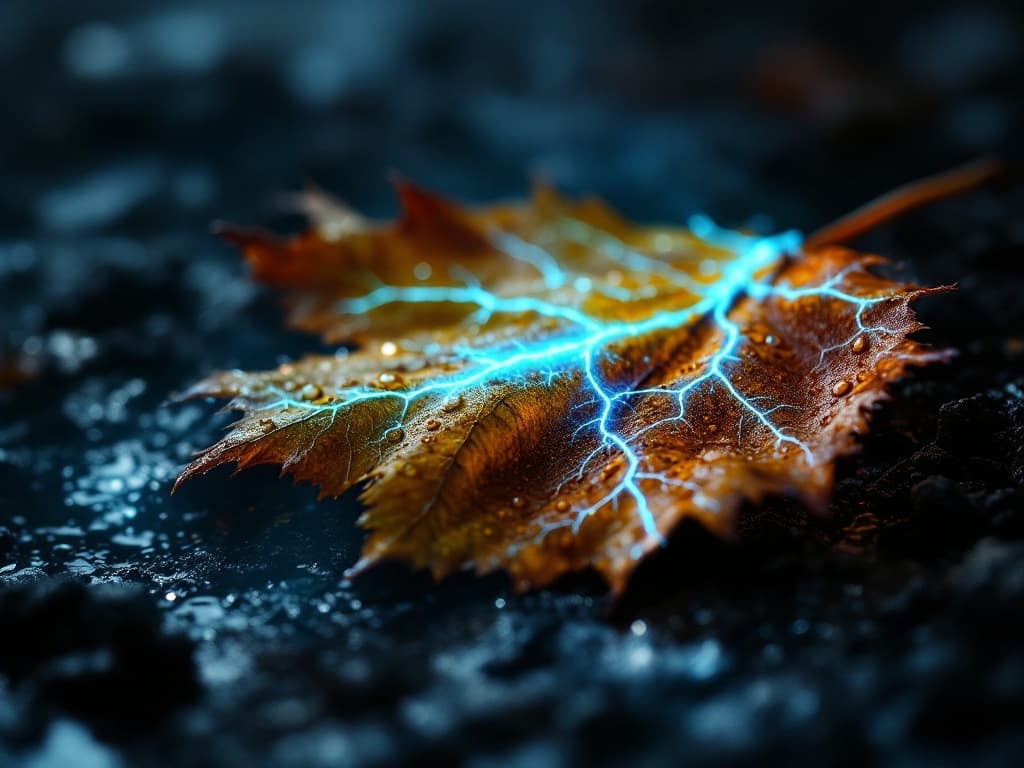
A leaf that died to give electricity. Dead energy paradox
A dead leaf should not produce electricity. Alive - yes. Photosynthesis is, after all, the world's oldest power plant: sunlight converted into chemical energy with an efficiency that artificial cells still cannot match. But a dead leaf? The one that fell from the tree is lying on the sidewalk and will turn into compost in a week? This one is waste. In the US, 8.8 million tonnes of it are produced each year: the equivalent of 1.76 billion garbage bags. It is burned or allowed to rot.
Yet a dead leaf has just been turned into a power generator. And not just any one: one that works without sun, without wind, without movement. It feeds only on moisture from the air.
The same leaf that nature designed to decompose turned out to be a better substrate for energy harvesting than any synthetic material.Therein lies the paradox.
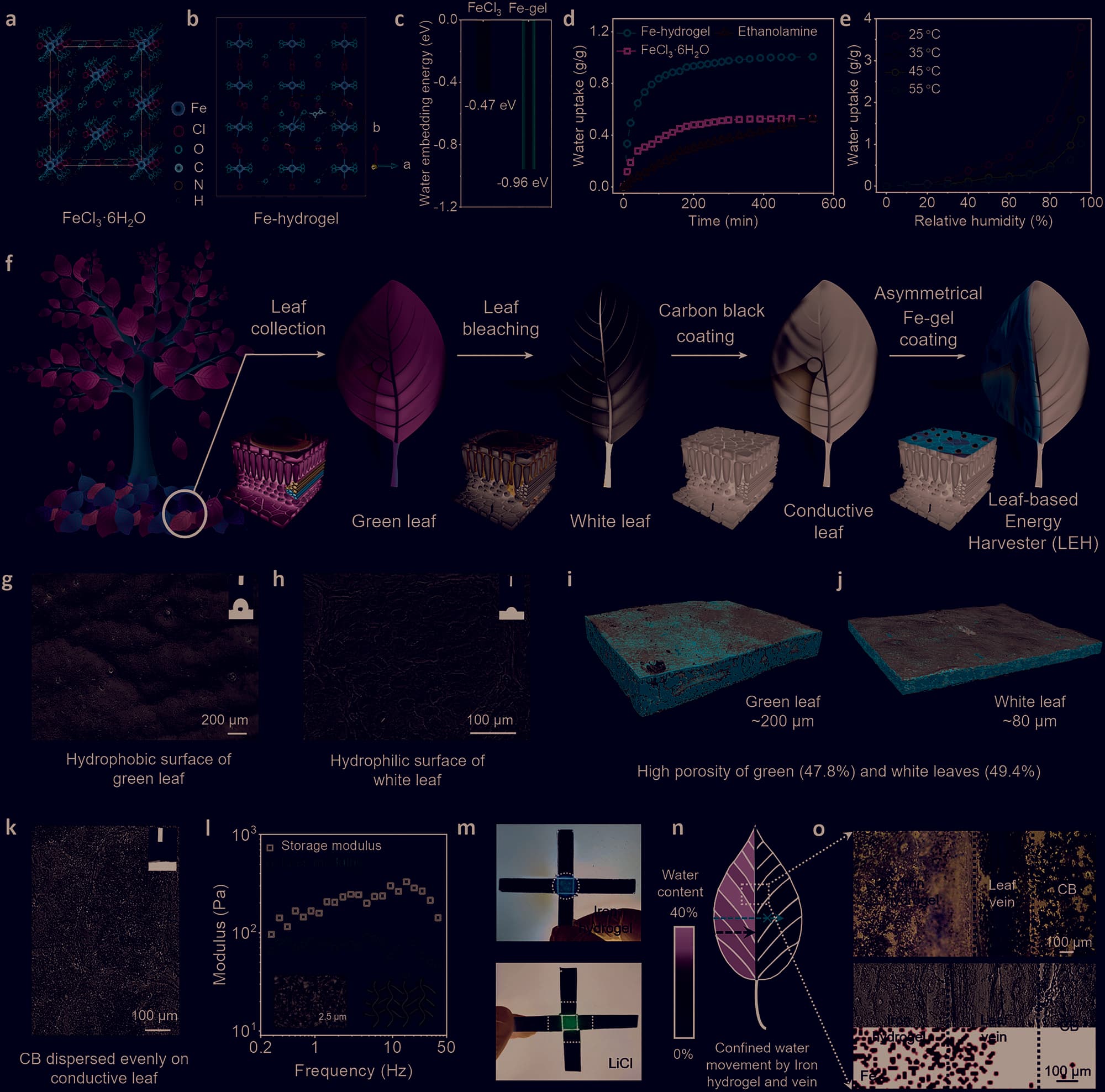
Rys. 1. Schemat konwersji opadłego liścia w harvester energii (LEH). Hydrożel żelazowy po jednej stronie liścia absorbuje wilgoć z powietrza, tworząc gradient wody, który generuje napięcie ~0.5 V. Źródło: Guo S. et al., Nature Communications (2025), DOI: 10.1038/s41467-025-60341-z.
Why dead is better than alive
The team of Shuai Guo from the National University of Singapore and Swee Ching Tan published in May 2025 inNature Communicationswork that reverses intuition: the key to harvesting energy from moisture is not an advanced polymer or nanomaterial from the laboratory - but the cellular structure of an ordinary leaf.
Leaves have two features that engineers have been unable to recreate cheaply for years. The first one ismicrogrooves on the cell surface— the same ones that are responsible for the lotus effect and hydrophobicity. Guo discovered that when they are covered with carbon black, they create a perfectly even conductive layer. Soot sticks together on smooth paper or plastic, but not on leaves. Cells act like molds.
The second feature isleaf veins. They transport water and nutrients in a living leaf. In the dead (after bleaching and delignification) they create a diffusion barrier. They divide the leaf into two zones: wet (covered with hydrogel) and dry. The moisture that the hydrogel absorbs from the air cannot get to the other side - the veins block it. It is this asymmetry that drives the entire mechanism.
The hydrogel is iron sulfate (FeCl₃·6H₂O) combined with ethanolamine. Together they form a network that absorbs 3.79 grams of water per gram of material (almost four times its weight) directly from atmospheric moisture. No need for rain. No fog needed. Just plain air in the room.
When the hydrogel soaks in, excess ions are created on the coated side. On the dry side - deficiency. Potential difference: 0.5 V. Maintains continuously for over 200 hours. And when the electrons flow through the external circuit and power the sensor or diode, the double electrical layer on the leaf surface rebuilds itself. In 30 times less time than it took to discharge. It's self-regeneration. Zero moving parts. No sun. Only moisture.
The paradox is that a structure designed by evolution for photosynthesis - a process that ends when the leaf dies - turns out to be perfect for something completely different.A dead leaf does not photosynthesize. But its cellular architecture, which served for photosynthesis, now serves to generate electricity.
49 microamps per square centimeter
The numbers are concrete. Single leaf energy harvester (LEH, odleaf-based energy harvester) generates 49 μA/cm² of short-circuit current and 497 μW/cm³ of volume power density. For comparison: a typical IoT sensor needs approximately 10–100 μW for periodic measurement and data transmission. One palm-sized leaf can power it.
Connected in a panel - 13 V, 0.2 mA/cm². This is enough to power an LCD display, a microprocessor or a Bluetooth Low Energy transmitter.
Moreover, life cycle analysis (LCA) shows that the environmental impact of LEH is lower than that of triboelectric nanogenerators (TENG), piezoelectrics or other energy harvesters. The raw material is waste. The production process involves immersion in a solution and drying. No high temperatures, no vacuum, no toxic solvents. Cost: Guo and Yu's team estimated it at less than $1 per device for mass production.
There is only one catch. And a serious one at that.
Iron hydrogel loses its absorption capacity above 55°C. In direct sunlight, on a hot day, it stops working. This is not technology for the desert. It is for shade, for interiors, for places where humidity exceeds 40%, i.e. for most of the inhabited planet. And for the trillions of IoT sensors that will need power without replacing batteries.
A race that no one sees - except in Asia
While Europe debates hydrogen and nuclear fusion, Southeast Asia is investing in something much simpler: electricity from moisture.
In 2024, Liu and Yao's team from the Chinese Academy of Sciences published inAdvanced Materialsthe concept of the "generic air-gen effect" - the universal effect of generating electricity from moisture in nanoporous materials. They found that virtually any material with pores smaller than 100 nanometers can generate voltage when exposed to water vapor. Problem? The synthesis of such nanoporous structures requires controlled conditions, high temperatures and expensive precursors. A single device costs tens of dollars.
Guo Leaf solves this problem using biology. Nature built the nanoporous structure for free. In every leaf that fell from the tree. This is perverse: the most advanced moisture harvesting technology turns out to not require advanced production technology. It only requires a leaf.
At the same time, there is competition in Hong Kong. Wang's team from Polytechnic University (co-author of Guo's work) is investigating the possibility of printing moisture harvesters on paper substrates - a leaf is one of the tested substrates. At KAUST in Saudi Arabia, De Wolf's team (also a co-author) is working to scale the process to a roll-to-roll format, as in paper production. If they succeed, the cost will drop to less than 10 cents per device.
And here comes paradox number two:the cheaper and simpler this technology becomes, the harder it becomes for funders to believe in it.How come - electricity from a dead leaf? It can't work on an industrial scale. The same was said about silicon solar cells in 1975.
Today, the energy harvesting market is worth $550 million and is growing at a rate of 10% annually, driven by IoT and wearable electronics. The main players - EnOcean (Germany, thermal and piezoelectric harvesters), Powercast (USA, radio), e-peas (Belgium, energy management systems) - none are investing in hygroelectricity. Everyone is waiting for someone else to prove it works outside the lab.
8.8 million tons waiting
The scale of the raw material is stunning and perverse. Cities around the world spend millions cleaning up leaves in the fall. In the US, leaf waste alone amounts to 8.8 million tons per year. There are no exact data in Poland, but Warsaw produces about 25,000 tons of green waste from parks and streets annually, of which leaves constitute a significant part.
Today, most of these leaves go to composting plants or are burned. Both release CO₂. Converting even a fraction of this stream into energy harvesters has a double benefit: fewer emissions from decomposition and clean energy from moisture.
The company that masters mass production of LEH will not compete with photovoltaics. It will compete with button batteries, which today power hundreds of millions of sensors. Each such battery ends up in a landfill after a year. The leaf is still working after a year. And after use, it simply decomposes.
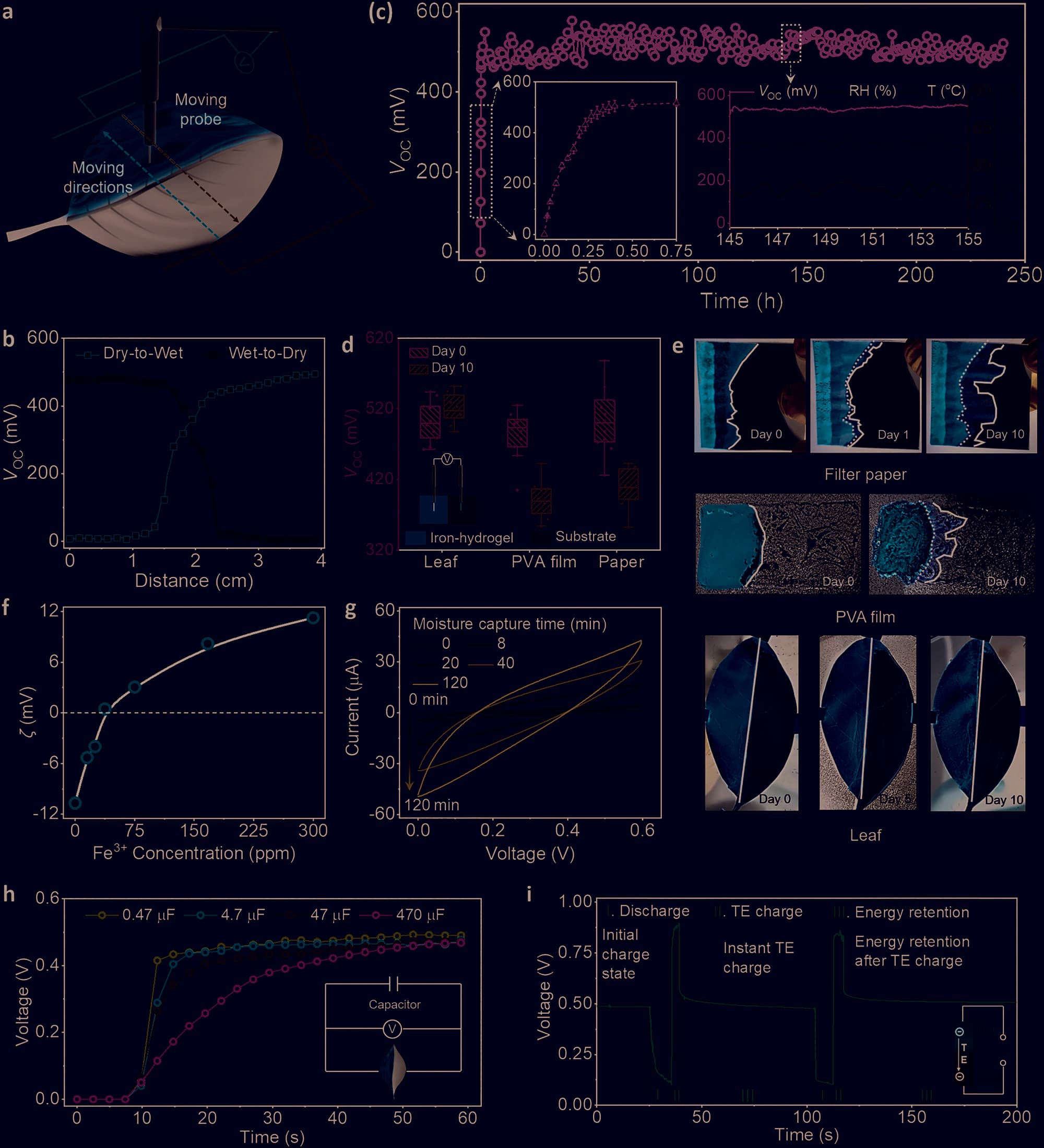
Rys. 2. Struktura komórkowa liścia po pokryciu sadzą węglową — mikrorowki umożliwiają równomierne przewodnictwo elektryczne. Źródło: Guo S. et al., Nature Communications (2025), DOI: 10.1038/s41467-025-60341-z.
Poland: there is wood, there will be leaves
Poland has three advantages in the race for biomass harvesters. And one serious problem that could destroy them all.
Advantage number one: raw material.We are one of the largest producers of wood and biomass in Europe. Forests cover 30% of the country's area. The wood industry generates lignocellulosic waste (sawdust, bark, chips), which have a very similar cellular structure to leaves and could be an alternative substrate for the same technology. Guo's team tested various substrates and found that surface roughness at the micrometer level was key - just like lignocellulosic materials.
Second advantage: know-how in hydrogels.Polish bands - including: from the Faculty of Chemistry of the Warsaw University of Technology, the Center for Polymer and Carbon Materials of the Polish Academy of Sciences in Zabrze and the Institute of Physical Chemistry of the Polish Academy of Sciences - have been working on intelligent hydrogels for years. Prof. Marcin Karbarz from the University of Warsaw has published several dozen papers on hydrogels sensitive to stimuli, including moisture. It's not the same chemistry as Guo's iron hydrogel — but the polymer network design competencies are transferable.
Third advantage: IoT made in Poland.The Polish Internet of Things market is growing at a rate of 15% annually. Companies such as Siarkopol (environmental sensors), AIUT (industrial monitoring systems) and SatRevolution (observation satellites) design devices that need autonomous power supply. Each of these sensors could be powered by a leaf.
Problem: money.Harvesting energy from moisture is not a priority in any Polish grant program. NCN has panels in condensed matter physics and materials science, but moisture as an energy source does not fit either photovoltaics or energy storage. NCBR finances hydrogen and battery technologies, not hygroelectricity. FENG (European Funds for a Modern Economy) has a path to deep tech, but it requires an industrial partner with its own contribution.
However, entry costs are low. Need: iron chloride (PLN 50/kg), ethanolamine (PLN 80/liter), carbon black (PLN 100/kg), leaves - free. Equipment: scale, magnetic stirrer, dryer. Budget for the prototype: less than PLN 5,000. This is garage technology.
One decision (NCN Miniatura or OPUS grant for PLN 400,000) would be enough for the Polish team to research optimization for local tree species (oak vs. birch vs. beech - each has a different cellular structure) for two years and test the prototype in real conditions. So far, no one in Poland has submitted an application for funding for "leaf-based energy harvesting".
This is a window.Guo, Tan and Chen have not patented the process in Europe - the patent applications apply only to Singapore and China. The competition is in Hong Kong (PolyU, Wang's team, co-author), Singapore (NUS) and Saudi Arabia (KAUST, De Wolf's team). Silence in Europe. Poland has two, maybe three years to enter this niche before the Germans or the Dutch do.
The problem is that no one enters a niche they don't see. And air moisture as an energy source still sounds like a paradox.
Sources
- Guo S., Zhang Y., Yu Z. et al.,Leaf-based energy harvesting and storage utilizing hygroscopic iron hydrogel for continuous power generation, Nature Communications 16, 5267 (2025).DOI: 10.1038/s41467-025-60341-z
- Liu X., Gao H., Sun L., Yao J.,Generic air-gen effect in nanoporous materials for sustainable energy harvesting from air humidity, Advanced Materials 36, e2300748 (2024).DOI: 10.1002/adma.202300748
- Nandakumar D.K. et al.,A super hygroscopic hydrogel for harnessing ambient humidity for energy conservation and harvesting, Energy & Environmental Science 11, 2179–2187 (2018).DOI: 10.1039/C8EE00902C
- Hu Q. et al.,Hydrovoltaic electricity generation induced by living leaf transpiration, Nature Water 2, 988–998 (2024).DOI: 10.1038/s44221-024-00314-2
- EPA,Advancing Sustainable Materials Management: 2018 Fact Sheet, United States Environmental Protection Agency (2020).
Comments· 0
No comments yet. Be the first.