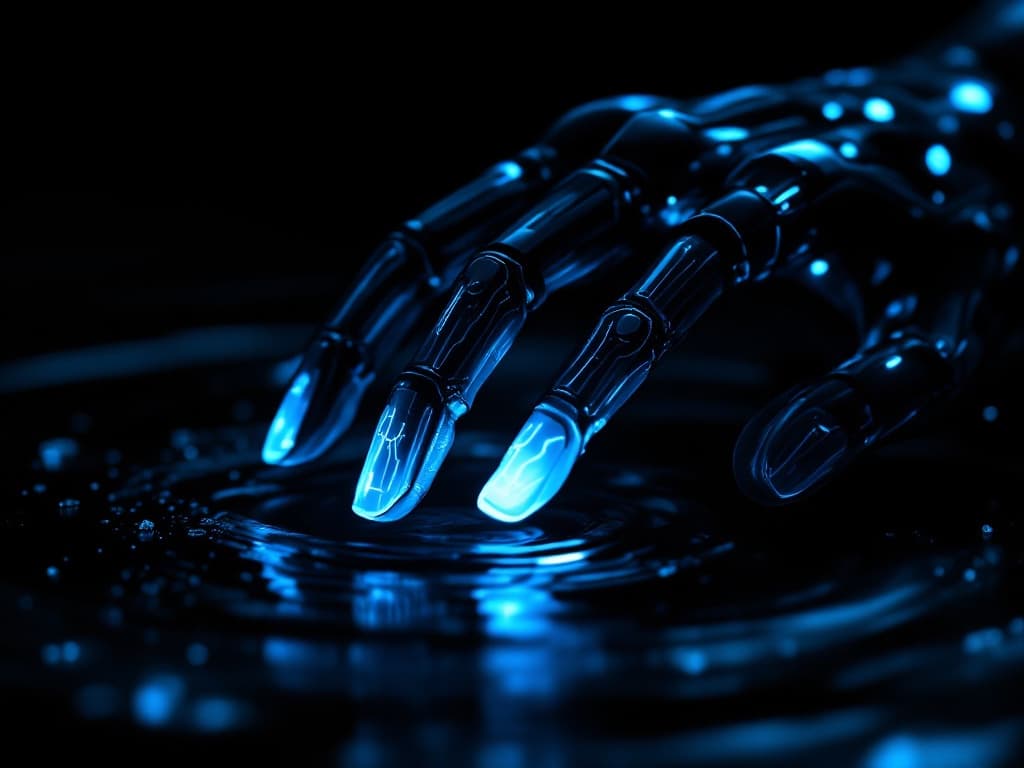
A hand that remembers touch
The clinic that wasn't planned
Sriramana Sankar did not plan to visit a prosthetic clinic. He was a robotics engineer at Johns Hopkins University - his world was pneumatic actuators, piezoresistive sensors, Izhikevich neural models. But Nitish Thakor, his mentor, a neuroengineer with 30 years of experience and 600 publications, persuaded him: "Before you design another hand, see how the ones that already exist are used."
Sankar went to the Philadelphia VA Medical Center, a veterans hospital that is also one of the largest amputee rehabilitation centers on the East Coast. He stood in the corner of the rehabilitation room and watched. A patient with a below-the-elbow amputation was fitted with an $80,000 prosthesis — a myoelectric prosthesis controlled by EMG signals from the forearm muscles. The dentures clamped down on a plastic cup of water. Too hard. The cup broke. Water spilled on the table.
"I'm sorry," said the patient. "I didn't know I was holding too tight."
He didn't know. Because the prosthesis doesn't feel. There is no touch. There is no temperature. There is no texture. She is blind.
Sankar returned to the lab with one question nagging at him: Why couldn't an $80,000 hand tell the difference between Styrofoam and metal? It took him three years to respond. And it required building a hand that was neither soft nor stiff — just a hybrid.
Three layers. No feeling
The human hand is a marvel of hybrid engineering. Bones and joints provide strength, soft tissues provide compliance. The skin is not just a covering - it is a dense network of mechanoreceptors: Meissner corpuscles sense light touch, Merkel corpuscles - pressure, Ruffini - stretching, Pacini - vibrations. Four types of sensors in three layers of skin provide the brain with information about every object you touch.
Prostheses do not have any of these sensors. They grasp but do not feel. They tighten with a force programmed into the microcontroller - blind force.
Sankar decided to build a hand that feels. But not by adding a single sensor — by copying the entire architecture of human skin.
28 billion and a blind hand
The global upper limb prosthesis market was worth $1.2 billion in 2023. It is expected to grow 5.8 percent annually, driven by an aging population, diabetes and war injuries. The most expensive myoelectric prostheses — controlled by EMG signals from the residual limb muscles — cost between $25,000 and $100,000.
And neither of them feels.
Össur — an Icelandic prosthetics giant with revenues of $717 million (2023) — sells the i-Limb prosthesis with five independently controlled fingers. Ottobock, the German leader with €1.5 billion in revenue, offers the Michelangelo Hand with seven grips. Touch Bionics, Open Bionics - all invest in grip precision. Nobody invests in feeling.
Sankar saw this gap. But he also knew why no one had filled it out. Adding a sensor to a prosthesis sounds simple. The problem is that the prosthesis is stiff. The robot's fingers do not yield under pressure - the sensor on a rigid surface will either not sense anything or will break on first contact. Soft fingers, on the other hand, do not have the strength to hold anything.
And here came an idea that Sankar later called "obvious after the fact": the hand must be a hybrid.
Four months that produced nothing
Sankar's first attempt was simple: one piezoresistive sensor on a fingertip. A single layer of conductive fabric that changes resistance under pressure. No neural modeling, no silicone, no "nail". Only one sensor.
Sankar spent four months on calibration. He woke up at six, went to the laboratory, calibrated. The finger distinguished a smooth from a rough surface with an average accuracy of 63 percent. Little more than a coin flip.
"It didn't make sense," Sankar later said at a conference in Baltimore. "One sensor gave too little information. I needed three layers - like in human skin. But everyone in the lab said the same: three sensors placed on top of each other will interfere with each other. The outer one will suppress the middle one, the middle one - the inner one."
Everyone was wrong.
Sankar designed three layers of sensors, each in a different material and at a different depth. Outer - Flexible piezoresistive fabric with nine measurement points, like the cuticle, on the surface of the finger. Middle - embedded in silicone, like the dermis, responding to the stretching of the substrate. Internal - a rigid piezoelectric transducer glued to a PLA "nail", detecting only vibrations - the beginning and end of contact.
The key was not in the material. He was lying in a structure. Each layer responds to a different physical stimulus - pressure, stretching, vibration - so they do not interfere with each other. Just like the epidermis, dermis and Pacinian pads in the human finger.
The language that neurons speak
Collecting signals from three layers of sensors is only half of it. They still need to be encoded in a language that the nervous system understands. Human neurons don't send numbers - they send impulses. Series of action potentials. Their frequency and intervals between pulses carry information about texture, pressure force and temperature. When you touch a cup of hot coffee, your median nerve sends out a volley of about 200 impulses per second. When you touch cold metal - different pattern, different frequencies, different spacing.
Sankar couldn't just plug a sensor into a computer and expect the brain to understand the numbers. He needed a translator.
He used the Izhikevich neural model, a mathematical description of how a real neuron generates spikes in response to a stimulus. The model is simpler than the Hodgkin-Huxley simulation (four differential equations instead of twenty), but rich enough to capture the dynamics of different types of neurons. Each layer of sensors got its own variant: tonic for Merkel cells (constant response to pressure), phasic for Meissner corpuscles (impulse only when changing), fast for Ruffini endings. The analog signal from the sensor passed through the neuron model and came out as a train of impulses—just like a real nerve would send to the somatosensory cortex.
Result? The hybrid finger distinguished 26 textures with an average accuracy of 98.38 percent. Pure soft finger - 82 percent. Purely stiff - 83 percent. The hybrid beats both. And it was not by accident - each layer contributed different information, and the neural translator merged it into a language understandable to the nervous system.
A hand that remembers touch
When Sankar folded five fingers into a full hand, the test no longer involved sliding over textured plates. The test involved grabbing everyday objects: an apple, a sponge, a metal water bottle, a plastic cup with water. Fifteen objects. 99.69 percent accuracy in distinguishing them.
The hybrid hand picks up a one and a half liter bottle (1600 grams) and does not crush it. Lifts a plastic cup of water (280 grams) and does not leave a dent. It shakes a human hand - and doesn't break a bone.
Strength comes from a rigid PLA endoskeleton covered with silicone joints. Each finger has three independently pneumatically controlled joints. Thumb - two. Fourteen joints in total. At 7 psi (48 kPa), the finger flexes 130 degrees - three times as much as a clean soft finger at three times the pressure.
But it is not strength that is the breakthrough. The breakthrough is feeling.
Poland: from the laboratory to the forearm
In Poland, there are several teams working at the interface of soft robotics and human-machine interfaces. Joanna Kujawa and Sławomir Boncel from the Silesian University of Technology published in the Chemical Engineering Journal (2024) a review of the applications of PVDF and carbon nanomaterials in sensors and energy - the same PVDF whose piezoelectric variants are the basis of touch sensors. Anna Filipowska from the Silesian University of Technology has developed a gesture recognition glove based on machine learning (Sensors, 2024). Kinga Korniejenko from AGH is researching additive manufacturing in underwater applications - 3D printing technologies that Sankar used to produce a PLA endoskeleton.
The problem is not competence. It lies in the bridge between the laboratory and the product.
Sankar has a background from Johns Hopkins, NIH grants, and direct access to patients through the Philadelphia VA Medical Center, a veterans hospital that is also a research center. He tested the prosthesis on amputees for three months before publishing the results. The Polish equivalent - a technical university plus a teaching hospital - exists, but the last link is missing: a company that will take the TRL 4 prototype and drag it through CE certification to TRL 7.
FENG (European Funds for a Modern Economy) offers paths for deep-tech in medicine - the "SMART Path" program with a budget of EUR 4.5 billion for 2021-2027. NCBR announces competitions for medical devices. But there is a desert between a research grant and clinical trials: there is no center in Poland that combines robotic engineering with testing prostheses on patients in an outpatient setting - as does the VA Medical Center in Philadelphia.
It's not a money problem. It's a problem of institutional imagination.
What's next?
The Sankara prototype is an early stage - TRL 4, functional validation in the laboratory. The fingers do not have rigid joints in the endoskeleton, so the range of motion is smaller than in the human hand. The thumb is not fully opposable - it will not touch the little finger. Pneumatic valves are noisy. The compressor does not fit in the forearm.
Sankar knows it. His next goal is miniaturization: replacing pneumatics with HASEL silicone muscles that operate on electrical voltage, not compressed air. And adding peripheral nerve stimulation - so that the impulses from the sensors are not only classified by the computer, but actually reach the user's brain.
But the direction is set. Hybrid - soft power plus rigid precision plus touch - is not a compromise between the two worlds of robotics. This is a new category. Sankar showed that three layers of sensors provide more information than one - not additively, but multiplicatively. That neuromorphic coding allows you to speak to the nervous system in its own language. That your hand can crush metal and stroke Styrofoam at the same time.
A patient who spilled water at the Philadelphia VA Medical Center three years ago could pick up the same cup today. And feel that it is cold. And wet. And full.
And that changes everything.
Sources
Sankar S., Wenyu C., Zhang J., Slepyan A., Iskarous M.M., Greene R.J., DeBrabander R., Chen J., Gupta A., Thakor N.V.,A natural biomimetic prosthetic hand with neuromorphic tactile sensing for precise and compliant grasping, Science Advances (2025), DOI:10.1126/sciadv.adr9300
Comments· 0
No comments yet. Be the first.