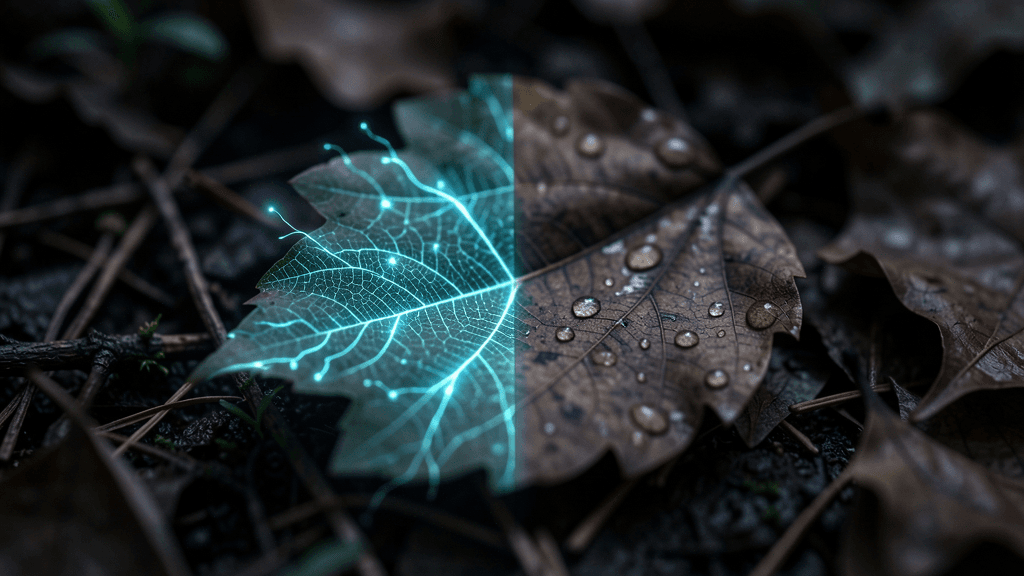
A battery that falls from a tree. How a dead leaf will power the Internet of Things
Battery graveyard
Fall 2024, forest in Oregon. A team of ecologists from the US Forest Service throw up their hands. Seventeen of the two hundred sensors monitoring soil moisture and fire risk are operational. The rest died. Batteries that were supposed to last two years died after eight months. Replacing it would cost more than the sensors themselves. "We have created an electronics graveyard," says one of the technicians, looking at the plastic cases covered with moss. No one knows yet that the solution lies literally under their feet.
At the same time, six thousand kilometers away, Shuai Guo - a postdoc at the National University of Singapore - stands at a lab table, holding a dead leaf in his hand. There is a layer of gel polymer on it, as thin as a human hair. Connects the meter. The needle is twitching. Guo smiles - he's just solved a problem that engineers in Oregon will struggle with for months to come.
Twenty-nine billion batteries to replace
The Internet of Things (IoT) is not a fad - it is infrastructure. By 2030, there will be 29 billion IoT devices in the world. Sensors in forests measuring CO₂, sensors on bridges monitoring stresses, detectors in pipelines detecting leaks, tags on containers tracking the supply chain. Each of these devices needs power.
And here comes the problem that engineers call the "battery barrier". Replacing the battery in a single sensor in the forest costs an average of $120 - more than the sensor itself. On a scale of one billion devices, that's $120 billion in servicing costs per year. In addition, there is waste: 78,000 tons of used lithium batteries from IoT sensors alone by 2030 (data: Journal of Cleaner Production, 2024).
"For a decade we have been trying to replace batteries with energy harvesting - collecting energy from the environment," explains Prof. Swee Ching Tan, head of the laboratory at NUS and co-author of the study. Photovoltaics under tree crowns produce microwatts - not enough. Thermoelectricity requires a temperature difference that does not exist in a humid forest. Vibrations? It's too quiet in the forest.
There is one more candidate left. Moisture.
A wet dead end
Moisture energy – MEG, moist-electric generator – is a concept that has been around for a decade. The principle is simple: the material absorbs water from the air, an ion concentration gradient is created, a potential difference is created, and current flows. The problem is that it only works for a few minutes.
"The first generation of MEGs had a fundamental flaw," Guo explains. "The water absorbed quickly, a gradient was created, the current flowed - and after a few minutes everything evened out. The end. Zero tension."
Scientists have tried everything. Hydrogels – they absorb water very well, but release it just as quickly. Nanocellulose – biodegradable, but does not conduct electricity well enough. Graphene oxide – conducts, but does not create a permanent moisture gradient. Each material had some advantage and some disadvantage that disqualified it.
In 2023, a team from MIT published a paper inNature Nanotechnology, in which he announced that "continuously generating energy from moisture in an open environment may be physically impossible." The argument was simple: the moisture gradient always equalizes - this is the second law of thermodynamics. To maintain the flow of current, you must constantly supply new moisture and constantly remove the already absorbed moisture. The leaf does not pump. The leaf breathes.
Or – as it turned out – it combines one thing with the other.
Anatomy of a watershed
Guo's team's key insight wasn't about new material. It concerned an old structure.
A leaf that has fallen from a tree is not a random piece of organic matter. It's the product of three hundred million years of evolution - a water management system that no engineer could have designed. Leaf veins create a network of transport channels that distribute water and nutrients throughout the living leaf. In the dead - they limit its flow. Mesophyll cells, which make up the leaf blade, have microscopic grooves - natural channels with a diameter of several micrometers. And they turned out to be crucial.
Guo's team took a dead leaf - an ordinary leaf picked from the ground - and covered just ONE half of it with a ferric chloride hydrogel. This iron is not random - Fe³⁺ ions in the hydrogel act as a pseudocapacitor, storing electric charge in redox reactions on the surface. The other half of the leaf remained bare. Asymmetry did the rest.
When moist air touches the leaf, the hydrogel side absorbs water and generates ions. The side without hydrogel remains dry. A gradient is created - permanent, because the leaf veins slow down the diffusion of water between areas. At the same time, micro-grooves in the leaf's cellular structure act as natural templates for conductive carbon nanoflakes. Instead of clumping together - which has always been a problem when applying carbon to smooth surfaces - the carbon spreads evenly along the grooves, creating conductive paths.
Effect? Direct current: 49 microamps per square centimeter and 497 microwatts per cubic centimeter. Not for a minute. Not for an hour. Continuously, as long as there is moisture in the air.
"It's not the highest power density in the world," Guo admits. "But it is continuous. And in the energy industry, continuity means more than peak power."
One device – one leaf – generates enough energy to power a simple temperature and humidity sensor that transmits data once an hour. Three leaves connected in series provide the voltage needed to power the microcontroller. No batteries needed. No solar panels needed. It is enough that it is humid in the forest - and it always is in the forest.
Poland: a forest that measures itself
There are 9.2 million hectares of forests in Poland. The State Forests manage a network of over 800 meteorological stations and hundreds of sensors monitoring litter moisture - a key indicator of fire risk. Each sensor requires battery replacement on average every 14 months. In the Białowieża Forest, where access is limited, servicing one sensor is a half-day trip.
Two thousand miles from Oregon, but same problem.
Prof. Małgorzata Hawrot-Paw from the West Pomeranian University of Technology in Szczecin has been working on environmental monitoring systems based on IoT since 2022. "Power supply is our biggest problem," she said during a conference in Warsaw in March 2025. "Every grant for smart monitoring ends with the same question: who will replace the batteries?"
The leaf generator does not need lithium, cobalt or copper. The raw materials are water, iron chloride (cost: ~ PLN 2 per kilogram) and leaf - zero cost. The prototype costs less than a zloty in materials. Scaling up to mass production - we are talking about devices printed on cellulose substrates - could go below PLN 20 per unit.
Poland has advantages. The Pulp and Paper Institute in Łódź has been developing plant biomass processing technologies for years. The Łukasiewicz Research Network - with centers in Warsaw, Poznań and Kraków - has pilot lines for printing electronics on paper substrates. European Funds for a Modern Economy (FENG) for 2021–2027 provide EUR 450 million for low-emission technologies, part of which goes to energy harvesting.
"It's not about competing with lithium-ion batteries," Tan emphasizes. "These are places where the batteries cannot be replaced. And there are more such places than we think."
Energy that cannot be seen
Work by Guo and team, published inNature Communicationsin 2025, does not solve all problems. 49 μA/cm² is not enough for video transmitting sensors. The device only works at humidity above 60% - no chance in the desert. The viability of the iron hydrogel in field conditions has not yet been tested - in the laboratory it worked continuously for 90 days, but a forest is not a laboratory.
But this is not a weakness - this is the essence of a breakthrough. Guo's team did not attempt to break the power density record. They were trying to solve a specific problem: powering a sensor in the forest without replacing the battery. And they did it using something that was literally lying on the ground.
There is some irony in this. For a decade, engineers have been designing complex triboelectric nanogenerators, piezoelectric vibration harvesters, and thermoelectric Peltier modules. Meanwhile, nature solved this problem three hundred million years ago. All you had to do was look at your feet.
If the Singapore team manages to go from prototype to production within 18 months - and this is the goal, according to declarations made after publication - the first forest sensors powered by leaves could be hanging on trees by the end of 2027. First in Southeast Asia, where the humidity is perfect. Then – wherever there is a forest.
Sources
Guo S., Zhang Y., Yu Z. et al.,Leaf-based energy harvesting and storage utilizing hygroscopic iron hydrogel for continuous power generation, Nature Communications 16, 60341 (2025). DOI:10.1038/s41467-025-60341-z
Journal of Cleaner Production,Life cycle assessment of IoT sensor batteries: environmental and economic analysis, 452, 142167 (2024).
MIT Research Laboratory of Electronics,Fundamental limits of continuous moist-electric generation, Nature Nanotechnology 18, 1122–1130 (2023).
State Forests,Report on the condition of forests in Poland 2024, Warsaw (2025).
Hawrot-Paw M.,Smart environmental monitoring in protected areas – power supply challenges, SmartForest conference materials, Warsaw (2025).
European Funds for a Modern Economy 2021–2027,Program – Priority 2: An environment conducive to innovation, Ministry of Funds and Regional Policy (2024).
[[FIGURE:1]] [[FIGURE:2]]
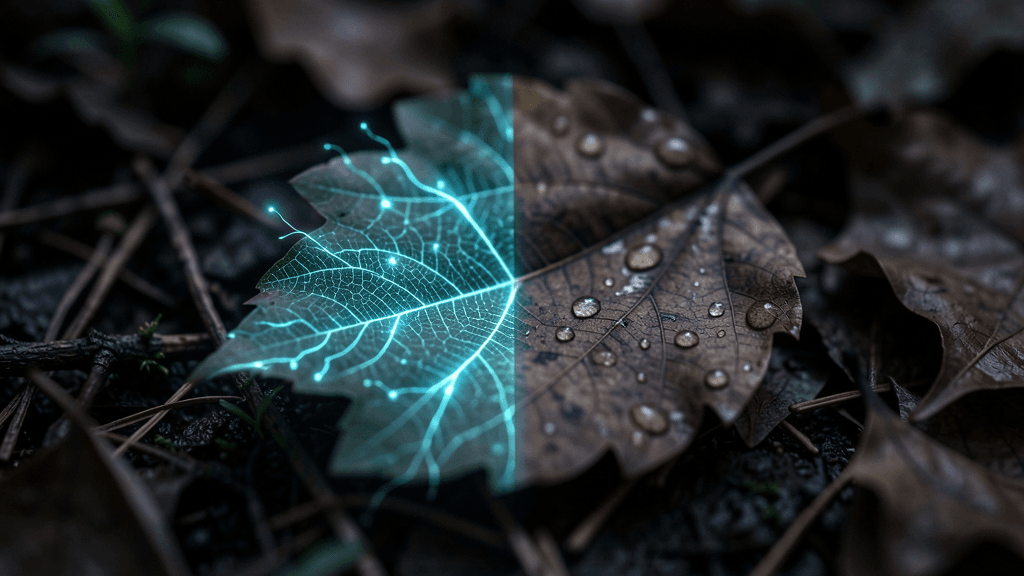
Rys. 1. Schemat działania generatora z liścia: asymetryczna powłoka z hydrożelu żelazowego (po prawej) tworzy gradient wilgoci, który generuje ciągły prąd elektryczny. Źródło: Guo S. et al., Nature Communications (2025), DOI: 10.1038/s41467-025-60341-z.
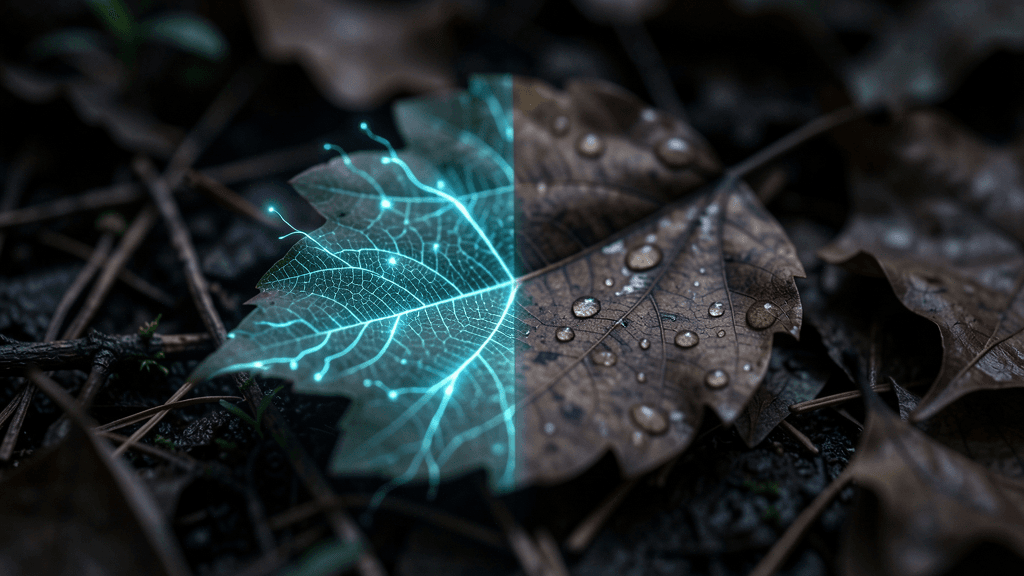
Rys. 2. Struktura liścia pod mikroskopem elektronowym — widoczne mikro-rowki w komórkach mezofilu, które działają jak naturalne szablony dla przewodzących nanopłatków węgla. Źródło: Guo S. et al., Nature Communications (2025), DOI: 10.1038/s41467-025-60341-z.
Comments· 0
No comments yet. Be the first.